

TL;DR
Choose a virtual assistant for modular, task-based work you need started this week, or to test a function before you commit to a role. Choose a dedicated remote employee when the work needs context that builds up over time or someone who is available every day. The cost gap is smaller than most people think: a full-time offshore hire on $800 a month costs $1,280 in total through Adaptive Teams, about $7.40 an hour. Watch the compliance trap: a VA who works only for you, on your schedule, can legally look like an employee.
Most founders asking this question already know what a virtual assistant is. They have probably used one. They are not here for a definition. They are here because the VA they hired six months ago is not working out, or because they are about to outgrow what a task-based setup can handle.
The virtual assistant vs remote employee decision is about structure, not just headcount. Getting it wrong costs more than money. It costs months of ramp-up time and the drag of starting over. So before you post another job ad, be clear on what you actually need.
This article breaks down the real differences between a virtual assistant and a remote employee: cost, commitment, control and when each model works.
What You're Really Choosing Between
A virtual assistant is usually an independent contractor who handles separate, repeatable tasks: calendar management, inbox triage, data entry, basic research and social media scheduling. Most freelance VAs work for several clients. You pay for hours or for finished tasks. You do not manage their time closely.
A remote employee works full time, or close to it, for your company only. They are part of your team, join your meetings, are accountable for outcomes and not just tasks, and build up knowledge of your business over time. Owl Labs' State of Remote Work report tracks how remote workers rate their jobs each year, and long-term remote employment is now a normal way to build a team.
In practice the line blurs. Some "VAs" are really full-time contractors with a single client who were never set up as employees. Some remote employees are hired for narrow tasks a good VA could cover. A full-time dedicated virtual assistant who works only for you sits somewhere in between.
So the real question is simple. Do you need someone to execute tasks, or a member of the team?
The Cost Question (and Why It's Often Asked Wrong)
The usual framing is "VAs are cheaper." On the surface that is true. Hourly VA rates vary a lot by marketplace, agency and country. If you pay a freelancer $10 an hour for 20 hours a week, you spend about $870 a month for half a person who also works for other clients.
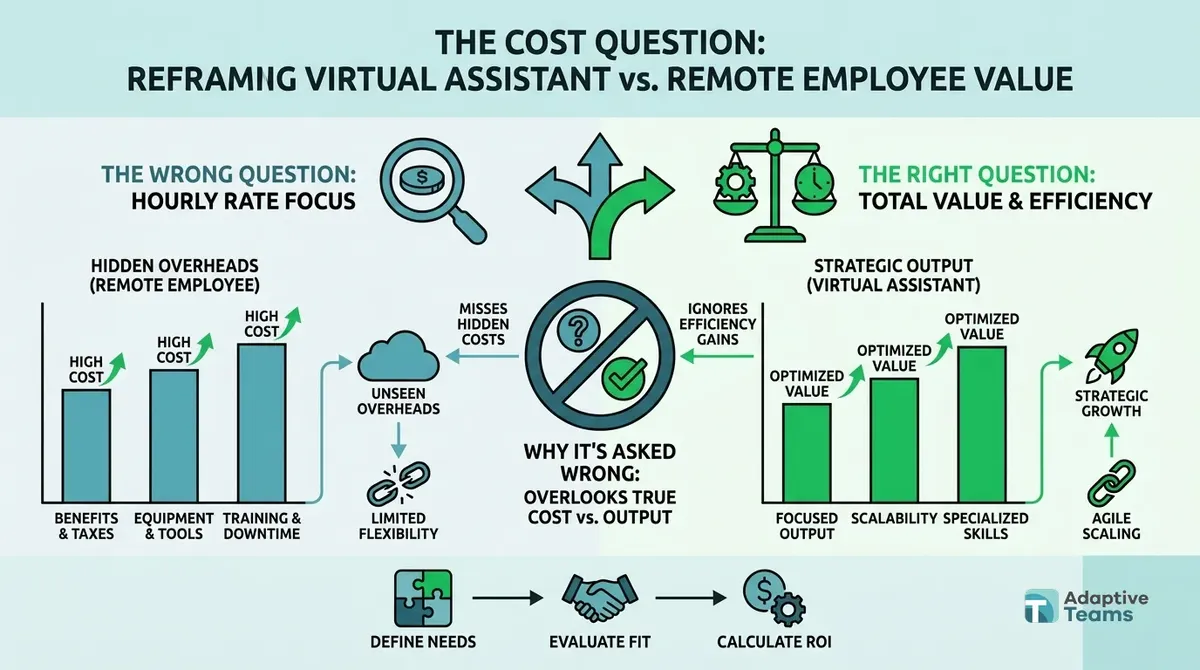
Now compare a full-time offshore hire through a staffing partner. In our salary benchmarks, a Philippine customer service rep earns $700 to $900 a month and a Latin American rep $900 to $1,050. With Adaptive Teams you pay the salary plus a staffing fee that is a percentage of it:
| Monthly salary | Staffing fee | Total per month | Per hour at 40 hours a week |
|---|---|---|---|
| $800 | 60% | $1,280 | About $7.40 |
| $1,000 | 60% | $1,600 | About $9.25 |
| $2,000 | 50% | $3,000 | About $17.30 |
The fee falls step by step to 30% above $4,500 a month, and it covers recruiting, payroll, HR and performance management. There is no placement fee. For context, the Society for Human Resource Management puts the average US cost per hire above $4,000. With a staffing partner that recruiting cost sits inside the monthly fee.
So in the virtual assistant vs remote employee cost comparison, the hourly gap is smaller than people expect. What changes is what you get for the money.
With a VA, you pay for output on demand. There is no cost when work is slow. But there is also no ownership, no guaranteed availability and little context building up. If your VA handles five other clients, you are not their priority on a busy Tuesday.
With a remote employee, you buy dedicated availability, skills that grow inside your business and someone who learns your systems, clients and preferences over time. That value compounds. It is just harder to put in a spreadsheet.
So the question is not which is cheaper per hour. It is which gives better value for the work you are hiring for.
Where VAs Win
In some situations the VA is clearly the right call.
You need help now, not in a month. Hiring a full-time remote employee takes time for sourcing, vetting, onboarding and ramp-up. Through a partner, most roles fill in 2 to 3 weeks. A freelance VA can often start this week. If you have an immediate volume spike, such as a launch, a conference or a backlog, a VA solves it faster.
The work is truly modular. If the work does not need deep context, task-based help works fine. Think formatting reports, building spreadsheets, transcribing calls or booking travel. Nobody needs years of company knowledge to update a CRM.
You are testing a function. Before you hire a full-time operations coordinator, let a VA handle those duties for 90 days. You will learn exactly what the role needs to look like. That is real discovery work.
Your budget is tight. Early-stage companies sometimes cannot commit to a full-time hire yet. A VA gives you help without a payroll commitment.
Where Remote Employees Win
The math changes the moment the work becomes complex, depends on relationships or matters to strategy.
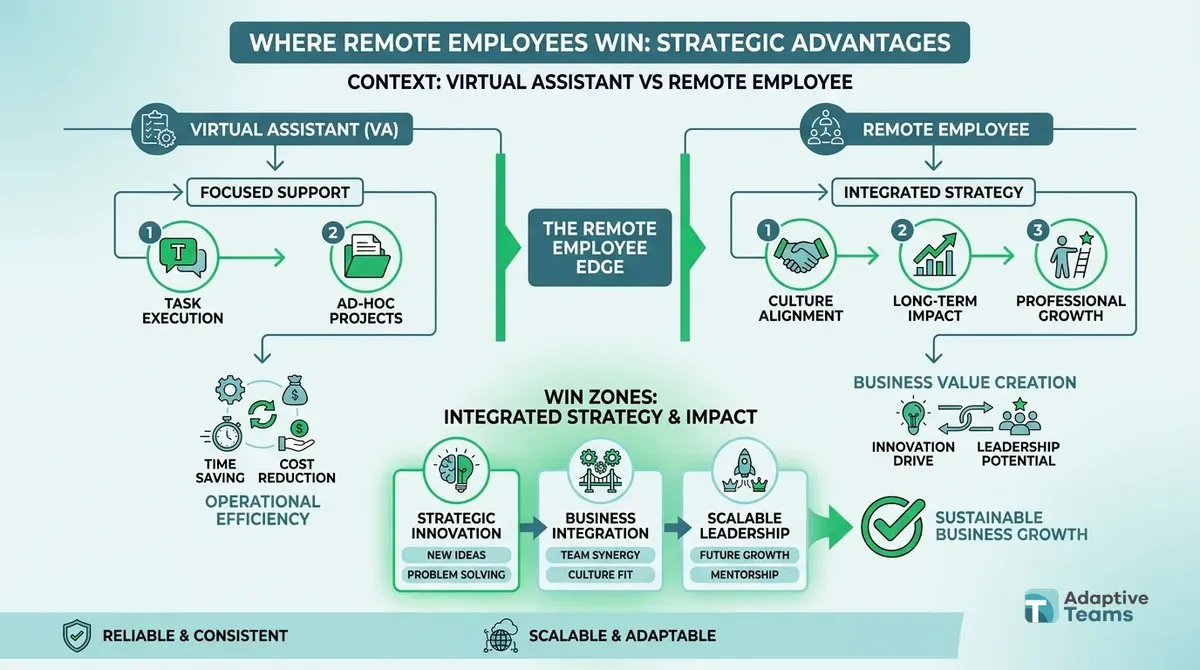
The work needs context that builds up. A customer success role, a marketing coordinator or a finance assistant all get better as the person learns your clients, your preferences and your systems. A VA spread across several clients does not build that depth. A remote employee does, and that knowledge compounds.
You need availability, not just output. Some roles need someone present: in your Slack, in your meetings, answering when customers write in. Task-based setups do not cover that. You cannot put a part-time VA on call. Roles like customer service representatives and executive assistants almost always need a dedicated person.
You are building a team, not a task list. Companies that scale well build teams with shared context and accountability, not a loose set of contractors for single deliverables. If you want a team, hire team members.
Turnover is costing you. If you went through three VAs in a year because the good ones left for better clients, a structured remote role with a clear scope, real raises and regular reviews usually keeps people longer.
The Compliance Risk Hiding in Many VA Arrangements
Here is a problem that catches founders off guard. Many "VA arrangements" are really employment relationships in disguise, and that exposes the company to misclassification risk.
If you decide when someone works, require them to use your tools, set their schedule and they effectively have one client (you), many jurisdictions will treat them as an employee whatever the contract says. The IRS guidance on contractors and employees is one common framework for judging this. Getting it wrong can mean back taxes, benefits liability and fines.
That does not mean you cannot hire contractors. You can, and it is often the right call. It does mean you should set the arrangement up correctly from the start, or work with a provider that handles the compliance side for you. Our guide to hiring contractors internationally covers the options, and our HR outsourcing service takes the employment side off your desk.
Hybrid Arrangements and What Actually Works
Many growing companies do not make an either-or choice. They run both, on purpose. A few patterns work well.
VAs for side tasks, remote employees for core functions. Keep your operations coordinator, customer success person and marketing hire in full-time remote roles. Use VA contractors for overflow work, one-off projects or functions that do not need deep integration.
Start with a VA to define the role, then convert. This works when you are not sure what you need. Run the function for 90 days with a VA, write down what the job really involves, then hire a dedicated remote employee into a well-defined role. Our guide to scaling a team without hiring full time first covers this path.
Use a staffing partner for the back end. If you want a dedicated remote employee without building HR from scratch, a managed staffing provider handles payroll, compliance, equipment and performance management. You get the team member. They handle the admin. Our recruitment service shows how that works from search to start date.
The Real Question to Ask Before You Hire
Before you decide between a virtual assistant and a remote employee, answer three questions honestly.
- Does this role need more than task execution? If yes, you probably need a remote employee rather than a VA.
- Do you have the management time to onboard and develop someone? A remote employee is only as good as the management around them. If you cannot make time for onboarding and feedback, a VA with a clear brief is more likely to succeed than an employee left on their own.
- What does it cost if this function runs poorly for the next 12 months? If the answer is "a lot", such as damaged customer relationships, bottlenecks or lost founder time, that argues for a committed remote hire.
The companies that regret choosing a VA usually used it to delay a hire they needed. The companies that regret the remote employee path usually hired before they had the systems and management time to support the person.
Neither model is right by default. The question is whether the model matches the work.
Making the Decision Without Overthinking It
A quick decision guide:
- The work is task-based and modular: a VA is probably fine.
- The work needs context, availability or ownership of outcomes: hire a remote employee.
- You are not sure what the role needs: start with a VA for 60 to 90 days, then turn it into a remote employee role.
- You have compliance or misclassification concerns: use a managed employment model.
One more thing. Who you hire matters more than how you hire them. A mediocre full-time remote employee underperforms a great VA. The structure sets the conditions. The person delivers the results. Our guide on interviewing remote candidates helps you find the right person either way.
Where to Go From Here
The virtual assistant vs remote employee decision comes down to what you are buying: task capacity or team depth, flexibility or commitment, speed or value that compounds.
Most companies that scale well use both, with intent. They know which functions need a dedicated remote employee and which are better served by a VA handling tasks on demand.
You can also explore our HR outsourcing for small business guide to understand the full infrastructure picture.
If you need dedicated remote team members who are actually yours, managed properly and kept over time, Adaptive Teams builds and manages those teams. We handle sourcing, HR, payroll and performance management so you can focus on the work. Contracts run month to month, and if a hire does not work out in the first 2 months we replace them at no cost. Book a free consultation to talk through the role.
Frequently asked questions
What is the main difference between a virtual assistant and a remote employee?
A virtual assistant is usually an independent contractor paid for tasks or hours, often working for several clients at once. A remote employee works only for your company, is part of your team and is accountable for outcomes, not just tasks.
Is it cheaper to hire a virtual assistant or a remote employee?
A VA looks cheaper at first, but the gap is smaller than it seems. Through Adaptive Teams, a full-time offshore hire on $800 a month costs $1,280 in total, about $7.40 an hour, with recruiting, payroll and HR included. The real difference is what you get: a VA gives you task capacity on demand, while a remote employee gives you dedicated availability and knowledge of your business that grows over time.
Can a virtual assistant become a remote employee?
Yes, and it happens often. A company starts with a contractor, the work becomes more integrated and it makes sense to formalize the relationship. That needs a new contract, the correct classification and possibly different pay and benefits, but it is a common path.
What tasks are virtual assistants best suited for?
VAs work best for modular, repeatable or one-off tasks: calendar and inbox management, data entry, scheduling, research, content formatting and basic bookkeeping. In short, work that does not need deep context and can be specified clearly upfront.
What are the compliance risks of hiring a virtual assistant internationally?
Misclassification is the main risk. If your VA works like an employee, with one client, a schedule you set and your company tools, many jurisdictions will treat them as an employee for tax and labor purposes. A managed staffing provider that handles classification and compliance removes most of that risk.
How long does it take to hire a dedicated remote employee?
Through Adaptive Teams most roles fill in 2 to 3 weeks. Specialist or senior roles can take 4 to 6 weeks.

Written by the people who recruit, pay and manage remote teams every day, with Nate Ginsburg and Menno Gottmer. About Adaptive Teams