

TL;DR
Hiring international contractors works when you treat it as a repeatable process. Define the role by outputs, check the classification rules in the contractor's country, and sign a written contract that covers IP and payment terms. Regulators judge a contractor by how the work really runs, not by the label on the contract. And a role left open too long can cost more than the contractor's fee.
If you want to grow without adding full-time headcount in every market, you need to know how to hire contractors internationally. International contractors give you capacity fast. You fill key roles sooner, you reach a much deeper talent pool, and you skip long local hiring cycles.
Speed without structure is a problem, though. It creates legal risk, payment problems and weak performance. This guide shows the step-by-step process, the main compliance risks, the tools that help and the mistakes that make global hiring expensive.
Most companies that search for this are trying to solve a speed problem without creating a compliance problem. That is the right instinct. As more companies run distributed teams, hiring abroad has become an operating skill, not just an HR task.
What does it mean to hire contractors internationally?
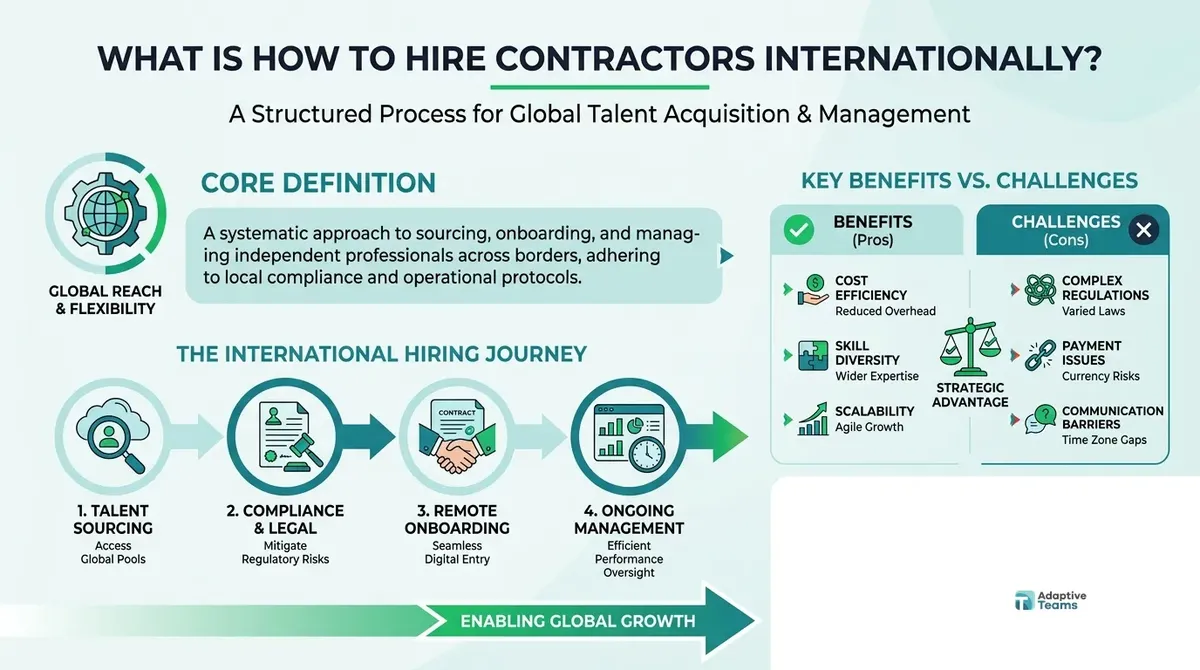
Hiring contractors internationally means engaging self-employed professionals in other countries without making them local employees. In practice it covers five things: classification, a compliant contract, secure payments, tax documents and day-to-day management. To do it well you need both speed and structure.
For growing companies the appeal is speed. Local hiring is slow and costly. A search takes weeks of sourcing and interviews, and then the new hire works out a notice period. SHRM benchmarking data puts the average US cost per hire near $4,700, before any salary is paid. A contractor abroad can often start sooner, when you need the work done now and not next quarter. That is one reason operators look at international contractors before they open a new entity.
The model only works when you treat it as infrastructure, not a shortcut. If you classify people wrongly or pay them on an ad hoc basis, the savings disappear fast. That is why many companies pair contractor hiring with a clear plan for HR operations and payroll from the start.
How it works
The international contractor process in practice
The flow is simple, but every step needs a paper trail. First you define the role and decide whether contractor status fits at all. Then you check the local classification rules, issue a compliant agreement, collect tax and identity documents and set up a payment workflow. Skip any one of these and the risk goes up.
After that you bring the contractor into how your team works: communication norms, deliverables, deadlines, tools and reporting. Finally you review performance and renew, expand or convert the engagement. Hiring a contractor abroad is not only a sourcing task. It is a full operating process.
A practical 6-part workflow
- Define the scope of work and the outputs you expect.
- Confirm contractor classification in the worker's country.
- Write a contract with IP, confidentiality and payment terms.
- Collect tax, banking and identity details.
- Pay through a documented workflow you can repeat.
- Manage performance like any other business process.
Each country applies its own tests. Calling someone a contractor does not make them one. Regulators look at how much you control the work, whether the person works only for you, their hours, who supplies the equipment and how dependent they are on your income. The IRS guidance on independent contractors uses the same ideas of behavioral and financial control, and most other countries ask similar questions.
Key benefits
Why operators use international contractors
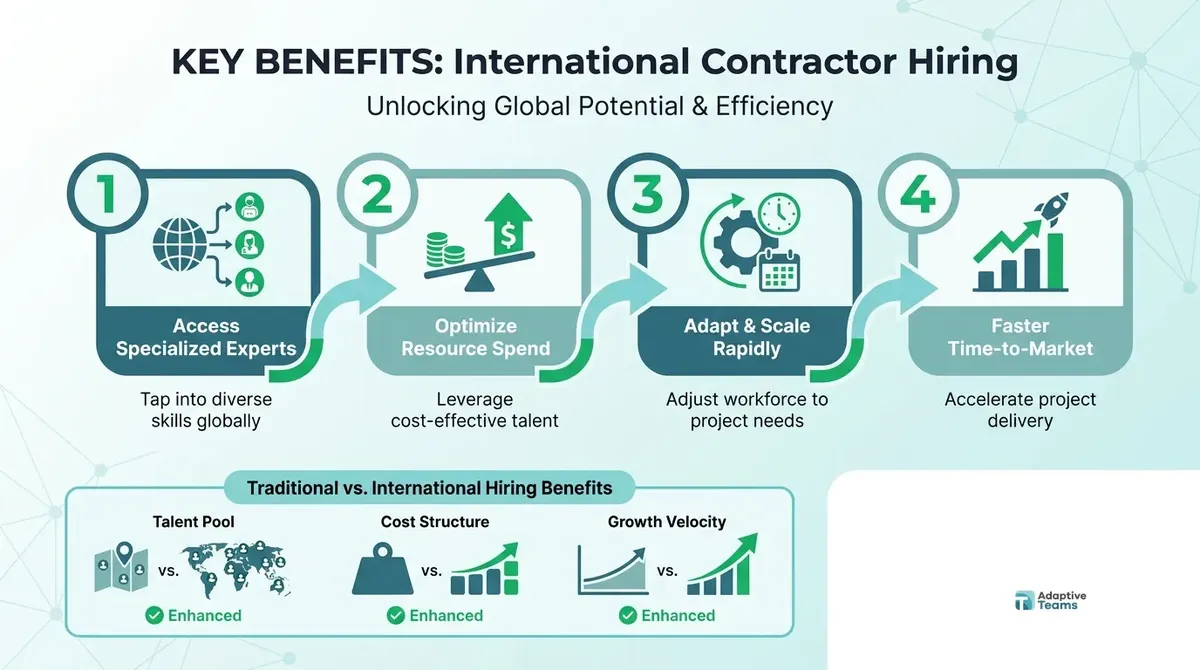
- Faster hiring. You can often fill specialist roles in days or weeks instead of waiting through a full local hiring cycle.
- Wider talent access. You are not limited to one city or one market, which matters when niche roles are scarce.
- Lower fully loaded cost. A contractor model often cuts the employer-side costs tied to payroll tax, benefits and entity setup.
- Market testing without lock-in. You can try a new function or region before you commit to permanent headcount.
- Flexibility. You can scale up or down around workload, product launches or client demand.
- Founder time back. With a good system you spend less time on ad hoc recruiting and admin. Recruitment outsourcing takes sourcing and screening off your plate as well.
- Long-term embedded support. With the right model, contractors work like members of your team rather than one-off freelancers.
Here is the math that matters. If one open operations role delays client delivery by 30 days, the hidden cost can be higher than the contractor's fee. That is why many companies stop hiring one person at a time and build a repeatable system for scaling a team without hiring full time. Seen this way, the decision is less about cheap labor and more about getting work done under control.
For salary planning, our offshore salary benchmarks show real monthly pay by role and region. A customer service rep in the Philippines runs $700 to $900 a month. A bookkeeper in India runs $1,000 to $1,750.
Step-by-step guide
1. Define the role before you source
Write down the outputs, the areas the person owns, the working hours and how you will measure success. If the role looks like a fixed full-time job under close supervision, contractor status may be the wrong model.
Start with outcomes, not tasks. Outcomes give you a cleaner basis for both classification and performance reviews.
2. Check classification risk country by country
Next, check whether the person can legally work as an independent contractor in their country. Some countries are strict about exclusivity, control and mandatory benefits. This is one of the most important steps in the whole process.
You do not need to become a labor lawyer. You do need a written decision you can point to later. If you are unsure, ask local counsel or use a partner that employs the person for you.
3. Use a compliant written contract
Your agreement should cover payment terms, notice periods, confidentiality, intellectual property, data security and local law where needed. A vague contract creates expensive arguments later.
If the contractor will touch customer data or internal systems, add security obligations and access controls from day one.
4. Collect documents before work starts
Gather tax forms, invoice requirements, bank details, proof of business registration where relevant and an ID check. Many teams leave this until the first payment is due, and then everything slows down.
A short onboarding checklist cuts the back and forth and protects your finance process.
5. Set a payment workflow you can repeat
Decide how invoices are submitted, approved and paid. Late or uneven payments hurt retention fast, especially on international teams.
Use one schedule, one owner and one approval path. At Adaptive Teams, payroll runs through Deel twice a month, on the 15th and the 30th, so people always know when they get paid.
6. Build an onboarding system
Once the contract is signed, treat onboarding as part of delivery quality. Give the contractor context on the role, your SOPs, tool access, communication channels and reporting expectations.
This is where many companies fail. They hire fast and then leave the person unmanaged.
7. Track output, not just availability
Measure the work with weekly deliverables, scorecards or KPI reviews. Contractor relationships drift when nobody owns performance management.
For a wider view of the systems that help, see our guide to remote team management tools. It applies to long-term contractors as much as to employees.
8. Review whether contractor status still fits
Recheck the arrangement every few months. If the person is now fully part of the team, works only for you and is supervised every day, an employee or employer of record setup may be safer.
Best tools and resources
The systems that make global contractor hiring easier
For policy context, start with official sources. The International Labour Organization, the OECD and the U.S. Internal Revenue Service all publish guidance on how work is classified and how labor protections apply.
Build a contract template library and have local counsel review it for your main markets. That is worth more than a generic template copied from the internet.
For payments, pick a cross-border payment provider or global payroll platform that supports contractor invoices and keeps an audit trail. Whatever you choose, insist on clear payment records and an approval workflow.
Then connect hiring to what happens after the start date. Our guides on outsourcing HR operations and the benefits of offshore teams cover retention and daily execution.
Common mistakes to avoid
1. Treating every overseas hire as a contractor
Not every role fits contractor status. Ignore that and you raise your risk of misclassification, back pay and tax problems.
2. Using weak or generic contracts
A short contract without IP ownership, confidentiality or local compliance terms leaves too much open to dispute. Cleaning it up gets harder once the relationship changes.
3. Paying inconsistently
Late invoices, unclear currency terms or a changing approval path damage trust fast. On a distributed team, reliable pay matters as much as the rate.
4. Skipping onboarding
Many companies think contractor status means little management. In reality, poor onboarding lowers output and raises churn.
5. Ignoring conversion signals
If a contractor now works full time, uses your tools all day and depends on one client, the original setup may no longer fit. Review this early, not after a dispute.
Advanced tips and strategies
Build a country risk matrix
Rank your target countries by classification complexity, payment friction, language fit and talent depth. That shows you where contractor hiring is truly efficient. Our pages on hiring in the Philippines and hiring in Latin America are a good starting point.
Separate sourcing from compliance review
Do not let recruiters make the final model decision alone. Source widely, then run a second review for classification, contract terms and payment setup.
Standardize role scorecards
Use the same weekly scorecard for every international contractor in a similar role. You can then compare output, spot drift early and make better renewal decisions.
Design for conversion paths
Some of your best contractors will become long-term core team members. Plan for that with set options: stay a contractor, move to managed staffing or move into an employee structure when needed.
Use a partner for long-term embedded teams
If your goal is a stable team rather than one-off projects, a managed staffing partner cuts the admin. You keep the flexibility of international talent and add recruiting, payroll, performance oversight and retention around it.
At Adaptive Teams you pay the salary plus a staffing fee, a percentage of that salary. The fee is 60% up to $1,500 a month, 50% up to $2,500, 40% up to $3,500, 35% up to $4,500 and 30% above that. A $1,000 a month hire costs $1,600 in total. A $2,000 hire costs $3,000. Recruitment is included, there is no placement fee, contracts run month to month with 30 days notice, and we replace a hire for free in the first 2 months. If you only want the search, recruitment only is $4,000 flat per hire.
The real cost is rarely the hourly rate. More often it is founder time lost to messy hiring, payment confusion and churn you could have prevented.
Next steps
If you want to hire contractors internationally without hidden compliance or management problems, start with structure. First decide whether contractor status truly fits the role. Then build the agreement, the payment workflow and the onboarding plan before the person starts.
The goal is not only to hire faster. It is to build a global team that gives you speed, control and retention without extra admin. Define the role clearly, check classification, put the agreement in writing and onboard well, and you have a system that scales. If you want help designing it, see who we hire or book a free staffing consultation below.
Frequently asked questions
Is it legal to hire contractors internationally?
Yes, it can be. Whether it is legal depends on the worker's country, the nature of the role and how much control you have over the work. Check the classification rules locally and document the relationship clearly.
How do you pay international contractors?
Usually through invoices paid by bank transfer or through a global payment platform that supports contractor payouts. What matters is one repeatable process with clear records, currency terms and approvals.
What is the biggest risk when hiring contractors abroad?
Misclassification. If a regulator decides the contractor works like an employee, you may face back taxes, penalties, benefit claims or employment obligations going back to the start.
Can international contractors work full time for one company?
In some cases, but that setup raises the classification risk. The more the relationship looks exclusive and closely controlled, the more carefully you should check whether contractor status still fits.
Do international contractors need contracts?
Yes. Always use a written agreement that covers scope, payment terms, confidentiality, intellectual property and how either side can end it. Without one, disputes are much harder to settle.
When should you choose an employee model instead?
Consider an employee or employer of record model when the role is permanent, closely controlled, deeply part of the team or central to the business. That shift usually lowers compliance risk over time.

Written by the people who recruit, pay and manage remote teams every day, with Nate Ginsburg and Menno Gottmer. About Adaptive Teams