

TL;DR
Customer service reps earn $700 to $900 a month in the Philippines and $900 to $1,050 in Latin America. Bookkeepers in India earn $1,000 to $1,750. Mid-level automation engineers in Latin America earn $1,500 to $2,250. These are gross salaries from our own payroll records. Your provider's fee comes on top, so ask how it is set before you budget.
Every range on this page comes from payroll records. They cover full-time professionals that Adaptive Teams recruited and manages. There are 148 salary records in total, taken as a snapshot in July 2026. We publish only bands by role and region. Each band is backed by at least 3 placements, and we show the sample size for every row. Small samples get wider bands on purpose, so no one's salary can be read off this page.
Use these numbers to budget a hire or to check a quote from a staffing provider. Still deciding whether offshore hiring fits your business? Read our breakdown of the benefits of offshore teams first, then come back here for the numbers. To compare providers, see our list of the best offshore staffing companies.
How we built these benchmarks
Here is the method, so you know exactly what you are looking at.
- Source. Salary records for full-time placements that Adaptive Teams recruited and manages. For active placements we use the current salary. For completed ones we use the final salary. The snapshot date is July 2026. Of the 148 records, 115 sit behind the published rows. The rest belong to groups too small to publish safely.
- Sample. Every published row combines 3 or more placements. Where one role in one country had fewer than 3, we widened the group to a region or to a family of closely related roles. Otherwise we left the row out.
- What the numbers mean. Gross monthly salary in USD. This is what the professional is paid. Provider fees, platform fees and equipment are not included.
- Ranges. Rows with 8 or more placements show the 10th to 90th percentile, rounded to $50. "Typical" is the median. Rows with fewer than 8 placements show a wider band instead. We push the endpoints out to $250 steps, and the band is always at least $500 wide. We publish no median for those rows. The band still works for budgeting, but no one can work out what a single person earns.
- Anonymity. Nothing on this page traces back to a person. Names and client details stay out. We left out executive roles entirely, because one salary there would be easy to identify.
We refresh this page as the placement base grows. That way the ranges keep tracking what these roles really cost on payroll.
Offshore salary benchmarks by role
All figures are USD per month for full-time work.
| Role | Region | Monthly range | Typical | Placements (N) |
|---|---|---|---|---|
| Customer Service Representative | Philippines | $700 to $900 | $800 | 36 |
| Customer Service Representative | Latin America (all countries) | $900 to $1,050 | $1,000 | 31 |
| Customer Service Representative | Argentina | $900 to $1,000 | $950 | 12 |
| Sales Agent / SDR | Philippines | $800 to $900 | n/a | 9 |
| Sales Agent / SDR | Latin America | $750 to $1,500 | n/a | 4 |
| Bookkeeper | India | $1,000 to $1,750 | n/a | 5 |
| Automation and AI Engineer (mid-level) | Latin America | $1,500 to $2,250 | n/a | 4 |
| Automation and AI Engineer (junior) | Mixed regions | $250 to $1,000 | n/a | 5 |
| Operations Coordinator | Latin America / Philippines | $1,000 to $1,750 | n/a | 5 |
| Operations Specialist | Latin America | $1,250 to $2,000 | n/a | 5 |
| Operations Manager | Latin America | $1,750 to $2,500 | n/a | 4 |
| Recruiter (sourcer to specialist) | Philippines / Latin America | $500 to $1,750 | n/a | 4 |
| Marketing Specialist (SEO, analytics, lead gen) | Latin America | $750 to $2,250 | n/a | 3 |
The Argentina row is part of the Latin America customer service row. We show it on its own because the sample is big enough to stand alone. Rows marked n/a show only the band. Either fewer than 8 placements sit behind them, or the median would simply repeat one end of the band.
Customer service and sales roles
Customer service is the largest part of our placement base. That makes these the most reliable rows on the page.
The Philippines is still the best value for voice and chat support. A full-time agent earns $700 to $900 a month. English skills are strong, and the country ranks well in the EF English Proficiency Index. The talent pool is deep, so you can hire in volume without pushing pay up.
Latin America costs about 20 to 25 percent more for the same seat. Our typical rep there earns $1,000, against $800 in the Philippines. Argentine placements fall between $900 and $1,000. The wider regional band covers placements from Colombia, Costa Rica, El Salvador, Bolivia and several neighboring countries. For the extra cost you get working hours that line up with the US day, plus native Spanish. That matters a lot if many of your customers speak Spanish. Our page on hiring in Latin America covers the region in more detail.
Phone sales agents earn close to what support agents earn in the Philippines, at $800 to $900. In Latin America they cost a bit more. Commission plans sit on top of these figures and differ by client. Treat the ranges as base salary only.
One pattern is worth knowing. In our placements, the strongest team leads were promoted from the agent pool after six months to a year. Clients who plan that promotion path early tend to keep their best people.
Finance and accounting roles
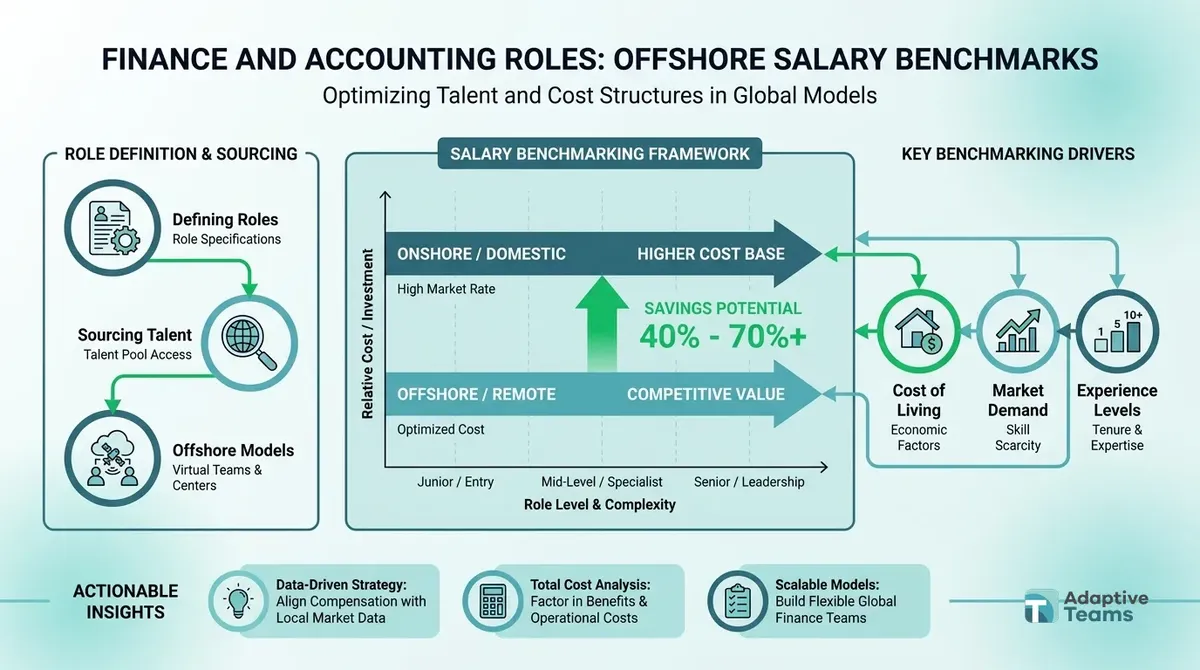
Most of our accounting placements are in India. A full-time bookkeeper falls in the $1,000 to $1,750 band. That covers transaction coding, reconciliations and accounts payable and receivable. Senior accounting roles that own the month-end close earn clearly more. Our sample there is still too small to publish a fair range.
Engineering and automation roles
Automation and AI engineers build internal tools, integrations and AI workflows. At mid level they earn $1,500 to $2,250 a month in Latin America. The top of that band buys someone who can scope, build and maintain production automations without supervision. Juniors start below $1,000 a month across several regions. South Asian markets sit at the low end and Latin America at the high end.
If you need engineers who sit inside your business and ship automations from week one, see our forward deployed engineers. For a full product team, read our guide to choosing an offshore development company.
Operations support roles
Operations support has grown fastest in our placement base. Coordinators keep projects, schedules and daily workflows moving for US businesses. They earn $1,000 to $1,750 a month. Specialists own one defined part of the operation and earn $1,250 to $2,000. Operations managers carry full responsibility for results. In Latin America they earn $1,750 to $2,500.
Recruiting and marketing roles
The recruiting band is wide because the row covers the whole ladder. It runs from sourcers in the Philippines to specialist recruiters in Latin America. Pay lands between $500 and $1,750, depending on seniority. Marketing specialists in SEO, analytics and lead generation earn between $750 and $2,250. Scope and experience drive most of that spread.
What actually moves an offshore salary
Four factors explain most of the spread inside these ranges.
- Region and time zone. In our placements, Latin America costs 20 to 40 percent more than the Philippines for the same role. You pay for working hours that overlap the US day. South Asia is the most affordable market for back-office and technical work. See our page on hiring in the Philippines for that market.
- English requirements. Voice roles that talk to US customers all day pay more than back-office roles at the same skill level.
- Scope over title. Two people with the same title can differ by 2x on payroll. It depends on whether they carry out tasks or own outcomes. You can see this in the recruiter and operations rows. There, the band width mostly reflects a seniority ladder.
- Tenure. Offshore professionals expect real raises in their first two years. We suggest budgeting 5 to 15 percent a year if you want to keep good people. If you do not fund that raise, a competitor will.
Salary is not the full cost
The ranges above are gross salaries. For a realistic monthly budget, add the following.
- Employment and payroll costs. Someone has to employ the person, run payroll and handle local rules. An employer-of-record or contractor platform charges a monthly fee per person that depends on the country and setup. Our guide to hiring contractors internationally walks through the options.
- Equipment and software. Usually a one-time laptop cost plus seat licenses.
- Recruiting and staffing fees. If you hire through a partner, ask exactly how the fee is set. At Adaptive Teams you pay the salary plus a staffing fee, which is a percentage of that salary. That fee covers recruiting, payroll through Deel, HR and performance management. There is no placement fee.
Our staffing fee falls as the salary rises.
| Monthly salary | Staffing fee | Example |
|---|---|---|
| Up to $1,500 | 60% | $800 salary: $1,280 a month in total |
| $1,501 to $2,500 | 50% | $2,000 salary: $3,000 a month in total |
| $2,501 to $3,500 | 40% | $3,000 salary: $4,200 a month in total |
| $3,501 to $4,500 | 35% | $4,000 salary: $5,400 a month in total |
| Above $4,500 | 30% | $5,000 salary: $6,500 a month in total |
So a Philippine support rep at the typical $800 costs $1,280 a month in total. A Latin American rep at the typical $1,000 costs $1,600. Teams of 2 or more get volume discounts of 3 to 9 percent. Contracts run month to month with 30 days notice.
Even fully loaded, these figures sit well below US pay for the same work. For country wage data, the ILO wage statistics are a good place to compare.
Hire at these rates without running the search yourself
Adaptive Teams recruits and manages full-time offshore professionals for US businesses at these market rates. You interview the finalists. We handle sourcing, payroll and the ongoing management work. Tell us the role you need, and we will quote it honestly using the same data you just read.
Frequently asked questions
Are these salaries or billing rates?
Salaries. These figures are what the professionals are paid each month, before any provider or platform fees.
Why do some rows show no typical figure?
Rows with fewer than 8 placements show only a wider band. A median over 3 or 4 people would come too close to publishing someone's real salary. So we widen the band and leave the midpoint out.
Why do some rows cover a whole region instead of one country?
We only publish a range when at least 3 real placements back it. Where one country had fewer than 3 for a role, we widened the group to the region or left the row out.
Do offshore hires expect benefits on top of these figures?
It depends on the country. A thirteenth-month salary is standard in the Philippines, and health stipends are more and more common everywhere. Budget roughly 8 to 12 percent on top of base salary if you want a competitive offer.
How current is this data?
The ranges are a July 2026 payroll snapshot. Nearly all the placements behind them started between 2024 and mid-2026. Team members who have been with us longer count at what they earn today. We update the page as our placement base grows.
Can I hire at the bottom of these ranges?
Sometimes, for junior candidates. In practice, an offer near the middle of the band gets you better candidates and less churn. The dollar difference is small next to the cost of a bad hire.
What does a full-time offshore hire cost through Adaptive Teams?
The salary plus a staffing fee that is a percentage of it. The fee is 60% up to $1,500 a month and falls step by step to 30% above $4,500. An $800 salary costs $1,280 a month in total, and a $1,000 salary costs $1,600.
Can I cite these offshore salary benchmarks?
Yes, with credit to Adaptive Teams and a link to this page. The records behind them are confidential. The method is described above.

Written by the people who recruit, pay and manage remote teams every day, with Nate Ginsburg and Menno Gottmer. About Adaptive Teams