

TL;DR
Interview remote candidates with a role-specific scorecard and a short work sample. Test for output ownership, written clarity and judgment under ambiguity, because describing how you would work is very different from showing it. Score observable signals, such as naming the next action without being prompted, so vague traits like "proactive" do not win by default. Then decide on one question: will this person make the team easier to run?
Interview remote candidates with a role-specific scorecard and a short task that shows how they work on their own. Ask them to explain a past handoff, then check whether their written updates give teammates enough context to act.
Knowing how to interview remote candidates is not about copying your office interview onto a video call. The risk is different. A weak remote hire does not only miss tasks. They create lag, unclear ownership, extra management work and hidden coordination costs across the team.
The strongest remote interviews test for the environment the person will actually work in. Can they clarify a vague request? Can they show progress before being chased? Can they make decisions asynchronously without waiting for a meeting? Can they work across time zones without turning every handoff into a delay?
For scaling agencies, ecommerce operators, SaaS teams and lean operations teams, those questions matter more than a polished video presence. A candidate can be articulate for 45 minutes and still struggle when the job needs written updates, independent prioritization and steady output without constant supervision.
So remote interviewing needs a sharper system. You are not only judging experience. You are testing whether the person will reduce the drag on your operation after they join.
Start with the remote reality of the role
Before the first interview, define what remote success means for this seat. Many hiring teams skip this and fall back on generic traits like "self-starter" or "good communicator." Those words sound useful until every interviewer reads them differently.
For a customer support lead, remote success might mean documenting recurring issues, flagging patterns without being asked and keeping response quality the same across shifts. For an operations coordinator, it might mean managing handoffs between finance, fulfillment and leadership without turning every update into a live meeting. For a paid media specialist, it might mean explaining campaign changes clearly enough that the founder can approve them without opening the ad account.
Turn those realities into four interview dimensions.
Output ownership
Can the candidate take responsibility for a result, not just a task list? Remote teams break when people wait for permission on every small decision. The interview should show whether the candidate can move work forward while staying aligned.
Written clarity
Remote work runs on written context. Video calls help, but they cannot carry every decision. You need to know whether the candidate writes updates that are short, specific and useful to someone reading them 6 hours later.
Judgment under ambiguity
Most growing teams are not fully documented. The right remote candidate asks good questions, spots missing inputs and makes a sensible next move. The wrong one either freezes or improvises without checking in.
Collaboration rhythm
Remote hiring is not a personality contest. You are looking for a working rhythm that fits your team. That includes time zone overlap, response expectations, meeting habits and comfort with the tools your team already uses.
If you are building a distributed team from the ground up, this role definition should tie into your wider operating model. Interviews are only useful when the team structure is clear. If you hand the search to a recruitment partner, write this definition with them before a single candidate is contacted.
Build an interview scorecard before you talk to anyone
A remote interview without a scorecard tends to reward confidence, charisma and similarity to the interviewer. That is expensive. You need one consistent way to compare candidates against the work, not against each other in vague terms.
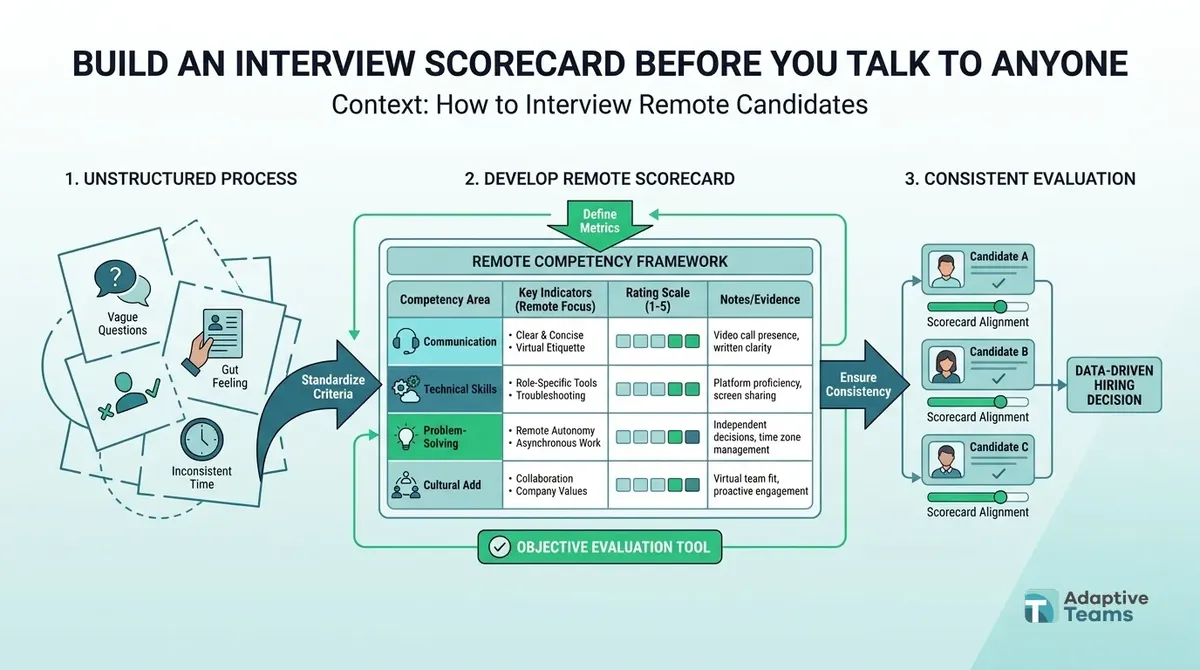
Keep the scorecard simple enough that interviewers will use it. Five categories are usually enough:
- Role capability
- Remote communication
- Ownership and follow-through
- Problem solving
- Culture and working style fit
Each category needs observable signals. "Great communicator" is not observable. "Explains tradeoffs clearly in writing" is. "Proactive" is vague. "Names the next action without being prompted" can be tested.
The US Office of Personnel Management has long recommended structured interviews because they improve consistency and reduce interviewer bias. The same logic applies even more in remote hiring. When the interview already runs through screens, time zones and compressed context, structure stops you from overvaluing polish.
Use a 1 to 5 scale for each category, and define what each number means. Here is one way to anchor the remote communication score:
| Score | What you observed |
|---|---|
| 5 | Clear written updates, separates facts from assumptions, flags risks early without being asked |
| 3 | Communicates well enough when asked, but needs prompting to share context or risks |
| 1 | Answers are vague, late or hard to act on |
The goal is not paperwork. It is faster decisions with fewer regrets.
Use the first screen to test clarity, not charm
The first remote screen should answer three questions:
- Does the candidate understand the role?
- Can they communicate clearly without heavy coaching?
- Is there a practical fit on availability, pay and working model?
Do not spend the screen walking through the resume. You can read the resume before the call. Use the time to hear how the candidate thinks about the work. Ask questions like these:
- "Walk me through the last role where you managed work without daily supervision. What did you own, how did you report progress and what changed because of your work?"
- "When you get a task that is missing context, what do you do before you start?"
- "What kind of manager helps you do your best work remotely, and what kind slows you down?"
Good answers are specific. The candidate names a situation, the stakes, the action they took and what happened next. Weak answers stay at the level of principles: "I communicate a lot," "I am organized" or "I can work independently."
Remote screens should also include a short written part. After the call, ask the candidate to send a brief recap of what they understood about the role and what they would want to clarify before joining. This is not busywork. It shows how they process context, whether they listened and how they write when the reader is a future manager.
Replace hypotheticals with work samples
Remote candidates are often good at describing how they would work. That is not the same as seeing how they work. A small work sample gives you better signal than another hour of hypothetical questions.
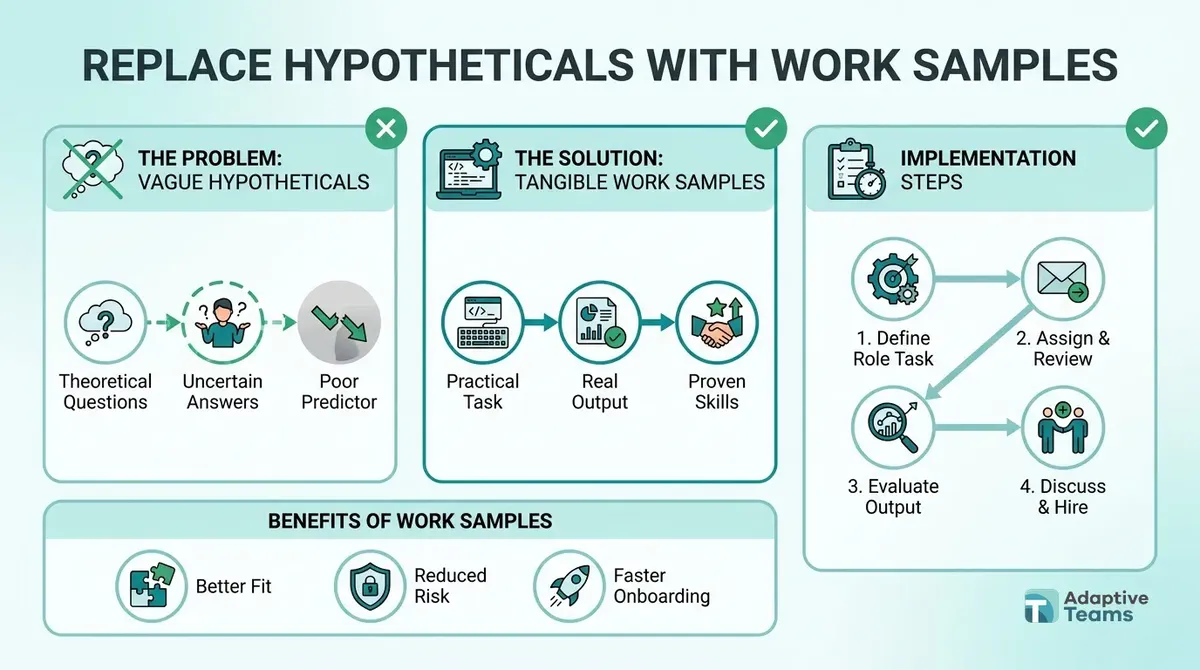
Keep the exercise close to the real job and small enough to respect the candidate's time. You are not asking for free labor. You are testing judgment.
- Operations role: give a messy handoff, such as a customer complaint, an incomplete internal note and 3 competing priorities. Ask for the next update to the team and what they would do first.
- Marketing role: give a campaign performance snapshot and ask for the 3 observations they would send a manager. You want prioritization, not a full strategy deck.
- Finance support role: give a sample reconciliation issue and ask how they would investigate it, who they would ask and what they would document.
- Customer support role: give 2 difficult tickets and ask for draft replies plus an internal escalation note.
The work sample should show four things.
How they interpret ambiguity
Do they spot what is missing? Do they make reckless assumptions? Do they ask focused questions, or do they need the whole task rewritten?
How they communicate tradeoffs
Remote work needs visible judgment. Strong candidates explain why they would do one thing before another. Weak candidates list tasks without showing priority.
How they handle written output
Most distributed teams lose time through unclear updates. A good work sample shows whether the person can produce written context others can use.
How much management load they create
The best remote hires reduce the number of decisions sitting on your desk. The wrong hire adds status checks, correction cycles and rework.
This matters because remote hiring is not just about filling capacity. It is about lasting output. Our comparison of the best offshore staffing companies shows which providers stay involved after the hire and which stop at the placement.
Interview for operating rhythm
A candidate can be qualified and still be a poor fit for your remote rhythm. That is especially true when you hire across regions.
Ask directly about working hours, overlap, response expectations and meeting preferences. Do not leave these as admin details for the end. They decide whether the hire will actually function inside your team. Useful questions:
- "What hours do you usually keep, and where can you create predictable overlap with our team?"
- "How do you keep stakeholders updated when you work asynchronously?"
- "Tell me about a time zone handoff that worked well. What made it work?"
- "What tools have you used for project visibility, documentation and daily communication?"
The point is not to force everyone into one schedule. It is to stop vague expectations from turning into management friction later. Our guide to remote team time zone management covers how much overlap different roles need.
The Bureau of Labor Statistics reported that 35 percent of workers did some or all of their work from home in 2023. Remote experience is no longer rare. What sets candidates apart is whether they have learned to make remote work run cleanly.
For global hiring, settle the work model before the offer too. Contractor and employee models can both work, depending on the role, the country, the risk and how much control you need. If you are weighing options, our guide on how to hire contractors internationally gives a practical framework for avoiding compliance and management gaps.
Ask better behavioral questions
Behavioral questions still matter, but only when they are grounded in remote work. Do not ask, "Are you comfortable working remotely?" Almost everyone says yes. Ask for evidence:
- "Tell me about a time you had to deliver work while your manager was unavailable. How did you decide what to do?"
- "Describe a time you misunderstood a remote instruction. What happened, and how did you stop it from happening again?"
- "Give me an example of a project where documentation made the difference between success and confusion."
- "Tell me about a time you pushed back on a deadline or priority remotely. How did you say it?"
- "What is the most useful weekly update you have ever sent or received? What made it useful?"
Listen for ownership, specifics and self-awareness. Strong candidates can explain what they learned from remote friction. They do not pretend every collaboration problem was someone else's fault.
The Society for Human Resource Management recommends preparing questions in advance and keeping interviews on job-related criteria. That matters even more here, because remote interviews drift into casual chat quickly. Friendly rapport is useful, but it is not a selection method.
Watch for remote interview red flags
Some warning signs are obvious: missed calls, poor preparation or a big gap on pay. Others are quieter and matter more after the hire.
- Vague ownership language. If the candidate keeps saying "we handled it" but cannot explain their own part, you may be hearing about the team, not the person.
- Meeting dependence. If every answer assumes a live meeting, the person may struggle on an async team. Meetings have a place, but remote teams need people who move work forward between calls.
- Tool name dropping without process. Tools only help when the candidate knows how to create visibility, document decisions and close loops.
- Remote work as a lifestyle perk only. Flexibility is valuable, but the role still needs dependable output. A strong candidate can explain how they protect focus, share their availability and stay accountable.
Also check your own side. If candidates keep misreading the role, the problem may not be the talent market. It may be your job brief, your interview process or the handoff between recruiters and hiring managers.
Make the decision around management load
The final question should not be, "Do we like this person?" It should be, "Will this person make the team easier to run?"
That question changes the decision. A candidate with a bit less direct experience but stronger ownership, clearer writing and better follow-through may outperform a more senior candidate who needs constant steering. For each finalist, answer:
- What will this person own in the first 30 days?
- What decisions can they make without escalating?
- What documentation will they need to be effective?
- What management rhythm will keep them aligned?
- What risk would make this hire fail?
If you cannot answer those questions, you are not ready to make an offer. You are guessing.
The offer stage should also confirm the support system around the hire. Remote performance depends on recruiting quality, onboarding, payroll, HR administration and ongoing management. When those pieces are scattered, even good candidates underperform. That is why we pair recruitment with HR and performance management, with a dedicated manager for every placement and formal reviews twice a year.
How do you check whether remote experience matches your role?
Ask how much of the candidate's past work happened remotely and what support they had during the day. Someone who always worked next to a manager may need different onboarding from someone used to independent handoffs.
In the first quarter of 2024, 22.9% of people at work in the US teleworked or worked at home for pay in a given week, according to the US Bureau of Labor Statistics. Of those teleworkers, 52.1% worked remotely for some of their hours and 47.9% for all of them. A hybrid background and a fully remote background are not the same experience.
Ask the candidate to walk through a task they finished while their manager was unavailable. Follow up on how they got missing information and how they decided when to escalate.
How can you compare candidates when a video call goes wrong?
Reschedule an interrupted interview or offer an equal way to finish the assessment. Keep the questions and scoring criteria the same, so every candidate gets a fair chance to show the skills the role needs.
For a role built around written work, review the same written task before you decide. If live calls are essential to the job, agree on a retry and assess the candidate against the connection requirements stated in the job brief.
Where to start
Remote interviews should help you predict output, not just confirm that someone sounds good on a call. Define the remote reality of the role, use a structured scorecard, test written clarity and make the final decision around management load.
If you would rather not build this process yourself, Adaptive Teams runs it for you. Our TeamTailor account holds 956 jobs and 64,982 applications, and most roles are filled in 2 to 3 weeks. If a hire does not work out in the first 2 months, we replace them at no cost. Start with our recruitment services, or browse the roles we hire most, like customer service representatives and executive assistants.
Frequently asked questions
How long should a remote candidate interview process take?
A strong process usually fits into 2 to 4 stages: screen, structured interview, work sample and final decision. Stretching it further slows hiring without adding much signal.
Should remote candidates always complete a work sample?
For roles where written output, prioritization or independent judgment matter, yes. Keep it short, tied to the role and respectful of the candidate's time.
What is the biggest mistake when interviewing remote candidates?
Overvaluing video presence and undervaluing written clarity, ownership and follow-through. Remote performance depends on what happens between meetings.
How do you assess culture fit remotely?
Assess working style fit, not personality similarity. Ask how the candidate handles feedback, ambiguity, documentation, time zones and conflict when they are not in the same room as the team.
Can contractors be managed like remote employees?
Not exactly. Contractors and employees can both work well, but the right structure depends on role scope, country, compliance risk, control and expected tenure.

Written by the people who recruit, pay and manage remote teams every day, with Nate Ginsburg and Menno Gottmer. About Adaptive Teams