



If you ask five founders what a remote executive assistant costs, you will get five confident answers that disagree by a factor of six. The real remote executive assistant cost sits somewhere between $1,200 and $8,000 per month, and the spread is not noise. It reflects genuinely different hiring models, experience levels, and locations. The number you should budget depends on which of those you actually need.
Table of Contents
This guide breaks the price down by model, shows you the costs that never appear on the invoice, and walks through a realistic monthly budget for each option. By the end you should be able to put a defensible number in your operating plan instead of a guess.
Why the quotes vary so wildly
Three variables drive almost all of the variation in what you will pay.
Location. A senior executive assistant in New York and an equally capable one in Manila or Buenos Aires do the same work at very different price points, because their local costs of living differ that much. According to the U.S. Bureau of Labor Statistics, executive secretaries and executive administrative assistants in the United States earn a mean wage of roughly $75,000 per year. Comparable offshore talent typically costs a quarter to a third of that. Our offshore salary benchmarks by role and region show the same pattern across nearly every support function.
Scope and seniority. There is a real difference between someone who books travel and manages a calendar, and someone who runs your inbox with delegated authority, preps board materials, and manages projects across your leadership team. The second person is rarer and priced accordingly, in every market.
Hiring model. This is the variable most buyers underestimate. The same assistant can cost you very different amounts depending on whether you hire through a freelance marketplace, a task-based VA service, a staffing partner, or a direct full-time hire. Each model bundles different things into the price, which is why comparing headline rates across models misleads you.
The four hiring models, priced
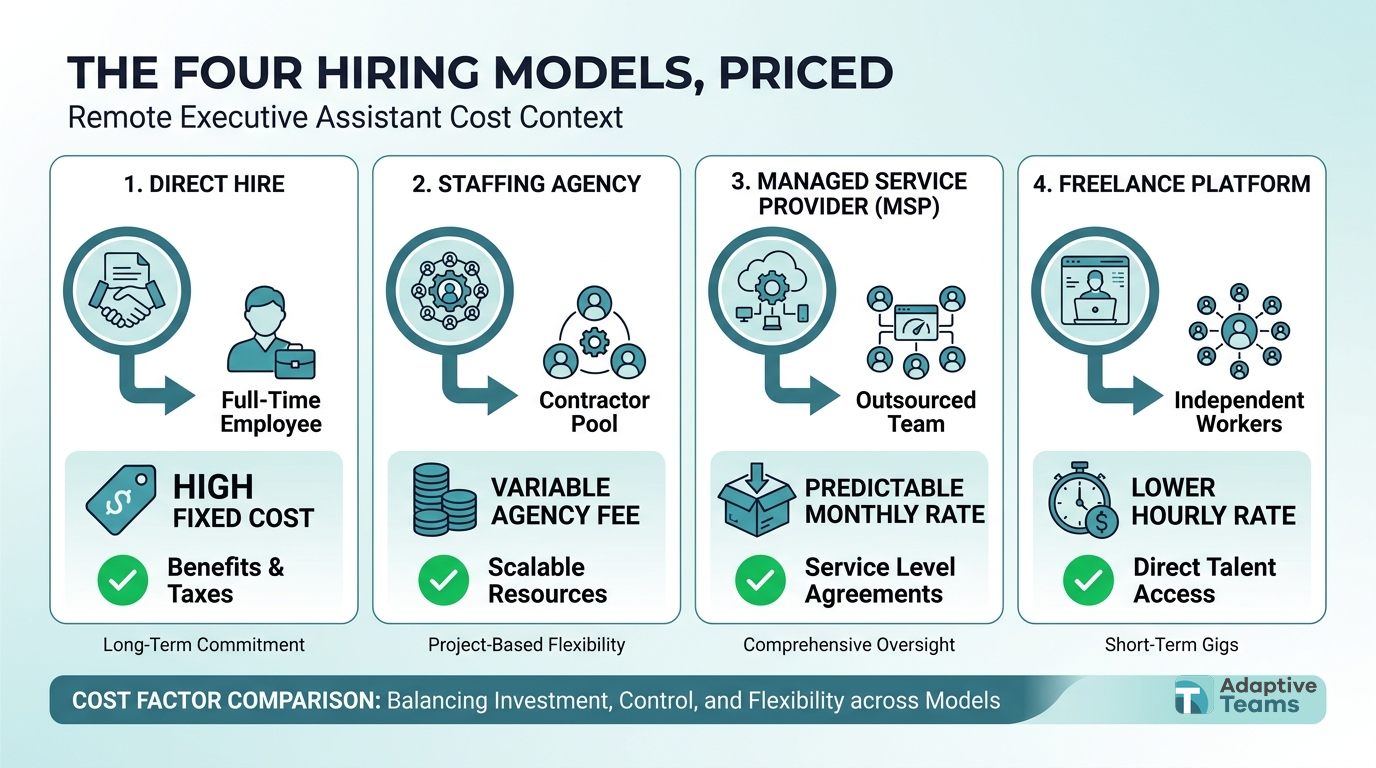
Freelance marketplaces: $15 to $50 per hour
Hiring directly through a marketplace looks cheapest on paper. You pay only for hours worked, and rates for capable offshore assistants start around $8 to $15 per hour, with experienced US-based freelancers charging $35 to $50.
The catch is that everything else becomes your job: sourcing, vetting, onboarding, backup coverage when they disappear, and replacement when they leave. For a low-stakes, five-hour-a-week workload, that trade can be fine. For an assistant who touches your calendar, inbox, and vendor payments, the vetting burden is exactly where you cannot afford to cut corners.
Task-based VA services: $500 to $3,000 per month
Subscription assistant services sell blocks of hours, usually 20 to 80 per month, with an account manager and some ability to swap assistants. Expect $500 to $1,500 per month for part-time offshore coverage and $2,000 to $3,000 for dedicated US-based plans.
These services work well for overflow tasks. They work poorly for genuine executive support, because the person changes, the context resets, and nobody builds the deep familiarity with your business that makes a great EA valuable. If you have ever re-explained your travel preferences to a third new assistant in six months, you know this cost even though it never shows up as a line item.
Full-time offshore hire through a staffing partner: $1,500 to $3,500 per month
This is the model most growing companies land on once the workload justifies a dedicated person. A full-time executive assistant in the Philippines typically runs $1,200 to $2,200 per month in salary. In Latin America, where time zone overlap with US business hours is nearly total, $1,800 to $3,500 is the realistic range for senior candidates.
A staffing partner adds a margin on top of that for recruiting, replacement guarantees, payroll, and ongoing support. Before you flinch at the margin, read what that fee actually covers. We wrote a candid breakdown in our guide to staffing agency markup, and the short version is that you are mostly buying risk transfer: someone else absorbs the cost of a mis-hire, and someone else has a bench when you need coverage.
All-in, budget $2,000 to $4,000 per month for a dedicated, full-time, experienced remote executive assistant through this model.
Direct US-based full-time hire: $6,500 to $9,000 per month
Take the BLS mean of about $75,000, add benefits and employer taxes, which the BLS employer cost data puts at roughly 30 percent of total compensation, and a US-based executive assistant costs $95,000 to $105,000 per year fully loaded. That is $8,000 or more per month before recruiting costs.
For executives whose assistant must attend in-person meetings or handle physical logistics daily, this can be the right spend. For everyone else, it is worth asking honestly which parts of the role require a US salary and which require a capable person in a compatible time zone.
The costs that never show up on the invoice
Whatever model you choose, four hidden costs deserve a line in your mental budget.
Recruiting. SHRM’s benchmarking research puts the average cost per hire near $4,700, and that is an average across all roles. Sourcing and properly vetting an EA who will hold sensitive access takes real hours from someone senior, because a resume tells you almost nothing about judgment and discretion.
Mis-hires and turnover. An assistant who leaves at month four costs you the recruiting cycle twice, plus every hour of context you invested. This is the strongest argument for models with replacement guarantees, and for hiring processes that test real work. Our guide on hiring an overseas executive assistant you can trust covers the vetting steps that reduce this risk more than any interview question does.
Management time. A junior assistant at $800 per month who needs daily direction can cost more, in your hours, than a $2,500 senior assistant who runs autonomously. Price the pair of you, not just the hire.
Tools and security. Password managers, a dedicated email seat, and access controls are cheap in dollars but essential. Skipping them is how a $1,500-a-month hire becomes a five-figure incident.
Get a Real Quote for Your Assistant Budget
Tell us what you need handled and we will show you exactly what the right EA costs, with no obligation.
A worked example: what $2,800 a month actually buys
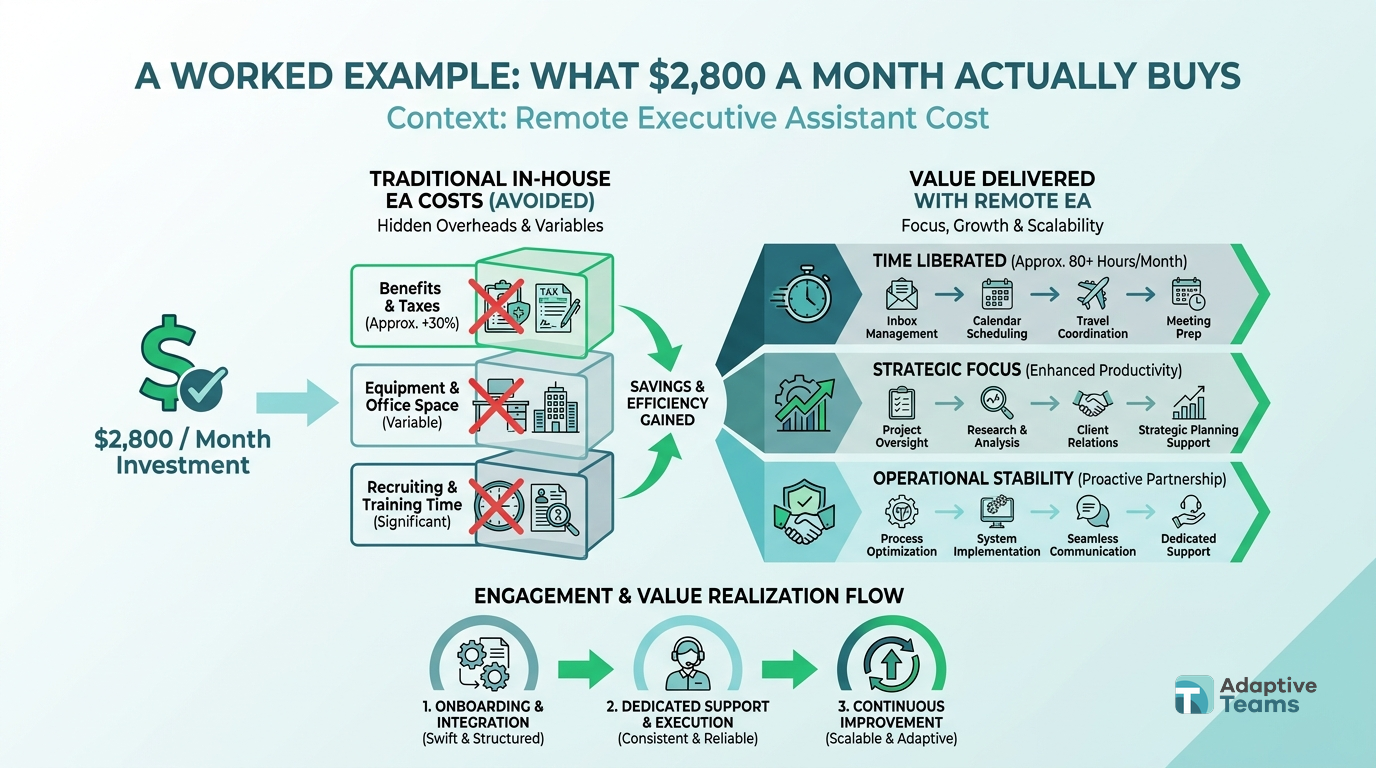
Say you are a founder spending 15 hours a week on scheduling, inbox triage, travel, invoicing follow-ups, and meeting prep. Here is a realistic budget for a dedicated, senior, full-time remote executive assistant based in Latin America through a staffing partner:
Against that $2,800, you recover roughly 60 hours of your own time each month. If your effective hourly value is $150, that is $9,000 of founder time redirected to work only you can do. The model breaks even long before the assistant reaches full speed, which is typically around week six with a structured onboarding.
Run the same math on the other models and the comparison gets clearer. The $500 subscription plan saves you less time because coverage is partial and context keeps resetting. The $8,000 US hire recovers the same 60 hours at nearly triple the cost. The freelance route matches the price but moves the recruiting and continuity risk onto your desk.
When cheap gets expensive
The most common budgeting mistake is not overspending. It is buying below the level the role requires and paying for it in churn and rework.
An executive assistant is a trust position. They see your calendar, your inbox, your finances, and often your personal life. Optimizing that hire for the lowest hourly rate selects for exactly the candidates who treat the role as temporary. The pattern we see repeatedly: a company cycles through two or three budget hires in a year, then pays a proper rate for a senior person and wonders why they waited.
There is also a mismatch failure mode. Some workloads genuinely do not need an executive assistant. If your task list is mostly discrete, low-context tasks, a generalist virtual assistant is the better buy at a lower rate. We break down that decision in virtual assistant vs remote employee, and getting it right matters more than negotiating any single rate.
The honest rule: pay for the least expensive model that still gives you a dedicated person, real vetting, and a replacement path. For most growing companies, that is a full-time offshore hire through a partner who guarantees the seat, not the individual.
How to budget for it this week
If you want a number for your operating plan today, use this sequence:
- Log a week of delegable work. Track everything you do that someone else could own. Under 10 hours a week points to a task-based service. Over 15 points to a dedicated hire.
- Pick the model, not the person. Decide between subscription, freelance, partner-sourced offshore, or US direct hire based on how much continuity and trust the workload demands.
- Budget the all-in number. Compensation plus fees plus tools plus a realistic estimate of your management time in month one.
- Reserve for onboarding. The first four to six weeks run at partial productivity. Companies that plan for this keep their assistants; companies that expect day-one autonomy churn them.
Frequently asked questions
How much does a remote executive assistant cost per hour?
Rates range from $8 to $15 per hour for capable offshore assistants, $20 to $35 for senior offshore or entry US-based talent, and $35 to $50 or more for experienced US-based executive assistants. Hourly pricing mainly applies to freelance and subscription models, since dedicated full-time hires are priced monthly.
Is a full-time remote executive assistant worth it compared to a part-time one?
It depends on volume and continuity. If you have more than 15 hours a week of delegable work, full-time usually wins because the assistant builds context that makes every task faster. Part-time works when the tasks are discrete and low-context, like basic scheduling or data entry.
Why are offshore executive assistants so much cheaper?
The difference reflects cost of living, not skill. A $2,000 monthly salary in Manila or Medellin is a strong professional wage locally, so these markets attract experienced, often degree-holding candidates at rates that would be entry-level in the US. Time zone overlap, especially from Latin America, has removed most of the old coordination penalty.
What is the cheapest way to hire a remote executive assistant?
Freelance marketplaces have the lowest sticker price, but you absorb all sourcing, vetting, and replacement risk yourself. The cheapest reliable option for a dedicated assistant is usually a full-time offshore hire through a staffing partner, where the fee buys vetting and a replacement guarantee.
Should I hire my executive assistant as a contractor or an employee?
Both models work, and the right answer depends on the country, the level of integration, and your compliance preferences. Many companies start with a contractor arrangement and move to an employment model as the role becomes permanent. A staffing partner can run either structure for you.
Where to start
The fastest way to get a real number is to stop comparing rate cards and start from your own workload. List what you would hand off, decide how much trust the role carries, and price the model that fits. If you want help with that, our recruitment team builds dedicated executive assistant placements with vetting, onboarding support, and a replacement guarantee built in. Book a call, bring your task list, and you will leave with a concrete budget either way.
Ready to Build Your Dream Team?
Book a free staffing consultation with our remote team specialists. No obligations, just actionable insights for scaling your operations.