

TL;DR
Flexible team scaling means adding capacity when the work arrives, without signing up for a full-time local hire first. Match each workload to a model: a dedicated remote team member for ongoing work, a contractor for a short project, or a managed staffing partner when payroll and HR are involved. With Adaptive Teams, most roles are filled in 2 to 3 weeks, month to month, with no placement fee.
Growth rarely waits for your hiring plan. Tickets pile up, invoices age and the IT backlog grows while a job post sits open for months.
Hiring slowly is expensive too. According to SHRM benchmarking data, the average cost per hire in the US was nearly $4,700, and many employers put the full cost of a new hire at three to four times the position's salary. The labor pool is tight as well. The U.S. Chamber of Commerce reports 1.7 million fewer Americans in the workforce than in February 2020.
This guide shows how to add output without that fixed cost, function by function.
What is scaling a team without hiring full time?
Scaling a team without hiring full time means adding capacity without adding permanent local employees right away. That can mean embedded remote team members, offshore staffing, contractors, part-time specialists or a managed staffing partner.
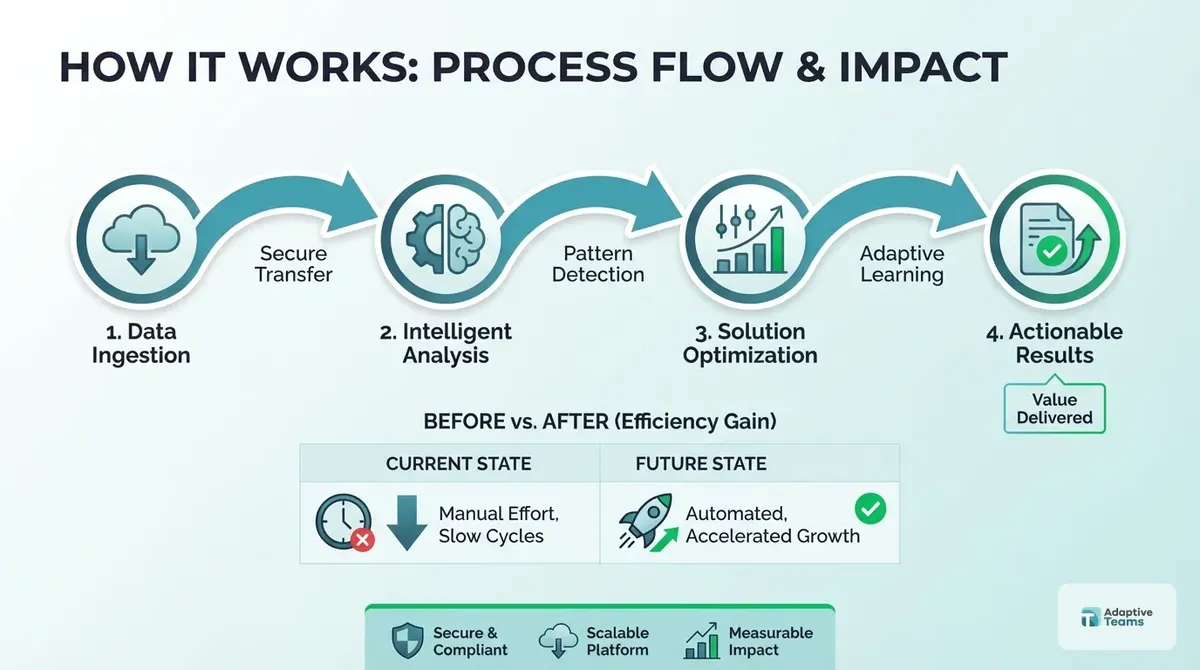
It matters because demand rarely rises in a straight line. One quarter you need support coverage. The next you need bookkeeping help or a second developer. Locking in fixed local salaries too early strains cash flow when growth slows down.
Full time and local are two separate decisions. A dedicated remote hire can work 40 hours a week for you, inside your tools, without being a local employee on your payroll.
How flexible team scaling works in practice
Flexible team scaling starts with the work, then picks the model. You do not ask "who should we hire?" You ask which work is slowing the business down and how much of it there is.
- List the bottlenecks. Write down the work that keeps slipping: response times, aging invoices, open tickets, missed follow-ups.
- Size the work. Count the hours a week each task takes. Anything above 30 hours a week that will still be there in six months is a full role.
- Pick the model. Ongoing, repeatable work fits a dedicated remote team member. A one-off project fits a contractor. Anything that touches payroll, HR or compliance fits a managed partner.
- Write it down. SOPs, templates and a short scorecard cut ramp time and keep quality steady.
- Pilot one function. One role, one manager, one scorecard. Expand after the first workflow is stable.
Can we scale our team quickly without hiring full time?
Yes. You can usually add a dedicated team member in 2 to 3 weeks without making a full-time local hire. Specialist or senior roles can take 4 to 6 weeks. A traditional local search usually takes longer once you count sourcing, interview rounds and the candidate's notice period.
The speed comes from sourcing wider. Our recruitment services source candidates internationally, test skills and English, and send you a shortlist of 3 to 5 people. You interview only the finalists. Our TeamTailor account holds 956 jobs and 64,982 applications, so for most roles we are not starting from zero.
The person is employed through Deel, which covers 150+ countries. You need no local entity, and our team runs payroll from day one, twice a month on the 15th and the 30th. You stay month to month with 30 days notice, so the role can shrink or grow with demand.
Scaling by function: support, AR, IT and operations
Each function scales differently. Here is what works for the areas we get asked about most.
Customer support
Scaling support without hiring locally usually means a remote agent trained on your help desk and macros. Offshore agents can cover the hours your team is offline, so tickets that arrive at night are answered by morning. Start with one queue and a response-time target. A full-time support rep in the Philippines earns $700 to $900 a month, according to our offshore salary benchmarks.
Fulfillment and operations
To scale fulfillment without hiring an ops team, split the work first. Order exceptions, carrier claims, inventory reconciliation and supplier follow-up are all desk work a remote coordinator can own. Physical picking and packing stays with your warehouse or 3PL. Operations coordinators in our placement base earn $1,000 to $1,750 a month.
Growth and marketing
A growth team without full-time hires often starts with one remote marketing coordinator who runs the calendar, the reporting and the campaign admin. Demand for these roles is deep. Marketing roles alone have drawn 13,506 applications in our recruiting system.
Need help scaling an AR team without hiring more staff?
You can scale accounts receivable by adding a remote AR specialist who owns invoicing, payment reminders and cash application under your controller. AR is rule-based work, so it transfers well once your collection steps are written down.
Start with the tasks that eat the most hours: sending statements, chasing invoices past 30 days, matching payments to open items and updating notes in your accounting system. Give the specialist read access first, then posting rights once their matching is clean. Bookkeepers in India, where most of our accounting placements sit, earn $1,000 to $1,750 a month.
Accounting is one of the 6 departments KO Storage built with us. They started with 4 call center agents and grew to 70+ team members across call center, revenue management, accounting, asset management, security and IT within 18 months.
How to scale your IT team without recruitment
You scale an IT team without running your own recruitment by letting a staffing partner source, test and employ the people while you manage the work. Your team keeps ownership of the architecture and the priorities.
Help desk, system administration, QA and routine development tickets are the easiest to hand over. Keep security decisions and access policies with a senior person in house. Give remote IT staff their own accounts with the least access they need.
For development work, see how we hire software developers or how our software team augmentation works. If you are weighing whether an engineer should be a contractor or an employee, our guide on hiring contractors internationally covers the misclassification risk and when each model fits.
Scale your team without hiring locally
Hiring outside your city widens the talent pool and lowers the fully loaded cost of many roles. The role stays full time and dedicated to you. Only the location changes.
Time zones decide which region fits. Latin America shares most of a US workday, which suits sales, support and engineering sprints. Asia and Africa suit back-office work that can be handed off overnight. We source where the role works best. See hiring in the Philippines and hiring in Latin America for the details on each.
Remote hires need a clear manager and regular check-ins. Our guide to remote team management tools covers the systems that help remote people plug into an existing team.
Best staffing companies for scaling a team without increasing payroll costs
The best staffing companies for scaling without adding payroll take over recruiting, employment and payroll, and tell you the full monthly cost up front. Check the fee model before anything else.
Ask each provider four things:
- Is there a placement fee? Many agencies charge a percentage of first-year salary up front.
- How is the monthly fee set, and what does it cover? Ask for a sample invoice with the salary and every fee on it.
- Who handles HR and payroll? A partner that employs the person removes that admin from your team.
- What happens if the hire does not work out? Look for a replacement guarantee.
At Adaptive Teams you pay the salary plus a staffing fee, a percentage of that salary:
| Monthly salary | Staffing fee | Example total |
|---|---|---|
| Up to $1,500 | 60% | $1,000 salary: $1,600 |
| $1,501 to $2,500 | 50% | $2,000 salary: $3,000 |
| $2,501 to $3,500 | 40% | $3,000 salary: $4,200 |
| $3,501 to $4,500 | 35% | $4,000 salary: $5,400 |
| Above $4,500 | 30% | $5,000 salary: $6,500 |
Recruitment is included. There is no placement fee, terms are month to month, and we replace a hire for free in the first 2 months. Teams of 2 or more get volume discounts of 3 to 9 percent. If you only need the search, recruitment only costs $4,000 flat per hire.
For a wider view of the market, see our comparison of the best offshore staffing companies. If HR admin is the real bottleneck, HR outsourcing may help before you add any headcount.
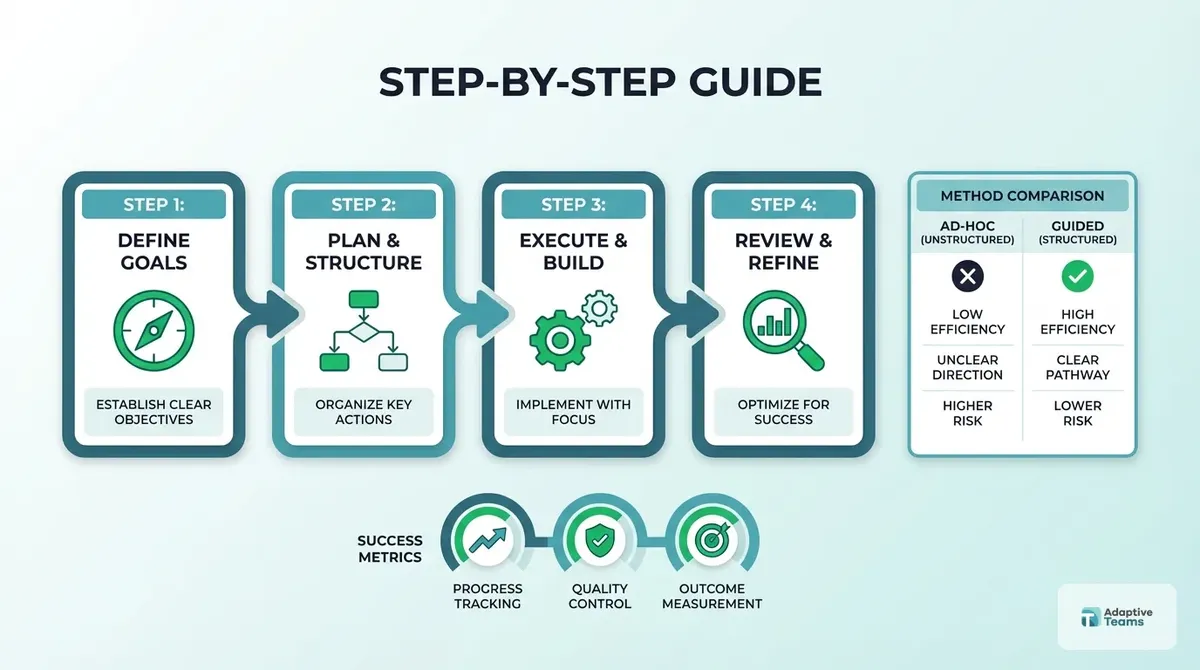
Step-by-step guide
Follow this sequence so flexible staffing adds output instead of chaos.
Step 1: Audit your bottlenecks
List the work that keeps slowing delivery, sales follow-up, finance or support. Use response time, backlog size and senior hours spent on low-value work.
Step 2: Put a price on the delay
A founder spending 10 hours a week on admin is pulling that time from sales and delivery. That cost often exceeds the cost of support.
Step 3: Break roles into tasks
Some tasks need process discipline. Others need deep expertise. The split tells you whether you need a dedicated hire or a specialist.
Step 4: Document the workflow
Create SOPs, handoff rules and escalation paths before onboarding. Give every recurring workflow one owner.
Step 5: Track output
Measure turnaround time, error rate, throughput and manager time saved. "Hours available" tells you little. Our performance management service runs this tracking for every placement.
Step 6: Review at 30, 60 and 90 days
If the workload is stable and strategic, you may have the case for a permanent hire. If not, keep it flexible.
Common mistakes to avoid
Flexible models fail when companies treat them as a shortcut.
- Hiring for tasks you have not defined. If you cannot explain the output, the new hire will guess. Ramp time gets longer and quality drops.
- Choosing the cheapest option for critical work. Low-cost freelancers help in narrow cases. For recurring, customer-facing work, missing oversight leads to missed deadlines and rework.
- Leaving nobody accountable. Every role needs a manager, even part time or remote. Otherwise priorities drift until results slip.
- Ignoring compliance. International contractors without a clear framework create misclassification and payment risk. Our guide to outsourcing HR operations shows how a small business can close that gap.
- Expanding before the first workflow is stable. Adding people to a broken process scales the mess faster than the output.
Tools that keep a flexible team organized
A few tools cut the coordination drag. Asana gives every recurring task an owner and a deadline. Slack keeps conversations sorted by team or project, as long as you agree on response times. Loom turns a process walkthrough into a video your new hire can replay. Your own SOP library still matters most.
Next steps
Waiting for the perfect full-time hire can quietly cost more than the hire itself. Name the work that is slowing you down, match it to a model and pilot one role.
If you want a plan for remote staffing, recruiting, payroll and performance management, book a free staffing consultation. We map the role to a region, a shortlist and a start date, usually 2 to 3 weeks out.
Frequently asked questions
Is scaling a team without hiring full time only for startups?
No. Startups use it to stay lean, but agencies, SaaS companies, ecommerce brands and service businesses use the same model to protect margin while they grow. KO Storage, a self-storage operator, grew from 4 remote call center agents to 70+ team members across 6 departments in 18 months this way.
What roles are easiest to scale without hiring full time?
Customer support, accounts receivable, bookkeeping, recruiting coordination, IT help desk and operations admin are the easiest starting points. The work repeats, it can be written down as a process, and the output is easy to measure. Roles that need deep local relationships or in-person work are harder to move.
Is flexible staffing cheaper than hiring employees?
Usually, yes, once you count the full cost. SHRM puts the average US cost per hire near $4,700 before salary and benefits. With Adaptive Teams you pay the salary plus a staffing fee of 30% to 60% of it, with no placement fee. A $1,000 a month support rep costs $1,600 in total. The bigger gain is matching team cost to the workload you actually have.
How do you keep quality high with remote team members?
Write the process down before the first day, give each person one manager and track a short scorecard every week. Turnaround time and error rate show problems early. Regular check-ins keep remote people connected to your team. Without those basics, any staffing model will underperform, local or remote.
When should you move from flexible support to full-time hiring?
Consider a permanent local hire when the work is stable, central to your strategy and heavy enough to justify the fixed cost for years. Review each flexible role at 30, 60 and 90 days. Many teams find a dedicated remote hire already gives them that stability.

Written by the people who recruit, pay and manage remote teams every day, with Nate Ginsburg and Menno Gottmer. About Adaptive Teams