



If you searched for staffing agency markup explained, you are probably not asking for a dictionary definition. You are trying to understand whether the gap between a worker’s pay rate and your invoice is fair, bloated, or hiding work your internal team would otherwise have to absorb.
Table of Contents
- What staffing agency markup actually means
- Why markup exists in the first place
- A simple bill-rate example
- What is a normal staffing markup?
- Markup is not the same as a placement fee
- What a fair markup should include
- Red flags in markup discussions
- How to compare staffing quotes without getting misled
- The operator’s test: what does the markup remove?
- FAQ
That is the right question. Markup is not just a percentage. It is a pricing signal. It tells you how much of the hiring, payroll, compliance, benefits administration, recruiting risk, replacement risk, performance support, and account management burden sits with the staffing partner instead of your team.
The mistake is judging markup in isolation. A 35% markup can be expensive if the agency only forwards resumes and disappears. A 70% markup can be reasonable if it includes sourcing, vetting, payroll, HR administration, replacement coverage, management follow-up, and a lower fully loaded cost than the local equivalent.
Operators should not ask, “Is the markup high?” The better question is, “What operating cost does this markup remove, and what risk still stays with us?”
What staffing agency markup actually means
Staffing agency markup is the percentage added on top of a worker’s direct pay rate to create the bill rate you pay.
If a remote operations coordinator earns $18 per hour and the agency charges you $30 per hour, the markup is calculated like this:
$30 bill rate minus $18 pay rate equals $12 markup.
$12 markup divided by $18 pay rate equals 66.7% markup.
That does not mean the agency earns 66.7% profit. Markup is not margin. It is the total spread that covers employment costs, recruiter time, payroll administration, legal structure, insurance, management overhead, technology, replacement risk, and profit.
Margin is what remains after those costs are paid. A partner with a high-service model may show a larger markup than a low-touch provider, while keeping a lower actual profit margin because more of the spread funds delivery.
Why markup exists in the first place
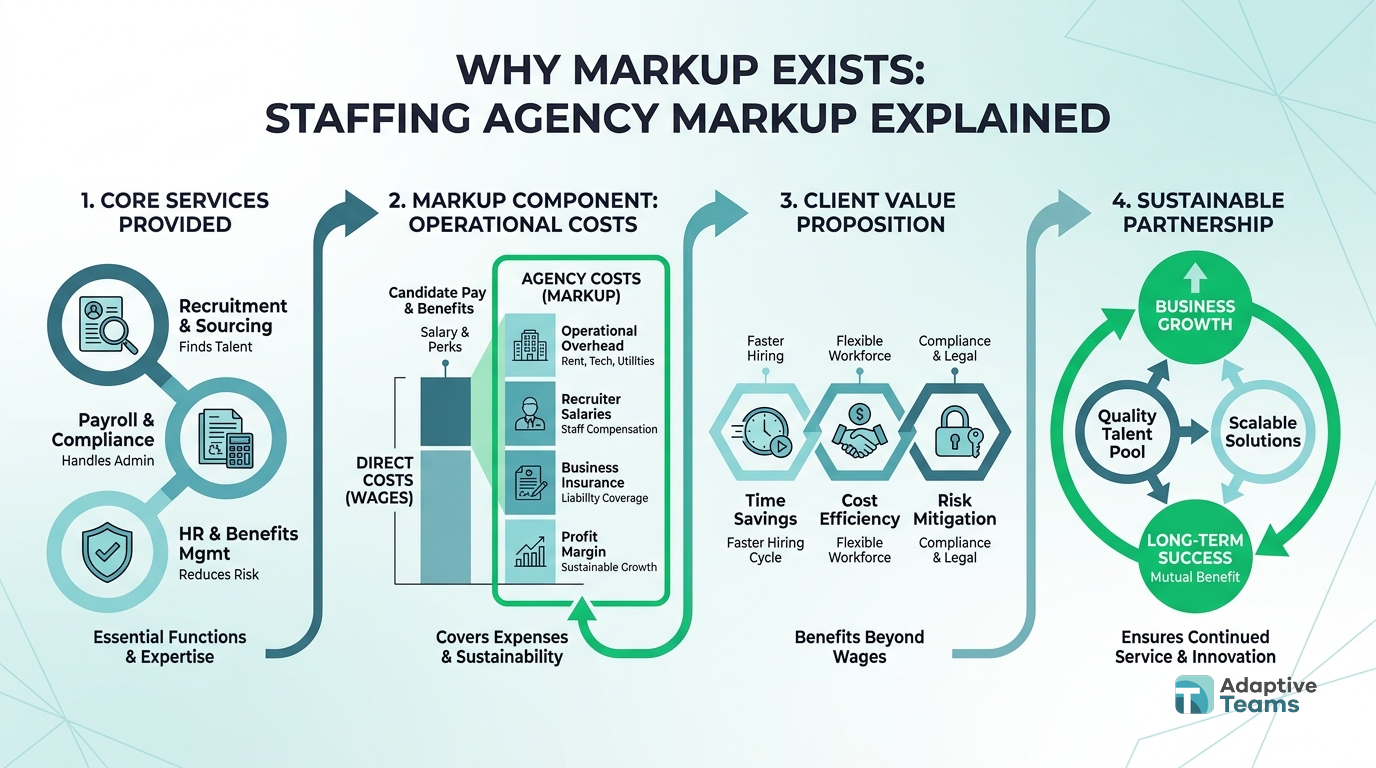
If your company hires directly, many costs do not show up on the salary line. They still exist.
The Bureau of Labor Statistics employer cost data regularly shows that wages are only part of total compensation. Benefits, insurance, taxes, and paid leave can materially increase the real cost of an employee. For international or remote hiring, you also add country-specific payroll rules, classification decisions, currency movement, equipment, onboarding, and management time.
Staffing markup packages many of those costs into one visible number. That visibility can feel uncomfortable because it puts a price on work that internal teams often treat as “free” until it slows the company down.
The spread usually covers 5 categories.
1. Recruiting and selection
Someone has to source candidates, screen for skill, check communication quality, assess reliability, coordinate interviews, and keep the process moving. If your founder, COO, or department lead spends 15 hours per role on recruiting, that time has a cost.
For a growing agency or e-commerce operator, the opportunity cost can be higher than the agency markup. Every week spent in hiring mode is a week not spent fixing delivery capacity, improving margins, or serving clients.
2. Payroll and employment administration
The agency often handles payroll processing, payments, local documentation, worker records, time tracking, and payment support. In some models, it also manages statutory employer obligations or coordinates contractor administration.
This is where provider models differ. Adaptive Teams supports both contractor and employee models depending on the role, country, risk profile, and operating need. The point is not to force one model. The point is to structure the relationship correctly from the start.
3. Compliance and classification risk
Worker classification is not just paperwork. The IRS worker classification guidance makes clear that behavioral control, financial control, and relationship structure matter. The U.S. Department of Labor also treats misclassification as a serious wage and hour issue.
For international teams, the risk changes by country. A cheap arrangement can become expensive if the company is using contractors like employees without the right structure, documentation, or oversight.
4. Replacement and continuity
Good staffing partners price in the fact that not every hire works. If a candidate leaves early or is not a fit, the partner should help replace the person without forcing your team to restart the hiring process alone.
That matters because replacement cost is not only another recruiting fee. It is lost training time, delayed output, team frustration, and management attention pulled back into hiring.
5. Account management and performance support
Low-touch staffing ends at placement. Managed staffing continues after the hire starts.
For operators, this distinction matters. If a partner checks in on performance, supports onboarding, helps resolve communication gaps, and keeps the role aligned to business outcomes, the markup is funding operational infrastructure. If the partner only sends invoices, the markup is mostly sales margin.
This is why Adaptive Teams positions remote team members as embedded support, not one-off labor. The goal is not a short-term placement. It is a durable team member with HR, payroll, performance, and follow-up built around them.
A simple bill-rate example
Say you need a remote customer operations specialist.
A local hire might cost $60,000 in salary. Once you include benefits, taxes, equipment, paid time off, management overhead, recruiting time, and replacement risk, the fully loaded cost can move meaningfully above the salary line.
Now compare a managed remote staffing model:
Role pay rate: $1,800 per month
Agency markup: 65%
Monthly bill rate: $2,970
Annual bill rate: $35,640
At first glance, 65% sounds high. In absolute terms, the company is still paying far less than a local fully loaded hire. More important, the company is not building a payroll process, compliance workflow, recruiter bench, and replacement system around one role.
That is the calculation operators should run. Markup percentage matters less than total cost, speed-to-fill, retention, and management drag removed.
For a broader cost comparison, see our breakdown of what operators actually save with remote staffing. If the hire is technical, our guide to offshore development team cost shows how the same logic applies to delivery teams.
What is a normal staffing markup?
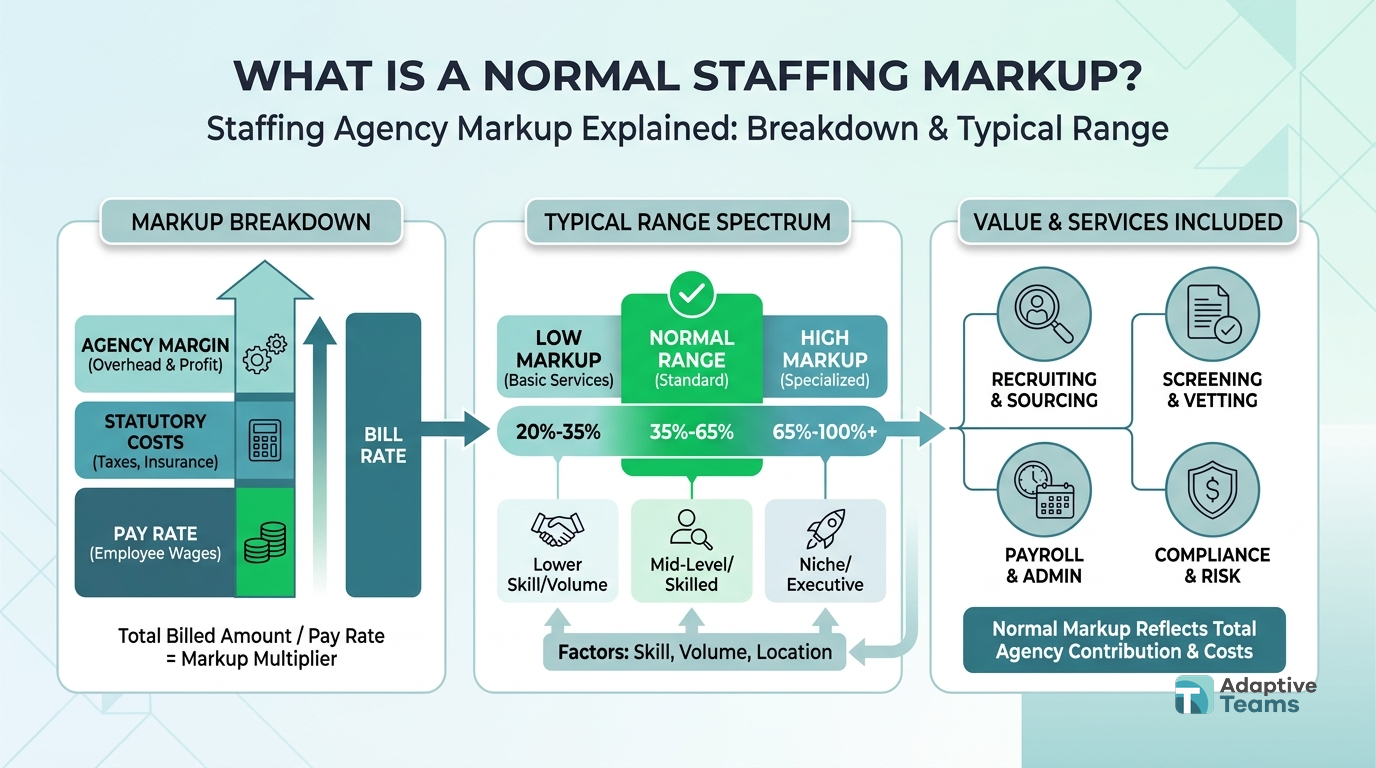
There is no single normal number because the model changes the economics. A light industrial temp role, a senior finance hire, a remote customer support role, and an offshore developer are not priced the same way.
Still, many staffing arrangements fall somewhere between 25% and 100% markup. The lower end usually appears when the provider has limited responsibility after placement. The higher end appears when the provider carries more recruiting work, employment administration, replacement coverage, compliance support, benefits, management oversight, or niche sourcing requirements.
The role also matters. A high-volume admin role should not carry the same economics as a hard-to-source bilingual operations manager. Urgency matters too. If you need 5 trained hires in 30 days, someone is paying for compressed sourcing, screening, and onboarding work.
The SHRM human capital benchmarking research often points leaders back to the same operational reality: hiring is not free just because internal people do it. Recruiting time, vacancy cost, turnover, and HR administration all belong in the comparison.
See the Real Cost Behind Markup
Get a practical staffing model that compares bill rate, replacement risk, HR overhead, and expected savings before you hire.
Markup is not the same as a placement fee
Traditional recruitment agencies often charge a one-time placement fee. The client hires the person directly, then owns payroll, HR, compliance, management, retention, and replacement after any guarantee period ends.
Staffing markup works differently. You pay an ongoing bill rate because the partner remains involved in the employment or contractor infrastructure. That can be useful when you want speed and flexibility without building internal HR capacity first.
Neither model is automatically better. A placement fee can make sense when you already have strong HR operations and only need candidate access. Ongoing staffing markup can make sense when you want the recruiting, payroll, compliance, and performance layer bundled with the hire.
This is especially relevant when comparing staff augmentation for flexible growth with permanent hiring. The right model depends on how much infrastructure you want to own.
What a fair markup should include
A fair markup should be explainable in plain language. If the provider cannot tell you what is included, you are not looking at a pricing model. You are looking at a black box.
Ask what is covered before you compare rates.
Recruiting quality
Does the partner source from a known talent market, or does it simply post jobs? Are candidates screened for role skill, communication, reliability, and remote working habits? How much interview coordination does the partner handle?
Hiring velocity only helps if quality stays intact. A fast bad hire is still an expensive hire.
Onboarding support
Remote hires need role clarity, communication norms, access setup, and early feedback loops. If your team has to build every onboarding asset from scratch, the markup is not removing enough operating drag.
remote onboarding systems that reduce ramp time
HR and payroll administration
Check who handles payment issues, documentation, time tracking, HR questions, leave coordination, and country-specific administration. If those tasks come back to your team, the real markup is higher than the invoice says because your internal overhead is still active.
HR outsourcing support for lean teams
Performance follow-up
Ask how often the partner checks in after placement. Strong providers help catch issues before they turn into churn. They also help managers communicate expectations clearly across time zones and cultures.
performance management support for remote teams
Replacement coverage
If the hire is not a fit, what happens next? How long does replacement support last? Is the process documented? Are there conditions that make the guarantee useless in practice?
A replacement guarantee is not valuable because it sounds reassuring. It is valuable because it reduces the cost of a failed hire and gives your team a path forward without restarting from zero.
Red flags in markup discussions
The biggest warning sign is a provider that talks only about the pay rate. Cheap pay without the right structure can create churn, weak performance, and hidden management load.
Another warning sign is a provider that refuses to separate what the worker earns from what the client pays. You do not need every internal cost line, but you should understand whether the spread funds taxes, benefits, payroll, recruiting, account management, replacement coverage, or pure margin.
Be careful with “all-in” quotes that leave out the role scope. A $2,500 monthly bill rate can be expensive for a low-skill task role and cheap for a trained operations specialist who protects a $50,000 monthly client account.
Also watch for short-term thinking. If the agency optimizes only for filling seats, you may get resumes quickly and still fail operationally. The better test is whether the partner can explain how the role will be managed, retained, and improved after day 30.
How to compare staffing quotes without getting misled
Put every quote into the same operating model.
Start with the bill rate, not the markup. Then list what is included: recruiting, screening, payroll, compliance structure, HR administration, replacement support, onboarding help, management follow-up, reporting, and service level expectations.
Next, calculate the internal work you still own. If your team must write job posts, screen candidates, manage contracts, handle payroll questions, solve compliance issues, and replace churned hires, the cheaper quote may not be cheaper.
Then compare time-to-fill. A role filled in 21 days can create value sooner than a role filled in 60 days, especially if the bottleneck is hitting client delivery, customer response time, or founder capacity.
Finally, compare retention assumptions. If one provider is cheaper but churn is higher, the savings disappear into repeated onboarding and lost output.
For role planning, recruitment services that shorten hiring cycles can help you connect hiring model, salary level, and operational urgency before you commit.
The operator’s test: what does the markup remove?
A good staffing markup should remove measurable friction. You should be able to point to the founder hours saved, the HR tasks avoided, the payroll complexity handled, the hiring cycle shortened, or the replacement risk reduced.
If none of those are clear, the markup is probably just a premium on labor. If several are clear, the markup may be buying capacity your company cannot build internally yet.
This is the difference between cheap labor and managed staffing infrastructure. Cheap labor gives you a person. Infrastructure gives you a role that can keep producing without forcing your leadership team to become a recruiting, HR, payroll, and performance department.
FAQ
What is a good staffing agency markup?
A good staffing agency markup is one that matches the responsibility the provider carries. A low-touch resume provider should not charge the same markup as a managed staffing partner handling sourcing, payroll, compliance support, replacement coverage, and performance follow-up.
Is staffing agency markup negotiable?
Sometimes. The better negotiation is not only the percentage. Ask what changes if you adjust the scope, guarantee, volume, role requirements, speed, or management support. A lower markup with weaker replacement coverage can cost more in practice.
Does a higher markup mean the agency is overcharging?
Not automatically. Higher markup can reflect payroll costs, benefits, employment risk, specialized sourcing, management support, or replacement coverage. It becomes a problem when the provider cannot explain what the spread funds.
How do I compare staffing markup with hiring directly?
Compare the bill rate against fully loaded internal cost, not salary alone. Include recruiting time, vacancy cost, taxes, benefits, HR administration, compliance work, equipment, management time, and turnover risk.
Should I choose a contractor or employee model?
It depends on role scope, control, country, duration, and risk tolerance. Adaptive Teams supports both contractor and employee models, with the structure tailored to the work and compliance profile rather than forced into one default answer.
Where to start
Staffing markup is not the enemy. Unclear value is the enemy.
Before you reject a quote because the markup looks high, map the work it removes from your team. Before you accept a quote because the markup looks low, map the work it leaves behind.
The right partner should help you understand pay rate, bill rate, replacement coverage, HR administration, payroll structure, and performance support in one operating model. That is how you protect margin while building a team that feels embedded, reliable, and long-term.
If you want that model built before you hire, start with Adaptive Teams recruitment services and compare the real cost of managed staffing against the cost of owning every hiring and HR task internally.
Ready to Build Your Dream Team?
Book a free staffing consultation with our remote team specialists. No obligations, just actionable insights for scaling your operations.