TL;DR
Staff augmentation means adding outside professionals who work under your direction, in your tools, as part of your team. A provider handles sourcing, payroll and compliance; you run the work. Most roles fill in 2 to 3 weeks instead of the 44 days SHRM reports for a typical US hire. At Adaptive Teams you pay the salary plus a staffing fee of 30% to 60% of it, so an $800 support rep costs $1,280 a month in total. The model fails when augmented staff are treated as outsiders.
Augmentation of staff means bringing outside professionals into your team to work alongside your own people. Unlike traditional outsourcing, they work under your direction. They use your tools and follow your workflows. They act as part of your in-house team, not as a separate vendor.
This guide explains how the model works, what it costs, how to set it up step by step and which mistakes sink it.
What Is Augmentation of Staff?
Augmentation of staff is a hiring model in which a provider finds and employs people who then work full time inside your team. You decide what they work on. The provider handles the parts of employment you do not want to own: sourcing, contracts, payroll and local compliance.
The model matters because it solves two problems growing companies hit at the same time: speed and specialization. Hiring in the US is slow. The Society for Human Resource Management has reported an average of 44 days to fill a role, and that is before the new hire starts and ramps up. A good staffing partner can usually fill a role in 2 to 3 weeks. Specialist and senior roles take longer, often 4 to 6 weeks.
Use of the model has grown since 2020. Companies that used to hire only locally now hire across borders, because remote work became normal and the tools to manage distributed teams matured. As a result, staff augmentation has moved from a stopgap to a long-term way of building a team, for startups and established companies alike.
How Augmentation of Staff Works
The mechanics are simple. Still, knowing each phase helps you set realistic expectations and avoid delays.
1. Define your requirements
First, you set out the skills, experience level and hours you need. Include technical skills, soft skills and where the role sits in your current team. A clear brief here saves weeks later.
2. Partner with a staffing provider
Next, you work with a staffing partner that sources candidates for the role. The provider matches candidates to your brief and handles sourcing, screening and first-round qualification. This removes most of the recruiting work from your desk. For scale: our TeamTailor account holds 56,287 candidates, 64,982 applications and 956 jobs.
3. Interview and select
You then interview a shortlist, the same way you would for any internal hire. Because the provider has already screened for the basics, this stage moves quickly. You make the final call.
4. Onboard and integrate
Finally, the people you picked join your team. They use your chat tools, join your standups and work in your project management system. The provider handles payroll, compliance and admin while you manage the work itself.
In other words, staff augmentation gives you the person without the usual hiring burden. Your augmented team members report to you, but you do not carry the admin load of being their employer. For developer roles, our software team augmentation service works the same way.
Key Benefits of Augmentation of Staff
Augmentation of staff pays off on cost, speed and quality. These are the benefits that matter most:
- Faster time to productivity. Candidates are screened for the role before you meet them. They usually ramp up faster than a local hire found through a cold job post.
- Lower total cost. Offshore salaries sit well below US pay for the same work. In our salary benchmarks, a Philippine customer service rep earns $700 to $900 a month and a Latin American rep $900 to $1,050. With Adaptive Teams, an $800 salary costs $1,280 a month in total, staffing fee included. Recruiting, payroll and HR are part of that fee.
- Access to specialized skills. You can add niche skills, such as an automation engineer, a bilingual recruiter or a bookkeeper, without a long search in your local market.
- Scale up or down. You add people as the work grows. With month to month contracts and 30 days notice, you are not locked into headcount you no longer need.
- Lower hiring risk. If a hire does not work out, the provider replaces them. At Adaptive Teams replacement is free in the first 2 months.
- Continuity. Your projects keep moving while your core team focuses on the work only they can do. Augmented staff take on execution and specialist tasks.
Step-by-Step Guide to Augmenting Your Staff
Follow these steps to put staff augmentation in place in your company.
Step 1: Audit your current team gaps
Start by mapping your team's skills against the work in front of you. Find where you lack capacity or expertise. Note whether each gap is temporary (one project) or ongoing (daily operations). That difference shapes the kind of arrangement you need. Ongoing gaps suit a dedicated full-time hire. Short projects may suit a freelancer.
Step 2: Set a clear budget and timeline
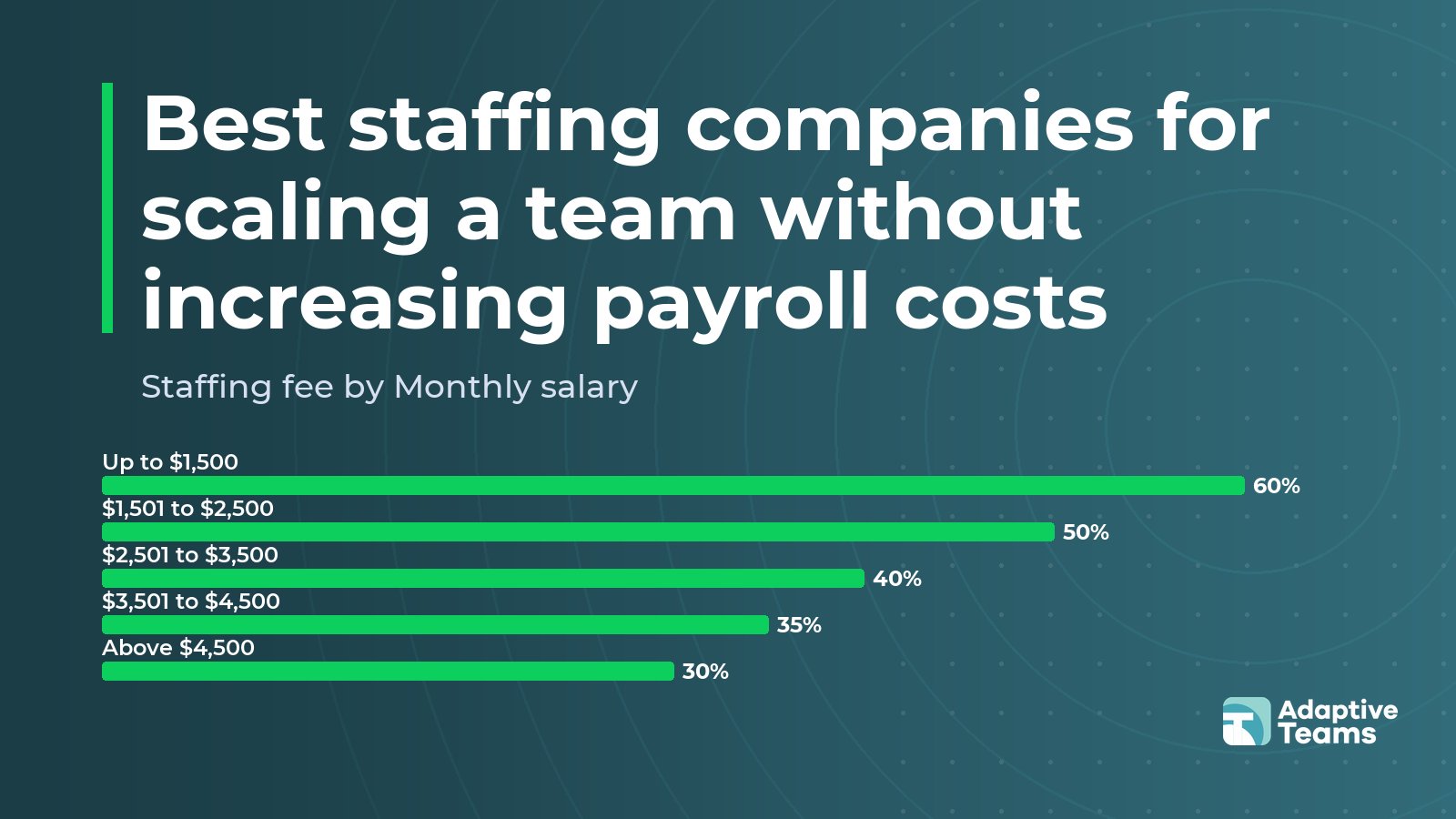
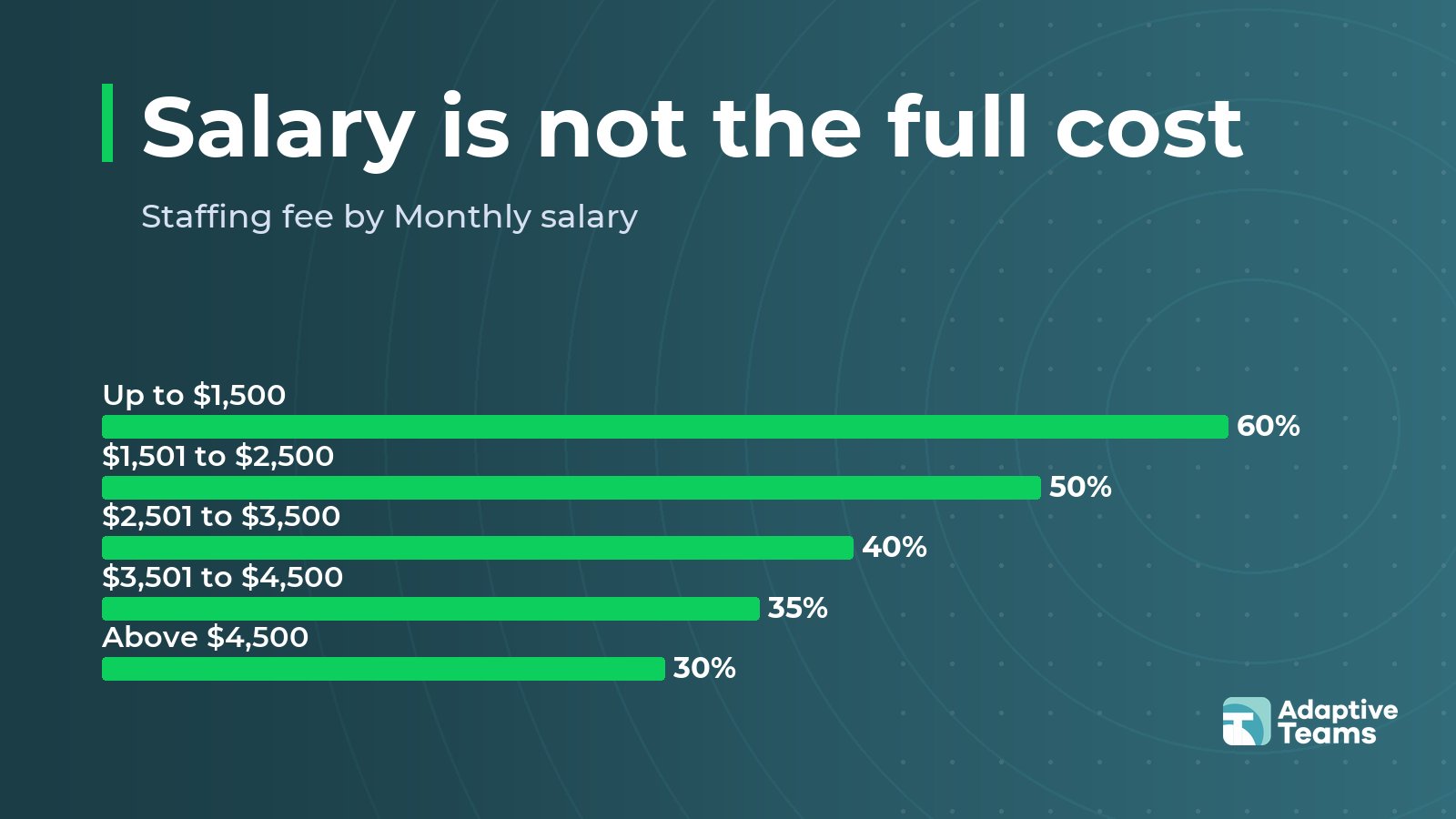
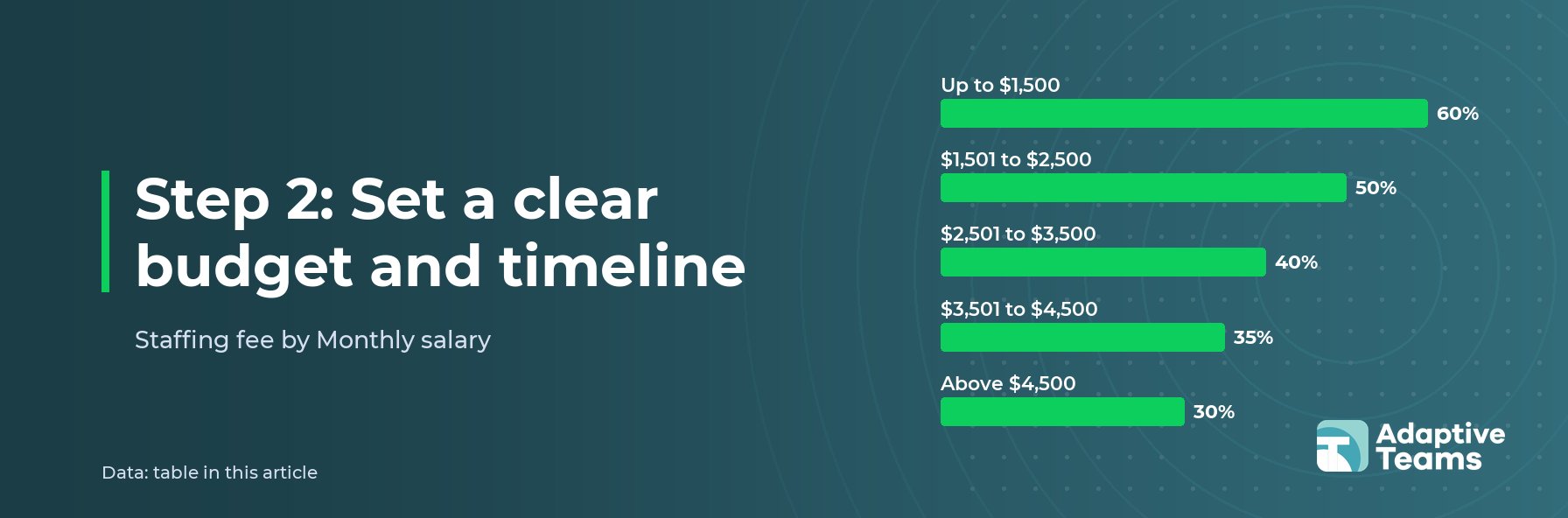
Decide what you can spend and when you need the person working. Plan the timeline backwards: 2 to 3 weeks to fill most roles, then one to two weeks for the new hire to reach full speed, depending on how complex the role is. For the budget, start from the salary and add the provider's fee. Our staffing fee is a percentage of the monthly salary:
| Monthly salary | Staffing fee | Example total per month |
|---|---|---|
| Up to $1,500 | 60% | $1,000 salary: $1,600 |
| $1,501 to $2,500 | 50% | $2,000 salary: $3,000 |
| $2,501 to $3,500 | 40% | $3,000 salary: $4,200 |
| $3,501 to $4,500 | 35% | $4,000 salary: $5,400 |
| Above $4,500 | 30% | $5,000 salary: $6,500 |
Teams of 2 or more get volume discounts of 3 to 9 percent. There is no placement fee.
Step 3: Choose the right engagement model
Decide between individual augmentation (adding one or two specialists) and team augmentation (building a whole function). Also settle who employs the person and how. A contractor setup and an employee setup carry different compliance rules and costs. The right answer depends on the role, the country and how closely you direct the work. Our HR outsourcing service covers both models.
Step 4: Select a staffing partner
Judge partners on the depth of their candidate pool, the countries they hire in, how they screen and their track record. Ask for case studies and references. A strong partner acts as an extension of your HR function, not just a source of resumes. Our list of the best offshore staffing companies compares ten providers on pricing and fit.
Step 5: Define roles and responsibilities clearly
Write a role description that covers daily tasks, who the person reports to, KPIs and how you expect them to communicate. Vague expectations at this stage cause friction later. In our experience they are the most common reason an augmentation setup underperforms.
Step 6: Interview and vet candidates
Run structured interviews on both skills and team fit. Your partner should send you screened candidates, but the final decision is yours. Apply the same standard you use for internal hires. A short paid test task often tells you more than a polished interview. Our guide on interviewing remote candidates has questions you can use.
Step 7: Onboard with intention
Build an onboarding plan for each augmented hire. Include tool access, introductions to the team, written workflows and clear goals for week one. A remote hire needs the same onboarding discipline as a local one, and often more. Our remote onboarding guide walks through a full plan.
Step 8: Set a communication rhythm
Set up regular check-ins, daily standups and weekly reviews. Use the same channels your core team uses. That way augmented staff feel part of the team instead of off to the side.
Step 9: Track performance and adjust
Track output, quality and collaboration from week one. Give feedback early and often. If the fit is wrong, work with your partner to fix it fast. At Adaptive Teams every placement has a dedicated manager and formal reviews twice a year, as part of our performance management.
Best Tools and Resources
Staff augmentation works best when the basic tools are in place before the first hire starts.
Project management platforms
Tools like Asana, Monday.com and Jira keep augmented and core staff aligned on tasks, deadlines and priorities. They give you the visibility you need to manage a distributed team.
Communication tools
Slack and Microsoft Teams give augmented staff a live connection to the rest of the team. Separate channels for each project and for quick questions cut response times and build trust.
Time tracking and accountability
Tools like Hubstaff and Toggl let you see how time is spent without hovering over anyone. They also give you data to balance workload between augmented and core staff.
Knowledge management
Notion and Confluence work as a central knowledge base. Augmented staff can look up processes, standards and documents themselves instead of interrupting your core team. For a full list of systems, see our guide to remote team management tools.
Common Mistakes to Avoid
Even experienced companies make these mistakes with staff augmentation. Knowing them in advance saves time and money.
Treating augmented staff as outsiders
The biggest mistake is a two-tier culture, where augmented staff are left out of meetings, decisions or team events. It hurts collaboration and lowers their output. Bring them fully into the team instead.
Skipping onboarding
Some companies assume experienced professionals can start at full speed with no onboarding. But every team has its own workflows, tools and habits. Skipping onboarding leads to confusion, rework and frustration on both sides.
Choosing on cost alone
The cheapest option often brings poor fit, skill gaps and high turnover. Scaling a team without hiring full time should save money, but the lowest price rarely gives the best value. Paying near the middle of the salary band for a role usually gets you stronger candidates and less churn.
Not defining success metrics
Without clear KPIs you cannot tell whether the arrangement is working. Define what success looks like before the engagement starts, and review those numbers on a schedule.
Micromanaging remote staff
Too much oversight destroys trust and slows people down. Set clear expectations, give people the right tools and then let them deliver.
Advanced Tips and Strategies
Once the basics work, these strategies help you get more out of staff augmentation.
Build hybrid teams by function
Instead of augmenting single roles, build teams where augmented and core staff share ownership of a function. For example, pair a local team lead with two or three augmented specialists. Knowledge spreads, and you are no longer dependent on one person.
Use augmentation as a long trial
After three to six months you know who performs in your real work, not just in an interview. That lowers the risk of a bad long-term hire, because you have already seen the person work. Many augmented hires simply stay on as long-term members of the team.
Default to async communication
If your augmented staff work in other time zones, make asynchronous communication the default. Use recorded video updates, written briefs and documented decisions. Work keeps moving without everyone online at once. Latin America overlaps the full US day; the Philippines runs 12 to 16 hours ahead. Our post on time zone management covers how to set overlap hours.
Write a staffing playbook
Document your augmentation process from start to finish: role templates, onboarding checklists, tool access steps and review formats. The next hire then goes faster, and building offshore teams becomes a repeatable process instead of a scramble.
Invest in team culture
Hold regular virtual team events, share wins in public and include augmented staff in company-wide updates. People who feel connected do better work and stay longer.
Proof from a real team
KO Storage started with 4 people through Adaptive Teams. Eighteen months later it had more than 70 team members across 6 departments, supporting 70+ US locations. Read the KO Storage case study for how that team was built.
Next Steps
Augmentation of staff gives you a proven way to grow your team faster, lower hiring costs and add specialist skills without the weight of local employment. The companies that do it well treat augmented professionals as full members of the team, invest in onboarding and measure results from day one.
Adaptive Teams builds extended teams that work inside your operation. We handle sourcing, screening, payroll, compliance and HR, and you keep full control of the work. Book a free staffing consultation to talk through your role and see what it would cost.
Frequently asked questions
What is augmentation of staff?
Augmentation of staff is a hiring model where outside professionals join your team and work alongside your own people. They work under your management, use your tools and follow your processes. A provider handles sourcing, contracts and payroll. It differs from outsourcing because the people join your team instead of working on their own.
How is augmentation of staff different from outsourcing?
With outsourcing you hand a whole function or project to a third party, which manages the work itself. With staff augmentation, outside professionals join your team and work under your direct supervision. You keep full control over priorities, processes and quality.
How long does it take to augment your staff?
At Adaptive Teams most roles are filled in 2 to 3 weeks. Specialist and senior roles can take 4 to 6 weeks. After that, plan one to two weeks for the new hire to reach full speed.
How much does staff augmentation cost?
With Adaptive Teams you pay the salary plus a staffing fee that is a percentage of it. The fee is 60% up to $1,500 a month and falls step by step to 30% above $4,500. A $1,000 salary costs $1,600 a month in total, and a $2,000 salary costs $3,000. Recruiting, payroll and HR are included, and there is no placement fee.
Is augmentation of staff cost-effective for small businesses?
Yes, often. Small businesses get specialist skills without building their own HR and payroll setup. Contracts run month to month with 30 days notice, so one hire does not lock you in. If you only need the search and will employ the person yourself, recruitment only costs $4,000 per hire.
What roles are best suited for augmentation of staff?
Software development, data and IT support are common. The model also works well for customer service, marketing, sales, bookkeeping, HR operations and admin. Any role you can define clearly and manage remotely is a good candidate.
How do you manage augmented staff across time zones?
Set two to four hours of shared working time for live collaboration and use async tools for the rest. Clear documentation and recorded updates keep everyone aligned. If you need full overlap with the US day, hire in Latin America.
What should you look for in a staff augmentation partner?
Look for a deep candidate pool, a clear fee you can check on a sample invoice, client references and a replacement guarantee. The best partners also handle compliance, payroll and HR after the hire, so you can focus on managing the work.

Written by the people who recruit, pay and manage remote teams every day, with Nate Ginsburg and Menno Gottmer. About Adaptive Teams