



Hiring offshore staff for accounting firm capacity is usually triggered by the same pattern: client work keeps growing, local hiring is slow, partners are reviewing instead of advising, and busy season turns into a margin leak. The problem is rarely whether remote accounting talent exists. The problem is whether the firm builds enough structure for that talent to produce clean work without creating more partner oversight.
Table of Contents
- Where offshore accounting staff actually creates leverage
- Offshore staffing is not the same as outsourcing
- The roles to offshore first, and the ones to delay
- What the cost model should include
- Controls that protect quality
- The first 30 days should be designed before hiring
- Payroll, compliance, and employment model choices
- How to know whether the model is working
- Mistakes that make offshore accounting hires expensive
- FAQ
For accounting firms, offshore hiring should not feel like handing work to an outside vendor and hoping for the best. It should feel like adding dedicated team members who understand your workflows, reporting standards, review notes, client expectations, and close calendar. That distinction matters because the wrong model saves salary cost on paper while moving hidden cost into rework, missed deadlines, and manager fatigue.
The firms that get value from offshore staff usually treat the move as an operating system decision, not a recruiting shortcut. They define the roles, protect quality controls, set communication rhythms, and make payroll and compliance boring from day 1. That is where the leverage appears.
Where offshore accounting staff actually creates leverage
Accounting firms often start with a broad goal: “We need help.” That is understandable, but too vague to hire against. Offshore staffing works best when you identify the specific pressure point inside the firm.
For one firm, the problem might be bookkeeping cleanup that keeps senior staff away from advisory work. For another, it might be monthly close work across 40 clients that depends on the same 2 overextended managers. Tax firms may need preparer capacity that follows consistent workpapers and review checklists. CAS practices may need recurring support across AP, AR, reconciliations, reporting packs, payroll coordination, and client inbox management.
The best first offshore roles are not always the most junior. They are the roles where work is repeatable, quality can be reviewed against clear standards, and handoffs can be documented. Common starting points include:
- Bookkeepers for transaction coding, reconciliations, and cleanup
- Staff accountants for month-end close support and reporting packages
- Tax preparers for organized return preparation under review supervision
- Payroll support specialists for recurring processing and client coordination
- Accounting operations assistants for document collection, client follow-up, and workflow hygiene
The financial case gets stronger when you compare fully loaded local cost, not just base salary. The U.S. Bureau of Labor Statistics employer costs data shows that benefits and payroll costs add materially to wages. For a firm already carrying recruiting fees, overtime, write-offs, and manager burnout, the real comparison is not local salary versus offshore salary. It is total delivery cost per clean client file.
Offshore staffing is not the same as outsourcing
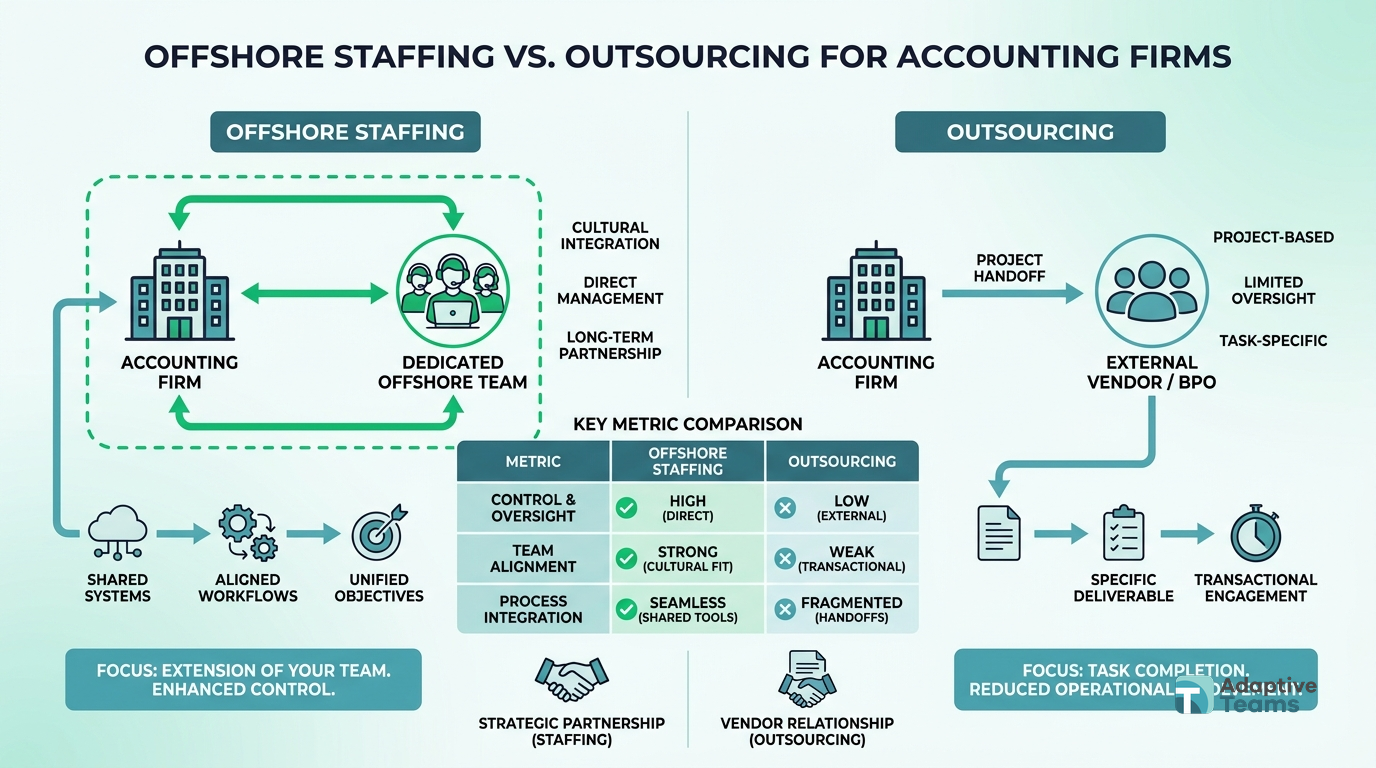
Traditional outsourcing moves a function outside the firm. You send work away, receive output back, and often have limited control over who did the work or how the process was run. That can work for narrow transactional tasks, but it rarely builds firm capability.
Offshore staffing is different. You add dedicated people to your team, usually in another country, and integrate them into your client delivery process. They attend team meetings, use your systems, follow your SOPs, and build context over time. This is why the model can support durable capacity rather than short-term overflow.
The distinction becomes visible in review quality. If a bookkeeper touches a client file once, they may complete the task but miss the history. If a dedicated offshore bookkeeper owns that client every month, they learn the recurring transactions, messy vendors, owner habits, close sequence, and manager preferences. That learning curve compounds.
This is also why offshore staffing must include HR and performance infrastructure. Recruiting alone does not solve retention, coaching, payroll, compliance, or escalation. A good staffing model combines hiring with the operating support needed to keep the person productive. That is the core difference between adding capacity and simply adding headcount.
For firms comparing hiring options, this is similar to the broader question of scaling a team without hiring full time. You are not trying to avoid commitment. You are trying to add the right capacity at the right cost structure, with fewer internal bottlenecks.
The roles to offshore first, and the ones to delay
The right first hire depends on your current delivery model. A firm with weak documentation should avoid throwing offshore staff into ambiguous advisory work. A firm with strong checklists can move faster.
Good first roles
Recurring bookkeeping is often the cleanest entry point because the work follows a predictable monthly rhythm. Bank feeds, reconciliations, vendor categorization, supporting schedules, and variance questions can be trained and checked.
Staff accountant roles can also work well when the firm has standardized close workpapers. The offshore hire can prepare schedules, reconcile accounts, update dashboards, and package review notes for a manager.
Tax preparation support can be effective when source document intake is organized. The offshore preparer should not be forced to chase clients, interpret unclear scope, and prepare returns in the same workflow unless the firm has already defined those handoffs.
Client operations support is underrated. Many firms lose senior time to document chasing, inbox triage, portal reminders, and status updates. A well-trained remote operations assistant can remove a surprising amount of drag before it reaches managers.
Roles to delay
Delay roles that require judgment without clear standards. Client advisory, complex tax planning, controller-level interpretation, and direct client-facing escalation should stay with senior staff until the offshore team has earned context and trust.
That does not mean offshore team members cannot grow into higher judgment work. Many can. It means you should not begin there. Start with work where quality can be defined, reviewed, and improved through repetition.
The same principle applies to candidate selection. A strong resume is not enough. You need to test accounting fundamentals, tool fluency, written communication, review response quality, and ability to follow multi-step instructions. Adaptive Teams uses structured screening because remote fit is not guesswork. how to interview remote candidates
What the cost model should include
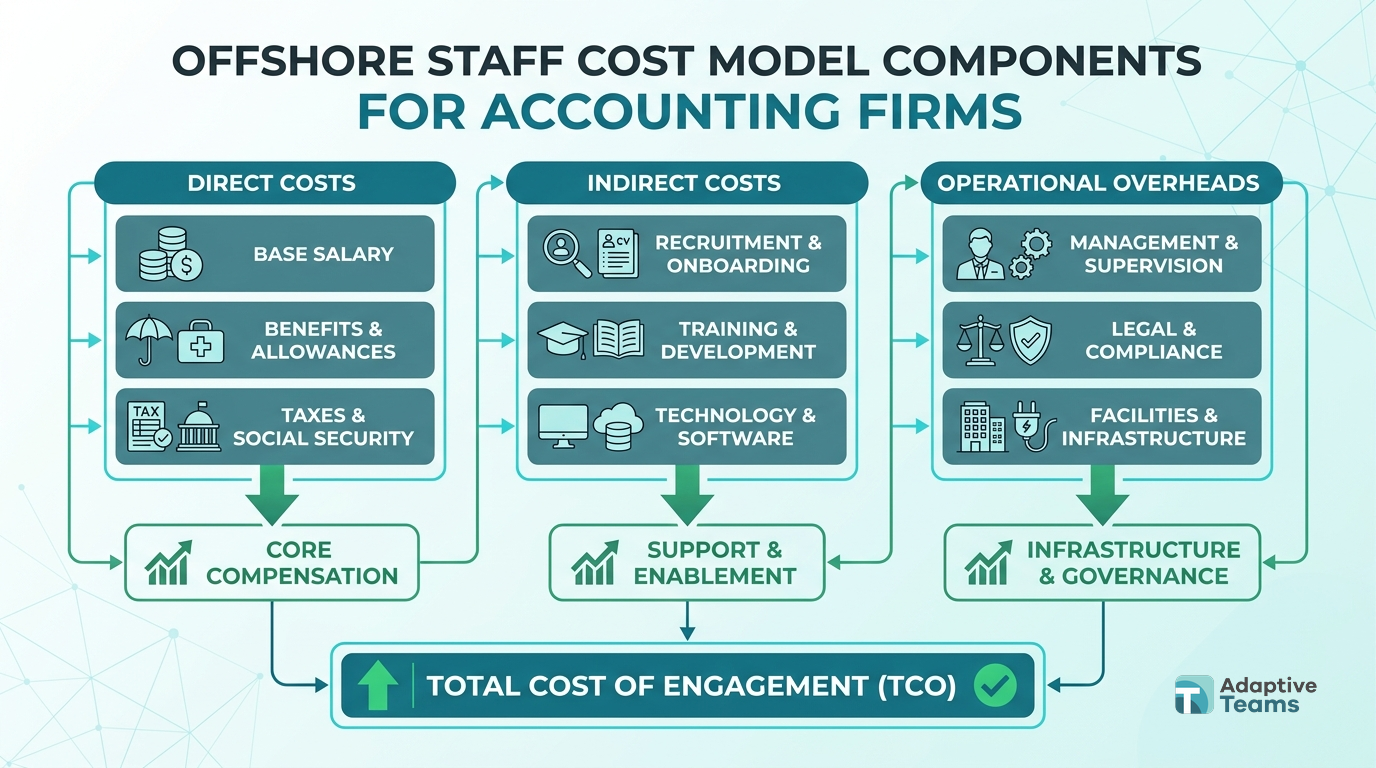
The obvious savings are labor cost and recruiting time. The less obvious costs determine whether the model actually works.
A practical cost model should include:
- Compensation and benefits in the offshore market
- Staffing partner fees or management cost
- Software licenses and secure access
- Training time for managers and reviewers
- Review capacity during the first 30 to 60 days
- Turnover risk and replacement coverage
- Compliance, payroll, and local HR administration
The American Institute of CPAs has reported that talent shortages remain a major pressure point for accounting firms, especially as the profession deals with fewer graduates and rising demand for advisory services. The AICPA accounting trends research is a useful backdrop: firms are not only competing for staff, they are competing for capacity in a shrinking pipeline.
That is why a simple “cheaper labor” case is too thin. The better business case is margin recovery. If offshore staff lets managers review instead of prepare, partners advise instead of chase, and client work move through close on time, the firm gains leverage beyond payroll savings.
Build Accounting Capacity Without Overhead
See how Adaptive Teams can recruit, onboard, and support dedicated offshore accounting staff for your firm.
Controls that protect quality
Accounting firms do not fail with offshore teams because the concept is flawed. They fail because controls are assumed instead of designed.
Start with access. Offshore staff should have role-based permissions, secure password management, MFA, and clear rules on client data handling. The IRS guidance on safeguarding taxpayer data is a useful reference point.
Then define the work standard. A reviewer should not have to explain from scratch what “done” means. Each recurring workflow needs a simple definition:
- Required source documents
- Naming conventions
- Review checkpoints
- Materiality thresholds
- Common exceptions
- Escalation triggers
- Final handoff format
Quality also depends on feedback speed. If offshore staff receive review notes 2 weeks after the work, they cannot improve quickly. A better rhythm is short-cycle feedback during onboarding, then a normal review cadence once accuracy stabilizes.
One CAS team had 3 managers answering ad hoc questions from offshore bookkeepers. The fix was a daily 20-minute queue review, a shared exception log, and a rule that repeat questions became SOP updates.
This is where remote onboarding best practices become operationally important. Onboarding is the system that turns a qualified hire into a predictable contributor.
The first 30 days should be designed before hiring
Most firms start planning onboarding after the person accepts. The first 30 days should be built before the job description goes live.
Week 1: context and tools
The new hire should learn the firm structure, client segments, accounting stack, security rules, workflow tool, communication norms, and review process. Give them sample completed work, not just instructions.
Week 2: supervised production
Assign a narrow set of recurring tasks with a named reviewer. The goal is accuracy, communication quality, and speed of correction.
Week 3: client ownership pattern
Move from isolated tasks to recurring ownership. The offshore team member should begin seeing the same client files more than once. This is where they start building useful context.
Week 4: throughput and exceptions
Increase volume only after quality holds. At this point, you should know which tasks are ready for independent execution and which still need tighter instructions.
For team structure decisions beyond accounting, Adaptive Teams has covered the mechanics of building a remote team from scratch. The same principle applies here: capacity follows operating design.
Payroll, compliance, and employment model choices
Accounting firms should not treat international hiring structure as an afterthought. Depending on the country, role, control level, and work arrangement, you may use a contractor model, an employee model through a local entity or employer arrangement, or another compliant structure. There is no single correct answer for every firm.
Contractor models can make sense for certain project-based arrangements. Employee models can make sense when you want long-term embedded staff, deeper control, and stronger retention infrastructure. The key is matching the model to the real working relationship. The IRS guidance on independent contractor classification is U.S.-focused, but the principle is relevant globally.
A managed staffing partner should help you think through payroll, local compliance, benefits, replacement coverage, and performance oversight before the hire starts. If the partner only sends resumes, the firm still owns too much backend complexity. HR outsourcing for distributed accounting teams
How to know whether the model is working
Do not judge offshore staffing by whether people seem busy. Accounting firms need delivery metrics.
Track a small set of numbers:
- Time from source documents received to file ready for review
- Review notes per file by category
- Rework hours by client or workflow
- Manager time spent answering recurring questions
- Deadline adherence during close or tax cycles
- Offshore staff retention and ramp time
- Client response time on document requests
The signal you want is not only lower cost. You want work to move through the firm with less senior intervention. If manager review notes become more precise, recurring errors drop, and partners spend less time on production work, the offshore team is doing its job.
If review notes stay high after 60 to 90 days, diagnose the system before blaming the hire. Common causes include unclear SOPs, poor examples, inconsistent reviewers, weak intake discipline, and too many client exceptions entering the workflow.
The broader benefits are similar to those described in our guide to the benefits of offshore teams, but accounting firms need to measure them through file quality, close speed, and senior capacity released.
Mistakes that make offshore accounting hires expensive
The first mistake is hiring for a vague role. “Accounting support” sounds flexible, but it leaves the new hire guessing.
The second is underinvesting in documentation. SOPs do not need to be perfect. They need to show the correct path and make exceptions visible.
The third is assigning one offshore hire to every leftover task. That creates context switching, weak ownership, and poor measurement.
The fourth is treating offshore staff as temporary help. If you want people to stay and represent your standards, they need feedback and development.
The final mistake is ignoring cultural fit. Accounting work is detail-heavy, but the operating environment is human. You need people who can ask clear questions, receive review notes well, and protect client trust.
FAQ
What is the best first offshore role for an accounting firm?
The best first role is usually recurring bookkeeping, staff accountant support, or accounting operations support. These roles have repeatable workflows, visible quality standards, and enough volume for the new hire to build context quickly.
How long does it take to onboard offshore accounting staff?
Most firms should plan for a structured 30-day ramp before expecting steady independent output. Strong candidates can contribute earlier, but quality improves faster when the first month includes examples, review notes, and recurring client ownership.
Should offshore accounting staff talk directly to clients?
They can, but not always on day 1. Start with internal workflows, then expand client communication once accuracy, tone, and escalation judgment are proven. Some firms keep client communication with local managers, while others train offshore staff for routine follow-up.
Do accounting firms need contractors or employees offshore?
It depends on the country, role, control level, and long-term plan. Contractor models and employee models can both work when structured correctly. The important step is matching the model to how the person will actually work.
Where to start
Offshore staffing works for accounting firms when it is built around durable delivery, not emergency labor. Start with the recurring work that drains senior time, define what good output looks like, and choose a hiring model that gives you payroll, compliance, retention, and performance support without adding internal HR overhead.
If you want offshore staff who operate like part of your accounting firm, not a disconnected vendor queue, Adaptive Teams can help you recruit, onboard, and manage the right people through a structured staffing model. Start with recruitment services for dedicated remote team members or book a free staffing consultation to map the first role.
Ready to Build Your Dream Team?
Book a free staffing consultation with our remote team specialists. No obligations, just actionable insights for scaling your operations.