

TL;DR
Cost-effective staffing means the lowest total cost of steady output, not the lowest hourly rate. Count recruiting time, ramp time, manager hours and replacement risk. A hire that saves $1,000 a month but costs a founder 10 extra hours of coordination is not cheaper. At Adaptive Teams you pay the salary plus a staffing fee of 30% to 60% of it, so a $1,000 salary comes to $1,600 a month with recruiting, payroll, HR and performance management included.
Cost-effective remote staffing solutions are not the same thing as cheap labor. The cheapest option often turns expensive once you add recruiting time, manager effort, payroll admin, compliance exposure, replacement risk and a slow ramp.
Operators usually start looking because local hiring has become too slow or too costly. A role sits open for 60 days or more. The founder is stuck reading resumes. A department lead is interviewing instead of managing output. Finance watches the fully loaded cost of each new hire climb faster than revenue. At that point, remote staffing looks attractive because it promises global talent without local salary pressure. That is usually when operators start comparing offshore staffing companies.
The mistake is to compare only hourly rates or base salaries. A lower monthly rate does not mean a lower operating cost. If the hire churns, needs heavy management, creates compliance risk or takes months to become useful, the business has not saved money. It has moved the cost to places that are harder to see.
The better question is simple: what does it cost to get steady output from this role?
What cost-effective remote staffing really means
A cost-effective staffing model lowers the total cost of getting work done. It does not just lower the wage line on the invoice.
For remote staffing, that means the role gets filled faster, recruiting does not eat leadership time, HR and payroll stay off the founder's desk, replacement risk is covered, and the manager gets a team member who can own work.
That is why you should judge any remote staffing option across the full operating stack:
- Role definition
- Candidate sourcing
- Screening and hiring speed
- Onboarding support
- Payroll administration
- HR management
- Compliance handling
- Performance oversight
- Retention and replacement support
If those pieces are missing, the low rate is incomplete. The company still buys recruiting work, HR work and management time somewhere else, often from its own leaders.
Adaptive Teams is built around the fuller model: recruiting, HR, payroll, compliance and performance management in one system. The point is not to place a person and disappear. The point is a remote team member who stays productive long after the hire.
Why hourly rate is the wrong first metric
Hourly rate is easy to compare, which makes it tempting. It is also incomplete.
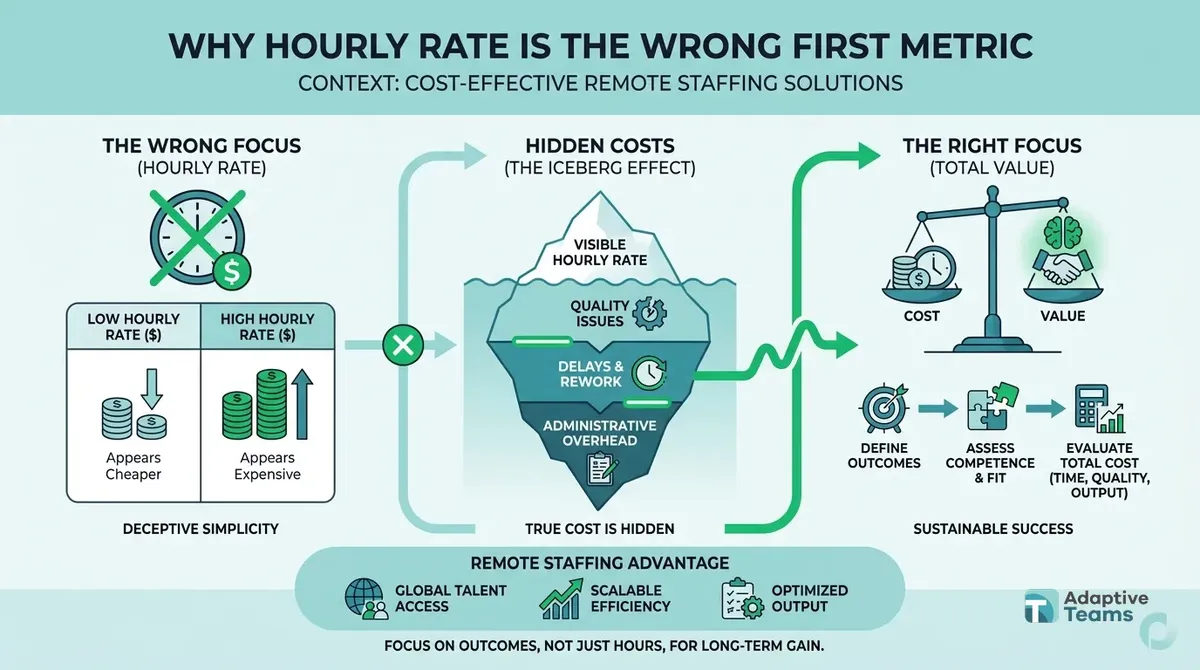
A freelancer at a low hourly rate can look cheaper than an embedded remote employee. But if that freelancer juggles several clients, needs constant clarification, owns nothing and leaves after a few months, the real cost rises fast.
A local employee looks expensive on salary, and salary is not even the full local cost. Benefits, payroll taxes, equipment, office space, hiring fees, manager time and replacement cost all add up. A recruiter fee alone can make a hire a large upfront expense before the person has produced anything.
The Bureau of Labor Statistics Employer Costs for Employee Compensation report is a useful reminder. For US private industry workers, wages make up only about 70 percent of total compensation. Benefits and legally required costs make up the rest. That gap changes the real comparison between local hiring and remote staffing.
Measure remote staffing by the monthly cost of steady output. That includes:
- How long it takes to fill the role
- How much leadership time the hiring process uses
- How quickly the new hire ramps
- How much supervision the person needs
- How often the role needs to be replaced
- How much HR and payroll work stays inside your company
If an option saves $1,000 a month but costs the founder 10 extra hours of coordination, the savings may not be real. For an operator, time is not free. It is the capacity that should go into revenue, delivery, hiring plans, customer retention and process work.
The hidden cost stack behind every hire
Every hire carries visible cost and hidden cost. Most companies only compare the visible part.
Visible cost is salary, contract rate, benefits and sometimes a recruiter fee. Hidden cost is everything the team does to make the hire productive and compliant.
For a local hire, the stack often includes:
- Salary
- Payroll taxes
- Benefits
- Equipment
- Recruiting fees or internal recruiter time
- Interview time from managers and founders
- Onboarding time
- HR administration
- Performance management
- Replacement cost if the hire fails
For a poorly managed remote hire, the hidden stack changes shape but does not go away:
- Time spent sourcing in markets you do not know
- Screening risk
- Time zone coordination problems
- Informal contractor classification
- Payment friction
- Unclear performance expectations
- Weak retention
- Repeated onboarding cycles
This is where managed staffing can beat basic recruiting. Recruiting matters, but the cost problem does not end when someone signs. It ends when the role produces reliably with a manageable amount of oversight.
For technical roles the same logic applies to offshore development team cost. The right comparison is not salary alone. It is the whole system needed to turn talent into output.
Local hiring vs freelance marketplaces vs recruiters vs managed staffing
There are several ways to add capacity. Each can work, and each has a different cost profile.
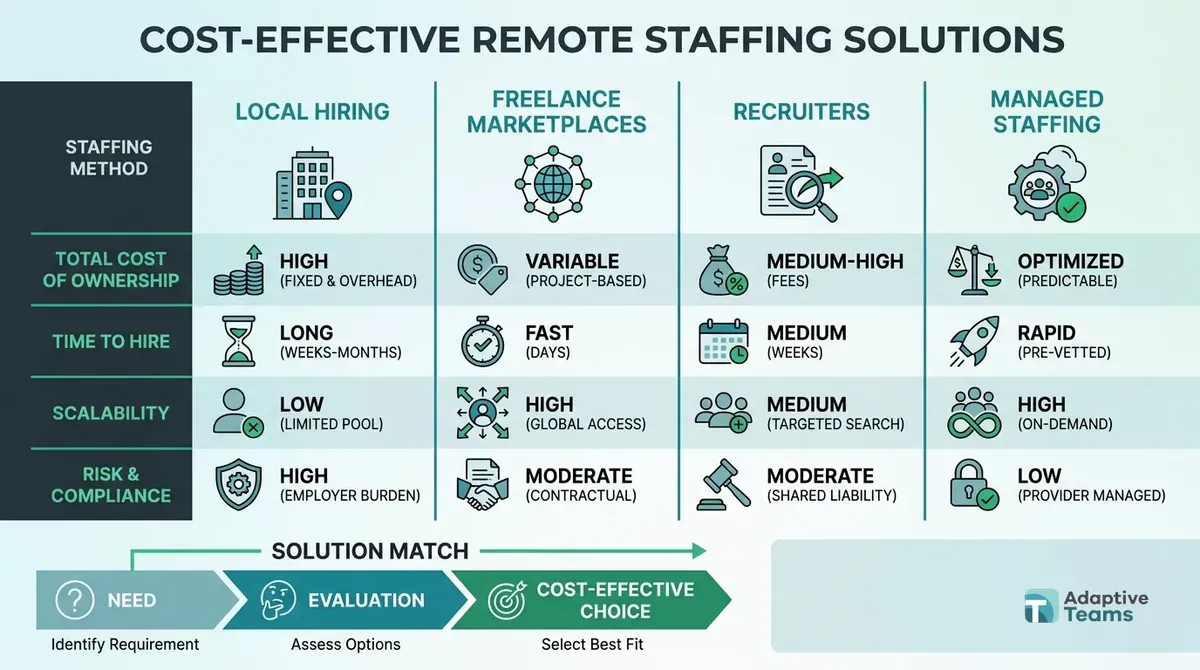
Local hiring gives you labor-market familiarity and sometimes easier collaboration. It usually has the highest salary base and the longest hiring cycle. For many operators the real issue is speed, not only pay. A 60 or 90 day search for a role that should already be producing has a cost of its own.
Freelance marketplaces are useful for short projects. They are usually weaker for long-term roles that need ownership, process memory and team fit. You may save upfront and pay later through uneven availability, low loyalty and repeated handovers. Our guide to Upwork alternatives lays out the fees involved.
Traditional recruiters can source candidates, but many stop at placement. After that you still own payroll, HR, onboarding, performance, retention and replacement risk. That works if you already have strong internal HR. It works less well when you want capacity without building a bigger HR function.
Managed remote staffing is a different category. The goal is not just to find a person. It is to embed a team member with a support system around them: recruiting, HR, payroll, compliance, performance oversight and replacement cover.
Here is how the four models compare on the costs operators tend to miss.
| Model | Upfront cost | Ongoing cost | Who runs payroll and HR | Main hidden cost |
|---|---|---|---|---|
| Local hire | Recruiter fee or internal recruiting time | Salary plus benefits and payroll taxes | You | Long search and high replacement cost |
| Freelance marketplace | Low | Hourly rate plus platform fees | Nobody, beyond the platform payment | Churn, handovers and split attention |
| Recruiter only | One-time placement fee | Salary plus your own HR and payroll setup | You | Everything after day one |
| Managed staffing (Adaptive Teams) | No placement fee | Salary plus a staffing fee of 30% to 60% of it | Adaptive Teams via Deel | Your management time, which a dedicated manager reduces |
That is why the most cost-effective option is usually the one that protects long-term output, not the one with the lowest first invoice.
What managed remote staffing costs at Adaptive Teams
Because the whole argument here is about total cost, here is ours in full. You pay the agreed monthly salary plus a staffing fee. The fee is a percentage of that salary and falls as the salary rises.
| Monthly salary | Staffing fee | Example salary | Total monthly cost |
|---|---|---|---|
| Up to $1,500 | 60% | $800 | $1,280 |
| Up to $1,500 | 60% | $1,000 | $1,600 |
| $1,501 to $2,500 | 50% | $2,000 | $3,000 |
| $2,501 to $3,500 | 40% | $3,000 | $4,200 |
| $3,501 to $4,500 | 35% | $4,000 | $5,400 |
| Above $4,500 | 30% | $5,000 | $6,500 |
That fee covers recruiting, payroll through Deel twice a month, HR, compliant contracts and performance management with a dedicated manager. There is no placement fee. Contracts run month to month with 30 days notice. Teams of 2 to 4 get a 3% discount, 5 to 9 get 6%, and 10 or more get 9%. If a hire does not work out in the first 2 months, we replace them at no cost.
If you already run payroll and HR yourself and only need the search, recruitment only costs $4,000 flat per hire. Over a long tenure that can cost less, as long as you have the people to run the employment side.
When remote staffing actually lowers cost
Remote staffing lowers cost when the role can be done well outside your local market and the support around it prevents drag.
Good fit roles have clear outputs, repeatable workflows, measurable quality standards and enough documentation or manager context to ramp someone properly. Examples include operations support, customer service, recruiting coordination, bookkeeping, marketing operations, development, design production, QA, account support and admin work.
Remote staffing is most cost-effective when:
- The role is needed long term
- Local salary benchmarks are high
- Hiring speed matters
- The manager can define outcomes clearly
- HR and payroll work would distract the internal team
- Replacement risk needs to be controlled
- The business wants capacity without growing an internal recruiting team
If the company has no role clarity, no manager ownership and no process discipline, remote hiring will not fix that. It will expose it faster.
So a good staffing partner should help with role scoping and performance expectations. It should help you pin down what the role owns, what success looks like and how performance will be checked. For a sense of what roles pay in each market, see our offshore salary benchmarks.
When low-cost staffing becomes expensive
Low-cost staffing gets expensive when a company buys capacity without structure.
The most common failure is hiring someone at a low rate, handing them vague work, then blaming the hire when output is uneven. The cost shows up as manager frustration, repeated explanations, slow delivery and, in the end, a replacement.
Another failure is treating remote staff as disposable. If the role matters, the person needs context, feedback, documentation and a path to ownership. Without that you get task completion at best, not real capacity.
Compliance is another hidden cost. Informal contractor setups look simple until worker classification, local rules, payments, equipment, data access or termination create exposure. A cost-effective model reduces that risk. It does not hide it.
For US companies, the Department of Labor's guidance on misclassification of employees as independent contractors and the IRS guidance on independent contractor status show why classification is an operating risk, not an afterthought.
Retention matters too. Replacing a remote team member is not just a sourcing problem. It means lost context, delayed work, a fresh onboarding round and management attention pulled back into hiring. A replacement guarantee helps, but the better goal is a system where good people stay.
What a staffing partner should own
A partner that only sends resumes is not solving the full cost problem. That may still be useful, but it is not managed remote staffing.
For remote staffing to be cost-effective, the partner should own or support:
- Role scoping and hiring criteria
- Candidate sourcing and screening
- Interview coordination
- Offer and onboarding support
- Payroll administration
- HR management
- Compliance handling
- Performance oversight
- Retention support
- Replacement if the hire does not work out
This is where Adaptive Teams differs from freelance marketplaces and pure recruiters. The model is built for embedded team members, not short-term task capacity. Recruiting is one part. Payroll, HR, compliance and performance management form the rest of the system around each hire.
That system matters more as hiring volume rises. KO Storage grew from 4 to more than 70 team members in 18 months across 6 departments without building an internal HR department to match. Our TeamTailor account holds 956 jobs and 64,982 applications, so the recruiting side has been tested at volume.
For an operator, the real win is not "we found someone cheaper." It is "we added capacity without building another internal department around it."
A practical evaluation checklist
Before you choose a remote staffing option, ask these questions:
- What is the full monthly cost, not just the hourly rate? Ask for a sample invoice.
- How long will it take to fill the role?
- Who handles sourcing, screening and candidate quality control?
- Who owns payroll, contracts, HR and compliance?
- What happens if the hire does not work out, and for how long is that covered?
- How is performance managed after placement?
- How much of your manager's time will the model need?
- Is the person embedded in your team or treated as outside task capacity?
- What retention support exists after onboarding?
- Does the partner understand what the role must produce for the business?
The best answer is not always the lowest price. It is the option that gives you reliable output with the least avoidable overhead.
The cost of ignoring the infrastructure
Companies often put off hiring infrastructure because it looks like overhead. Then growth forces urgent hiring, rushed decisions, weak onboarding and avoidable churn.
That cost compounds. A role stays open for 2 months. Founder time goes into interviews. Managers train people who leave. Payroll questions interrupt operations. Compliance details sit unresolved. The seat finally gets filled, but the business has already paid in delay and distraction.
Good remote staffing shortens that cycle. The right model gives you access to global talent and takes much of the operational load around that talent off your team.
This does not replace judgment. You still need to know what you need from the role. But you should not have to build a recruiting, HR, payroll, compliance and performance layer from scratch just to add reliable capacity. If hiring is too slow, HR work is pulling operators away from the business, or local salaries force hard tradeoffs, managed remote staffing can add capacity without another layer of internal overhead.
Frequently asked questions
Are cost-effective remote staffing solutions just cheaper outsourcing?
No. Cheap outsourcing focuses on a lower labor rate. Cost-effective remote staffing focuses on lower total operating cost, which includes hiring speed, HR work, payroll, compliance, retention and performance management.
How much does managed remote staffing cost?
At Adaptive Teams you pay the monthly salary plus a staffing fee of 30% to 60% of it, depending on the salary band. An $800 salary comes to $1,280 a month, a $2,000 salary to $3,000 and a $5,000 salary to $6,500. There is no placement fee, and contracts run month to month.
What roles are best for remote staffing?
Roles with clear outputs and repeatable workflows work best. Operations support, customer service, recruiting coordination, bookkeeping, marketing operations, development, QA, design production and account support all work when expectations are clear.
How do I compare remote staffing providers?
Compare total cost, not only the rate. Look at hiring speed, screening quality, onboarding support, who owns HR and payroll, compliance support, performance management, replacement terms and how much of your own management time the model needs.
Is a freelancer cheaper than managed remote staffing?
Sometimes, for short projects. For long-term roles a freelancer can become expensive if availability, retention, performance or repeated handovers become a problem. Managed staffing is usually stronger when the role needs lasting ownership.
When should a company avoid remote staffing?
Avoid it when the role is undefined, the manager cannot explain what success looks like, or the company expects a remote hire to fix broken internal processes without context. Remote staffing works best when you can define outcomes and want help with the infrastructure around the hire.

Written by the people who recruit, pay and manage remote teams every day, with Nate Ginsburg and Menno Gottmer. About Adaptive Teams