TL;DR
Hire dedicated offshore developers who join your standups and stay for years. Project outsourcing and freelance marketplaces lose context with every departure. A mid-level Manhattan engineer often costs $180,000 to $220,000 a year fully loaded. A dedicated senior developer in Latin America at a $5,000 salary costs $6,500 a month through us, about $78,000 a year, and works hours that overlap Eastern Time.
If you run a company in New York and want to hire offshore developers on New York terms, you want people who work your hours, join your standups and ship at your pace. The good news is that this is now a solved problem.
The hard part is not finding developers. The hard part is finding a setup where the savings survive contact with reality.
New York is one of the most expensive engineering markets in the world. The Bureau of Labor Statistics wage data shows software developers in the New York metro area earning well above the national mean. That figure leaves out benefits, payroll taxes, equity and office costs. Load everything in and a mid-level engineer in Manhattan often costs $180,000 to $220,000 a year. A senior engineer can pass $250,000 before you pay a recruiting fee.
That math is why offshore hiring comes up in every NYC founder conversation. Done well, you get strong engineers for well under half the loaded local cost, working hours that overlap with Eastern Time. Done badly, you get a rotating cast of strangers, a codebase nobody owns and a rebuild project eighteen months later. This article walks through the difference.
What "offshore" actually means for a New York company
The word covers three very different setups. Most bad experiences come from picking the wrong one for the job.
Project outsourcing. You hand a spec to an agency and get software back. This works for bounded work with a clear end: a marketing site, a data migration, a one-off integration. It fails for products that keep changing, because the people writing your code have no context and no future with you.
Freelance marketplaces. Fast and cheap for small tasks. For core product work, churn is the killer. Freelancers juggle several clients and move on when a better gig appears, and every departure takes context with it. If you are weighing a screened network instead, our guide to Toptal alternatives compares the options.
Dedicated offshore team members. Individual engineers, recruited for you, who work full time on your product as part of your team. They attend your standups, use your Slack and stay for years. This model behaves like hiring, not like purchasing. It is the only one of the three where the value grows over time. If you are choosing between vendors, our guide to offshore development companies covers how to tell a capacity builder from a body shop.
For a New York company hiring for the long term, the third model is almost always the right answer. The rest of this article assumes it.
| Model | Best for | Who keeps the context | Typical failure |
|---|---|---|---|
| Project outsourcing | Bounded builds with a clear spec | The vendor | Rework when the spec changes |
| Freelance marketplace | Small, short tasks | Nobody, once the freelancer leaves | Churn on core product work |
| Dedicated team member | Products that ship every week | Your team | Weak onboarding or weak screening |
The time zone question matters more than the rate
Most NYC teams start their offshore search by sorting candidates by rate. That is backwards. Sort by working-hours overlap first.
A developer in Buenos Aires or Bogotá is zero to two hours off New York time. They are in your morning standup live. They see your Slack messages when you send them. A code review turns around in an hour instead of overnight.
A developer twelve time zones away may cost a little less on paper, but every question becomes a 24-hour round trip. On a product that ships weekly, that delay costs more than the rate difference saves.
This is why Latin America has become the default region for NYC engineering teams. It offers strong computer science programs, good English in the professional workforce and full Eastern Time overlap. See hiring in Latin America for what that looks like in practice, or go straight to software developers in Colombia and software developers in Argentina.
Eastern Europe works for teams that can run a morning-overlap model, with senior talent that is hard to beat on systems work. Southeast Asia fits best when you deliberately want round-the-clock coverage, for example a support engineering rotation.
You do not need to solve this in the abstract. Decide how many hours of daily overlap your workflow needs, then recruit only in regions that provide it. Four hours of true overlap is a practical minimum for product engineering. Our piece on managing time zones across a remote team covers split-zone setups in more depth.
What the numbers actually look like
Pay varies by region, seniority and stack. Here is what we can back up from our own payroll and pricing.
In our offshore salary benchmarks, built from 148 placements, a mid-level automation and AI engineer in Latin America earns $1,500 to $2,250 a month. Senior product engineers earn more, and a $5,000 salary buys strong senior talent in the region.
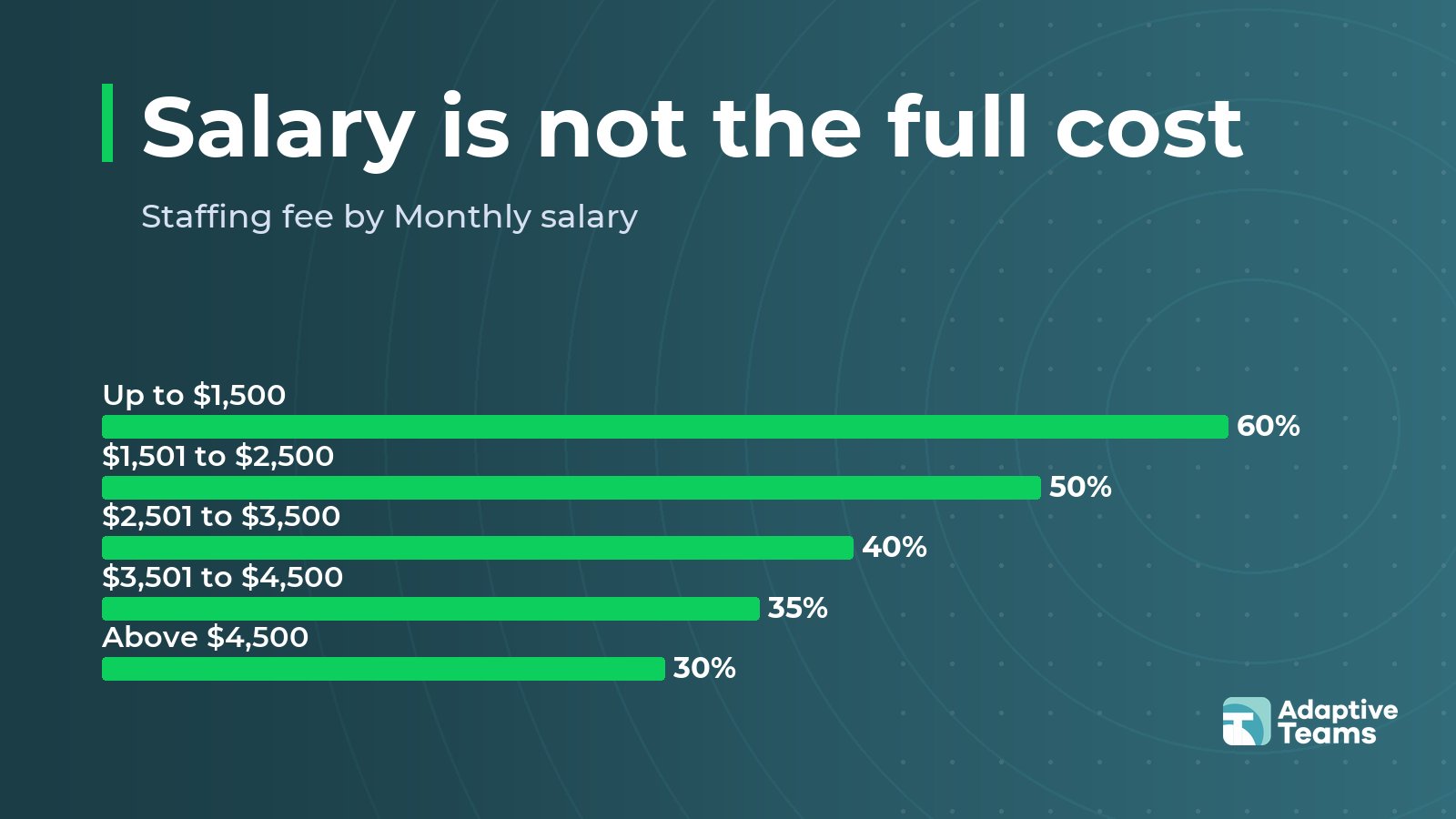
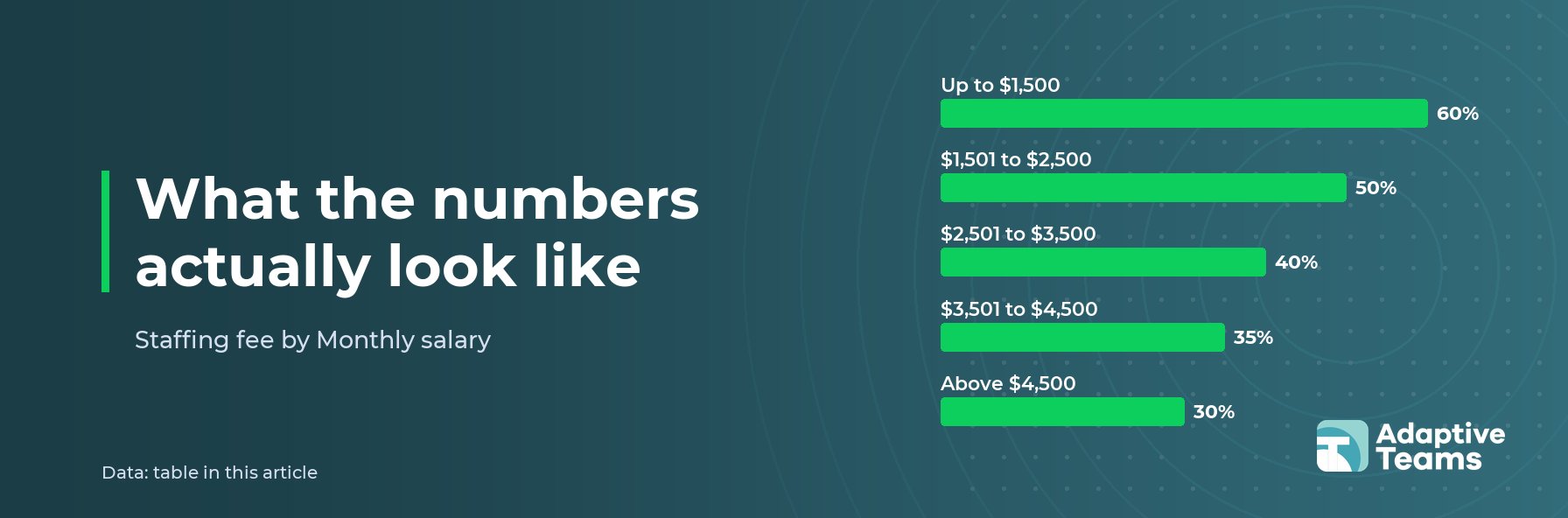
Through Adaptive Teams you pay the salary plus a staffing fee, a percentage of that salary. The percentage falls as the salary rises:
| Monthly salary | Staffing fee | Example total per month |
|---|---|---|
| Up to $1,500 | 60% | $1,000 salary: $1,600 |
| $1,501 to $2,500 | 50% | $2,000 salary: $3,000 |
| $2,501 to $3,500 | 40% | $3,000 salary: $4,200 |
| $3,501 to $4,500 | 35% | $4,000 salary: $5,400 |
| Above $4,500 | 30% | $5,000 salary: $6,500 |
Recruitment is included and there is no placement fee. Teams of 2 or more get volume discounts of 3 to 9 percent.
Compare that to New York. A senior developer at $5,000 a month costs $6,500 all in, or $78,000 a year. Against a $180,000 to $220,000 loaded Manhattan hire, that is a gap of roughly $100,000 to $140,000 per engineer per year. Multiply by a team of four and you are funding an entire extra product line.
Two caveats keep this honest.
- Load both sides. The offshore number should include the partner's fee, equipment and any local benefits, just as the NYC number includes payroll tax and health insurance.
- Cheap hires that fail are the most expensive hires you will make. A failed six-month engagement costs you the salary paid, the manager time burned and the roadmap slip. The slip usually costs more than the other two combined.
Our breakdown of what an offshore development team actually costs goes line by line through the full picture.
Contractor or employee? Both are legitimate
New York companies often assume offshore means contractor. It can, and for many teams an independent contractor agreement is the fastest clean start. But it is not the only option, and it is not automatically the right one.
If the role is long-term, full time and deeply tied into your team, employing the person through an employer of record in their country gives you better retention, cleaner IP assignment and less classification risk. If you are testing a new function or need flexibility, a contractor arrangement is simpler and faster.
The right model depends on the role, the country and your appetite for risk. SHRM's guidance on worker classification is a useful primer on how classification risk actually works. Our guide on hiring contractors internationally walks through the checks.
What matters more than the legal wrapper is the operating model: one person, full time, on your team, for years. Get that right and either structure works. We run contracts and payroll through Deel in 150+ countries, so you never need a foreign entity.
How to run the hire, step by step
You can start this process on a Monday and have strong candidates in front of you within a few weeks. Here is the sequence that works.
Define the role like a local hire
Write the same job scorecard you would write for a New York hire: outcomes for the first 90 days, must-have skills, the stack and the level. Vague briefs produce vague candidates.
"Senior backend engineer, Python and Postgres, owns our billing service, ships on their own within 60 days" is a brief a recruiter can act on.
Decide who sources
You have three options. Recruit directly on LinkedIn and regional job boards, use a recruitment partner that sources and screens for you, or tap your network.
Direct recruiting is cheapest per hire. It also costs dozens of founder hours per role, and you carry all the vetting risk in markets you do not know. A partner costs a fee but shortens the timeline and filters out applicants who look fine on paper and fail a real technical screen. If you only want the search, our recruitment-only option is $4,000 flat per hire.
Screen for the job, not the resume
Offshore resumes are noisy. Titles inflate, agencies ghostwrite profiles and a portfolio proves little about who did the work.
The fix is the same everywhere. Run a real technical interview with a live coding or systems exercise drawn from your actual product. Add a paid trial task where you can.
The Stack Overflow Developer Survey is a useful check on which tools and practices are standard among working developers. It helps you spot candidates whose claimed experience does not match how the field actually works. Our guide on interviewing remote candidates for real team fit covers the interview loop in detail.
Onboard like they are sitting next to you
The first 30 days decide whether an offshore engineer becomes a team member or stays a stranger. Give them a real onboarding:
- An architecture walkthrough.
- A first ticket that ships in week one.
- A named buddy.
- A daily check-in with their manager for the first two weeks.
Teams that skip this step are the same teams that later say "offshore does not work for us."
Where NYC companies get this wrong
Naming the failure modes is more useful than another list of benefits. Here are the four that cause most blown engagements.
Treating the engagement as disposable. If you plan for someone to leave in six months, they will. Offshore engineers respond to the same things local engineers do: real ownership, growth and being treated as part of the team. Retention is a design decision, not luck. At Adaptive Teams every placement has a dedicated manager, and our performance management includes formal reviews twice a year.
Hiring one isolated developer with no support. A single offshore engineer reporting to a busy founder, with no peer and no manager attention, often fails no matter how talented. Hire in pairs when you can. Or make sure the first hire lands inside an existing squad with a clear owner.
Confusing cheap with vetted. The bottom of the pay range is crowded with candidates who interview well and cannot ship. If a rate looks too good against the numbers above, that tells you something.
Skipping the paperwork. IP assignment, confidentiality and a clear contract in an enforceable form are not optional because the person is abroad. They matter more. Any serious recruiting partner or employer of record handles this as standard. If yours does not, that also tells you something.
Where to start
If your engineering roadmap is bigger than your New York hiring budget, the answer is not to lower the bar locally. It is to widen the market you hire from while keeping your hours, your standards and your culture.
Start with one role. Write the scorecard, pick a region with real time zone overlap and run a screening process you would trust for a local hire.
If you would rather hand that off, our software team augmentation service recruits engineers who join your stack and your standups while we run contracts, HR and payroll. Most roles are filled in 2 to 3 weeks, and specialist or senior roles can take 4 to 6. If a hire does not work out in the first 2 months, we replace them at no cost. Contracts run month to month.
Frequently asked questions
Do offshore developers need to be physically in NYC?
No. Hiring offshore developers "in NYC" almost always means hiring for a New York based company, with the developers working remotely from lower-cost regions on New York hours. If you need someone on site in New York, that is a local hire, and local market rates apply.
How much does it cost to hire an offshore developer for a New York company?
Through Adaptive Teams you pay the developer's salary plus a staffing fee of 30% to 60% of it, depending on the salary band. A developer at $2,000 a month costs $3,000 in total, and a senior developer at $5,000 costs $6,500. The equivalent loaded cost in Manhattan is often $15,000 to $20,000 a month.
How long does it take to hire?
With us, most roles are filled in 2 to 3 weeks, and specialist or senior roles can take 4 to 6. Sourcing on your own in a market you do not know usually takes longer, because you are building the candidate pipeline from zero.
Is the quality really comparable to local engineers?
At the senior level, yes, as long as the vetting is real. The global talent pool is far larger than any single metro market, and Latin America has many engineers who have spent their careers working for US companies. Quality problems almost always trace back to weak screening or weak onboarding, not geography.
What about security and IP protection?
Use the same controls you would for any remote employee: signed IP assignment and confidentiality agreements, least-privilege access, company-managed accounts and an offboarding checklist. Working through an employer of record or an established staffing partner adds contractual enforcement in the developer's own country.

Written by the people who recruit, pay and manage remote teams every day, with Nate Ginsburg and Menno Gottmer. About Adaptive Teams