

TL;DR
Offshore development team cost is more than the hourly rate. It includes pay, recruiting and onboarding time, management, payroll and compliance, and the cost of turnover. A cheap developer who needs heavy supervision can cost more than a better paid one inside a managed setup. With Adaptive Teams you pay the salary plus a staffing fee of 30% to 60% of it, so a developer on $3,000 a month costs $4,200 in total and one on $5,000 costs $6,500.
Offshore development team cost is usually shown as a neat hourly rate comparison. A senior developer in one country costs X, a developer in another costs Y, and the savings look obvious. That is only the start. The real budget depends on the mix of roles, how much management the team needs, how long people stay, how they are employed and how much rework your own team has to absorb.
For a growing agency, SaaS company or ecommerce brand building internal tools, the cheapest hourly rate is rarely the cheapest way to run a team. A low-rate team that ships unclear work, cycles through developers or waits 12 hours for every decision can quietly eat the margin you expected to protect.
This article gives you a practical way to estimate cost before you hire, including the line items most calculators leave out.
The real cost equation
An offshore development team is not a bundle of separate coders. It is a delivery system. The cost should include five layers:
- Salaries or vendor fees
- Recruiting and onboarding time
- Management and product oversight
- Tools, payroll, compliance and HR admin
- Turnover, rework and replacement cost
Most buyers compare only the first layer. That is why two teams with similar rates can produce very different financial results.
A developer on a low rate who needs constant supervision can cost more than a better paid developer inside a managed setup with clear performance oversight. So the question is not "What is the lowest rate?" The better question is "What does it cost to get reliable output without building a full HR and delivery operation myself?"
If you are still choosing the model, start with our guide to define offshore teams before you build one. It separates staff augmentation, managed team building and outsourced projects before the budget talk gets muddy.
Typical cost ranges by role
Pay varies by country, seniority, English level, tech stack and whether you hire directly, through a staffing partner or through a project vendor. Senior roles, niche stacks and full overlap with US hours push cost up. Repeatable work with a clear scope sits lower.
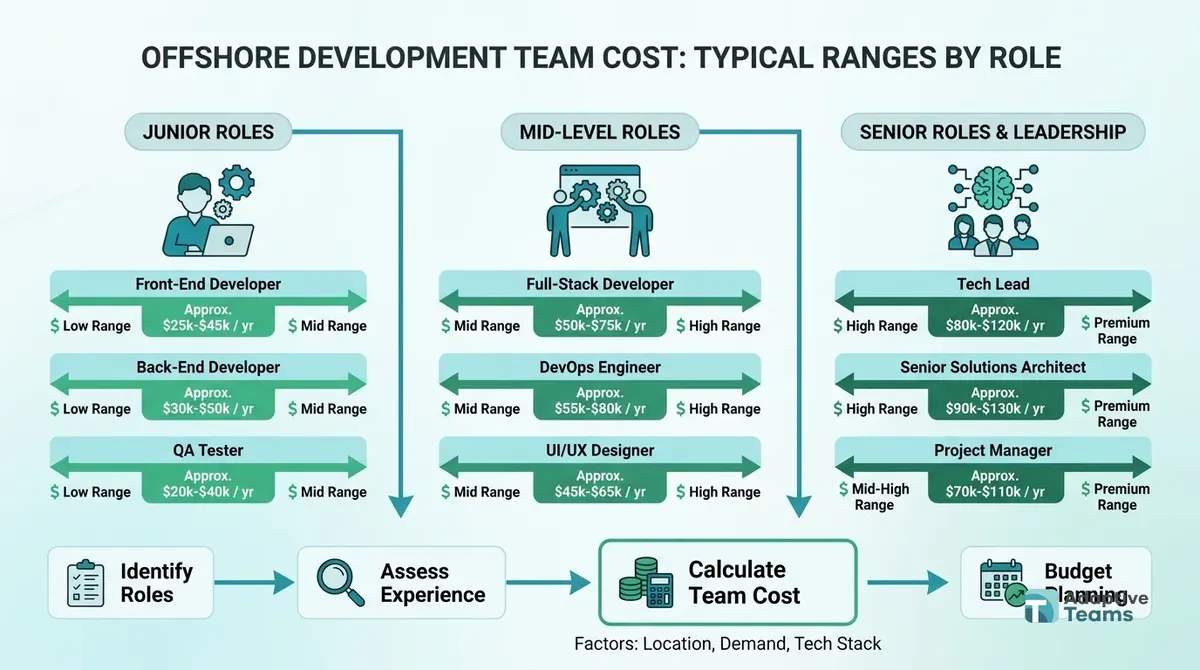
Our own payroll data gives a floor for technical roles. In our offshore salary benchmarks, built from 148 placement records in July 2026, mid-level automation and AI engineers in Latin America earn $1,500 to $2,250 a month. Juniors across several regions start below $1,000. Senior software developers, tech leads and DevOps engineers earn more, and the right figure depends on the stack and the market. Ask any provider to quote a real salary for your exact role, not a blended rate.
Once you have the salary, the full monthly cost with Adaptive Teams follows from our staffing fee, a percentage of that salary:
| Monthly salary | Staffing fee | Example total per month |
|---|---|---|
| Up to $1,500 | 60% | $1,000 salary: $1,600 |
| $1,501 to $2,500 | 50% | $2,000 salary: $3,000 |
| $2,501 to $3,500 | 40% | $3,000 salary: $4,200 |
| $3,501 to $4,500 | 35% | $4,000 salary: $5,400 |
| Above $4,500 | 30% | $5,000 salary: $6,500 |
The fee covers recruiting, payroll through Deel, HR and performance management. There is no placement fee, and teams of 2 or more get volume discounts of 3 to 9 percent. If you are pricing screened freelancers instead, our guide to Toptal alternatives compares how those platforms price engineers.
Compare these figures with local pay. The US Bureau of Labor Statistics publishes software developer wage data that shows the US baseline before benefits, recruiting, management and turnover enter the picture: BLS software developer data.
The point is not to replace your local team. The point is to keep expensive local capacity for work where closeness, market context or executive judgment matter most, and to build offshore capacity for repeatable technical work.
A practical team budget
Say a SaaS company needs to ship faster but cannot justify four more local engineering hires. A workable offshore pod could look like this, using salaries you agree with each hire:
| Role | Monthly salary | Staffing fee | Total per month |
|---|---|---|---|
| Senior full-stack developer | $5,000 | 30% | $6,500 |
| Mid-level back-end developer | $3,000 | 40% | $4,200 |
| QA engineer | $2,000 | 50% | $3,000 |
| Project coordinator | $1,500 | 60% | $2,400 |
| Team total | $11,500 | $16,100 |
That total already includes recruiting, payroll, compliance and performance oversight, and a team of four qualifies for a volume discount. These salaries are examples for the math, not a quote. Your real numbers depend on the stack and the seniority you need.
This team is not the same as four local engineers. It has a different management model and a different scope. But if it clears the backlog, cuts release delays and stops your engineering lead from becoming a full-time recruiter, the business case is simple.
Now compare that with the hidden cost of waiting three months to hire locally. If your product team misses two release cycles, delays features customers asked for and keeps senior staff stuck in interviews, the cost is not just salary. It is slower revenue and leadership time burned on hiring.
The savings matter, but getting capacity fast often matters more.
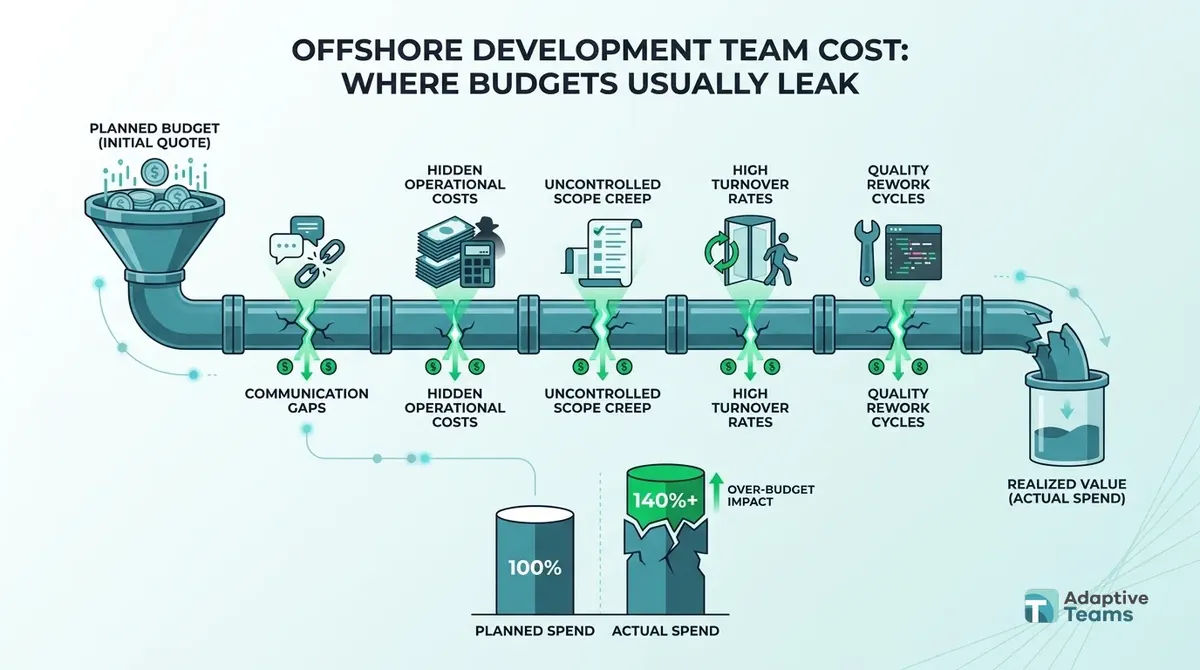
Where the budget usually leaks
Lower pay does not protect you from a poorly designed setup. The biggest cost leaks come from problems that never show up in the proposal.
Weak role definition
Hiring "a developer" is too vague. You need to know whether the person only implements, also makes architecture calls, writes technical specs, supports QA or talks to stakeholders directly.
When the role is unclear, you pay through rework. Tickets bounce between people, delivery slows and a senior person on your team becomes the hidden manager.
No performance system
Many offshore teams fail because nobody owns the rhythm. Work gets assigned, but priorities are not clear. Standups happen, but blockers stay vague. Output is measured by activity instead of shipped work.
You need a weekly rhythm: sprint planning, quality standards, escalation rules, review loops and manager follow-up. Without it you are buying capacity without control. Our performance management service gives every placement a dedicated manager and formal reviews twice a year.
Turnover and replacement lag
A developer who leaves after four months creates more than a recruiting problem. You lose code context, product knowledge, team rhythm and confidence in delivery. If the replacement takes another one to two months, your real monthly cost rises even when the salary line looks the same.
Retention belongs in the budget. Good onboarding, clear expectations, real raises and active management reduce churn. That is why the benefits of offshore teams only show up when the team is built for long-term output, not short-term savings.
Direct hire, staffing partner, or project vendor
Your operating model changes the cost more than most rate cards suggest.
Direct offshore hiring
Direct hiring can look cheaper on paper because you skip partner fees. It works best when you already have recruiting reach, knowledge of local labor rules, payroll, compliance and enough management time to support the hire.
The tradeoff is overhead. Someone has to source candidates, test skills, manage contracts, run payroll, handle replacements and keep the person connected to your team. If that someone is a founder, COO or engineering lead, the internal cost is real.
Direct hiring suits companies with mature people operations. It is less efficient when you need capacity fast and your leaders are already stretched. If you only need the search, our recruitment-only option costs $4,000 per hire and you employ the person yourself.
Managed staffing partner
A managed staffing partner usually costs more than direct hiring and less than a full project agency. You pay for infrastructure: recruiting, HR, payroll, compliance, performance oversight and replacement in one package. Our shortlist of offshore staffing companies compares the main providers.
This model fits companies that want offshore team members who feel part of the team, not disposable. It is most useful when the work is ongoing and the team has to plug into your own workflows. With Adaptive Teams, contracts run month to month with 30 days notice, and a hire who does not work out in the first 2 months is replaced at no cost.
Project vendor
A project vendor can make sense for a fixed scope, a clear deadline and little need for long-term knowledge inside your company. You pay for delivery, not for people on your team. Our guide to choosing an offshore development company covers how to judge one.
The risk shows up when ongoing product work is treated like a project. Every change request becomes a negotiation. Knowledge lives outside your company. Long-term maintenance may depend on people you do not manage.
For recurring technical work, a team that sits inside your company usually gives you more control.
Compliance and employment structure
International hiring is not only a sourcing question. You need a compliant way to pay and manage people. That can mean contractor agreements, local employment, an employer of record or payroll through a staffing partner.
There is no single correct structure. Adaptive Teams supports both contractor and employee models, depending on the role, the country, the risk and your plan. What matters is that you choose on purpose.
Contractor setups can work for defined scopes and independent professionals. Employee setups may be better for long-term roles with close direction and ongoing duties. Misclassification risk rises when a person works like an employee but is treated as an independent contractor.
The IRS guidance on worker classification explains the control factors behind that analysis: IRS worker classification guidance. For global employment, the International Labour Organization publishes background on employment relationships and labor standards.
Sort out international payroll and compliance before you scale across countries, not after you find the structure was an afterthought. Our HR compliance checklist for remote teams lists what to cover.
How to estimate your first 90 days
Budget the first 90 days differently from the steady state. You are paying for setup, onboarding, a management rhythm and the first proof of fit.
Start with work, not headcount
List the work that must move next quarter. Separate the product backlog, QA coverage, infrastructure, technical debt, customer implementations and internal tools. Then mark which work is blocked by missing capacity and which is blocked by unclear direction.
Do not hire offshore developers to fix unclear product ownership. You will only move the confusion across time zones.
Assign ownership levels
Decide which roles execute, which make technical decisions and which coordinate delivery. A mid-level developer can produce strong output when the scope is clear. A tech lead costs more because the role carries judgment, code review and architecture.
Paying senior salaries for execution-only work wastes budget. Hiring juniors for vague work creates management drag.
Add the management layer
Budget for project management, HR admin, payroll, compliance and performance reviews. With a partner, much of this sits inside the fee. If you hire directly, you still pay for it in internal time.
The cleanest budget shows this layer openly. Hiding management cost makes offshore hiring look cheaper than it is.
Plan for a replacement
Even good hiring misses sometimes. Your budget needs a replacement plan, not just a hiring plan. Who sources the replacement? How fast can they start? Who hands over the context? Who covers the gap?
A replacement guarantee lowers the downside. It turns a bad hire into a managed process instead of a scramble for leadership.
What a healthy cost target looks like
A strong cost target is not the lowest number you can negotiate. It is the lowest sustainable number that still protects output quality, retention and management control.
For most growing companies, a healthy target has these traits:
- A clear role mix, so you are not paying senior salaries for basic tasks
- A fixed management rhythm, so work does not drift between meetings
- A documented payroll and compliance model, so risk is not pushed into the future
- A replacement process, so a bad hire does not freeze delivery
- A shared communication rhythm, so offshore staff work as part of the team
The Stack Overflow Developer Survey is useful for understanding what developers expect on pay, remote work and what keeps them in a job. Pay matters, but developers also care about tools, autonomy, learning and the quality of their daily work.
Questions to ask before you approve the budget
Before you sign off on an offshore development plan, ask these questions:
- What work will this team own in the first 30 days? This stops vague capacity from turning into vague output.
- Who sets priorities each week? This protects your leaders from hidden management work.
- What happens if the first hire is not a fit? This tests whether replacement really works in practice.
- How are payroll and compliance handled? This lowers misclassification and payment risk.
- How many overlap hours do we need? This affects salary, the candidate pool and delivery speed. Latin America overlaps the full US day. See our guide to hiring offshore developers without losing local speed.
- How will quality be reviewed? This keeps lower cost from becoming lower standards.
- What is the full monthly cost per person, every fee included? Ask for a sample invoice.
These questions are not procurement theater. They show whether a quote reflects a real team-building system or just access to cheaper labor.
Where to start
Start with the operating model, not the rate card. Define the work, decide which roles need senior judgment, choose the employment structure and make management cost visible before you compare quotes.
If you want offshore capacity without turning your leaders into recruiters, payroll clerks and performance managers, Adaptive Teams can build the team and the structure around it. See how we hire software developers, or book a free consultation to map the right team before you hire.
Frequently asked questions
How much does an offshore development team cost per month?
It depends on the roles and their salaries. With Adaptive Teams each person costs their salary plus a staffing fee of 30% to 60% of it. A developer on $3,000 a month costs $4,200 in total and one on $5,000 costs $6,500. A four-person pod with salaries from $1,500 to $5,000 comes to about $16,000 a month, including recruiting, payroll, compliance and performance oversight.
Is offshore development cheaper than hiring locally?
Usually yes on salary. How much you save depends on how well the team is managed. Poor onboarding, high turnover, weak specs and rework can erase the gap between offshore and local hiring.
Should I hire offshore developers directly or use a staffing partner?
Direct hiring can work if you already have recruiting, payroll, compliance and management capacity. A staffing partner is usually better when you need speed, replacement cover and people who sit inside your team without building HR infrastructure yourself.
What is the biggest hidden cost in offshore development?
Management drag. If your founder, COO or senior engineer has to keep clarifying work, chasing updates and fixing quality issues, the team is cheap on paper but expensive in practice.
Can offshore developers work as long-term team members?
Yes. Offshore developers become long-term team members when expectations, communication, pay, career growth and performance management are handled properly.
Is there a placement fee on top of the staffing fee?
No. At Adaptive Teams recruiting is included in the staffing fee. If you would rather employ the developer yourself, recruitment only costs $4,000 per hire.

Written by the people who recruit, pay and manage remote teams every day, with Nate Ginsburg and Menno Gottmer. About Adaptive Teams