



If hiring delays are slowing down your growth, the benefits of offshore teams are hard to ignore. According to ManpowerGroup’s global talent shortage research, most employers still struggle to fill roles, while labor costs continue to rise in major hiring markets. As a result, the benefits of offshore teams now matter far more to operators who need hiring speed without adding operational drag.
Table of Contents
This guide breaks down the benefits of offshore teams in practical terms. You will learn what offshore teams are, how they work, where the real gains come from, and how to build a model that supports long-term performance instead of short-term patchwork. Just as importantly, you will see how the benefits of offshore teams translate into measurable gains for hiring velocity, coverage, and margin.
What Are the Benefits of Offshore Teams?
The benefits of offshore teams are the operational and financial gains you get when you build part of your workforce in another country while keeping that team integrated with your business. In practice, this means you can hire for roles such as customer support, operations, finance, marketing, recruiting, and technical delivery without relying only on your local market. When you assess the benefits of offshore teams honestly, the biggest upside is not geography alone. It is the ability to hire with more flexibility and less friction.
For growing companies, this matters because local hiring often becomes a bottleneck before revenue catches up. Moreover, offshore team building gives you access to broader talent pools, more flexible cost structures, and support capacity that can expand faster than traditional hiring. That is why the benefits of offshore teams matter most when you are trying to scale without overstretching your leadership team.
Today, more companies are using offshore teams as part of a long-term operating model rather than a temporary workaround. If you want a team that feels in-house while reducing recruitment friction, offshore hiring becomes a strategic advantage instead of just a cost play. For more context, see Building Offshore Teams: A Practical Guide to Scaling Without Hiring Bottlenecks.
How Offshore Teams Work
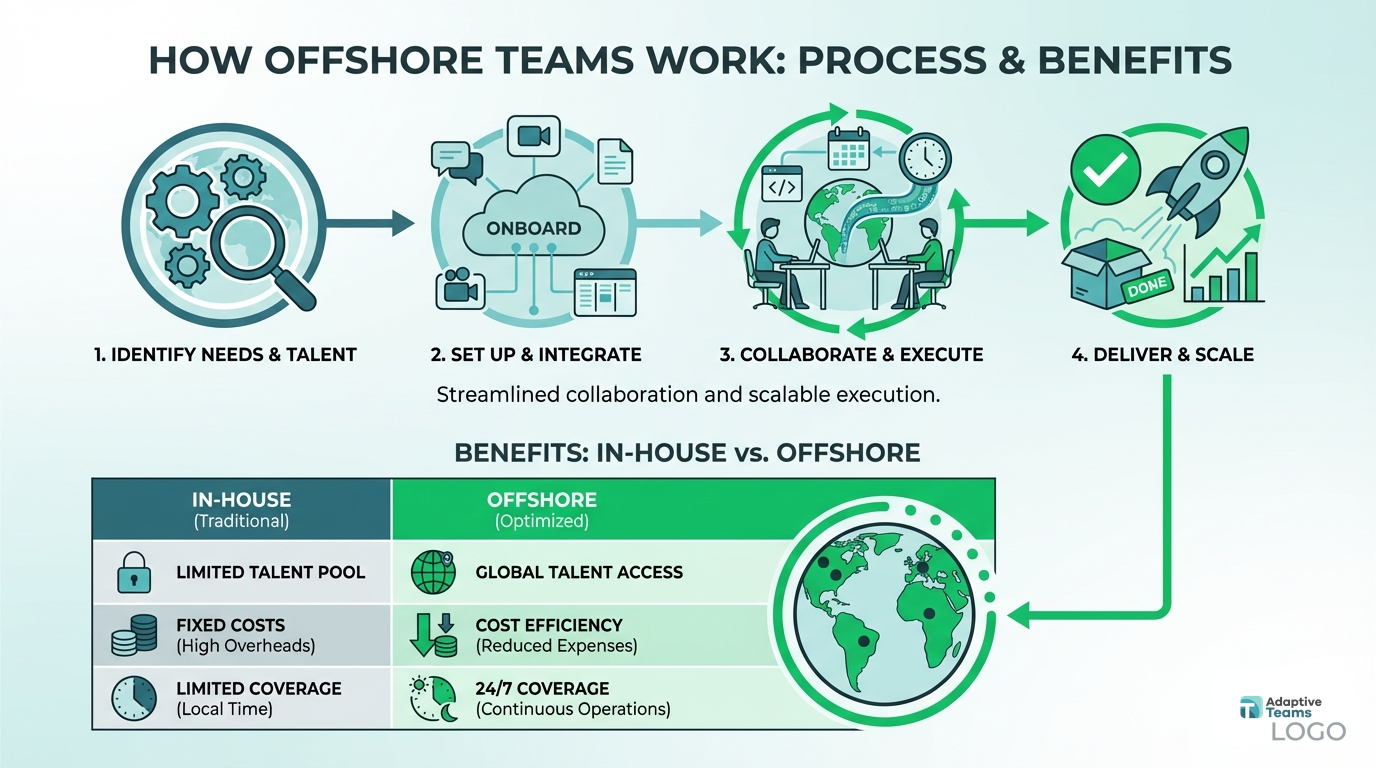
Offshore teams work best when you treat them like a structured extension of your business. In other words, you are not handing off random tasks to disconnected freelancers. You are building a managed team with defined roles, reporting lines, performance expectations, and communication rhythms. This is one of the biggest benefits of offshore teams because structure is what turns remote capacity into reliable output.
1. Define the roles you need
First, identify which functions create the most operational drag. These usually include repetitive admin work, process-heavy coordination suited for AI automation operators, support tasks, or specialist roles that are hard to fill locally.
2. Choose the right hiring model
Next, decide whether contractor or employee structures fit your risk profile, budget, and growth stage. If you need guidance, read Contractor vs Employee for Startups: How to Choose the Right Hiring Model.
3. Recruit for capability and fit
After that, screen for communication, reliability, technical ability, and alignment with your working style. Skills matter, but consistency matters just as much.
4. Set up onboarding and management
Then, give your offshore team clear KPIs, documented processes, regular check-ins, and access to the same operating information your local team uses.
5. Support payroll, HR, and compliance
Finally, put infrastructure in place for contracts, payroll, local regulations, performance reviews, and replacement planning. This is the step that turns offshore hiring into a scalable system.
Key Benefits
The benefits of offshore teams show up most clearly when your company is growing faster than your hiring capacity. In practice, the benefits of offshore teams compound when you combine recruiting, onboarding, and performance support in one system.
Faster access to talent
First, you can search beyond a tight local market. That reduces time-to-fill for critical roles and gives you more qualified candidates to choose from.
Lower fully loaded employment cost
Additionally, offshore hiring can reduce salary overhead, office costs, statutory expenses, and recruitment costs. The goal is not to hire cheaply. The goal is to build stronger output per payroll dollar.
Longer operating coverage
Furthermore, offshore teams can extend support hours, speed up turnaround times, and create better continuity across time zones. That matters for customer service, back-office processing, and project execution.
More focus for leadership
When you move recruiting, HR admin, and process work into a managed structure, founders and operators spend less time firefighting. As a result, they can focus on revenue, product, and team leadership.
Better scalability
You can usually add capacity in stages instead of making large local hiring commitments all at once. Therefore, offshore teams are useful when demand is rising but headcount planning still needs flexibility.
Improved process discipline
Because offshore teams rely on clear workflows, many companies end up documenting operations better. In fact, that often improves output across the entire business.
Stronger retention through support
With proper HR follow-up, coaching, and performance management, offshore teams can become stable long-term contributors rather than short-term staffing fixes.
For a broader view of scalable hiring models, review Scaling a Team Without Hiring Full Time: A Practical Guide for Growing Companies.
Step-by-Step Guide
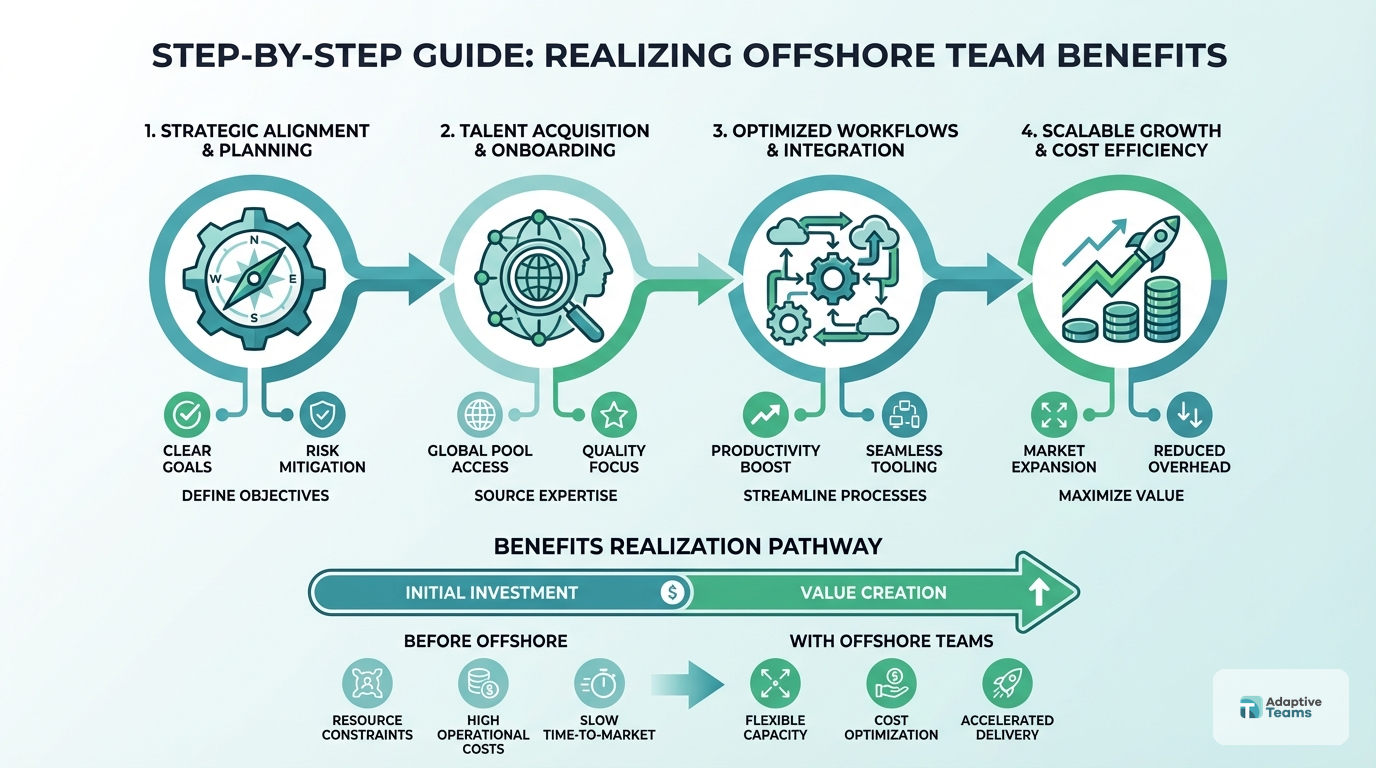
If you want to capture the benefits of offshore teams, you need a build process that protects quality. Otherwise, you lose the benefits of offshore teams to poor onboarding, unclear expectations, and weak management.
Step 1: Audit where hiring delays hurt most
First, map the roles or tasks that slow revenue, delivery, or customer experience. For example, slow reporting, unfilled support roles, and founder-owned admin work are strong starting points.
Step 2: Choose roles with repeatable outcomes
Next, prioritize work with clear outputs. Operations support, recruiting coordination, finance admin, marketing production, and customer service often perform well because success is measurable.
Step 3: Build scorecards before recruiting
Then, define success in advance. Include hard metrics such as response times, task completion, quality thresholds, and throughput. Without scorecards, hiring becomes subjective.
Step 4: Recruit for communication, not only skill
Moreover, test written communication, problem solving, and accountability during screening. A technically strong hire who cannot communicate clearly will slow the whole system down.
Step 5: Create a 30-60-90 day onboarding plan
After hiring, give each team member a ramp plan with role expectations, SOPs, and manager check-ins. This reduces uncertainty and speeds up contribution.
Step 6: Set one manager of record
Assign one person to own feedback, prioritization, and performance reviews. Otherwise, offshore team members get mixed signals from too many stakeholders.
Step 7: Standardize communication rhythms
Use weekly planning, daily updates where needed, and monthly performance reviews. Consistency matters more than communication volume.
Step 8: Measure business impact monthly
Finally, track whether the team is improving speed, reducing costs, increasing output, or freeing up senior bandwidth. If you cannot measure the result, you cannot validate the model.
Build an Offshore Team That Performs
Get a practical hiring plan with recruiting, onboarding, payroll, and performance support built in.
Best Tools and Resources
The best tools for offshore teams are usually the simplest ones. You do not need a bloated stack. You need visibility, accountability, and documented execution.
Project management platform
First, use a project management tool such as Asana, ClickUp, or Monday.com to assign work, track deadlines, and make ownership visible.
Documentation hub
Next, use a shared knowledge base such as Notion or Confluence for SOPs, onboarding guides, meeting notes, and process updates.
Communication layer
Additionally, Slack and Google Meet help your team stay aligned across locations. Fast written updates reduce unnecessary meetings.
Time and workload tracking
Tools such as Clockify or Harvest can help you understand utilization and workload. However, use them for planning and support, not surveillance.
Data and hiring benchmarks
For labor market context, review sources like the ManpowerGroup Talent Shortage report, the World Bank data portal, and OECD employment outlook data. These help you frame hiring trends and market conditions with credible external data.
You can also explore Offshore Staffing Solutions: The Complete Guide to Building Your Global Team for a deeper look at infrastructure choices.
Common Mistakes to Avoid
Many companies miss the benefits of offshore teams because they copy the wrong operating model. In many cases, companies say they want the benefits of offshore teams while still managing hiring as if every role were a short-term patch.
Treating offshore hires like temporary help
If people feel detached from the business, performance drops. Instead, include them in goals, updates, and team rituals so they understand how their work affects outcomes.
Hiring without process documentation
Furthermore, offshore teams struggle when workflows live only in a founder’s head. Poor documentation creates repeated mistakes, slower onboarding, and frustration on both sides.
Optimizing only for low salary
A lower rate means very little if output is inconsistent or turnover is high. Therefore, hire for reliability, communication, and role fit instead of chasing the lowest price.
Ignoring management capacity
Even strong hires need structured support. If no one owns feedback and prioritization, work quality will drift.
Using the wrong legal model
Finally, weak contract structures and poor payroll setup can create compliance risk. A managed staffing model reduces that risk while keeping hiring flexible.
Advanced Tips and Strategies
Once you understand the basics, you can increase the benefits of offshore teams by improving how the system runs. At that stage, the benefits of offshore teams become less about cost and more about resilience, management leverage, and repeatable performance.
Build pods instead of isolated hires
First, group complementary roles together. For example, pairing an operations coordinator with customer support and finance admin creates handoff efficiency and reduces dependency on one person.
Use role ladders early
Create growth paths with clear expectations for progression. As a result, team members see long-term opportunity, which supports retention and stronger performance.
Tie KPIs to business outcomes
Do not stop at task completion. Instead, connect each role to outcomes such as faster response times, shorter hiring cycles, cleaner reporting, or lower error rates.
Run quarterly process reviews
Moreover, review bottlenecks every quarter. Ask where work stalls, where managers repeat themselves, and where SOPs need updates. Small process gains compound quickly.
Blend local leadership with offshore execution
In many cases, the best model keeps strategic ownership local while offshore teams handle execution, coordination, and specialist support. That balance protects quality while increasing leverage.
For another example of structured remote performance systems, read How to Manage Remote Employees Effectively: A Practical System for Better Performance.
Frequently Asked Questions
What are the main benefits of offshore teams?
The main benefits of offshore teams include faster hiring, access to broader talent pools, lower fully loaded labor costs, better time-zone coverage, and reduced management drag when the right infrastructure is in place.
Are offshore teams only useful for large companies?
No. In fact, smaller and mid-sized companies often benefit the most because local hiring bottlenecks hurt them faster. Offshore teams can give you capacity without forcing you into heavy local overhead too early.
Do offshore teams reduce quality?
Not if you build the team properly. Quality problems usually come from weak hiring, poor onboarding, and unclear management. When you use structured recruitment, scorecards, and regular performance reviews, offshore teams can perform at a very high level.
Which roles work best for offshore teams?
Operations, customer support, finance administration, recruiting coordination, marketing production, and process-driven specialist roles are usually strong fits. The best roles have clear deliverables, repeatable workflows, and measurable outcomes.
How do you manage offshore teams effectively?
You manage offshore teams effectively by setting clear ownership, defining KPIs, documenting workflows, and running consistent feedback loops. Strong communication rhythms matter more than constant supervision.
Are offshore teams the same as outsourcing?
Not always. Traditional outsourcing often focuses on handing work to an outside vendor with limited integration. Offshore team building is different when the team operates as part of your business with direct alignment, structured support, and long-term accountability.
What is the biggest mistake companies make with offshore teams?
The biggest mistake is treating offshore hiring as a shortcut instead of an operating system. If you optimize only for cost and ignore onboarding, management, and compliance, the model usually breaks down.
Next Steps
The benefits of offshore teams are real, but only when the model is built for long-term performance. If you want faster hiring, better cost control, and less operational drag, start by identifying which roles create the most pressure in your business today. That is the easiest way to turn the benefits of offshore teams into a practical hiring plan instead of a vague growth idea.
Then, build a staffing structure that supports recruiting, onboarding, payroll, compliance, and performance management from day one. If you want help designing that system, book a free staffing consultation. You can also review HR Outsourcing for Small Business: A Practical Guide to Scaling Without HR Bottlenecks to compare support models before you decide.
Ready to Build Your Dream Team?
Book a free staffing consultation with our remote team specialists. No obligations, just actionable insights for scaling your operations.
Related reading: Contractor vs Employee for Startups.