
Building a Remote Team from Scratch: What Actually Works
TL;DR: What works is treating remote hiring as an infrastructure problem you design before you recruit. Decide upfront whether you’re optimizing for cost or for removing a bottleneck entirely, since that drives where you source and what you pay. Before the first hire, write down what good looks like at 30 and 90 days, and build an async-first environment.
Most operators who fail at remote hiring don’t fail because they hired the wrong person. They fail because they built the wrong system around that person.
Table of Contents
- Introduction: The Real Problem With Remote Hiring
- The Three Mistakes That Derail Remote Teams Early
- What Building a Remote Team Requires Before You Hire
- How to Source Remote Talent That Will Actually Perform
- Step-by-Step: Onboarding Remote Hires in the First 30 Days
- Benefits of a Structured Performance Layer (And How to Build One)
- Tools and Infrastructure for Compliance and Payroll
- Advanced: What Operators With Scaled Remote Teams Do Differently
- Final Steps: Where to Start If You’re Starting Now
- Frequently Asked Questions
Building a remote team from scratch isn’t a talent problem, it’s an infrastructure problem. And the operators who treat it like an infrastructure problem scale faster, retain longer, and spend less time re-hiring.
This article is for founders and COOs who are already convinced remote works and want to do it right the first time, not a debate about whether distributed teams are viable. According to Buffer’s State of Remote Work report, over 98% of remote workers want to continue working remotely at least some of the time, but the same data shows that collaboration and communication remain the top challenges. The infrastructure gap is real.
Introduction: The Real Problem With Remote Hiring
Before you write a job post for building a remote team from scratch, you need to answer one question: are you building a team to reduce your operational bottleneck, or are you building one to reduce cost?
Both are valid, and both require different approaches.
When building a remote team from scratch for cost reduction, you’re optimizing for rate arbitrage. You source from lower-cost markets, accept some efficiency gap, and win on margin. This works for defined, repeatable roles, customer support, data entry, research, basic content production.
Capacity-first hiring optimizes for leverage. You’re not looking for someone cheaper; you’re looking for someone who removes the founder from a function entirely. This requires a higher bar for communication, ownership, and judgment. It also requires a higher investment in onboarding and management infrastructure.
Getting this decision wrong at the start leads to the common failure pattern: a founder hires for cost, gets cost-tier execution, then concludes “remote doesn’t work for anything important.” The actual problem was misaligned expectations from day one.
Decide which mode you’re in for each role before you recruit. This decision drives everything that follows, where you source, what you pay, what your onboarding looks like, and how you measure success.
The Three Mistakes That Derail Remote Teams Early
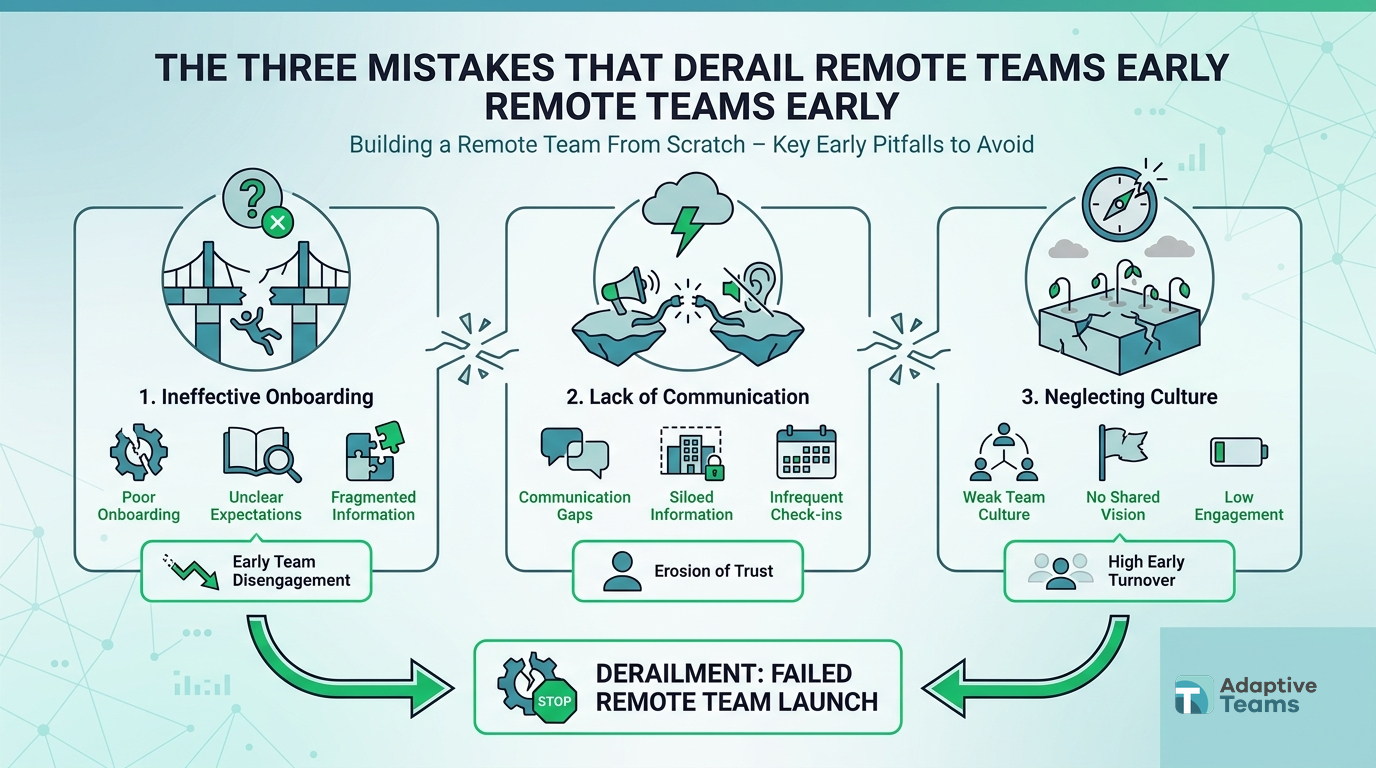
The typical first move when building a remote team from scratch is posting on a freelance marketplace, hiring the cheapest credible-looking candidate, and hoping they’ll figure it out. This creates the three most common failure modes:
No context transfer. The hire arrives with no understanding of your business, your customers, or your standards. They default to their last employer’s way of doing things, which may have nothing to do with yours.
No feedback loop. There’s no structured way to catch problems early. Issues compound over weeks before anyone notices, by which point the sunk cost of re-hiring feels enormous.
No success definition. The hire doesn’t know what “good” looks like in your context. They work hard at the wrong things. Everyone is frustrated despite real effort on both sides.
These aren’t talent failures. They’re system failures. And they’re all preventable.
What Building a Remote Team Requires Before You Hire
The operators who successfully navigate building a remote team from scratch have usually done three things before the first hire joins:
Define what “good” looks like in writing
Not a job description, an actual performance standard. What does this role look like at 30 days? 90 days? What output signals that it’s working? What signals that it isn’t?
When you’re building a remote team from scratch, this document becomes the foundation of your entire hiring and onboarding process. If you can’t write it before you hire, your new team member can’t possibly know it either.
Build an async-first operating environment
Remote teams that run on synchronous-only communication (perpetual Zoom meetings, constant Slack back-and-forth) burn people out and create timezone bottlenecks. The better default: make information accessible without requiring a meeting to retrieve it. Documented processes and clear decision rights allow people in different timezones to move without waiting for approval every hour.
This doesn’t mean no meetings, it means meetings should be intentional, not a substitute for good documentation.
Install a structured feedback cadence
Weekly check-ins (15, 20 minutes, structured around progress, blockers, and priorities) catch problems before they compound. Not as a status report, as a working conversation. The goal is early signal, not surveillance.
Without these three pieces in place, you’re setting up your first remote hire to fail regardless of their competence.
Stop Rebuilding the Same Hiring Infrastructure Twice
Adaptive Teams handles recruiting, HR, payroll, and performance management in one stack, so your remote team runs from day one.
How to Source Remote Talent That Will Actually Perform
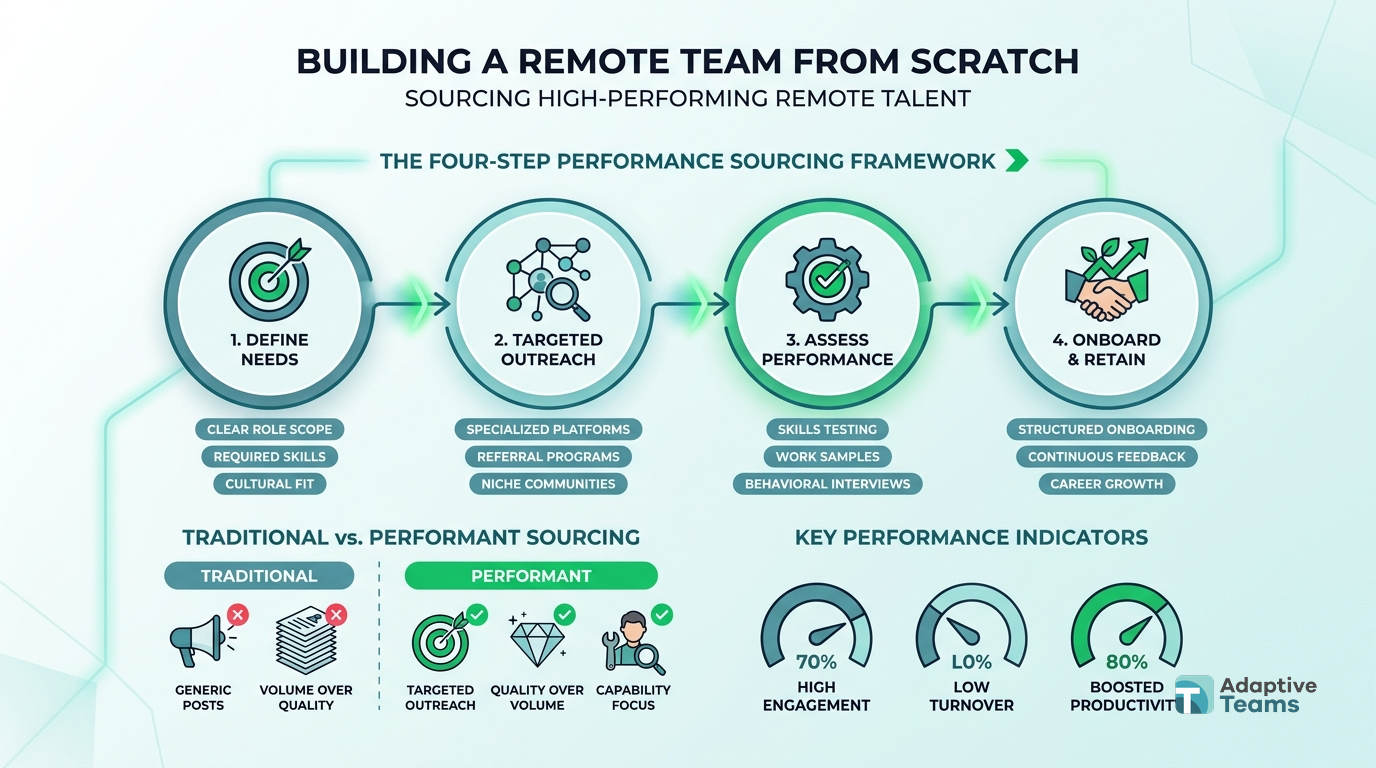
Once your infrastructure is in place, the sourcing question for building a remote team from scratch becomes: where do you find people who will actually perform in your specific environment?
The answer depends on the role type and the market you’re targeting.
Specific-skill roles (developers, designers, paid media managers, financial analysts) have deep talent pools in the Philippines, Latin America, Eastern Europe, and South Africa. Each market has different cost structures, timezone compatibility, and communication norms. Philippines talent skews toward strong English communication and service orientation; Latin America has timezone overlap with North American business hours; Eastern Europe has strong technical depth.
The mistake most operators make: picking a market based on cost alone without considering timezone fit for the role. A software developer who needs to collaborate with your engineering team synchronously should probably be in a compatible timezone. A customer support role might not care.
A McKinsey analysis on talent in a new era found that 87% of executives report experiencing skill gaps or expecting them within a few years, and that the talent search has gone genuinely global in response. Building a remote team from scratch now means competing for candidates across markets, not just locally.
Broad operational roles (executive assistants, operations coordinators, project managers) require more judgment and communication skill. The bar for these hires is higher, and the sourcing process should reflect that, structured interviews, work samples, reference checks, a paid trial period where possible.
One important structural decision: contractor vs. full-time employment. The right hiring model for your situation depends on the role’s permanence, your compliance risk tolerance, and how much management infrastructure you want to own. Getting this wrong has legal and operational consequences that are harder to unwind than people expect.
Step-by-Step: Onboarding Remote Hires in the First 30 Days
Remote onboarding is where most of the early failures happen, not in hiring. How you bring people in matters as much as who you hire.
The first 30 days determine whether a new team member builds the right mental model of your business and develops real operational confidence, or whether they drift toward doing whatever seems safe and avoiding anything uncertain.
Start with context, not paperwork
Don’t open with HR forms and tool logins. Start with context: why the company exists, what the team is trying to accomplish this quarter, and specifically how this person’s role contributes to that. People make better decisions, about everything, when they understand the bigger picture.
Then document your actual processes for the role. Not best-practice articles from the internet, your specific way of doing things. If these don’t exist yet, the first two weeks of onboarding is the right time to build them together.
Create early wins with bounded scope
Give the new hire a defined project they can complete and close in the first two weeks. Finishing something builds confidence and creates a natural feedback opportunity. Avoid assigning only vague ongoing responsibilities for the first month, ambiguity is demoralizing in a remote context where you can’t read the room.
Schedule check-ins instead of relying on open-door
Don’t wait for the new hire to raise issues. Schedule daily 10-minute syncs for the first two weeks, then weekly after that. New remote hires often struggle in silence because they don’t want to seem needy or incompetent. Removing that barrier explicitly, by making check-ins a standing expectation, is one of the highest-leverage things you can do in the first month.
For more detail on the management infrastructure that makes distributed teams perform long-term, the practical system for managing remote employees effectively is worth reading alongside this.
Benefits of a Structured Performance Layer (And How to Build One)
Hiring and onboarding are visible costs. Performance management is where the invisible costs accumulate, and for most operators, it’s the layer that gets built last, or not at all.
The typical approach: set KPIs at hire, check in occasionally, have a hard conversation when something goes wrong. This works reasonably well in an office where you can observe context, pick up on signals, and course-correct informally. It fails at distance.
Remote performance management needs to be more explicit, not more demanding. The goal isn’t surveillance, it’s removing the ambiguity that causes good people to underperform.
Quarterly role reviews (not just performance reviews)
Role conversations matter more than performance scores. Is this person working on the right things? Has the role evolved since they were hired? What would it take for them to move to the next level? These conversations prevent the drift where someone works hard at outdated priorities.
Document decision rights explicitly
Remote team members need to know what decisions they can make independently, what requires input, and what requires approval. Without this clarity, either everything gets escalated (slow) or nothing does (risky). Write it down and share it during onboarding.
Watch for retention signals before attrition signals appear
Most teams only notice performance problems when they become serious. A more useful habit: notice engagement signals early. Is the person asking questions, contributing ideas, flagging issues proactively? Those are retention signals. Is the quality of work declining, communication getting shorter, deadlines starting to slip? Address those early, long before they require a difficult conversation.
If building this infrastructure from scratch sounds expensive, consider what it costs to not have it. The average cost of replacing a remote employee, including re-hiring, re-onboarding, and lost productivity during the gap, runs at 50, 150% of annual salary depending on the role’s complexity. The operational case for managed HR infrastructure makes this calculation concrete.
Tools and Infrastructure for Compliance and Payroll
The operational mechanics of actually paying remote team members, especially internationally, are more complex than most founders expect.
Payroll across borders involves currency conversion, local tax withholding, social contributions, and employment law that varies significantly by country. Getting this wrong exposes the company to legal liability and creates massive friction for the team members who depend on reliable pay. The IRS guidance on worker classification is US-centric, but the core principle applies globally: misclassification triggers back taxes, penalties, and in some jurisdictions, forced employment contracts retroactively.
The practical options: hire through a global payroll provider, use an employer-of-record (EOR) model, or manage it through a staffing partner who handles this as part of their service. Each has different cost structures and trade-offs. The comparison between PEO and EOR models for international hiring breaks down when each makes sense.
The key point: compliance is not optional, and it’s not something to figure out after the team is hired. Build your payroll and compliance approach before your first international hire joins.
Advanced: What Operators With Scaled Remote Teams Do Differently
The operators who get this right consistently have a few things in common.
They’ve stopped thinking about remote as a location arrangement and started thinking about it as an operating model. The question isn’t “where is this person working”, it’s “do we have the systems to make this person successful regardless of where they are.”
They’ve invested in documentation as infrastructure. Their processes are written. Their standards are explicit. New team members can onboard without requiring a senior person to hold their hand through every step.
They’ve built a management layer that scales. Not one founder doing ad-hoc check-ins, but a structured rhythm of reviews, feedback, and role conversations that works the same whether the team is 3 people or 30.
The practical framework for building offshore teams at scale covers how this infrastructure evolves as headcount grows.
Final Steps: Where to Start If You’re Starting Now
The process for building a remote team from scratch, whether your first hire or your fifteenth, follows a consistent sequence:
- Define success metrics for the first role before you recruit, not after.
- Choose the right hiring model (contractor vs. employee) for your legal and operational context.
- Set up your async operating environment: documentation, communication protocols, decision rights.
- Build a 30-day onboarding plan before the hire starts.
- Install your performance feedback cadence from day one, not when problems appear.
The infrastructure investment upfront is what separates teams that compound from teams that churn.
If you’d rather not build this from scratch, or you’ve already tried and want a different approach, Adaptive Teams provides the full stack: recruiting, HR, payroll, compliance, and performance management, without the founder needing to manage each piece separately. Book a free staffing consultation to see what this looks like for your specific situation.
Frequently Asked Questions
How long does it take to build a functional remote team from scratch?
Most operators have their first remote hire performing at full capacity within 60, 90 days if the onboarding infrastructure is in place. Without structured onboarding, that same hire may take 4, 6 months to reach the same output, or never fully get there. The timeline is mostly a function of onboarding quality, not talent quality.
What’s the biggest mistake companies make when hiring remotely for the first time?
Skipping the performance definition step. Most first-time remote hires fail because no one defined what success looks like at 30, 60, and 90 days. The hire works hard at the wrong things, or defaults to low-value safety tasks, and the founder concludes remote doesn’t work for this function.
Which roles should you hire remotely first?
Roles with defined output and measurable quality are easiest to start with: customer support, data analysis, content production, financial operations, administrative coordination. Roles requiring heavy real-time collaboration or significant judgment calls in ambiguous situations are harder to staff remotely without more mature management infrastructure.
Do you need to hire full-time remote employees, or do contractors work just as well?
It depends on the role’s permanence and your compliance exposure. Contractors work well for project-based or seasonal work where volume fluctuates. For core operational roles you need reliably staffed, full-time employment (or an EOR arrangement) typically produces better retention and stronger alignment. The legal risk of misclassifying employees as contractors is also significant in many jurisdictions.
How do you maintain culture with a fully distributed team?
Culture in remote teams is built through operational consistency more than social events. Clear values, explicit standards, consistent feedback, and equitable treatment across timezones create the reliability that people associate with good culture. Video all-hands, informal chat channels, and occasional in-person gatherings help, but they don’t substitute for the operational layer.
Ready to Build Your Dream Team?
Book a free staffing consultation with our remote team specialists. No obligations, just actionable insights for scaling your operations.
Related reading: When to Hire Your First Remote Team.