TL;DR
The best offshore staffing companies are Adaptive Teams, Hire Overseas, Near, Cloudstaff and 1840 & Company. Pick Adaptive Teams if you want one partner for recruiting, payroll, HR and performance management, with no placement fee and a staffing fee set as a percentage of salary. Pick Near if you would rather employ the person yourself and pay a one-time fee per hire.
Full disclosure: Adaptive Teams publishes this list and is the first entry. The other nine companies are real alternatives, each with a note on who it fits best.
How we picked these companies
Every company here has a live site that explains how its engagement model works, and we quote only numbers each company publishes itself. We rechecked every figure on the companies’ own websites in September 2026. Firms whose sites gave us too little to check were left off, and where we are the wrong fit we name the competitor to call instead.
Still deciding whether offshore hiring makes sense at all? Start with our guide to the benefits of offshore teams. The model works when someone competent runs the recruiting and someone competent runs the employment side after day one. The companies below differ mostly in how much of that second part they take off your plate.
The 10 best offshore staffing companies
1. Adaptive Teams
Adaptive Teams is our company, so read this entry knowing that. Here is what we can back up.
Nate Ginsburg and Menno Gottmer built an 80+ person distributed team while running SellerPlex, their Amazon agency, and have hired remote talent across continents since 2018. Adaptive Teams turns that system into a service for US companies. Our TeamTailor account holds 956 jobs and 64,982 applications, and most roles are filled in 2 to 3 weeks. Specialist or senior roles can take 4 to 6.
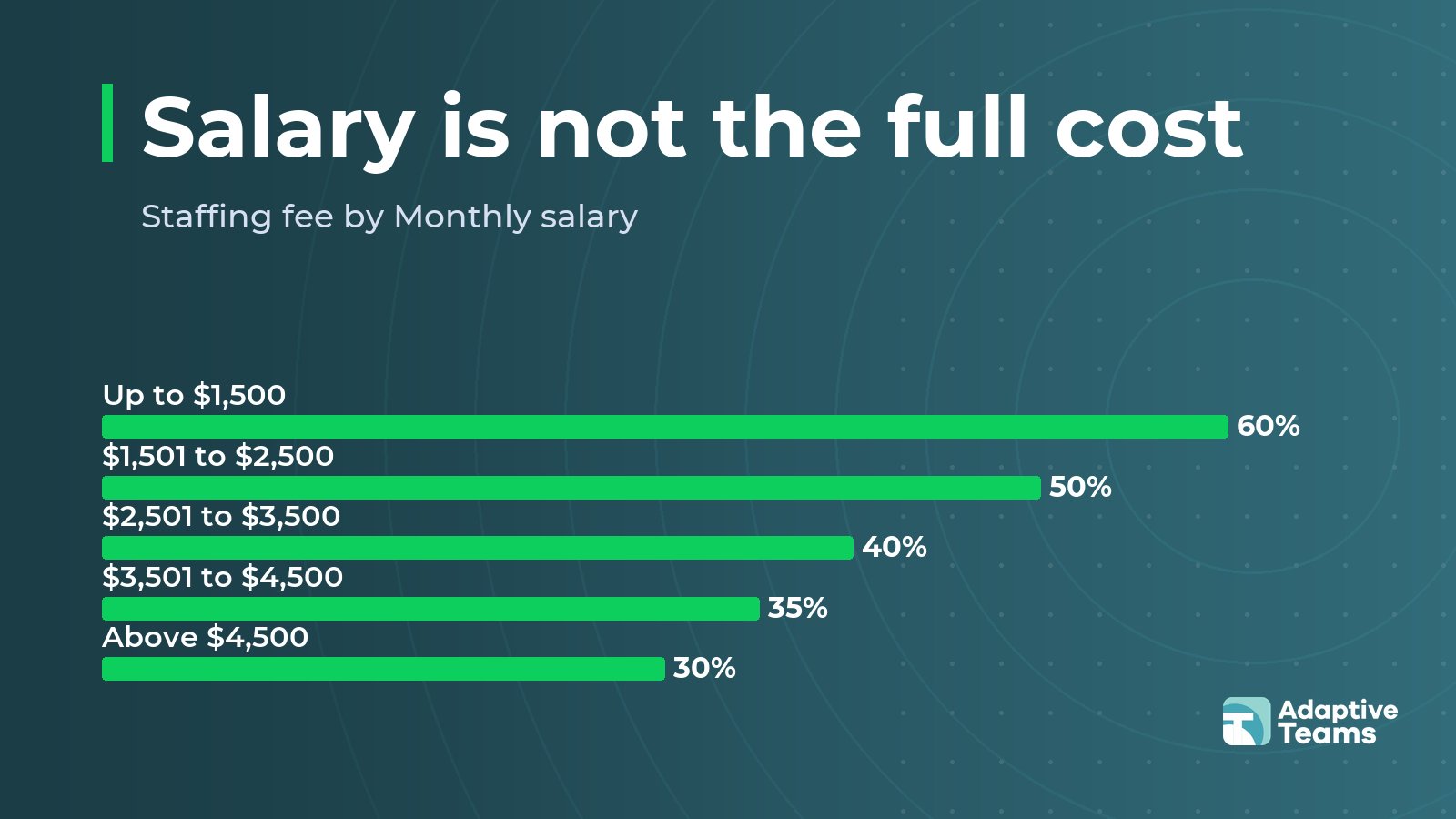
After the hire we stay on for the HR layer: payroll through Deel with salaries passed through at cost, compliant contracts in 150+ countries and performance management with a dedicated manager for every placement. You pay the salary plus a staffing fee, a percentage of that salary: 60% up to $1,500 a month, falling step by step to 30% above $4,500. There is no placement fee, contracts run month to month, and teams of 2 or more get volume discounts of 3 to 9 percent. If a hire does not work out in the first 2 months, we replace them at no cost. KO Storage grew from 4 to more than 70 team members in 18 months across 6 departments with us.
Who we are the wrong fit for: if you want one freelancer for a two-week gig, a marketplace will cost you less. If you need thousands of seats run as one outsourced function, you need a BPO.
Best for: growing companies that want recruiting and the ongoing employment layer handled by one partner. adaptiveteams.co
2. Hire Overseas
Hire Overseas is a managed staffing company that recruits full-time offshore talent and keeps running the employment side after the hire. It sources from the Philippines, Latin America and Africa, and you set the role, budget and hours before it screens and shortlists candidates. Once you choose someone, Hire Overseas handles onboarding, payroll and compliance and serves as Employer of Record in 150+ countries, so you never open a foreign entity. Every hire is trained on current AI and productivity tools through its in-house program, Hire Overseas University, and the company says it accepts under 1% of applicants. Pricing is a flat monthly subscription from $2,000, month to month with no deposit, and a hire is replaced at no cost if the fit is off in the first two weeks. It recruits for roles such as executive assistants, bookkeepers, customer support reps and sales development reps.
Best for: companies that want a full-time offshore hire plus payroll, compliance and AI training handled on one monthly fee. hireoverseas.com
3. Near
Near is a staffing and recruiting agency that helps US companies hire in Latin America. You choose between a one-time placement fee or a monthly fee that includes payroll and compliance support. Near says it sends shortlists in under 5 days and fills roles in about 3 weeks, and every hire carries a 180-day replacement guarantee. It reports 3,500+ candidates hired for 950+ US companies.
Best for: US teams that want hires in their own time zone and a choice on who runs payroll. hirewithnear.com
4. Cloudstaff
Cloudstaff has run managed offshore teams for 20 years, with talent in the Philippines, Colombia, India and Kenya. You pay one monthly rate per staff member and Cloudstaff handles HR, payroll, compliance and the technology behind each seat. Most teams are running in 15 to 25 days. The company is ISO 27001 and 9001 certified, and reports 1,000+ client companies and a 99% staff retention rate.
Best for: established companies building larger back-office or support teams that want mature infrastructure and certified security behind every seat. cloudstaff.com
5. 1840 & Company
1840 & Company covers a wide range for one vendor. It places dedicated offshore and nearshore staff you manage, runs fully managed BPO teams when you want to hand off a function, and offers recruitment process outsourcing for direct hires. Talent comes from 150 countries, with dedicated hiring in the Philippines, India, Brazil, Mexico, Poland and South Africa. The company says you can hire in under two weeks and save up to 70% on hiring costs.
Best for: companies whose needs shift between single hires and managed teams. 1840andco.com
6. Doxa Talent
Doxa Talent calls its model Conscious Outsourcing: it directly employs your offshore team members with full benefits. Hubs sit in Manila, Barranquilla, Ho Chi Minh City and Nairobi. Pricing is one all-inclusive monthly rate with no setup or recruitment fees, and contracts carry a 30-day cancellation policy. Doxa is Great Place to Work Certified and reports 1,000+ team members placed and a client NPS of 84.
Best for: buyers who weigh how their offshore staff are employed as heavily as the savings. doxatalent.com
7. MultiplyMii
MultiplyMii works in one market, the Philippines, and screens for what it calls the top 2% of talent. It recruits heavily for ecommerce brands and has placed degree-educated hires since 2019. After recruitment it can employ your hire through its Employer of Record service, so you stay compliant without a Philippine entity. It also publishes a free salary guide on what to pay offshore.
Best for: companies committed to a Philippines team, especially in ecommerce. multiplymii.com
8. Virtustant
Virtustant places Latin American talent on all-in hourly rates starting at $7 an hour, with payroll and HR handled and no recruitment fees. It promises a shortlist in 48 hours and a start in 72 hours. Its replacement guarantee has no time limit: if your hire ever leaves, it finds a replacement at no cost. It reports 2,028 hires placed since 2021 for 1,000+ US companies.
Best for: small businesses that want fast, low-commitment hires for roles like assistants and support reps. virtustant.com
9. Outsourced
Outsourced is a Philippine staffing provider based in Quezon City. It recruits dedicated full-time staff who work from home, from its offices or in a hybrid setup. It screens for the top 1% of Philippine talent, reports 98%+ staff retention, holds data security to ISO standards and says 450+ companies use it.
Best for: companies that want dedicated Philippine staff with real office facilities behind them. outsourced.ph
10. Remote Team Solutions
Remote Team Solutions (RTS) works from one country, Mexico. Team members work from RTS offices while your managers direct their daily work, and RTS management sits in La Laguna. The fee is flat and all-inclusive, covering recruitment, benefits and taxes, and RTS works month to month with no contract. It reports 98% employee retention and recruits for accounting, customer service, legal support and software roles.
Best for: US companies that want office-based nearshore staff working US hours. remoteteamsolutions.com
Comparison at a glance
| Company | Best for | Pricing model | Who employs the hire | Guarantee or terms |
|---|---|---|---|---|
| Adaptive Teams | Recruiting plus ongoing HR, payroll and performance | Salary plus a 30% to 60% staffing fee, no placement fee | Adaptive Teams via Deel | Free replacement in first 2 months |
| Hire Overseas | Full-time hire with HR, payroll and AI training | From $2,000 a month subscription | Hire Overseas via EOR | Free replacement forever |
| Near | Time-zone-aligned Latin America hires | Placement fee or monthly fee | Your choice | 180 days |
| Cloudstaff | Larger managed back-office teams | Monthly rate per staff member | Cloudstaff | Not published |
| 1840 & Company | Needs that shift between hires and managed teams | Staffing, managed BPO or RPO | Depends on the service | Not published |
| Doxa Talent | Buyers who care how staff are employed | All-inclusive monthly rate | Doxa, with full benefits | 30-day cancellation |
| MultiplyMii | Philippines-first ecommerce teams | Recruitment plus EOR | MultiplyMii EOR | Not published |
| Virtustant | Fast, low-budget Latin America hires | All-in hourly rate from $7 | Virtustant | Lifetime replacement |
| Outsourced | Dedicated Philippine staff with office options | Dedicated full-time staffing | Outsourced | Not published |
| Remote Team Solutions | Office-based teams in Mexico | Flat all-inclusive fee, month to month | RTS | No contract required |
What is the best offshore staffing agency for a small business?
For most small businesses the best offshore staffing agency has no upfront fee and no long contract, so a single hire does not lock you in. Adaptive Teams, Virtustant and Remote Team Solutions all work month to month or without a contract, and none of the three charges a placement fee.
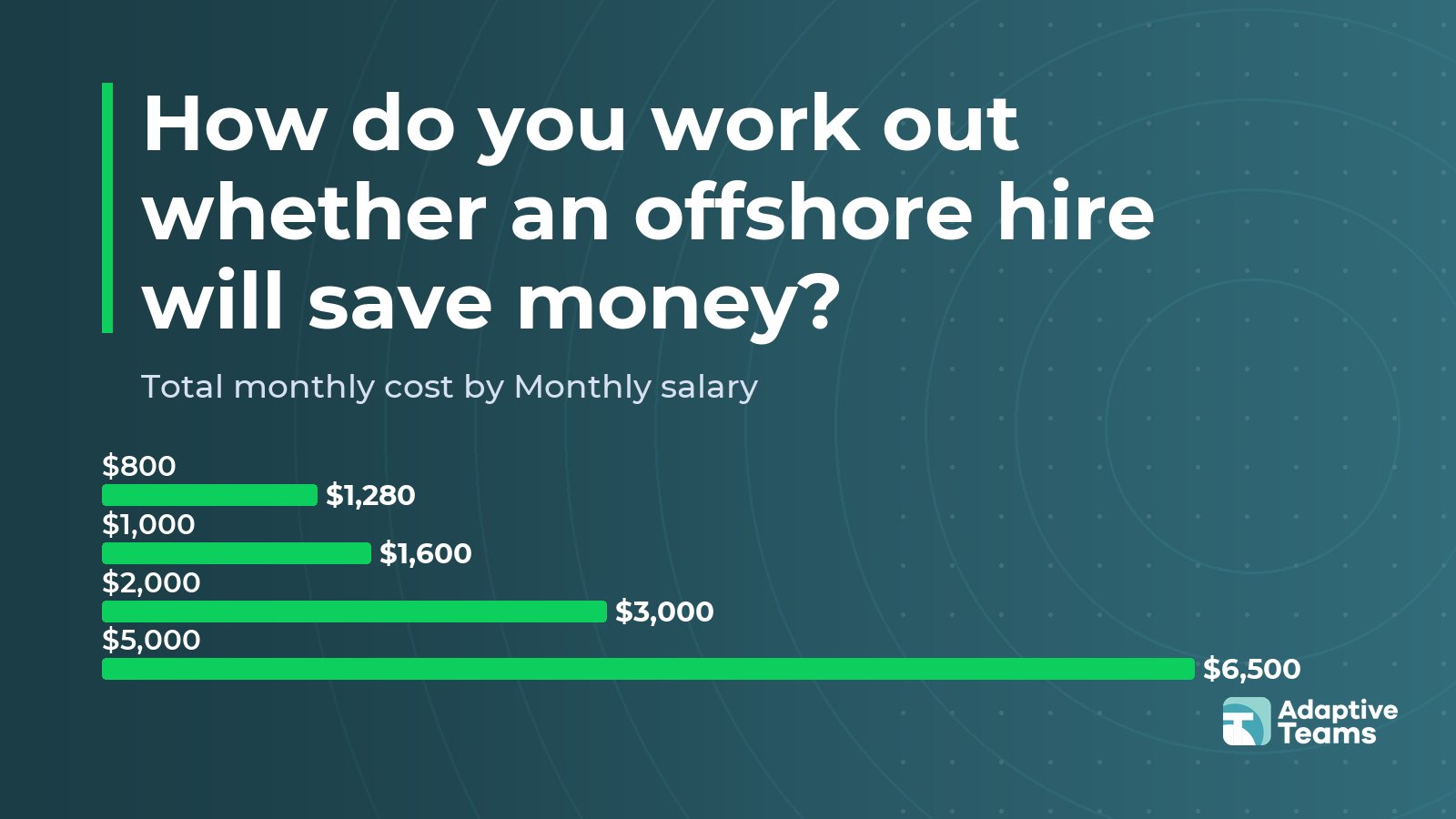
Budget decides the rest. Virtustant starts at $7 an hour and is the cheapest way to test one assistant or support role. With Adaptive Teams an $800 a month support rep costs $1,280 all in (salary plus a 60% staffing fee), and that includes HR, payroll and a dedicated manager. That matters when the owner has no time to manage someone abroad. If you already run payroll and only need the search, Near’s one-time placement fee or our recruitment-only option at $4,000 per hire can cost less over a multi-year hire.
Which offshore staffing companies work best for US companies?
US companies usually do best with a provider that removes the foreign-employer problem and overlaps their working day. Adaptive Teams, Near and Hire Overseas handle employment through an EOR, so you never open a foreign entity. Adaptive Teams contracts through Deel in 150+ countries.
For time zones, Near, Virtustant and Remote Team Solutions hire only in Latin America and Mexico, which covers the full US day. Philippine providers such as Cloudstaff, Outsourced and MultiplyMii work well for back-office and support roles where staff can shift to US hours or where overnight coverage is a plus.
Philippines, Colombia or India: what does each region cost?
For support roles the Philippines is usually the cheapest region. Latin America, Colombia included, costs more but works US hours. The numbers below come from our offshore salary benchmarks, built from 148 Adaptive Teams payroll records in July 2026. They are gross monthly salaries before any provider fee.
- Customer service rep, Philippines: $700 to $900 a month, typical $800 (36 placements).
- Customer service rep, Latin America including Colombia: $900 to $1,050, typical $1,000 (31 placements).
- Bookkeeper, India: $1,000 to $1,750 (5 placements).
- Operations manager, Latin America: $1,750 to $2,500 (4 placements).
Across our placements Latin America runs 20 to 40 percent above the Philippines for the same role, which is the price of built-in US hours. South Africa is a common pick for English-speaking customer service and accounting; Hire Overseas and 1840 & Company both hire there. For country-by-country hiring data, see hiring in the Philippines and hiring in Latin America.
Staffing company, marketplace or EOR platform?
An offshore staffing company gives you a dedicated full-time person who works only for you. That is the right model for any role that repeats every week. A freelance marketplace fits a short project. An EOR or global payroll platform employs someone you already found, but will not recruit or manage them.
Inside staffing, the question is who employs the hire. On direct hire (one of Near’s two options) you pay a one-time fee, and every payroll, compliance and retention problem lands on your desk. Managed providers such as Adaptive Teams, Cloudstaff, Hire Overseas, Doxa Talent and Remote Team Solutions bundle that work into a monthly rate. You pay more per month and absorb fewer surprises. Hourly models like Virtustant sit in between.
What should you ask a provider before you sign?
Ask what happens after the hire starts, because that is where most offshore placements fail. These questions separate a placement service from a partner:
- Who runs performance management after month one? At Adaptive Teams every placement has a dedicated manager and formal reviews twice a year.
- What exactly does the replacement guarantee cover, and for how long? Terms on this list run from 2 months to no time limit.
- What is the full monthly cost, salary and every fee included? Ask for a sample invoice.
- Who is the legal employer, and who handles local tax and labor law?
- How many candidates will you see, and how were they tested for the role?
Ask what happens in month seven when a hire resigns. That scenario costs you the most, and the answer tells you how much of the employment side the provider really owns.
Frequently asked questions
What is an offshore staffing company?
An offshore staffing company recruits full-time people for you in lower-cost countries and usually keeps running payroll and local compliance after the hire starts. You manage the person’s daily work as part of your own team. Some providers, including Adaptive Teams and Cloudstaff, also handle ongoing HR and performance management for the life of the engagement.
How much does offshore staffing cost?
It depends on the pricing model. Direct-hire firms such as Near charge a one-time fee when you hire. Managed providers charge a monthly rate: at Adaptive Teams that is the salary plus a staffing fee of 30% to 60% of it, depending on the salary band. Hourly models such as Virtustant start at $7 an hour. Salaries themselves start around $700 a month for a Philippine support rep.
Is remote staffing the same as offshore staffing?
Mostly, yes. Remote staffing means the person works from somewhere other than your office; offshore staffing means that place is another country, usually with lower salaries. Nearshore is the part of offshore that shares your time zone, such as Latin America for US companies.
What is the difference between offshore staffing and a BPO?
An offshore staffing company recruits named people who join your team and report to your managers, while the provider handles employment in the background. A BPO takes over a whole function, such as a 200-seat support operation, and manages the work itself.
Which country is best for offshore staffing?
It depends on the hours you need covered and the role. Latin America gives US companies nearly full time-zone overlap, which matters for sales and phone-heavy work. The Philippines has a deep pool for support and back-office roles at the lowest salaries. India is strong for accounting, and South Africa for English-speaking service roles.

Written by the people who recruit, pay and manage remote teams every day, with Nate Ginsburg and Menno Gottmer. About Adaptive Teams