

TL;DR
A virtual assistant agency finds a remote assistant for you and, depending on the model, either shares that person across clients or places one who works only for you. At Adaptive Teams you agree the salary, pay a staffing fee of 30% to 60% of it, and get recruitment, payroll, HR and a 2-month free replacement included. Roles typically fill in 2 to 3 weeks, month to month.
Most founders start looking for help the same way. The inbox is two days behind, the calendar runs the week, and a spreadsheet that should take ten minutes waits until Sunday night. Hiring one more person feels like the answer, but a US admin hire takes months and a lot of money before they open their first email.
An agency promises a shortcut. The trouble is that the word covers very different businesses, and the differences decide what you pay and who actually shows up to work each morning.
What does a virtual assistant agency actually do?
A virtual assistant agency sits between you and the assistant: it sources the person, checks they can do the work, and handles some or all of the employment admin. What it does after the hire is where agencies split.
Three models cover nearly everything you will find when you search:
| Shared or pooled assistant | Freelance marketplace | Dedicated staffing agency | |
|---|---|---|---|
| Who does the work | A rotating person or small pod | A freelancer you pick | One assistant who works only for you |
| How you pay | Hourly or a block of hours | The freelancer's rate plus platform fees | Agreed salary plus a staffing fee |
| Who screens | The agency | You | The agency, you make the final call |
| Contract, payroll, HR | The agency | Mostly you | The agency |
| Fits best | A few hours of overflow a week | Small, defined tasks | Daily admin you want to hand over for good |
Adaptive Teams runs the third model. The assistant is yours full time, follows your hours and learns your business, while we carry the contract, payroll and people management in the background.
Shared assistants and hourly plans
Pooled models sell hours. You buy a block, tasks go into a queue, and whoever is available picks them up. That works for overflow, such as booking travel twice a month. It works badly for anything that needs memory: your preferred vendors, your tone in email, the investor who always gets a reply the same day.
Marketplaces
A marketplace hands you a search box and lets you choose. Rates can be low, but you do the screening, the contract and the follow-up yourself. If the freelancer disappears, so does the knowledge they built up. We compared these trade-offs for employment versus freelance help in our guide to whether a virtual assistant or a remote employee fits your business.
How much does a virtual assistant agency cost?
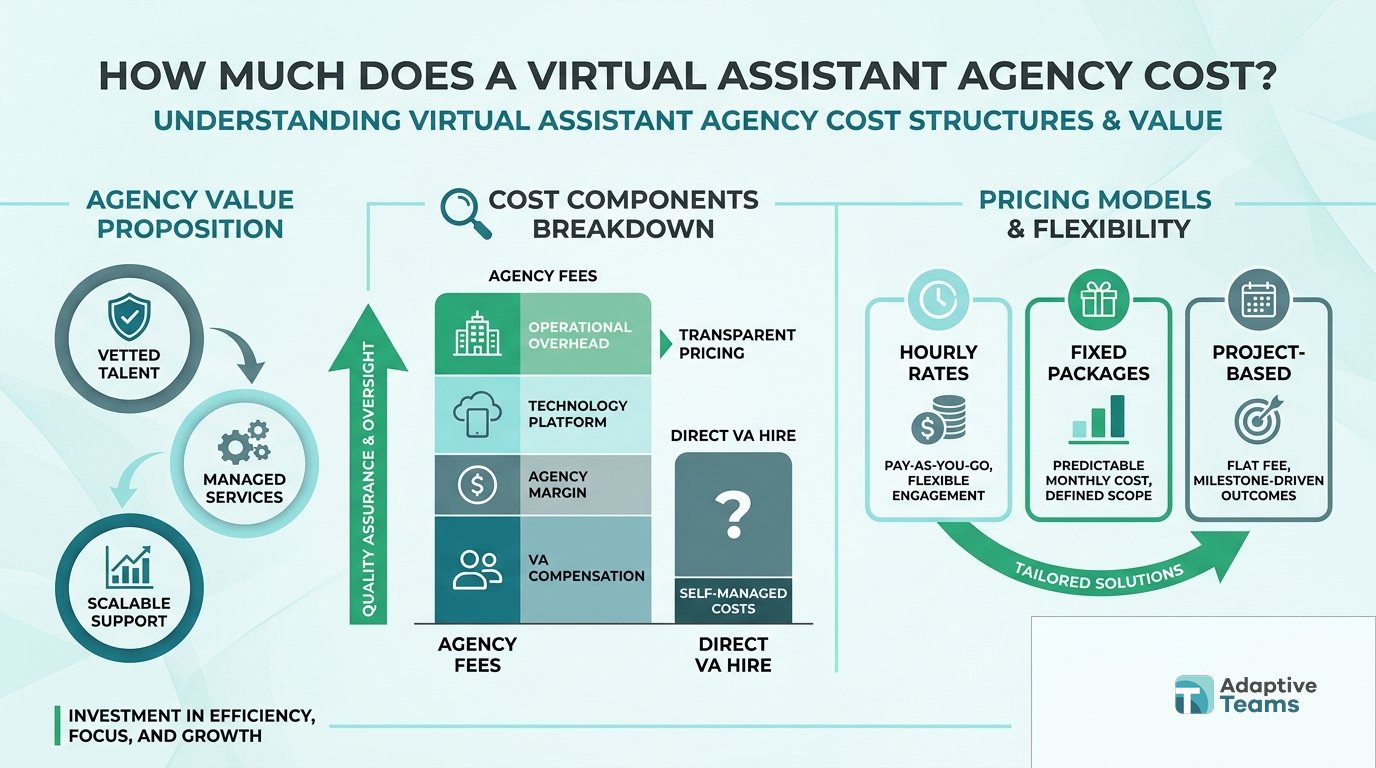
The price depends on the model, so compare the full monthly cost of one person working only for you.
At Adaptive Teams you agree a monthly salary directly with your hire. Our staffing fee is a percentage of that salary, and the percentage drops as the salary rises:
- Up to $1,500 a month: 60%
- $1,501 to $2,500: 50%
- $2,501 to $3,500: 40%
- $3,501 to $4,500: 35%
- Above $4,500: 30%
Two worked examples
Say you agree a salary of $1,200 a month with an assistant in the Philippines. The staffing fee is 60%, or $720, so you pay $1,920 a month in total. If the role needs more experience and you agree $1,800, the fee is 50%, or $900, and your monthly total is $2,700.
Both totals include recruitment, the contract, payroll, HR support and a performance manager. Teams of 2 to 4 people get 3% off the fee, 5 to 9 people get 6%, and 10 or more get 9%. If you only want us to find the person and you run everything after, recruitment on its own is $4,000 flat per hire.
For more detail on how fees like these compare with what other agencies charge, our explainer on how staffing agency fees are built walks through the common structures.
The US benchmark
A local hire costs more than the salary alone. The Bureau of Labor Statistics puts the median wage for secretaries and administrative assistants at $48,310 a year, which is about $4,026 a month. According to the BLS employer cost release for June 2026, wages make up 70% of what private employers spend per hour worked and benefits make up the other 30%.
Gross up that median wage by the same share and a typical US assistant costs an employer roughly $5,750 a month before recruiting. Hiring adds more on top: SHRM's benchmarking data put the average cost per hire at nearly $4,700.
If your assistant mostly supports one executive, our breakdown of remote executive assistant cost covers that role in more depth.
What should a virtual assistant handle in the first month?
Start with the work that repeats and has a clear right answer. Our virtual assistant hiring page lists the core of the role:
- Inbox and calendar management
- Data entry and CRM updates
- Research and list building
- Travel booking and scheduling
- Document prep and simple reporting
Give the first week to two of these, with written examples of what good looks like. A screen recording of you doing the task once is worth more than a page of instructions. By week three most assistants can take over the inbox triage and the calendar, which is usually where the hours come back fastest.
Keep anything that needs your judgment on money, hiring or customer escalations with you until trust is built. Your assistant can prepare the decision, draft the reply and chase the answer. You still press send on the things that matter.
How do you check an agency before you sign?
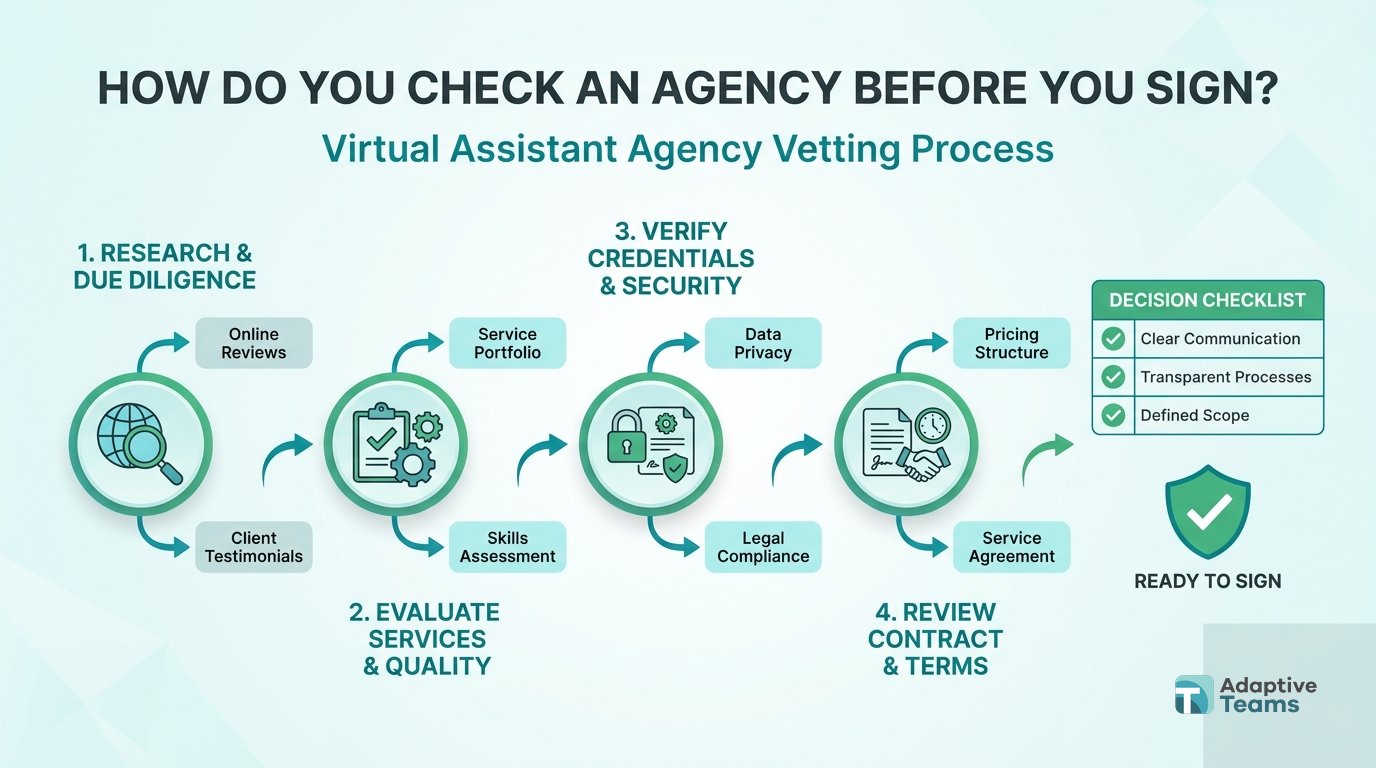
Ask how they screen, who employs the assistant, and what happens when the hire does not work out. The answers tell you more than any sales page.
Screening you can see
Every Adaptive Teams candidate takes a written English test, an attention to detail task and a tools check in Google Workspace or Microsoft 365, then records a video interview. You meet a shortlist of 3 to 5 screened people and choose who joins. Ask any agency for the same: what was tested, and can you see the result.
Who holds the contract
If the agency employs or contracts the assistant, it should also run payroll, leave and the paperwork in the assistant's country. We sign every contract through our global payroll partner and pay twice a month, so you need no local entity. Some agencies leave that part to you, which is fine if you have an HR person and a reason to own it.
The replacement promise
People sometimes leave or turn out to be the wrong fit. Our free replacement covers the first 2 months, and the engagement runs month to month with 30 days notice. Be wary of annual lock-ins for a role you have never hired before.
Proof from the pipeline
Ask for real volume. Our TeamTailor account holds 56,287 candidates and 64,982 applications across 956 jobs run since September 2024, which is the bench every search draws from. One client, KO Storage, started with four call center agents in August 2024 and had 70+ Adaptive Teams contractors across six departments 18 months later.
Where should your assistant be based?
Pick the location by the hours you need covered and the kind of work, then compare salaries.
The Philippines has the deepest pool for assistant and back-office roles at the lowest salaries of the regions we hire in. It runs 12 to 16 hours ahead of US time zones, and night shifts on US hours are normal for support and assistant roles. English is an official language there and the working language of business.
Colombia, Argentina and Brazil share US working hours. They suit assistants who talk to your customers or team live during the day, or who need more judgment in finance or operations. The same screening, contract and support apply in every country.
Common mistakes when hiring through an agency
The first is buying hours when you need a person. If the work needs context, a shared queue keeps resetting it.
Another is skipping the salary conversation. When the agency hides what the assistant earns, you cannot tell whether a good person will stay. We confirm the salary band with you before anyone is sourced, and you agree the salary with your hire.
The last is handing over everything on day one. An assistant who gets fifteen tasks and no examples will make fifteen small mistakes. Two tasks done well in week one build the trust that the next ten depend on.
Frequently asked questions
Is a virtual assistant agency better than hiring a freelancer?
It depends on how long you need the help. A freelancer suits a short, defined project you can check yourself. An agency suits ongoing work, because it screens candidates, holds the contract, runs payroll and replaces the person if it goes wrong. At Adaptive Teams that replacement is free in the first 2 months.
How fast can an agency place a full-time virtual assistant?
At Adaptive Teams most roles fill in 2 to 3 weeks. We confirm the hours, tools and salary band first, then source and screen candidates with skills tests, English checks and a recorded video interview. You interview a shortlist of 3 to 5 and pick who joins. Payroll and HR start on day one.
What is included in the staffing fee?
The fee covers recruitment, the contract, payroll twice a month, HR support, a performance manager and the 2-month free replacement guarantee. It is a percentage of the salary you agree with your assistant, from 60% for salaries up to $1,500 down to 30% above $4,500.
Can I hire a virtual assistant without a long contract?
Yes. Adaptive Teams engagements run month to month with 30 days notice, and there is no placement fee upfront. That lets you test the role for a few months before you commit to more hires. Teams that grow to 2 or more people also get a volume discount of 3% to 9% on the fee.
Where to start
Write down the ten tasks that ate most of your last week, and mark the ones a capable person could do from a screen recording. That list is the job description.
If you want help turning it into a hire, our recruitment team scopes the role with you, confirms the salary band and puts 3 to 5 screened candidates in front of you, usually within 2 to 3 weeks.

Written by the people who recruit, pay and manage remote teams every day, with Nate Ginsburg and Menno Gottmer. About Adaptive Teams