
Remote Recruitment Agency: What You Get and What It Costs
TL;DR: A remote recruitment agency finds, screens and hires remote staff for you, usually from other countries, and the good ones also handle the contract and payroll after the hire. At Adaptive Teams most roles fill in 2 to 3 weeks. Staffing costs the agreed monthly salary plus a staffing fee of 60% down to 30%, and a free replacement covers the first 2 months. Recruitment-only costs $4,000 per hire. Recruit yourself only if you have a recruiter and time.
Table of Contents
- What does a remote recruitment agency actually do?
- Placement agency or staffing partner: which model fits?
- How much does a remote recruitment agency cost?
- How fast can a remote recruitment agency fill a role?
- What should you check before you sign?
- What does it look like when it works?
- When should you recruit in house instead?
- Where to start
- Frequently Asked Questions
Most people land on this search after a role has been open too long. The job post went up, applications came in from everywhere, and nobody on the team had the hours to sort 200 CVs from six time zones. That is the moment a remote recruitment agency starts to make sense.
The trouble is that “agency” covers very different businesses. Some send you a list of names and an invoice. Others recruit the person, employ them in their country and stay on the hook if the hire does not work out. This guide walks through what you should expect to get, what it costs, and how to tell the two apart before you sign.
What does a remote recruitment agency actually do?
A remote recruitment agency sources, screens and places people who will work for you from somewhere else, usually another country. The work starts before any candidate appears: someone has to turn “we need help with operations” into a role with a salary band that will attract good people in the right region.
At Adaptive Teams the process runs in six steps:
- Role scoping. We agree the tasks, hours, time zone overlap and pay range with you.
- Sourcing. We post and headhunt mostly in the Philippines and Latin America.
- Screening and assessment. Skills tests, video interviews, an English check, background verification and reference checks.
- Shortlisting. A pool of 100+ applicants usually narrows to 10 to 15 qualified people, and you see the best 3 to 5.
- Interviews. We book them across time zones; you make the final call.
- Contract and onboarding. The hire signs, gets paid and starts.
Step 6 is where agencies split. A placement-only agency stops at the offer letter. A staffing partner keeps going and handles contracts, payroll, HR support and replacements for as long as the person works for you.
Placement agency or staffing partner: which model fits?
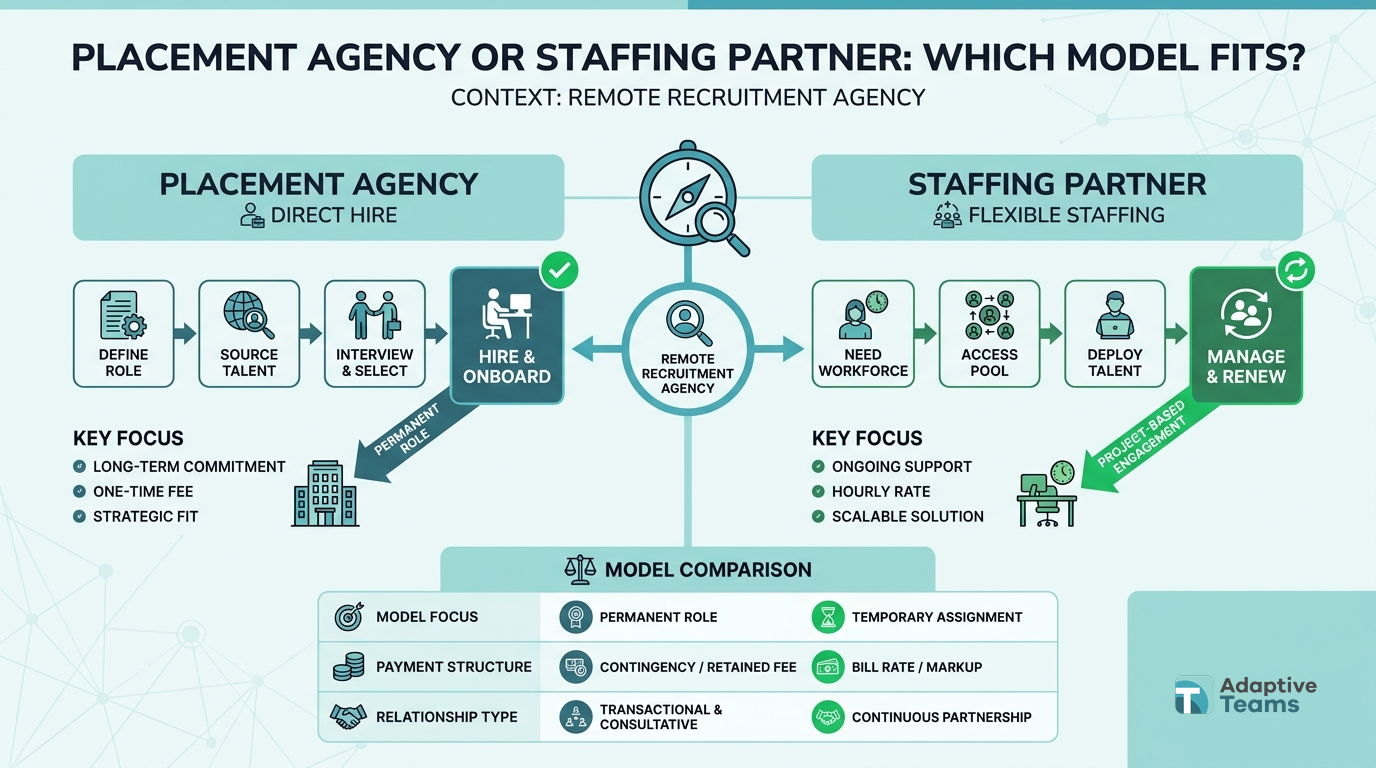
The right model depends on who you want to employ the person after day one. If you already have an entity and payroll in the hire’s country, a placement fee can work. If you do not, you need someone to employ or contract the person legally, and that is the part most first-time remote hirers underestimate.
| Remote recruitment agency (staffing partner) | Placement-only agency | Freelance marketplace | Recruiting in house | |
|---|---|---|---|---|
| Who finds candidates | The agency | The agency | You | Your team |
| Who screens | The agency | The agency | You | Your team |
| How you pay | Salary plus a monthly staffing fee | One-off fee per hire | Hourly or fixed rate plus platform fees | Recruiter time, job ads and tools |
| Contract and payroll | Handled by the agency | Yours | Through the platform, contractor only | Yours |
| If the hire leaves early | Replacement included | Depends on the fee terms | New search | New search |
| Best for | Long-term remote team members | Companies with a local entity | Short, defined tasks | Teams with a recruiter on staff |
Adaptive Teams runs the first column. We support both contractor and employee setups, depending on the role, the country and how you want to work with the person. We handle payroll through Deel.
Contractor or employee?
Classification is a legal question as much as a cost one. The IRS guide to independent contractors and employees looks at three kinds of evidence: behavioral control, financial control and the type of relationship. A person who works your hours, uses your tools and does core work for years looks like an employee, wherever they live. A good agency asks these questions during scoping. If you want to go deeper, our guide on contractor vs employee for startups covers the trade-offs.
How much does a remote recruitment agency cost?
Pricing comes in two shapes. Placement agencies charge a one-off fee per hire, often a share of first-year salary. Staffing partners bill the salary each month plus a management fee that covers recruitment, compliance, payroll, HR support and the replacement guarantee.
At Adaptive Teams the numbers are:
- Staffing: the agreed monthly salary plus a staffing fee of 60% for salaries up to $1,500, reducing to 30% for salaries above $4,500
- Recruitment-only: $4,000 per hire
- month-to-month contracts, no long lock-in
- Staffing fees between those bands: 50% for salaries of $1,501 to $2,500, 40% for $2,501 to $3,500 and 35% for $3,501 to $4,500
- Volume discounts on the staffing fee: 3% for 2 to 4 team members, 6% for 5 to 9 and 9% for 10 or more
Compare that with doing it yourself. According to SHRM’s benchmarking data, the average cost per hire in the US was nearly $4,700, and employers often put the full cost of a hire at three to four times the salary once lost time and ramp-up are counted. That figure covers domestic roles. Recruiting across borders adds work: pay benchmarks you do not know yet, interviews at odd hours and contracts in a legal system you have never used.
Markups are where agencies get vague. Before you sign, ask how much of the monthly invoice reaches the person doing the work. Our breakdown of staffing agency markup shows what a fair split looks like and which line items to question.
Get a Remote Hire Scoped This Week
Tell us the role and the hours you need covered, and we reply within 24 hours with a plan and a pay range.
How fast can a remote recruitment agency fill a role?
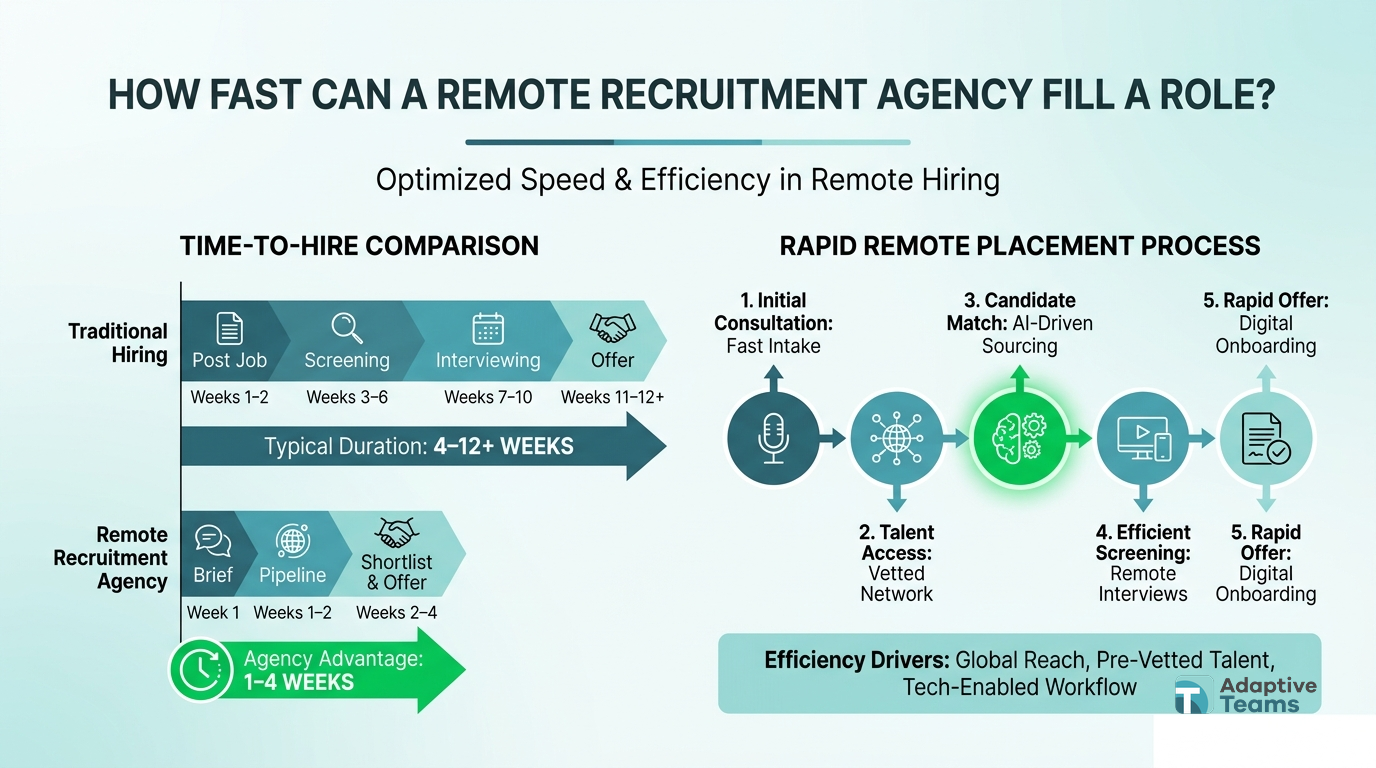
Most roles we take on are filled in 2 to 3 weeks from the scoping call. Specialized roles take 4 to 6 weeks. Traditional local hiring often takes 3 to 6 months for a single role.
Speed matters. The US Bureau of Labor Statistics JOLTS release for August 2026 counted 7.1 million job openings against 5.2 million hires. Good candidates have choices, and a slow, four-round process loses them to whoever makes an offer first.
Where the time goes
The first week is scoping and sourcing. Candidates usually apply in volume within days, so the bottleneck is screening. That is the work an agency takes off your plate: skills tests, recorded interviews and reference checks on 100+ people so you only interview the final 3 to 5. Week two or three is your interviews and the offer.
What should you check before you sign?
A shortlist of agencies all promise “top talent”. These questions separate them quickly:
Who employs the person after the hire? If the answer is “you”, you need your own contracts, payroll and tax setup in that country.
What happens if the hire leaves or does not work out? Ask for the replacement terms in writing. Ours is a free replacement during the first 2 months of employment.
How do they screen? Ask to see a sample skills test and how English is assessed. “We vet everyone” means nothing without the steps.
Which countries do they actually recruit in? An agency with people on the ground knows local pay. We recruit mostly in the Philippines and Latin America.
Is the contract month to month? Long minimum terms protect the agency more than you.
You will also want your own interview plan. Our guide on how to interview remote candidates has the questions we use to test communication and ownership over video.
What does it look like when it works?
The clearest example we have is KO Storage. It grew its team from 4 to 70+ people across 6 departments in 18 months working with Adaptive Teams. That is 17 times the team it started with, built role by role while KO Storage kept running the day-to-day work.
Our founders built the model on their own business first. Nate Ginsburg and Menno Gottmer grew a distributed team of 80+ people at SellerPlex, their Amazon agency, before opening Adaptive Teams to other companies. The lessons from that team are why we screen for written English and time zone overlap as hard as for skills.
The roles we fill most often are customer service, virtual assistants, data entry, accounting and bookkeeping, software development, digital marketing, project management, HR and operations, graphic design and content writing. If you are not sure what to budget for a role, our offshore salary benchmarks list real pay ranges by role and region.
When should you recruit in house instead?
An agency is not always the right call. Recruit yourself when you already have a recruiter with spare capacity and experience in the countries you want to hire in. The same goes for a single, one-off hire where you know the person you want, or when you have a legal entity and payroll in that country and only need a CV or two.
A freelance marketplace is the better fit for short, defined work: a logo, a one-month data cleanup, a landing page. You do the vetting, but you are not building a long-term relationship.
An agency earns its fee when you plan to hire more than one person, want them to stay for years and do not want to become an expert in foreign employment law to make that happen.
Where to start
Write down the role in one paragraph: the tasks, the hours that must overlap with yours and the budget. That is enough for a first conversation. From there, a scoping call turns it into a job description and a pay range, and candidates start coming in within days. Our recruitment services page shows the full process and pricing.
Frequently Asked Questions
How much does a remote recruitment agency charge?
It depends on the model. Placement agencies charge a one-off fee, often tied to first-year salary. Staffing partners bill the salary plus a monthly management fee. At Adaptive Teams staffing costs the agreed monthly salary plus a staffing fee of 60% for salaries up to $1,500, reducing to 30% for salaries above $4,500. Recruitment-only costs $4,000 per hire, and staffing contracts run month to month.
How long does it take to hire through a remote recruitment agency?
At Adaptive Teams most roles are filled in 2 to 3 weeks from the first scoping call, and specialized roles take 4 to 6 weeks. You only interview a shortlist of 3 to 5 people, because the agency screens the full pool of 100+ applicants before anything reaches your calendar.
Can a remote recruitment agency hire employees in other countries?
Yes, if it works with a payroll and compliance partner in those countries. Adaptive Teams recruits mostly in the Philippines and Latin America and handles payroll through Deel. Depending on the role and country, the hire joins as a contractor or an employee, and we handle the contract either way.
What happens if a remote hire does not work out?
With a staffing partner, you ask for a replacement and the search restarts at no extra cost. Adaptive Teams offers a free replacement during the first 2 months of employment. With a placement-only agency, check the guarantee period in the contract, because once it ends a new search usually means a new fee.
Ready to Build Your Dream Team?
Book a free staffing consultation with our remote team specialists. No obligations, just actionable insights for scaling your operations.