


The phrase talent development a guide for practice and research within sport points to a well-known sport science research volume, and behind it sit four decades of studies on how athletes go from promising to elite. The findings are uncomfortable for anyone who believes talent is something you find rather than something you build. The short version: early identification barely works, the environment matters more than the individual, and improvement comes from a specific kind of practice most organizations never design.
Table of Contents
That research was built on football academies and Olympic programs, but the mechanisms it describes are not about sport. They are about how humans acquire skill under pressure, with feedback, over years. Which makes it directly relevant to a question every operator running a distributed team eventually faces: you have hired capable people, so why are some of them compounding while others plateau?
This article pulls the sturdiest findings out of the sport literature and translates them into things you can actually run inside a remote or offshore team.
What the sport research actually found
Strip away the jargon and the talent development literature keeps returning to four findings.
Early identification is close to useless
Sport academies invested enormous sums in spotting future stars at age 10 or 12. The track record is poor. Most players selected early never reach elite level, and many eventual professionals were overlooked in early rounds. One reason is the relative age effect: a meta-analysis across sports found that children born early in a selection year are systematically overrepresented in talent programs, not because they are more talented but because they are a few months older and temporarily bigger. Selectors confused maturity with ability, at scale, for decades.
The business parallel is exact. Hiring processes that lean on pedigree, brand-name employers, or confident interview performance are selecting for the corporate version of “born in January”: polish that correlates with exposure, not with capacity to grow. If sport’s best-funded scouts could not reliably spot future performers, your 45-minute interview cannot either.
The environment outpredicts the individual
When researchers studied clubs that consistently produced elite athletes, the common factor was rarely a magic scouting formula. It was the development environment: long-term focus over early results, coaches who taught rather than ranked, clear next steps at every stage, and support that survived bad seasons. Programs with those features turned average intakes into strong cohorts. Programs without them burned through talented intakes and produced little.
For a team builder, this is the single most useful finding. It means the question “how do we hire better people?” is often the wrong question. The better one is “would a good person actually improve here, or just work here?”
Improvement requires deliberate practice, not repetition
Anders Ericsson’s research on deliberate practice drew a line between two things that look similar from the outside. Experience is doing the job. Deliberate practice is working at the edge of your current ability, on a specific weakness, with immediate feedback, repeatedly. Athletes log thousands of hours of the second kind. Most professionals log thousands of hours of the first kind and wonder why year eight looks like year three.
A bookkeeper who closes the books every month is getting experience. A bookkeeper whose manager reviews one close per quarter in detail, names the two slowest steps, and has them rework the process is getting practice. Same hours, completely different growth curve.
Development is nonlinear and takes years
Athlete trajectories are messy. Late bloomers overtake early stars. Progress stalls for a season and then jumps. The programs that produce elite performers are the ones that expect this and keep investing through the flat stretches. Programs that cut anyone who plateaus end up selecting for early maturity again, just later in the pipeline.
Translating this into a distributed team

The findings transfer cleanly, but only if you change what you measure and how you manage. Here is what each one looks like inside an offshore or remote team.
Hire for trajectory, not polish. Since early identification is unreliable, design interviews that sample the work instead of the resume. A structured working session shows you how a candidate thinks, takes feedback, and corrects course, which is precisely the raw material of development. We covered the mechanics of this in our guide to interviewing remote candidates for real team fit, and the sport research explains why it works: you are observing the development behaviors directly rather than inferring them from history.
Treat onboarding as the first development block, not paperwork. In sport terms, a new hire is entering your academy. The first 90 days set their trajectory more than the next two years will. That means a real ramp plan with graduated difficulty, not a folder of logins and a “reach out if you have questions” message. Our piece on remote onboarding best practices lays out the structure; the research adds the reason it pays off for years.
Turn managers into coaches, deliberately. The environment finding lands hardest here. In distributed teams, the manager is nearly the entire development environment, because there is no office osmosis to fall back on. A manager who only assigns and checks work gives people experience. A manager who reviews real work samples, names one specific improvement, and follows up next cycle gives people practice. The habits that make this work remotely are covered in how to manage remote employees effectively.
Budget for the plateau. Expect a strong hire to stall at some point in year one or two. In the sport data that is a normal part of the curve, not a signal to cut. The teams that win long term are the ones still coaching through month nine while competitors are already re-hiring, and re-hiring is the more expensive path: with U.S. job openings still above five million a month, replacing a role costs more than developing the person in it almost every time the person is coachable.
Build a Team That Gets Better Every Quarter
Tell us the roles you need and we will build an offshore team designed around development, not just placement.
The traps that quietly kill development
Sophisticated operators fail at this in predictable ways. The sport literature names most of them; the rest come from watching companies try.
Confusing selection with development. Running a hard hiring process and then providing no coaching is the corporate version of a club that scouts brilliantly and trains badly. The intake was expensive and the output is average. If your only development mechanism is “we hire well,” you do not have one.
Promotion as the only reward for growth. When the sole way to recognize improvement is a title change, you cap development at the org chart. Athletes improve for years inside the same role. Give your people the equivalent: expanded scope, harder problems, visible mastery, and pay that tracks skill, without requiring a management seat that may not exist.
Annual reviews as feedback. Deliberate practice needs feedback measured in days, not quarters. An annual review is a scoreboard, not coaching. If the only structured feedback a team member gets arrives twelve months after the work, you are running a sports program where the coach watches one game a year. Gallup’s ongoing workplace research keeps finding the same thing: engagement tracks manager behavior, and manager behavior is weekly, not annual.
Mistaking tenure for growth. Five years of experience can be five years of compounding or the same year repeated five times. If you cannot name what a team member can do now that they could not do a year ago, the honest answer is probably that nothing changed, and that is a system failure before it is a personal one.
Developing only the stars. Talent programs that concentrate resources on early standouts get burned by the relative age effect in slow motion: they over-invest in polish and cut future late bloomers. Spread the coaching. Your third-best performer with a steep curve is worth more over three years than your best performer who has flatlined.
A 90-day development loop you can run this quarter
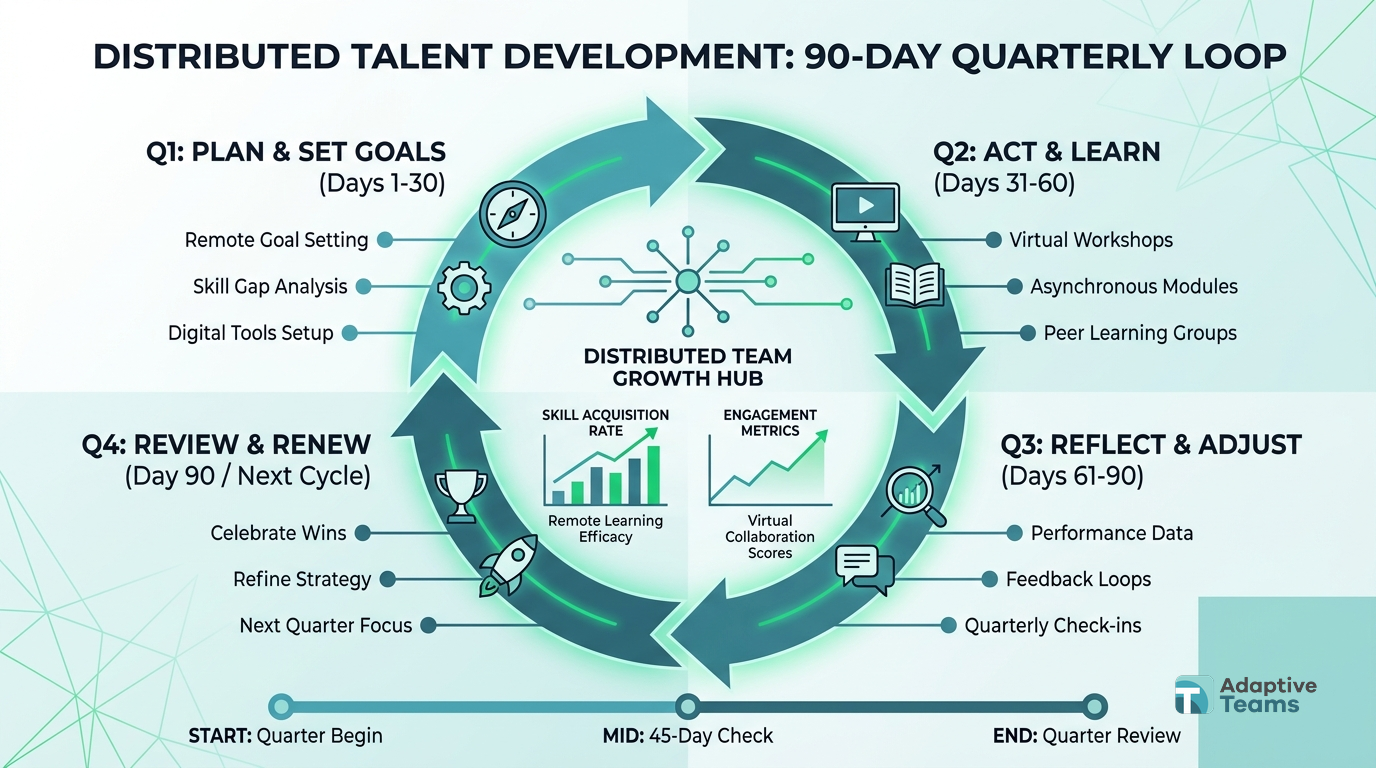
You do not need an HR platform to apply any of this. You need a repeating loop per person. Here is one that works at the scale of a five-person offshore team or a fifty-person department.
- Pick one edge per person. With each team member, name a single skill that is currently just beyond them. One. Writing client-ready summaries, owning a monthly close end to end, running a standup. Write it down where both of you can see it.
- Design the rep. Agree on the recurring piece of real work where that skill shows up. That work item is now their practice ground. No simulations needed; the job provides the reps.
- Review the work itself, on a schedule. Every one or two weeks, the manager reviews one concrete work sample against the named skill and gives one specific correction. Fifteen minutes. Not a status meeting.
- Log the delta. Once a month, write two sentences: what improved, what is next. This tiny artifact is what makes growth visible at review time and what tells you, honestly, whether development is happening.
- Reset every 90 days. Skill mastered: pick the next edge. Skill stalled: change the rep or the feedback before changing the person.
Run this for two quarters and you will know more about your team’s real trajectories than years of annual reviews would tell you. It is also, not coincidentally, the structure a good coach runs by instinct.
Frequently asked questions
Does sport talent research really apply to office and remote work?
The specific drills do not transfer, but the mechanisms do. Skill acquisition through feedback-rich practice, the outsized role of environment, and nonlinear progress are findings about human learning, not about sport. They have been replicated in music, medicine, and chess, which is strong evidence they describe how people improve at complex work generally.
How much time does structured development actually cost a manager?
Roughly 20 to 30 minutes per person per week if you run a loop like the one above: one short work review plus a monthly note. It replaces time managers currently spend re-explaining, correcting output late, and interviewing replacements, so most teams experience it as a net gain within a quarter.
Can offshore team members be developed to senior level, or only managed?
They develop exactly like local hires when the environment supports it. The failure mode is treating offshore staff as interchangeable capacity that gets tasks but never coaching. Teams that include offshore members in the same development loop routinely grow them into leads and managers of their own pods.
What should we do with someone who plateaus despite coaching?
First change the practice design: a different rep, tighter feedback, or a smaller skill edge. Plateaus are normal and usually break within a quarter when the loop changes. If two redesigned cycles produce no movement and the person is disengaged from the process itself, that is a fit conversation, and you can have it knowing the system gave them a real chance.
Should development plans be tied to promotions?
Loosely. Tie them to skills and scope, and let promotions follow when the org chart allows. Hard-coupling development to promotion creates a ceiling problem: people stop developing when no seat is open, which is precisely backwards.
Where to start
Pick three people, run the 90-day loop, and judge it on evidence: work samples improving cycle over cycle. That is the whole entry cost of applying forty years of talent research to your team.
If you would rather start with a team that is built for this from day one, that is what we do. Adaptive Teams recruits offshore professionals and builds the management structure around them so development is part of the operating system, not an afterthought. Start with our performance management support or book a free staffing consultation and tell us what you are trying to build.
Ready to Build Your Dream Team?
Book a free staffing consultation with our remote team specialists. No obligations, just actionable insights for scaling your operations.