



Introduction
If your team is growing, HR admin usually grows faster than expected. You start with a few hires. Then, suddenly, you are dealing with onboarding delays, payroll questions, contractor paperwork, time-off tracking, and performance issues that pull leadership away from revenue work. That is exactly why many operators choose to outsource HR operations.
Table of Contents
When you outsource HR operations, you shift repetitive and high-risk people processes to a specialist partner while keeping control over strategy, culture, and headcount decisions. In this guide, you will learn how the model works, where it delivers the biggest operational upside, which mistakes create risk, and how to build a setup that actually supports long-term team growth.
What Is Outsource HR Operations?
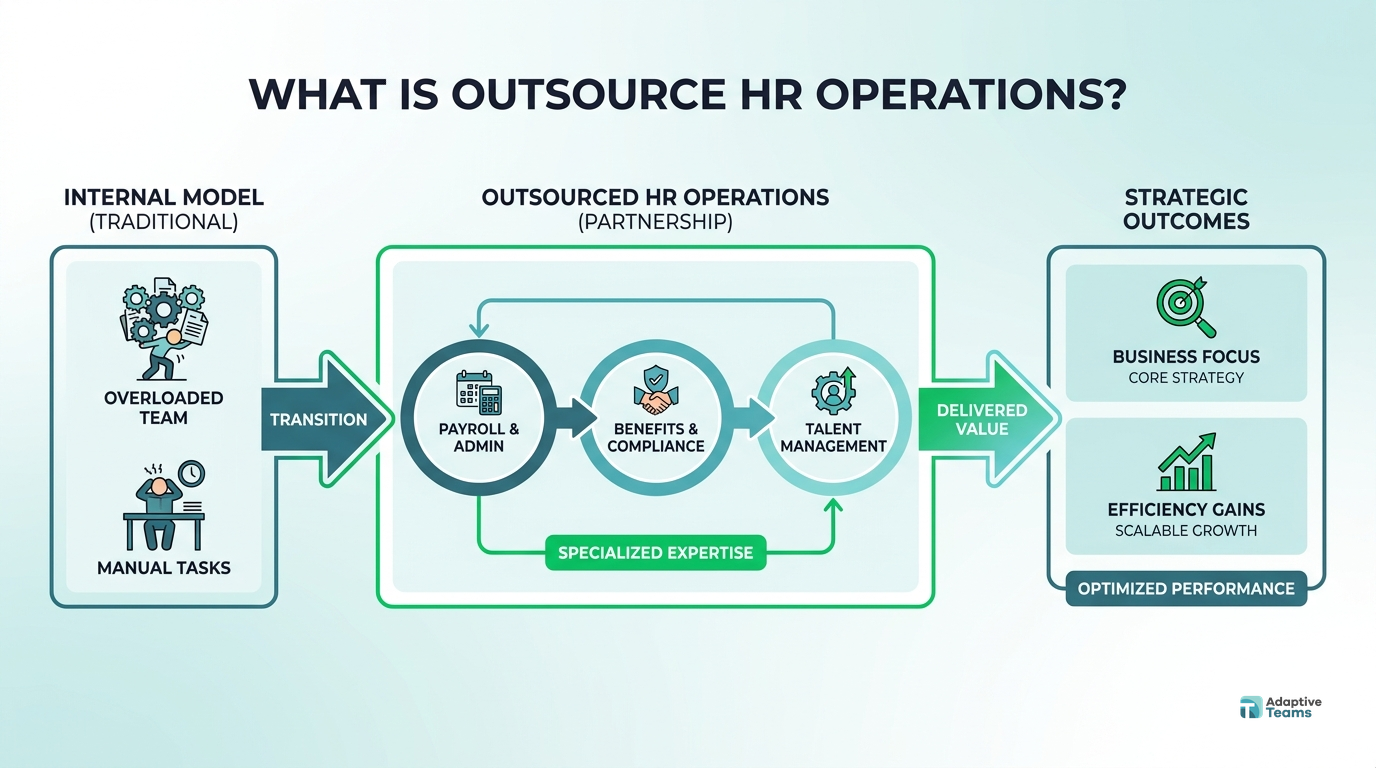
Outsource HR operations means using an external partner to run some or all of your day-to-day HR workflows. For example, that can include recruiting coordination, onboarding, payroll administration, compliance support, documentation, performance tracking, benefits coordination, and offboarding. Instead of building every process internally, you use outside infrastructure to reduce operational drag.
For growing companies, this matters because HR complexity rarely stays small. According to the U.S. Bureau of Labor Statistics, employee benefits account for roughly 30% of total compensation costs in many roles, which shows how quickly workforce administration becomes a real cost center. Additionally, the Society for Human Resource Management has repeatedly highlighted how compliance errors and poor onboarding increase turnover and replacement costs.
In practice, when you outsource HR operations, you are not giving up control. Instead, you are creating a system that lets your internal team focus on hiring decisions, culture, and performance outcomes. If you are scaling across markets or hybrid worker types, this can become a major operational advantage. For more context, see HR outsourcing for small business.
How It Works
When you outsource HR operations, the model works best when responsibilities are clear from day 1. In other words, you keep strategic ownership while the external partner runs execution-heavy workflows.
1. Define the scope
First, you identify which HR activities create the most friction. That usually includes onboarding, payroll, contracts, leave tracking, compliance documentation, and performance follow-up.
2. Choose the worker model
Next, you decide whether you need contractor support, employee support, or a mix of both. This matters because the right setup depends on geography, role type, tax exposure, and how embedded the team member will be.
3. Build the operating workflow
Additionally, you map handoffs between your managers and the HR operations partner. For example, your team may own hiring approvals and role design, while the partner owns sourcing coordination, paperwork, payroll runs, and recurring check-ins.
4. Centralize systems and reporting
Then, the partner creates shared workflows for contracts, onboarding documents, payroll schedules, performance reviews, and issue escalation. That reduces fragmentation and gives leadership one source of truth.
5. Review and optimize monthly
Finally, you track a few operating metrics such as time to fill, onboarding completion time, payroll accuracy, retention, and manager satisfaction. Those numbers tell you whether the outsourced model is removing friction or just moving it.
Therefore, the goal is not to outsource people management. The goal is to outsource the heavy operational layer so your leaders can spend more time building teams and less time managing admin. When you outsource HR operations with clear scope and reporting, the process becomes easier to scale across functions and markets.
Key Benefits
If you outsource HR operations well, the upside is not just convenience. More importantl
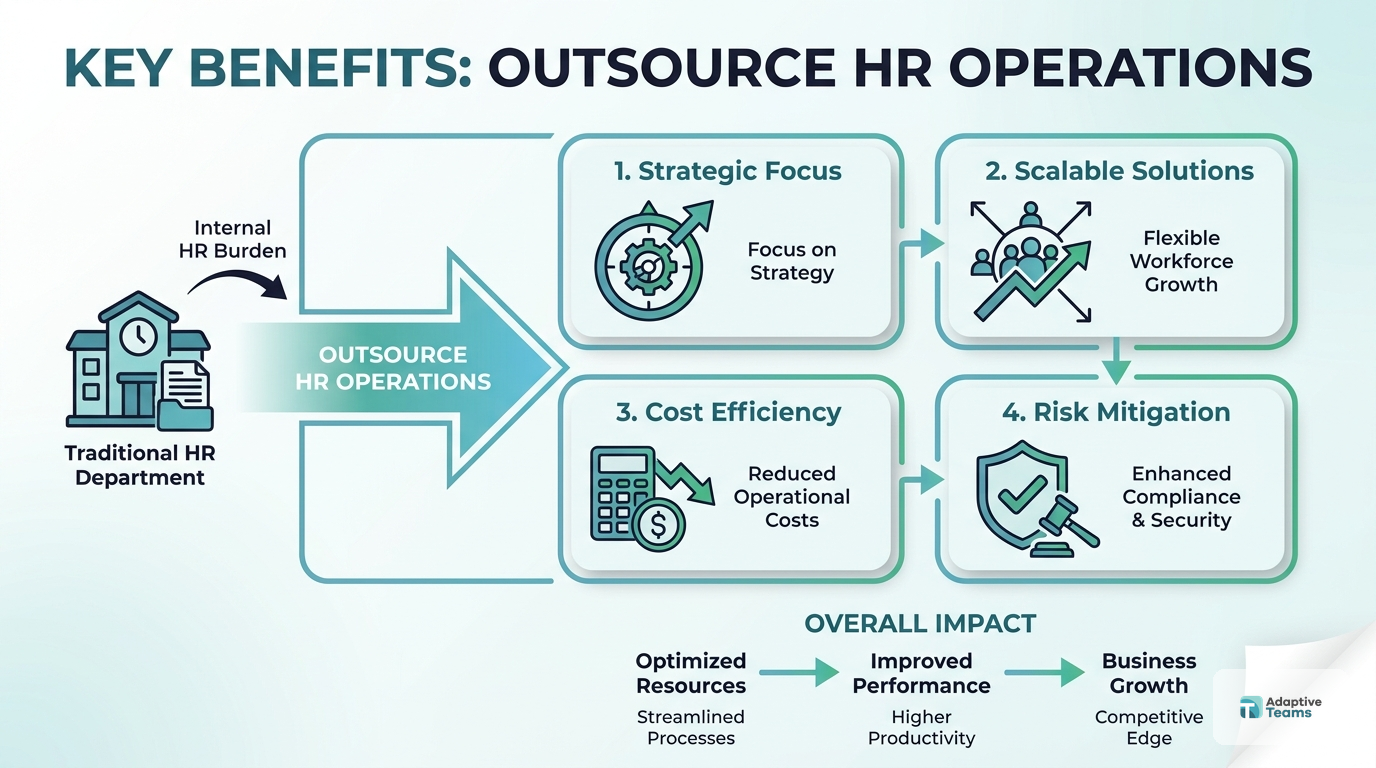
y, it changes how efficiently your business can scale.
Lower administrative overhead
According to research from Deloitte on outsourcing trends, companies often outsource to improve efficiency and free internal teams for higher-value work. That matters when founders or operations leaders are still handling HR manually.
Faster hiring cycles
A structured partner can reduce delays in sourcing coordination, interview scheduling, document collection, and onboarding. As a result, open roles move faster and managers spend less time chasing logistics.
Better compliance coverage
Misclassification, payroll errors, and missing documentation are expensive. Therefore, a partner with process discipline can reduce preventable compliance exposure.
More predictable employee experience
When HR processes are standardized, every new hire gets a more consistent onboarding and support experience. That consistency improves confidence and often supports better retention.
Easier multi-market expansion
If you plan to hire across borders, local requirements change quickly. An outsourced model helps you avoid rebuilding the same HR infrastructure country by country.
Stronger manager leverage
Managers should spend time coaching performance, not solving payroll tickets. Consequently, outsourcing HR operations gives department leaders more room to focus on output.
Reduced founder involvement
This is often the biggest hidden win. If you keep getting dragged into contracts, payroll questions, or exit admin, you are paying an opportunity cost that rarely shows up in your P&L. When you outsource HR operations, you protect leadership time that would otherwise disappear into repetitive admin.
Step-by-Step Guide
If you want to outsource HR operations without creating confusion, use this process.
Step 1: Audit your current HR workload
First, list every recurring HR task your team handles each month. Include recruiting admin, contract preparation, onboarding, payroll, leave tracking, performance reviews, and offboarding. Then estimate time spent and error frequency.
Step 2: Separate strategic work from operational work
Next, decide what your internal team should always own. Usually, that includes headcount planning, hiring standards, compensation philosophy, and culture. Everything else is a candidate for outsourcing.
Step 3: Identify your highest-cost bottlenecks
Additionally, look for tasks that slow growth or create avoidable risk. For example, if payroll takes 2 days per month, onboarding feels inconsistent, or contractor compliance is unclear, start there.
Step 4: Define your ideal support model
Do you need recruiting plus HR administration, or only back-office support after hire? In some cases, you need a long-term embedded staffing partner rather than a pure admin vendor. Offshore staffing solutions can be useful here when you want hiring and HR infrastructure together.
Step 5: Standardize core workflows before handoff
Before you outsource HR operations, document approvals, timelines, and responsibilities. Otherwise, you will outsource confusion. Create simple SOPs for onboarding, payroll cutoffs, leave requests, and issue escalation.
Step 6: Set service levels and reporting rules
Agree on turnaround times, reporting cadence, and escalation thresholds. For instance, payroll corrections may require same-day handling, while onboarding docs may have a 24-hour SLA.
Step 7: Align managers early
Furthermore, train managers on the new process. They need to know where requests go, what gets handled externally, and what still stays internal. That removes adoption friction.
Step 8: Review performance every month
Finally, track results against baseline metrics. Look at time to onboard, payroll accuracy, issue resolution time, retention, and manager satisfaction. If the numbers are flat, improve the workflow. The more intentionally you outsource HR operations, the easier it becomes to keep standards consistent as your headcount grows.
Remove HR Admin Bottlenecks Fast
See how a managed staffing and HR setup can free your team to focus on growth.
Best Tools & Resources
You do not need a bloated tech stack to outsource HR operations effectively. However, you do need the right categories of tools and resources.
Payroll and labor guidance
First, use official guidance from the U.S. Department of Labor or the relevant labor authority in your hiring market. This helps you validate classification, wage rules, and documentation requirements.
Benchmarking and HR research
Additionally, SHRM is useful for policy guidance, onboarding practices, and HR operating benchmarks. It is especially valuable when you are redesigning internal workflows.
Global employment data
Furthermore, the OECD employment database is useful when you want broader labor market context, wage trends, and cross-country workforce indicators before you outsource HR operations across markets.
Workforce cost modeling
A simple finance model is a powerful resource. In other words, calculate the fully loaded internal cost of payroll admin, recruiting coordination, compliance management, and turnover. That gives you a real basis for evaluating outsourcing ROI.
Team management systems
If your workforce is remote or distributed, strong team operations matter just as much as payroll. Remote team management tools can help you connect HR support to actual performance tracking.
Embedded staffing partner
Finally, if you need hiring, payroll, HR support, and performance oversight in one model, an embedded staffing partner may be more effective than stitching together separate vendors when you outsource HR operations for long-term team growth.
Common Mistakes to Avoid
Many companies outsource HR operations and still end up frustrated. Usually, the problem is not the model. The problem is weak implementation.
Treating outsourcing like abdication
If you expect a partner to fix broken internal decision-making, you will be disappointed. You still need clear ownership, manager accountability, and a defined people strategy.
Choosing only on headline price
A lower monthly fee can hide slower turnaround, weaker compliance support, or poor follow-up. As a result, you may save on paper and lose far more in delays and rework.
Ignoring manager adoption
If managers do not know how to use the new process, requests keep flowing through ad hoc channels. Therefore, the outsourced team never gets clean inputs and response times deteriorate.
Using the wrong worker model
Some roles fit contractors well. Others require an employee model because of control, integration, or legal factors. If you force one model everywhere, you increase risk.
Failing to measure outcomes
Without KPIs, you cannot tell whether you improved anything. Real-world consequences include payroll mistakes, slower onboarding, higher turnover, and more founder escalation. If you outsource HR operations without a scorecard, hidden failures stay hidden until they become expensive.
Advanced Tips & Strategies
Once the basics are working, you can outsource HR operations in a way that improves operating leverage even more.
Build role-based workflow templates
First, create separate onboarding and performance templates for customer support, operations, finance, and specialist roles. That reduces exceptions and speeds up execution.
Tie HR operations to retention metrics
Additionally, do not stop at admin accuracy. Track 90-day retention, ramp time, and manager satisfaction by hiring lane. That shows whether your HR operation is actually improving business performance.
Combine staffing and performance oversight
If you are building global teams, the most effective setups often include recruiting, payroll, and structured performance follow-up together. For example, building offshore teams becomes easier when one system covers the full employee lifecycle.
Create a leadership dashboard
Furthermore, report only the metrics leaders need: open roles, time to fill, onboarding completion, active issues, payroll accuracy, and retention. Simple dashboards improve decision speed.
Use scenario planning before expansion
Before entering a new market, model contractor versus employee cost, compliance workload, management capacity, and likely retention risk. In fact, this often prevents expensive hiring structure changes later. If you plan carefully before you outsource HR operations, you avoid rebuilding your people systems six months later.
Frequently Asked Questions
Should you outsource HR operations as a small business?
Yes, if HR admin is slowing hiring, creating compliance risk, or taking leadership time away from growth. Small businesses usually benefit when recurring workflows are handled by a specialist while internal leaders keep strategic control.
What does it mean to outsource HR operations?
It means an external partner manages some or all day-to-day HR tasks such as onboarding, payroll administration, documentation, compliance support, and employee lifecycle workflows. You still decide who to hire and how to lead the team.
Is it cheaper to outsource HR operations?
Often, yes, but the bigger value is not just lower cost. The stronger return usually comes from reduced admin time, fewer payroll or compliance errors, faster hiring, and better manager leverage.
Which HR functions should you outsource first?
Most companies start with payroll support, onboarding administration, contracts, compliance documentation, and recurring employee support tasks. Those are usually the highest-friction workflows with the clearest process structure.
Can you outsource HR operations for remote teams?
Yes, and in many cases it is even more valuable for distributed teams. Remote hiring creates more documentation, coordination, payroll, and compliance complexity, especially across multiple countries or worker types.
Does outsourcing HR operations reduce control?
Not if the model is designed correctly. You should keep ownership of workforce strategy, hiring decisions, compensation direction, and team culture while the external partner runs defined processes.
How do you choose the right HR operations partner?
Look at process clarity, reporting quality, compliance support, turnaround times, and whether the partner can support long-term team building. If you need deeper integration, review how to manage remote employees effectively and contractor vs employee for startups to align the model with your workforce plan.
Next Steps
If you plan to outsource HR operations, start by auditing where your current process wastes the most time or creates the most risk. Then build a clear division between strategic ownership and operational execution. That is what turns HR support into real leverage instead of another layer of complexity.
Ultimately, the right setup helps you hire faster, reduce compliance exposure, and give managers more time to lead. If you want a long-term model that combines recruiting, payroll, HR support, and performance oversight, book a free staffing consultation and see what an embedded team infrastructure could look like for your business. When you outsource HR operations with the right partner, you create a system that scales with your business instead of slowing it down.
Ready to Build Your Dream Team?
Book a free staffing consultation with our remote team specialists. No obligations, just actionable insights for scaling your operations.
Related reading: PEO vs EOR for International Hiring.