

TL;DR
Choose an offshore development partner by whether it takes management work off your team. A cheap team that needs 8 hours a week of rework from your engineers costs more than it saves. Look for partners who screen for communication, show the full monthly cost up front and work to prevent turnover. Define your real constraint before you compare vendors on rate.
Offshore development companies can give you a lasting engineering advantage. They can also add one more layer of coordination your team has to manage. The difference rarely comes from the country, the hourly rate or the tech stack. It comes from whether the partner can recruit, onboard, manage, retain and improve people inside the way you already work.
For a growing company the real question is not "Can we find developers abroad?" You can. The question is whether the offshore model will reduce delivery drag or just move it to a cheaper time zone.
That difference matters. A lower rate does not help if your senior engineers spend 8 hours a week rewriting unclear tickets, fixing defects that should not have shipped or managing churn. A partner that looks cheap on paper gets expensive once you count rework, missed sprint goals and founder time.
This guide gives you a practical way to judge offshore development companies before you sign. It covers team structure, accountability, cost, communication, HR support and the traps that make offshore hiring underperform.
Start with the capacity problem, not the vendor list
Most searches for offshore development companies begin with a comparison table. That is backwards. Before you compare providers, define the constraint you want to remove.
Are you short on people to ship a stable roadmap? Do you need specialist skills for one product area? Are local hiring cycles too slow? Is your engineering manager now also a recruiter, an onboarding lead and a performance coach?
Each constraint points to a different model.
- If you need 2 backend engineers to extend an existing team, staff augmentation may be enough.
- If you need a managed product squad with QA, delivery oversight and retention support, you need more than a partner that forwards CVs.
- If you need to take the founder out of recruiting, payroll, HR and performance management, you need a partner built to run that layer, not just to source.
This is where many companies lose margin. They buy "developers" when the real bottleneck is management capacity. The work still runs through the same overloaded leaders, just with more handoffs.
The 4 operating models you are really comparing
"Offshore development company" is a broad label. Under it sit several models with very different tradeoffs.
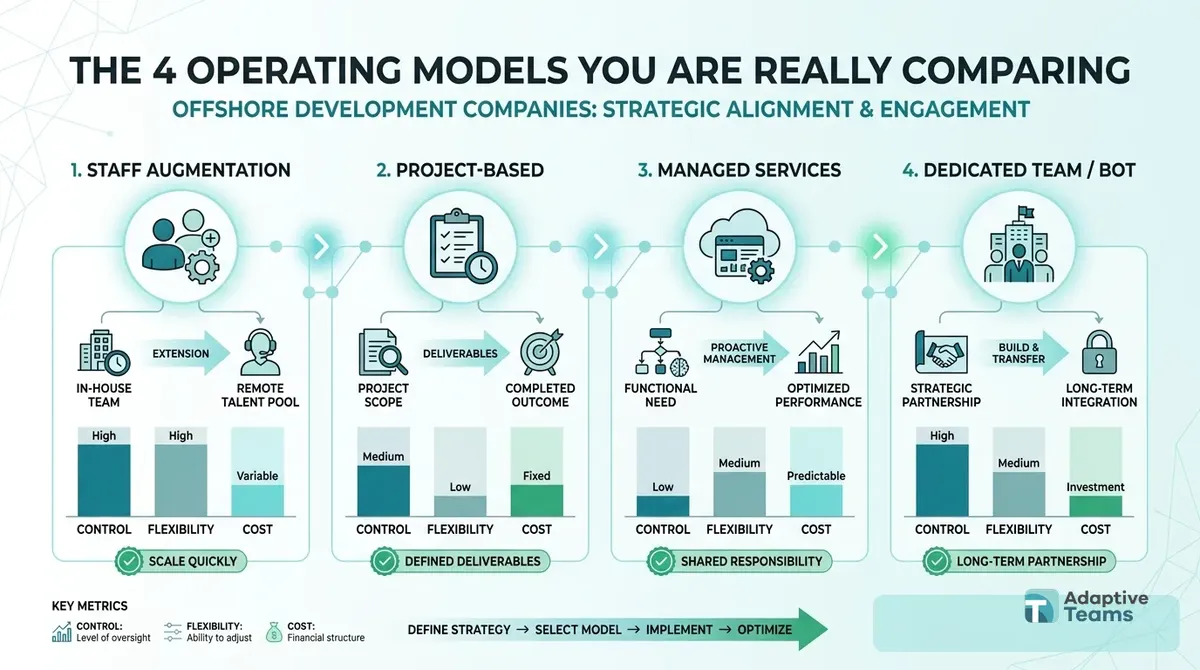
Project-based development shops
These companies quote a fixed scope, deliver the project and usually manage the work themselves. That can fit a fixed build where the spec is clear and you can check the output against a known standard.
The risk is flexibility. When priorities change, you renegotiate scope instead of redirecting people. If your roadmap is still moving, a project-based shop creates commercial friction right when you need speed.
Staff augmentation providers
Staff augmentation gives you individual developers who join your existing workflow. You keep technical leadership, backlog ownership, sprint planning and performance standards. Our software team augmentation service works this way. Engineers join your stack and your standups while we run contracts, HR and payroll.
This model works when your team already has strong management capacity. It fails when your managers are stretched. Adding people without adding coordination capacity can slow a team down before it speeds up.
Dedicated offshore teams
A dedicated offshore team gives you long-term capacity, often with developers, QA, support roles and a management layer. It is usually the best fit for companies that want people embedded in their rhythm, tools and culture.
The key word is "dedicated." You are not renting a temporary bench. You are building a team that should learn your codebase, your customers and your delivery standards over time. Our guide to the benefits of offshore teams covers this model in more depth.
Managed staffing with HR infrastructure
Some providers combine recruitment, HR operations, payroll, compliance, performance oversight and replacement support. Look at this model when you want offshore development capacity without building the whole people operations layer yourself.
You do not give up control. You keep control of priorities and standards while the partner runs the infrastructure around the team. For growing companies that often matters more than another 5 percent off the rate.
If you need senior engineers who own a whole build inside your business, look at forward deployed engineers. They cost $4K to $6K a month, against $15K to $25K for a comparable in-house hire.
What good offshore development companies do differently
The best providers are not just better at sourcing engineers. They are better at turning distributed hiring into steady output.
They screen for working style, not only technical skill
Technical screening is necessary, but it is not enough. A developer who does well on an isolated coding test may struggle in a remote product team with unclear requirements, async updates and dependencies across teams.
Strong partners test for clear communication, ownership, documentation habits, time zone fit and how candidates handle incomplete information. Those traits cut management load after the hire.
They make cost visible before you commit
The U.S. Bureau of Labor Statistics shows how high local software developer pay climbs. Add benefits and competition for talent and the gap grows. Offshore hiring can lower the fully loaded cost, but the hourly rate alone is not a useful comparison.
Ask for the full monthly cost by role, how every fee is calculated, the replacement policy, equipment expectations, who runs payroll and what management is included. If a vendor cannot explain what you are paying for, assume the margin is hidden somewhere you will feel later.
Here is how we price it. You pay the salary plus a staffing fee, a percentage of that salary: 60% up to $1,500 a month, 50% up to $2,500, 40% up to $3,500, 35% up to $4,500 and 30% above that. A mid-level automation engineer in Latin America earns $1,500 to $2,250 a month in our salary benchmarks. At a $2,000 salary the total is $3,000 a month. A senior developer at $5,000 costs $6,500. Recruitment is included and there is no placement fee.
They protect continuity
Churn quietly destroys offshore returns. When a developer leaves after 4 months, you lose codebase knowledge, delivery rhythm and management time. Fast replacement matters, but prevention matters more.
Ask how the company handles retention, check-ins, career growth, pay reviews and performance support. A serious partner has a clear answer. A weak partner treats turnover as your problem once the invoice is paid. At Adaptive Teams every placement has a dedicated manager, and our performance management includes formal reviews twice a year.
They support both contractor and employee paths
There is no single answer to contractor versus employee status. The right model depends on the role, the country, how long the work lasts, how much you control it, compliance rules and how closely the person works with your team.
The right partner helps you weigh both options. It should not force every hire into one model because that is easier for its back office. SHRM's overview of worker classification is a useful reminder that classification is an operating risk, not paperwork. Our guide on hiring contractors internationally walks through the checks.
The evaluation checklist that prevents expensive mismatches
Use this checklist before you compare proposals. It shows whether a provider can support the way your company actually works.
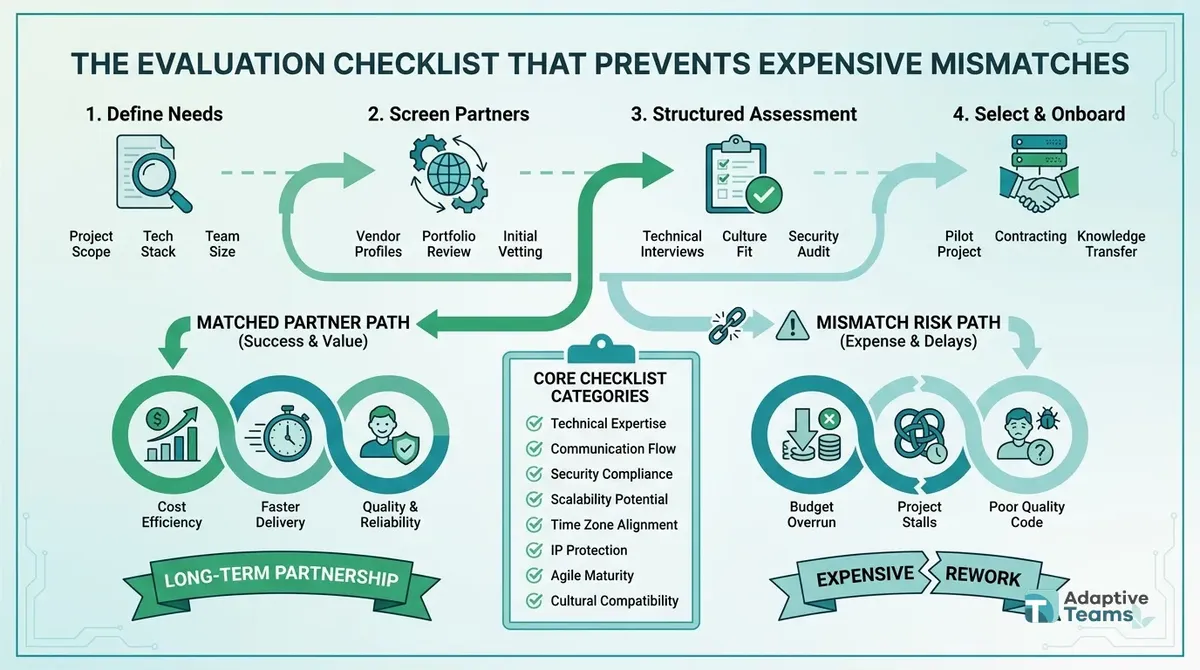
Role clarity
Define the outcomes each role owns. Avoid vague requests like "senior full-stack developer." A better brief says: maintain and extend a Node and React product, improve API reliability, review junior code, join sprint planning and document technical decisions.
The clearer the context, the easier it is to judge fit. It also stops providers from sending impressive profiles that miss the actual work.
Management responsibility
Decide who manages delivery, feedback, performance, attendance and escalation. If the answer is "our internal engineering manager," confirm that person has time.
A team lead who already runs sprint planning, roadmap tradeoffs, incident response and hiring interviews may have no room for 4 offshore hires. The extra output you expected disappears into coordination.
Communication rhythm
Look at overlap hours, written update standards, meeting expectations, documentation habits and escalation paths. A team can work across time zones if the rhythm is designed for it. Latin America shares most of the US workday. See hiring in Latin America for what that looks like in practice.
Poor communication is often a system problem, not a people problem. If tickets are vague, priorities change in private chats and decisions go undocumented, even strong offshore developers will underperform. The right remote team management tools help here.
Quality control
Ask how code review, QA, release readiness and defect follow-up work. Who catches weak output before it reaches your team? What happens when quality slips?
High-output offshore teams set standards before the first sprint. They do not wait for a missed deadline to invent a review process.
Replacement and ramp time
Replacement guarantees only help if they are specific. Ask what triggers a replacement, how fast the partner acts, who covers the ramp period and whether knowledge transfer is planned. Our guarantee is a free replacement in the first 2 months.
For long-term roles, also ask how the provider keeps people engaged. Retention is part of delivery. A structured onboarding plan protects the first 30 to 90 days.
Cost comparison: what to include beyond salary
Offshore development is attractive because the cost gap can be real. But the savings only count if you compare the full operating cost.
Include recruitment time, internal interview hours, management load, payroll admin, compliance support, equipment, benefits where relevant, turnover, delayed delivery and rework. Deloitte's research on global human capital trends keeps showing that how you organize your workforce affects productivity, not only hiring cost.
A useful comparison looks like this:
| Option | Speed | Cost | Management load | Best fit |
|---|---|---|---|---|
| Local hire | Slow to fill, high competition for talent | Highest | Internal HR workload | Roles that need full time zone alignment |
| Freelancer marketplace | Fast access | Varies | High, with uneven retention | Short, well-defined projects |
| Offshore development company | Varies by provider | Lower fully loaded cost | Depends on screening and oversight | Defined builds or extra capacity |
| Managed offshore team | Most roles in 2 to 3 weeks with us | Lower fully loaded cost | HR and payroll handled for you | Long-term embedded delivery |
The cheapest option is rarely the lowest-risk option. The best choice is the model that removes the constraint you actually have.
Red flags when reviewing offshore development companies
Some warning signs show up before the first contract.
- Resumes before questions. If a provider sends resumes before asking about your delivery process, it is matching keywords, not needs.
- Pricing that is too simple for complex roles. One blended rate across seniority levels, regions and management needs can hide tradeoffs you find later.
- No retention process. Offshore hiring is not a one-time transaction. The value grows when people stay long enough to learn your systems.
- Promises of full autonomy. Be skeptical if nobody asks who owns product decisions. Developers can work independently inside a clear system, but they cannot replace your product strategy.
- Slow sales follow-up. Slow replies, unclear ownership and vague next steps before the deal usually get worse after it.
How to run a low-risk first engagement
You do not need to bet the roadmap on the first hire. Test the model with one focused role or a small team.
Start with work that is important but bounded. Examples include clearing backlog in a stable product area, QA automation, support engineering, data pipeline maintenance or frontend work against a defined design system. Our page on how we hire software developers shows the roles we fill most.
Set expectations before the start date. Define the first 30 days, the communication rhythm, success metrics, the review schedule and the escalation path. Do not wait for the developer to guess your standards.
Measure the right signals: cycle time, review quality, ticket clarity, defect rates, handoff load and manager time. If you only measure hours worked, you miss the real economics.
If the first engagement works, grow around a stable core. Add roles that complement it, write down your rituals and build continuity. This is how offshore development moves from cheap labor to real capacity.
Where to start
Choosing between offshore development companies is not only a buying decision. It is a decision about how your company operates.
If your team already has strong management capacity, a focused staff augmentation provider may be enough. If your bottleneck includes recruitment, HR, payroll, performance oversight and retention, choose a partner that supports the whole team lifecycle. To compare providers side by side, see our list of the best offshore staffing companies.
Adaptive Teams builds offshore teams that work as part of your business, with recruitment, HR operations, payroll, compliance and performance management around the people doing the work. Start with recruitment services and build the development capacity your roadmap needs.
Frequently asked questions
Are offshore development companies cheaper than hiring locally?
Often, on fully loaded cost, especially for software roles in high-demand markets. The savings depend on seniority, location, the management model, retention and how much internal coordination the offshore setup needs.
What is the difference between staff augmentation and a dedicated offshore team?
Staff augmentation adds individual developers to your existing team, and you manage them. A dedicated offshore team is built for long-term capacity and may include delivery oversight, QA, HR support and a more structured working rhythm.
How do I know if an offshore development company is reliable?
Look for detailed questions about the role, clear pricing, strong candidate screening, specific replacement terms, a retention process and a communication rhythm that matches your team. References and a small first engagement also help.
Should offshore developers be contractors or employees?
Both can work. The right choice depends on the country, the scope of the role, how much you control the work, how long it lasts, compliance rules and how closely the developer works with your team.
How long does it take to build an offshore development team?
It depends on the roles and the market. With Adaptive Teams most roles are filled in 2 to 3 weeks, and specialist or senior roles can take 4 to 6. A multi-role team takes longer, because screening, onboarding, management setup and team fit all need to be done properly.
How much does an offshore developer cost with Adaptive Teams?
You pay the salary plus a staffing fee of 30% to 60% of it, depending on the salary band. A developer on $2,000 a month costs $3,000 in total, and one on $5,000 costs $6,500. Recruitment is included and contracts run month to month.

Written by the people who recruit, pay and manage remote teams every day, with Nate Ginsburg and Menno Gottmer. About Adaptive Teams