
PEO vs EOR for International Hiring: Which Model Fits Your Growth Plan?
TL;DR: Use a PEO if you already have a registered entity in the country and want support with local payroll and HR. Use an EOR if you don’t have an entity yet and need to hire quickly, since it becomes the legal employer on your behalf. An EOR often costs more per head but is cheaper overall early in expansion.
If you are weighing PEO vs EOR for international hiring, you are not alone. According to the World Bank, starting a foreign entity can take weeks or months depending on the country, while cross-border compliance keeps getting more complex as labor rules, tax obligations, and worker-classification standards tighten. As a result, many growing companies now compare these two models before they hire their first overseas team member.
Table of Contents
In this guide, you will learn what each model actually does, where the legal and operational differences matter, how to choose based on your stage, and what mistakes can quietly increase cost and risk. If you want to expand internationally without building unnecessary HR infrastructure, this breakdown will help you make the right call.
Introduction
If you are researching PEO vs EOR for international hiring, you are likely trying to balance hiring speed, compliance risk, and operating complexity at the same time. That is a high-stakes decision because the wrong model can delay hiring, inflate costs, or lock you into infrastructure you do not need yet. Therefore, understanding PEO vs EOR for international hiring early helps you avoid expensive rework later.
In practical terms, PEO vs EOR for international hiring is about choosing the right employment wrapper for your current stage. You need a model that fits your entity status, your headcount plan, and your tolerance for HR overhead. This guide breaks down PEO vs EOR for international hiring in a way that helps you decide faster.
What Is PEO vs EOR for International Hiring?
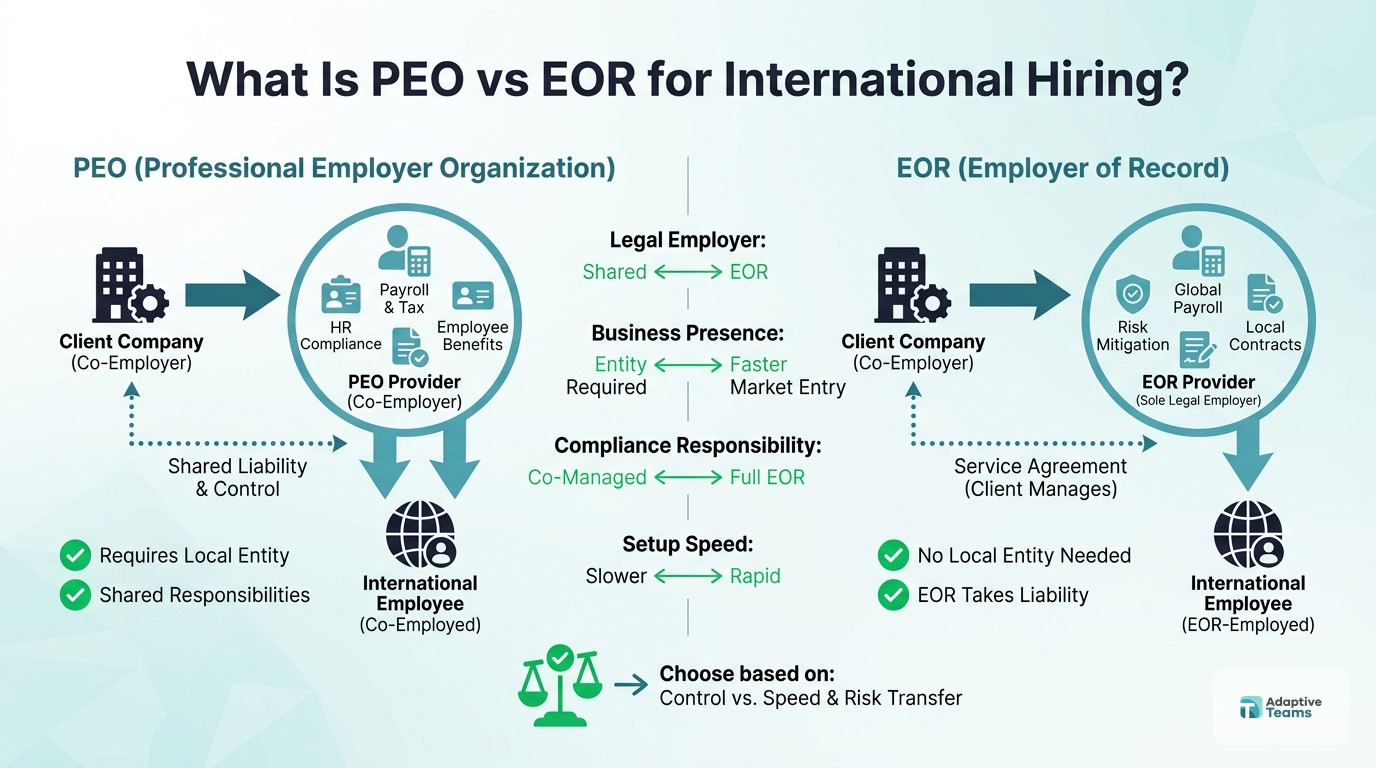
PEO vs EOR for international hiring refers to two different ways to employ and manage talent across borders. When you compare PEO vs EOR for international hiring, you are comparing two very different legal and operational setups. A professional employer organization, or PEO, typically co-employs workers with your company. In most cases, you still need your own legal entity in the country where the employee works. An employer of record, or EOR, becomes the legal employer on paper and hires the worker on your behalf.
However, the decision is not just legal. It affects speed, control, payroll complexity, benefits administration, tax exposure, and how much internal HR infrastructure you need to build. For example, if you already have an entity and plan to hire a larger in-country team, a PEO can support local HR administration. In contrast, if you want to test a market or hire quickly without opening an entity, an EOR often reduces setup time.
Given that global hiring is now a mainstream growth tactic, you need a model that matches your real operating plan, not just your next hire. and offshore staffing infrastructure both matter here because hiring structure shapes long-term margin and team stability.
How It Works
The PEO model in practice
With a PEO, your company and the PEO share employment responsibilities. In a PEO vs EOR for international hiring comparison, this matters because the PEO model assumes you already have local infrastructure. You remain the primary business employer, while the PEO supports payroll, benefits, HR administration, and compliance processes. However, you usually need a registered local entity before this setup works legally.
The EOR model in practice
With an EOR, the EOR legally employs the worker in-country and leases that employee’s services back to your business through a service agreement. In most PEO vs EOR for international hiring decisions, this is the option that increases speed. Therefore, you can hire in a new market without first creating a local subsidiary. You still direct the day-to-day work, goals, and performance standards.
A simple process comparison
- You define the role and country. First, you decide where you want to hire and whether the role should be employee or contractor.
- You assess entity status. If you already have a local entity, a PEO may be feasible. If not, an EOR is usually the faster option.
- The employment framework is set up. Next, contracts, payroll rules, statutory benefits, and local tax obligations are mapped.
- The worker is onboarded. The worker signs the relevant employment agreement, then payroll and benefits begin.
- You manage performance. In both models, you still lead output, onboarding quality, and team integration.
In other words, both models solve HR administration, but they solve different infrastructure problems. A PEO helps optimize employment inside an entity you already own. An EOR helps you hire before you own that entity.
Key Benefits
Why companies compare both models
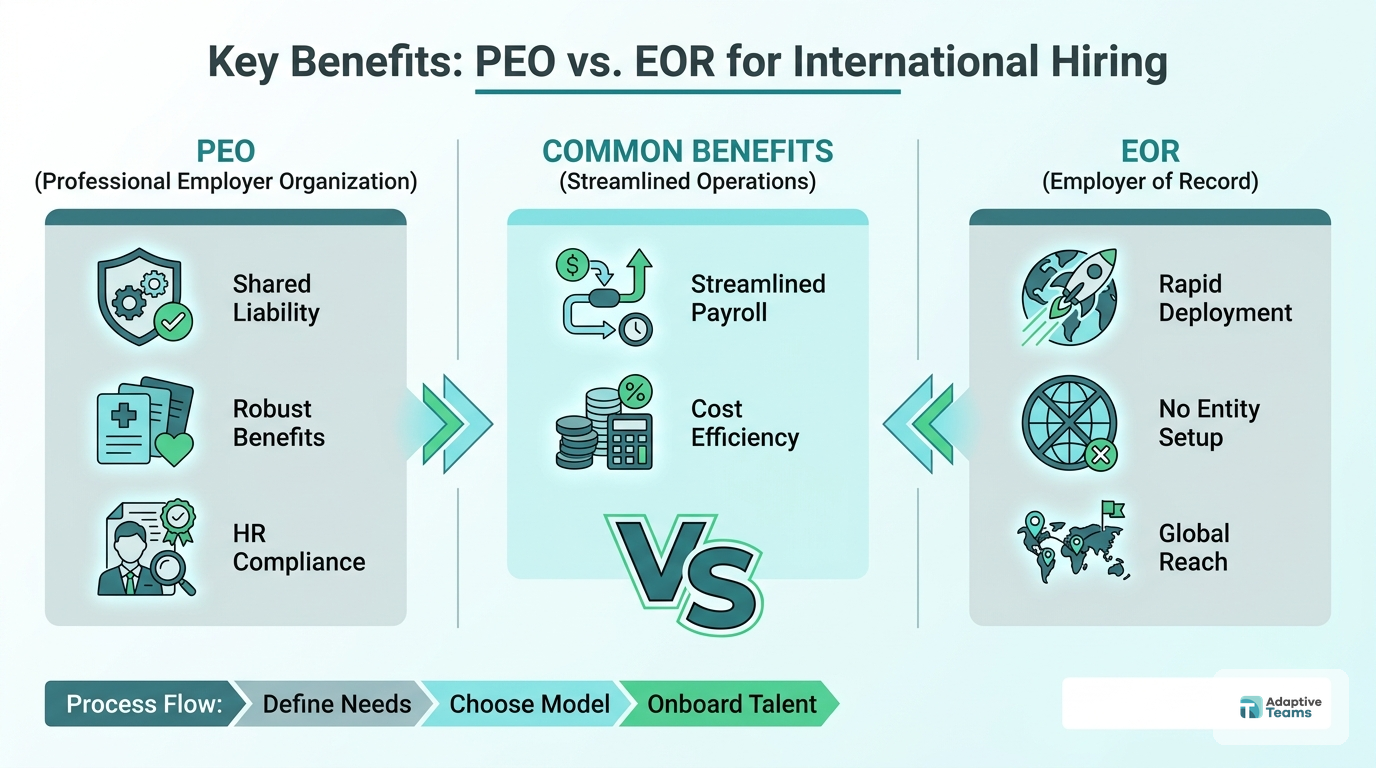
When you evaluate PEO vs EOR for international hiring, you are really comparing speed, control, cost structure, and risk allocation. A solid PEO vs EOR for international hiring decision should reduce operational drag, not just change who runs payroll. The best model depends on what pressure matters most right now.
- Faster international hiring: An EOR can help you onboard in new countries without waiting for entity setup. That matters when a key role has been open for 60+ days.
- Lower administrative burden: Additionally, both models reduce the amount of payroll, HR, and compliance work your internal team must absorb.
- Better compliance support: Local labor laws, statutory benefits, and termination rules vary sharply by country. Expert support lowers avoidable mistakes.
- Improved benefit management: A PEO can help standardize benefits and HR administration once your local footprint grows.
- More flexible expansion: An EOR lets you test demand, build a pilot team, or enter a market with less upfront commitment.
- Stronger operator focus: As a result, founders and operations leaders spend less time untangling payroll and more time building the business.
- Clearer workforce planning: Comparing both models forces you to define whether you are validating a market, scaling a team, or formalizing a long-term presence.
According to the OECD and World Bank, employment regulation and business setup friction still vary widely between markets. Therefore, choosing the right model early can save both direct cost and management time later.
Step-by-Step Guide
Step 1: Define your hiring objective
First, decide whether this hire is a market test, a long-term team build, or the start of a country expansion plan. This gives your PEO vs EOR for international hiring decision a clear business context. If you skip this step, you may choose a model that solves today’s problem but creates tomorrow’s overhead.
Step 2: Check whether you have a local entity
If you already have a compliant entity in the target country, a PEO may support payroll and HR administration efficiently. However, if you do not have one, an EOR is often the practical path because it removes the need for immediate entity formation.
Step 3: Classify the worker correctly
Next, decide whether the role should be employee or contractor based on control, exclusivity, schedule, and local legal tests. Misclassification can trigger back taxes, penalties, and forced benefit payments.
Step 4: Model the real cost
Do not compare only headline fees. Instead, include payroll taxes, statutory benefits, setup costs, internal admin time, legal review, and the cost of delays. In many cases, an EOR looks more expensive per head but is cheaper overall during early expansion because it avoids entity setup and internal complexity.
Step 5: Assess control needs
If you want long-term in-country infrastructure, local contracts, and deeper process ownership, a PEO may fit better after your team reaches scale. In contrast, if you need speed and flexibility, an EOR often wins.
Step 6: Review country-specific compliance risk
Labor rules differ on probation periods, mandatory benefits, leave entitlements, notice, and termination procedure. Therefore, review each country individually rather than assuming one global template works everywhere.
Step 7: Plan onboarding and performance management
Even if a PEO or EOR handles employment administration, you still need strong onboarding, role clarity, reporting lines, and manager accountability. is especially relevant because weak management ruins otherwise sound hiring models.
Step 8: Choose the model that matches your next 12 months
Finally, pick the structure that supports where you are going, not just where you are today. If you expect to hire 1 to 3 people in a new country, an EOR is often the cleaner entry model. If you already have a registered entity and plan to scale a stable local team, a PEO can make more sense.
Hire Internationally Without Extra HR Drag
Get a practical staffing plan for the right hiring model, payroll setup, and compliance path.
Best Tools & Resources
Government and compliance references
First, use the World Bank Doing Business archive and country labor ministry websites to understand setup friction, employer obligations, and local registration requirements. These sources help you pressure-test timelines and compliance assumptions.
Internal hiring model guidance
Next, review Contractor vs Employee for Startups to avoid classification mistakes before you choose a PEO or EOR path. This is one of the highest-leverage decisions in cross-border hiring.
Remote management systems
Additionally, Remote Team Management Tools 2026 can help you build reporting, visibility, and accountability once the hire is live. Employment structure alone will not fix operational drift.
Team-building playbooks
Finally, Building Offshore Teams gives you a broader framework for long-term international team design. Pair that with OECD employment data and ILO labor standards resources to benchmark labor expectations and compliance context across markets. If your goal is embedded team capacity rather than one-off hiring, that context matters more than vendor comparison charts.
Common Mistakes to Avoid
Mistake 1: Choosing based on fee alone
A lower monthly fee can hide higher total cost. For example, entity setup, legal review, payroll administration, and internal management time can erase any apparent savings.
Mistake 2: Assuming PEO and EOR are interchangeable
However, these models solve different problems. A PEO usually requires your entity, while an EOR removes that requirement. If you mix them up, your hiring timeline can slip fast.
Mistake 3: Ignoring worker classification risk
Some companies label a worker as a contractor when the role clearly functions like employment. Consequently, they create exposure around taxes, benefits, and labor claims.
Mistake 4: Underinvesting in onboarding
Even the best legal structure fails if the employee enters a vague role with poor management. scaling team systems is useful here because bandwidth problems often show up as onboarding failures first.
Mistake 5: Solving only for the first hire
Finally, many operators choose a structure that works for one person but breaks at five. Always ask what happens if the team doubles in the next 6 to 12 months.
Advanced Tips & Strategies
Build a country-by-country decision matrix
First, score each target country on entity readiness, hiring urgency, compliance complexity, and planned headcount. This turns an abstract debate into a practical operating choice.
Use EOR for entry, then reassess at scale
In many cases, the smartest path is phased. You can enter a market through an EOR, validate the role and demand, then evaluate a local entity plus PEO support once the team reaches meaningful scale.
Separate employment infrastructure from talent strategy
Moreover, do not let a legal wrapper drive the entire workforce plan. You may need employees in one function, contractors in another, and embedded offshore team members in a third. Adaptive staffing works better when you match structure to role economics.
Track founder time as a real cost
Most comparison guides ignore leadership drag. Yet every hour spent on payroll questions, local compliance research, or contract cleanup is an opportunity cost. If a model saves leadership bandwidth, that has real value.
Design for retention, not just activation
Ultimately, hiring internationally should create durable capacity. That means cultural fit, performance follow-up, and management rhythm matter just as much as legal setup. HR outsourcing systems can help you think beyond the first signed contract.
Frequently Asked Questions
What is the main difference between a PEO and an EOR for international hiring?
A PEO usually works alongside your existing legal entity and helps manage payroll, benefits, and HR administration. An EOR becomes the legal employer in-country, which lets you hire internationally without setting up your own entity first.
Is an EOR always better for a first international hire?
Not always. An EOR is often better when you need speed or do not yet have a local entity. However, if you already have an entity and expect stable in-country hiring, a PEO may be more efficient.
Can you use a PEO without opening a foreign entity?
In most cases, no. A traditional PEO model generally depends on your company having a registered entity in the country where the employee works. That is one of the biggest differences in PEO vs EOR for international hiring.
Which model is cheaper: PEO or EOR?
It depends on timing and scale. A PEO may have lower recurring costs once your local entity already exists, while an EOR may be cheaper in practice during early expansion because it avoids setup costs, delays, and extra internal admin.
Does an EOR remove all compliance responsibility?
No. The EOR handles the legal employment framework, payroll, and many local obligations, but you still need to manage the role properly, set expectations, and avoid behavior that creates legal or operational risk.
How do you choose between a PEO and an EOR for international hiring?
Start with three questions: Do you already have a local entity, how fast do you need to hire, and how many people do you expect to hire in that country over the next year. Those answers usually make the right direction much clearer.
Next Steps
Conclusion
PEO vs EOR for international hiring is not a branding choice. It is an operating decision that affects speed, compliance exposure, management overhead, and your ability to scale without friction. The best PEO vs EOR for international hiring choice is the one that matches your current stage and your next 12 months of growth. If you already have an entity and want deeper in-country HR support, a PEO may fit. If you need to hire fast without building local infrastructure first, an EOR often gives you a cleaner path.
The right answer depends on your growth plan, role mix, and tolerance for administrative drag. If you want help designing an international hiring model that supports long-term team performance, visit Adaptive Teams services and book a free staffing consultation.
Ready to Build Your Dream Team?
Book a free staffing consultation with our remote team specialists. No obligations, just actionable insights for scaling your operations.