



To define offshore teams properly, do not start with geography. Start with operating model. An offshore team is a group of professionals based in another country who work as an extension of your business, usually in long-term roles, with defined responsibilities, management rhythms, performance expectations, and compliant employment or contractor arrangements.
Table of Contents
- What an offshore team actually is
- Offshore team vs outsourcing vs freelancing
- Why companies build offshore teams
- What offshore teams are best for
- What offshore teams are not good for
- The operating model matters more than the country
- How to build an offshore team that works
- What it costs to ignore offshore team design
- A simple offshore team example
- FAQ
That definition matters because many companies use the phrase too loosely. They call a freelancer, vendor, outsourcing shop, or one-time project squad an offshore team. Those models can be useful, but they are not the same thing.
An offshore team should increase capacity without adding chaos. If it only moves tasks to a lower-cost market while your managers absorb more coordination, the model is not working. The point is not just access to people in another country. The point is reliable execution, lower fully loaded cost, and a staffing structure your company can keep using as it grows.
What an offshore team actually is
An offshore team is a dedicated remote team based outside your home country, usually built to support ongoing business functions. The team may include developers, customer support specialists, finance operators, recruiters, marketers, sales support staff, designers, data analysts, executive assistants, or operations coordinators.
The key word is dedicated. A true offshore team is not a rotating pool of anonymous resources. The people know your tools, customers, managers, standards, and internal context. They participate in your workflows with enough continuity to build institutional knowledge.
For example, a 35-person e-commerce brand might build an offshore team with 2 customer support specialists, 1 inventory analyst, 1 marketplace operations coordinator, and 1 creative production assistant. Those hires do not just handle tickets or tasks. They own recurring operating lanes that were previously split across founders, local managers, and overloaded generalists.
That is different from hiring a vendor to complete a fixed project. A project vendor delivers a scoped outcome. An offshore team becomes part of the operating system.
Offshore team vs outsourcing vs freelancing
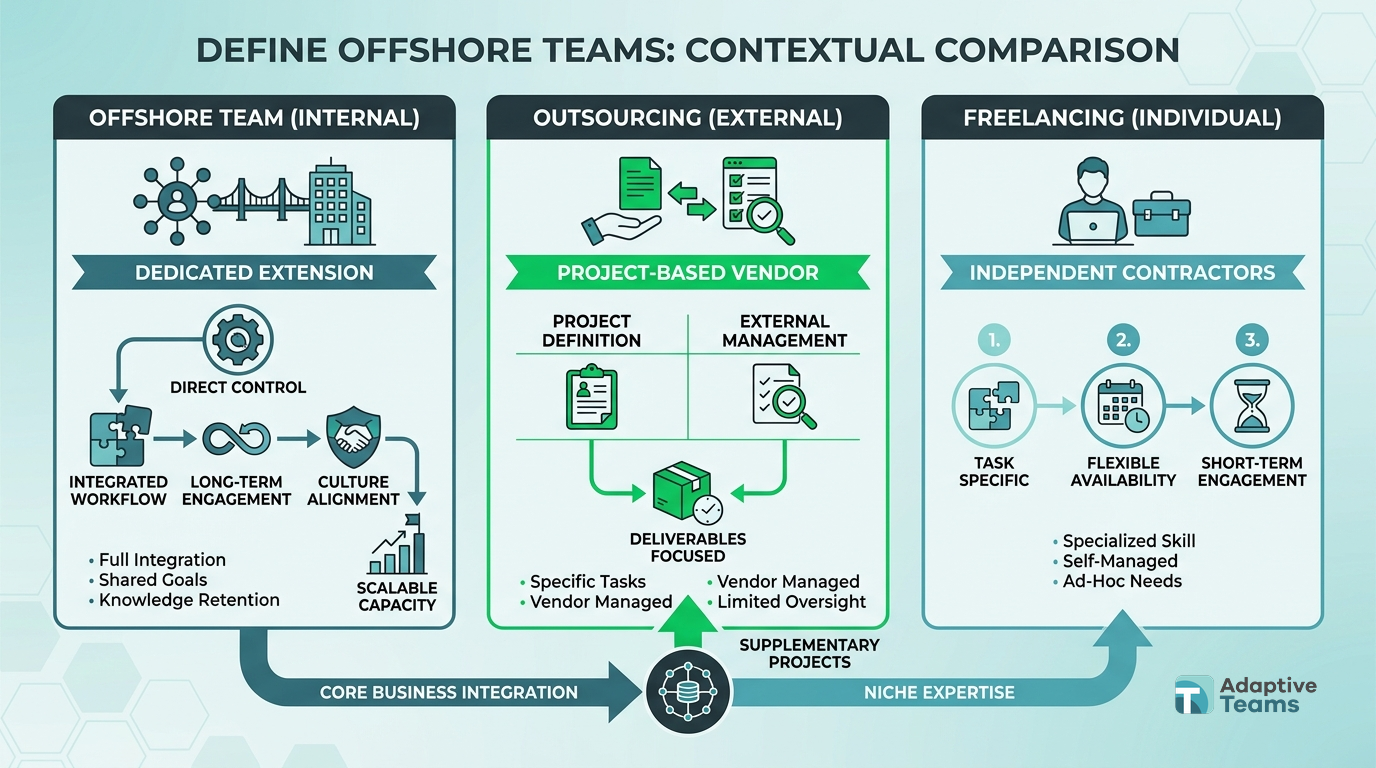
The easiest way to understand the difference is to look at control, continuity, and accountability.
Outsourcing usually means handing a function or process to an external company. You buy an outcome, often with limited visibility into who does the work. That can work for standardized processes, but it often breaks down when your business needs judgment, context, and daily collaboration.
Freelancing is usually individual and task-based. It can be fast and flexible, especially for specialized work. It is weaker when you need repeatable delivery, retention, coverage, and management depth.
An offshore team sits closer to an in-house team. The people may be employed through a staffing partner, contractor arrangement, or local employment structure, but the work pattern is embedded. They attend recurring meetings, use your systems, follow your standards, and build role-specific context over time.
If you are deciding between models, is a useful lens. The right answer depends on the role, the country, the level of control you need, and how long you expect the person to stay.
Why companies build offshore teams
Most companies first look offshore because hiring locally has become too slow or too expensive. That is real, but it is only part of the business case.
The stronger reason is operational leverage. You can move important work out of bottlenecked local roles and into a managed team structure that expands capacity faster than your domestic hiring pipeline allows.
Consider a SaaS company where the head of operations is personally handling onboarding calls, support escalations, CRM cleanup, invoice follow-up, and reporting. Hiring one local operations manager might cost 60 to 90 days of recruiting time, plus a high salary and benefits package. Building a 2-person offshore operations support layer can remove 30 hours of recurring work per week while preserving the local leader’s control over decisions.
The cost advantage can be meaningful. The U.S. Bureau of Labor Statistics shows that employer costs include wages plus benefits, and benefits can add a substantial percentage on top of salary for local employees. Offshore staffing changes the fully loaded cost structure, especially when payroll, benefits administration, and HR support are handled through a partner. Source: U.S. Bureau of Labor Statistics employer costs data.
Speed matters too. The Society for Human Resource Management has reported that average time to fill roles often stretches across weeks, and many specialized searches take longer. When the founder or COO is driving that process, every open role has a management cost beyond salary. Source: SHRM talent acquisition resources.
What offshore teams are best for
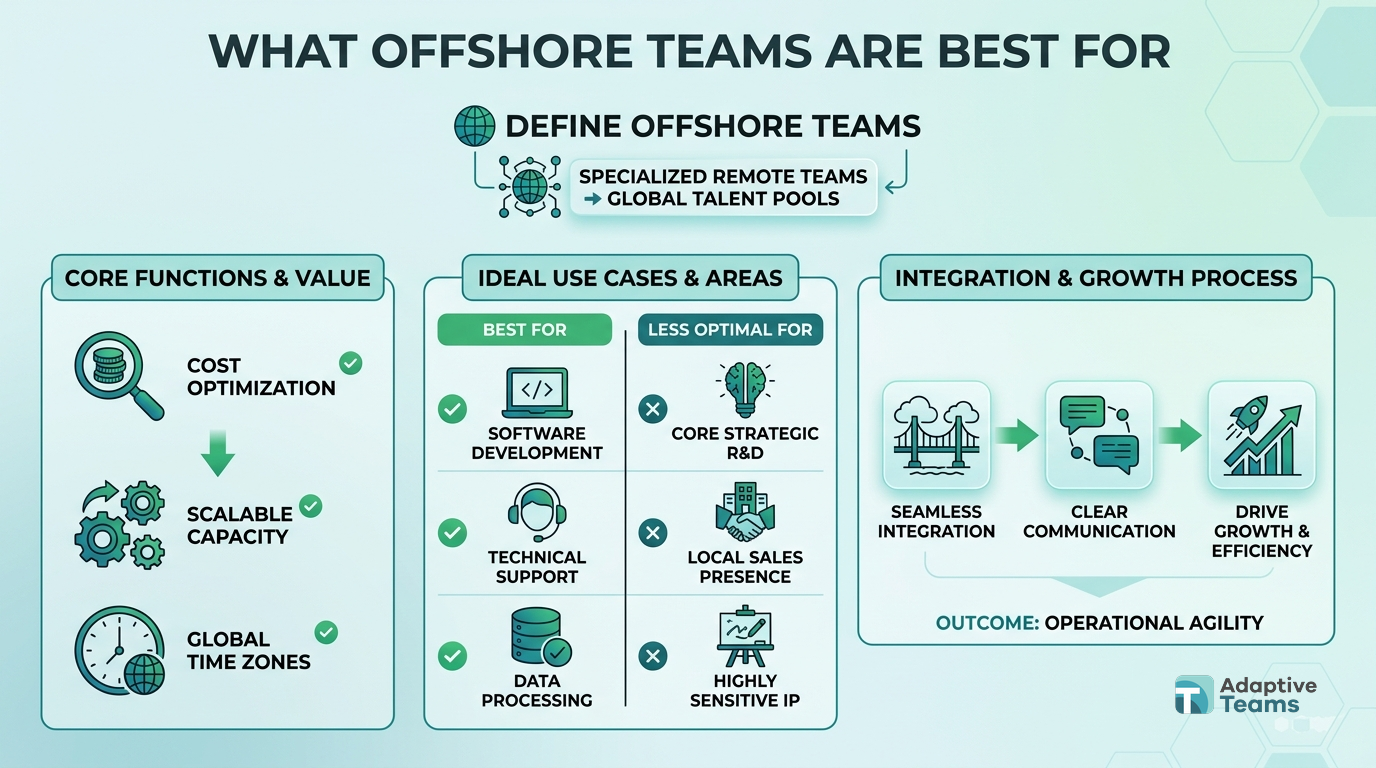
Offshore teams work best when the role has recurring work, clear outputs, and enough volume to justify dedicated capacity. The model is especially strong when your internal team already knows what good looks like but lacks time to execute consistently.
Common roles include:
- Customer support and customer success coordination
- Operations support and process administration
- Recruiting coordination and HR administration
- Finance operations, billing, and accounts support
- Content production, design support, and marketing operations
- Software development, QA, and data operations
- Executive support and business administration
The mistake is assuming offshore means low-value work. Many companies build offshore teams for judgment-heavy roles, but they do it gradually. They start with documented processes, build trust through measurable outputs, then expand ownership as the person learns the business.
For a practical view of how this model compares with broader remote hiring, see building a remote team from scratch. The same management principles apply, but offshore hiring adds payroll, compliance, and labor-market decisions that should be handled deliberately.
What offshore teams are not good for
Offshore hiring will not fix unclear management. If no one in your company can define the role, measure output, or give feedback, distance will expose that weakness quickly.
It is also a poor fit for tasks that require constant physical presence, heavy local licensing, or real-time in-person customer interaction. Some roles can be partly offshore, but not fully moved.
The model struggles when leaders treat offshore team members as disposable labor. That mindset creates churn, weak knowledge transfer, and low accountability. The companies that get the most value treat offshore hires as long-term team members, not interchangeable capacity.
There is also a compliance dimension. Different countries have different rules for employment, independent contracting, benefits, taxes, and worker classification. The Organisation for Economic Co-operation and Development tracks global labor and tax policy shifts that continue to affect cross-border work. Source: OECD employment and labour market policy.
You do not need to become a global HR expert to build offshore teams, but you do need a model that accounts for local rules. That may mean a contractor structure, direct employment, an employer of record, or a managed staffing partner. The right structure depends on risk, control, role type, and country.
Build Offshore Capacity Without HR Drag
Get recruiting, payroll, compliance, and performance oversight in one managed staffing system.
The operating model matters more than the country
Country selection gets a lot of attention, but it is rarely the biggest success factor. Labor market depth, English proficiency, time-zone overlap, salary expectations, and local retention norms all matter. Still, a well-designed role in a secondary market will usually outperform a poorly managed role in the most popular offshore destination.
Start with the operating model:
- What work should move out of local bottlenecks?
- Which outputs can be measured weekly?
- Who will manage the person day to day?
- What time-zone overlap is actually required?
- What tools, permissions, and documentation will the role need?
- Which employment or contractor model fits the role and country?
Once those answers are clear, country selection becomes practical. You are no longer asking, “Where can we find cheaper people?” You are asking, “Where can we build a stable team for this workflow with the right cost, skill, overlap, and compliance profile?”
That shift protects you from the most common offshore hiring failure: chasing wage arbitrage without building management infrastructure.
How to build an offshore team that works
The best offshore teams are not built by posting a generic job description and hoping for the best. They are built through role design, structured recruiting, onboarding, management cadence, and retention planning.
1. Define the business bottleneck
Do not start with the job title. Start with the drag on the business.
Maybe customer response times are slipping because local managers are buried in tickets. Maybe your founder is still screening candidates instead of closing partnerships. Maybe finance reporting is late every month because the controller has no support layer.
Write down the recurring work that creates the bottleneck. Then group it into a role that one capable person could own.
2. Separate ownership from tasks
A weak offshore role description lists tasks. A strong one defines ownership.
For example, “answer support emails” is a task. “Maintain first-response time under 4 business hours, escalate billing issues correctly, and keep customer satisfaction above target” is ownership.
This distinction changes recruiting. You stop hiring for availability and start hiring for accountability.
3. Choose the right engagement model
Some offshore hires are best structured as contractors. Others should be employees through a local entity, staffing partner, or employer of record. There is no universal answer.
Contractor models can offer flexibility, especially for specialized or part-time roles. Employee models can support stronger retention, clearer benefits, and deeper integration. A managed staffing partner can combine recruiting, HR administration, payroll, compliance support, replacement coverage, and performance follow-up.
If you are weighing options, PEO vs EOR for international hiring can help clarify where employment infrastructure becomes necessary.
4. Build the onboarding system before the hire starts
Offshore onboarding should be more structured than local onboarding, not less. The new hire needs access, documentation, communication norms, role expectations, and a clear escalation path.
Create a 30-day ramp plan with weekly outcomes. Do not overload the first week with every possible process. Give the person enough context to succeed, then expand responsibility as they prove accuracy and judgment.
5. Manage performance with rhythm
Remote performance does not improve through surveillance. It improves through clear outputs, visible work, and consistent feedback.
Use weekly priorities, simple scorecards, one-on-one meetings, and documented decisions. Tools matter, but management rhythm matters more. managing remote employees effectively covers the day-to-day system in more detail.
What it costs to ignore offshore team design
The obvious cost is delayed hiring. The less visible cost is management leakage.
Every week a role stays open, senior people keep absorbing work that should be below their level. Founders keep interviewing. Department heads keep chasing updates. Finance keeps reconciling messy inputs. Customer leaders keep handling escalations that a trained support layer could prevent.
The cost is not just salary. It is opportunity cost, execution drag, and slower decision-making.
Poor offshore design creates a second kind of cost: churn. If people are hired into unclear roles, managed inconsistently, or treated as low-context task handlers, they leave. Then the company repeats recruiting, onboarding, training, and knowledge transfer. The apparent savings disappear into rework.
A better offshore team model should reduce founder involvement in hiring, preserve manager control over standards, and create long-term retention. That is where the leverage comes from.
A simple offshore team example
Take a 50-person agency with delivery managers, account managers, and a founder still reviewing resource plans every week. The team is not failing because people are lazy. It is failing because too much coordination sits with expensive local staff.
A practical offshore team might include:
- 1 project coordinator to maintain timelines, update task boards, and chase missing inputs
- 1 reporting analyst to prepare weekly client performance snapshots
- 1 recruiting coordinator to support hiring pipelines for delivery roles
- 1 finance operations assistant to handle invoice preparation and collections follow-up
None of those roles replaces strategic leadership. They remove recurring administrative load from strategic people.
If each role saves 8 to 12 hours per week from local managers, the business gets 32 to 48 hours of leadership capacity back every week. That is before counting faster hiring, cleaner reporting, better follow-up, and fewer dropped handoffs.
This is why offshore teams should be evaluated on operational output, not only wage comparison.
FAQ
What does offshore team mean?
An offshore team is a dedicated group of professionals based in another country who work remotely as part of your business operations. They usually support ongoing roles rather than one-time projects.
Are offshore teams the same as outsourcing?
No. Outsourcing usually means handing a function to an external provider. Offshore teams are more embedded, with dedicated people, recurring responsibilities, and closer alignment to your internal workflows.
Can offshore team members be employees?
Yes. Offshore team members can work through contractor, employee, employer of record, or managed staffing models. The right structure depends on the role, country, risk profile, and retention goal.
What roles are best for offshore teams?
Offshore teams are strongest for recurring work with clear outputs, such as customer support, operations, recruiting coordination, finance operations, marketing support, software development, QA, and administrative support.
How do you manage an offshore team?
You manage an offshore team with clear role ownership, weekly priorities, measurable outputs, regular one-on-ones, documented processes, and a feedback rhythm. The goal is accountability, not micromanagement.
Where to start
If you want to build offshore capacity, define the operating model before you recruit. Choose the bottleneck, design the role, decide the engagement structure, and put management rhythm in place before the first interview.
Adaptive Teams helps companies build offshore teams that feel like in-house teams, with recruiting, payroll, HR administration, compliance support, performance oversight, and replacement coverage built into the model. If you want a managed path from role design to long-term retention, book a free staffing consultation.
Ready to Build Your Dream Team?
Book a free staffing consultation with our remote team specialists. No obligations, just actionable insights for scaling your operations.