TL;DR
Staff augmentation engineering means adding full-time engineers to the team you already lead, while a partner recruits, contracts and pays them. It works when someone on your team has time to direct the work and review the code. At Adaptive Teams you pay the engineer's agreed salary plus a 30% to 60% staffing fee, most roles start in 2 to 3 weeks and the agreement runs month to month.
Most engineering leads arrive here with the same problem. The roadmap is clear, the sprint board is full, and a local senior search will take months. Adding an outside engineer sounds simple until you ask who reviews their code, who answers their questions and what they work on in week one.
This page is written for the person who will manage that engineer. It covers the readiness check, the first seat to fill, what each seat costs and the signals that tell you after a month whether it works.
What does staff augmentation mean for an engineering team?
It means the added engineer works inside your process and takes direction from your own lead. They pull tickets from your backlog, push to your repository and sit in your standups and code reviews. The partner handles recruiting, the contract, payroll and HR in the background.
Outsourcing a project works the other way round. A vendor takes a scope, runs its own sprints and hands you a result. Our explainer on what staff augmentation means covers the contract side in more detail. For engineering the practical test is simple: if you want to keep setting priorities every day, you want augmentation.
Is your team ready to add an augmented engineer?
Your team is ready when the backlog is written down and one person can review the new engineer's code within a day. In the first month that reviewer also needs about an hour a day for questions. Without those, even a strong engineer spends their first weeks waiting.
Review speed decides how fast a new engineer learns
Code review is where an augmented engineer learns your standards, so slow reviews slow everything. Google's public engineering practices guide on review speed sets one business day as the maximum time to respond to a review request. The same guide warns that slow reviews create pressure to accept weaker changes.
For a remote hire that day can stretch into two if working hours barely overlap. That is why we agree on a fixed overlap window before a search begins. A question asked at 10:00 should get an answer before lunch.
A backlog the engineer can pick up without a meeting
Write the first five tickets before the engineer starts. Each one should have a clear outcome, a way to test it and a pointer to the code involved. If your tickets live mostly in people's heads, fix that first, because it will slow your next local hire just as much.
Which engineering seat should you augment first?
Start with the seat where work is piling up in writing and someone on your team can judge the output. For many product teams that is QA or a mid-level back end developer. A senior hire to "own architecture" is a harder first seat, because their value depends on context they do not have yet.
| Seat | Augment it when | Keep it local when |
|---|---|---|
| QA engineer | Releases wait on manual testing | Testing needs physical devices on site |
| Back end developer | Tickets are written and reviewed | The work is mostly unscoped research |
| DevOps engineer | You have a clear cloud setup to maintain | Access rules forbid outside contractors |
| Automation and AI engineer | Internal tools and integrations pile up | Nobody owns the processes being automated |
| Engineering manager | Rarely a good first seat | It sets product direction for the team |
The engineering searches we run cover front end and back end developers, QA for manual and automated testing, mobile, DevOps and cloud, data and machine learning, and UX and UI design. For product teams that mainly need developers inside their sprints, our page on software offshore staffing walks through that model in more depth.
What does an augmented engineering seat cost each month?
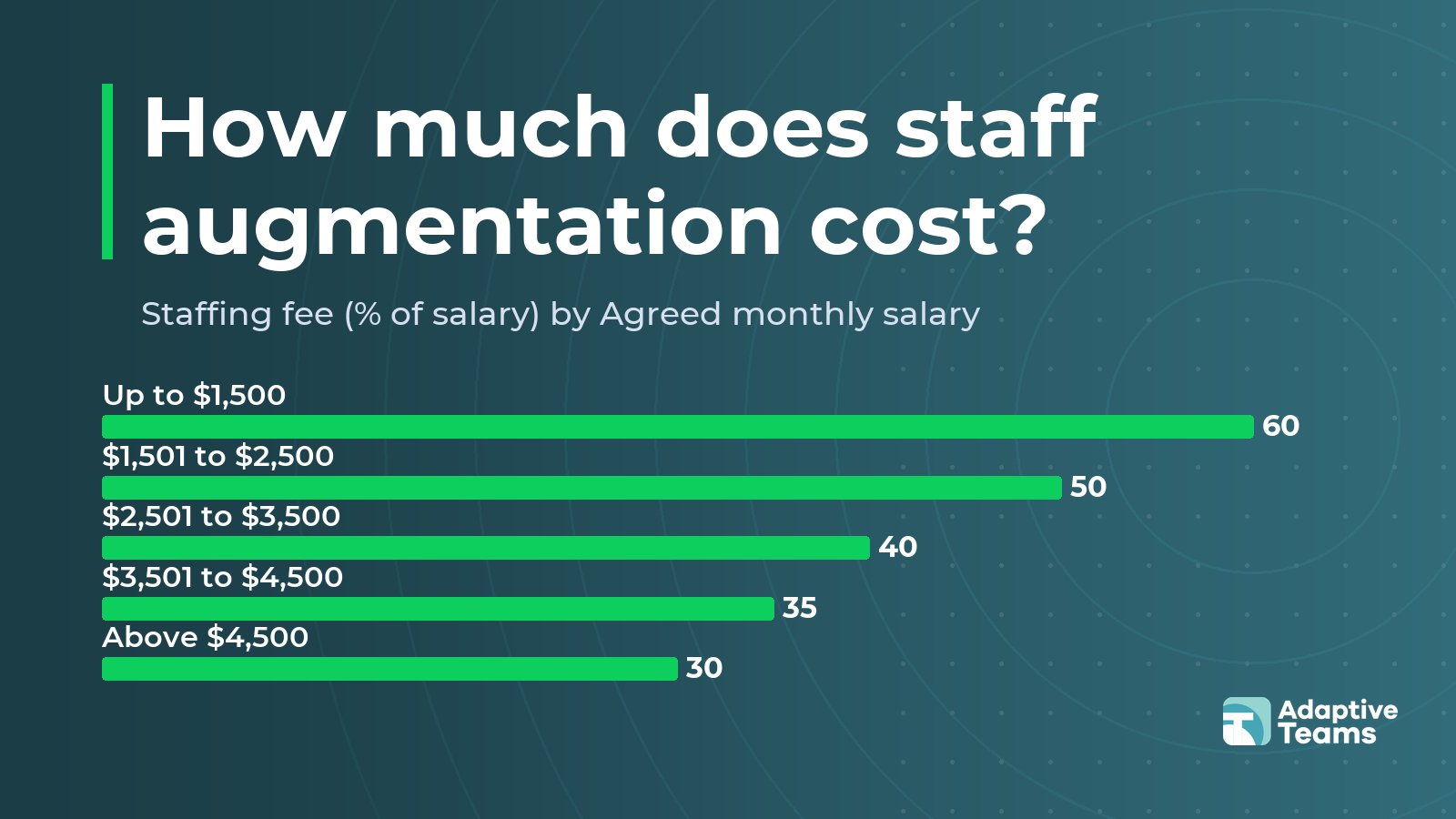
You pay the engineer's agreed monthly salary plus a staffing fee that is a percentage of it, with recruitment included. The fee is 60% up to $1,500, 50% to $2,500, 40% to $3,500, 35% to $4,500 and 30% above that.
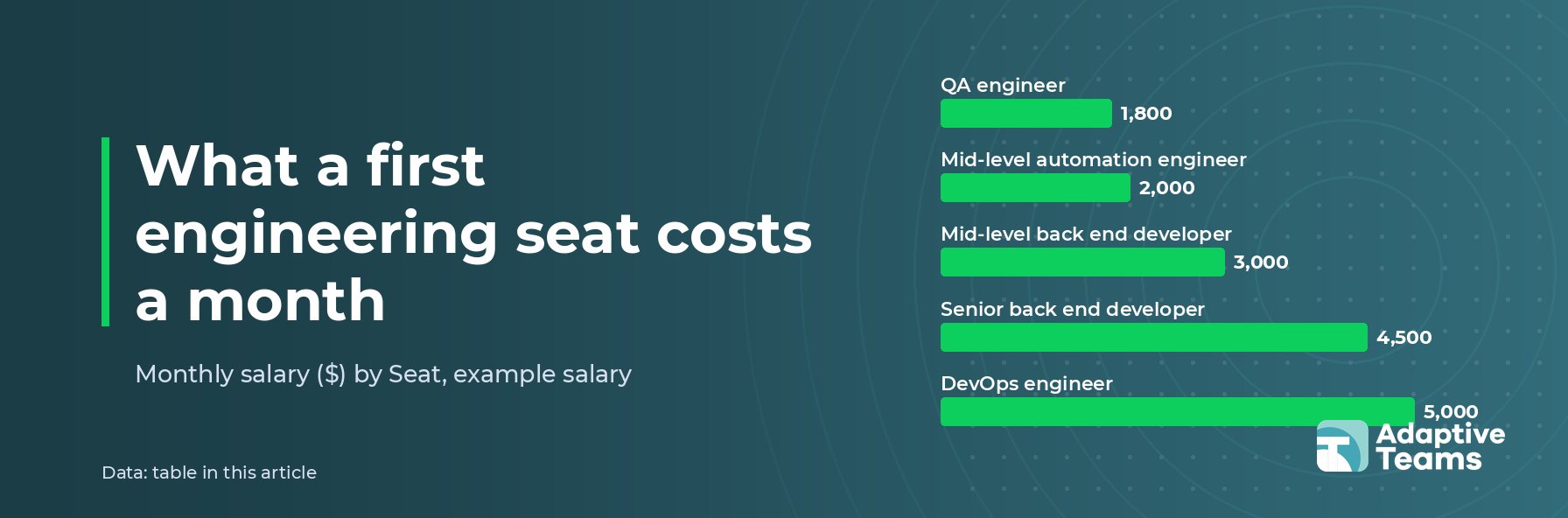
What a first engineering seat costs a month
| Seat, example salary | Monthly salary ($) | Staffing fee (%) | Monthly total ($) |
|---|---|---|---|
| QA engineer | 1,800 | 50 | 2,700 |
| Mid-level automation engineer | 2,000 | 50 | 3,000 |
| Mid-level back end developer | 3,000 | 40 | 4,200 |
| Senior back end developer | 4,500 | 35 | 6,075 |
| DevOps engineer | 5,000 | 30 | 6,500 |
The salaries are examples to show the math. Real salaries are agreed with each candidate for your stack and seniority. Our offshore salary benchmarks, built from 148 placement records in July 2026, show mid-level automation and AI engineers in Latin America earning $1,500 to $2,250 a month.
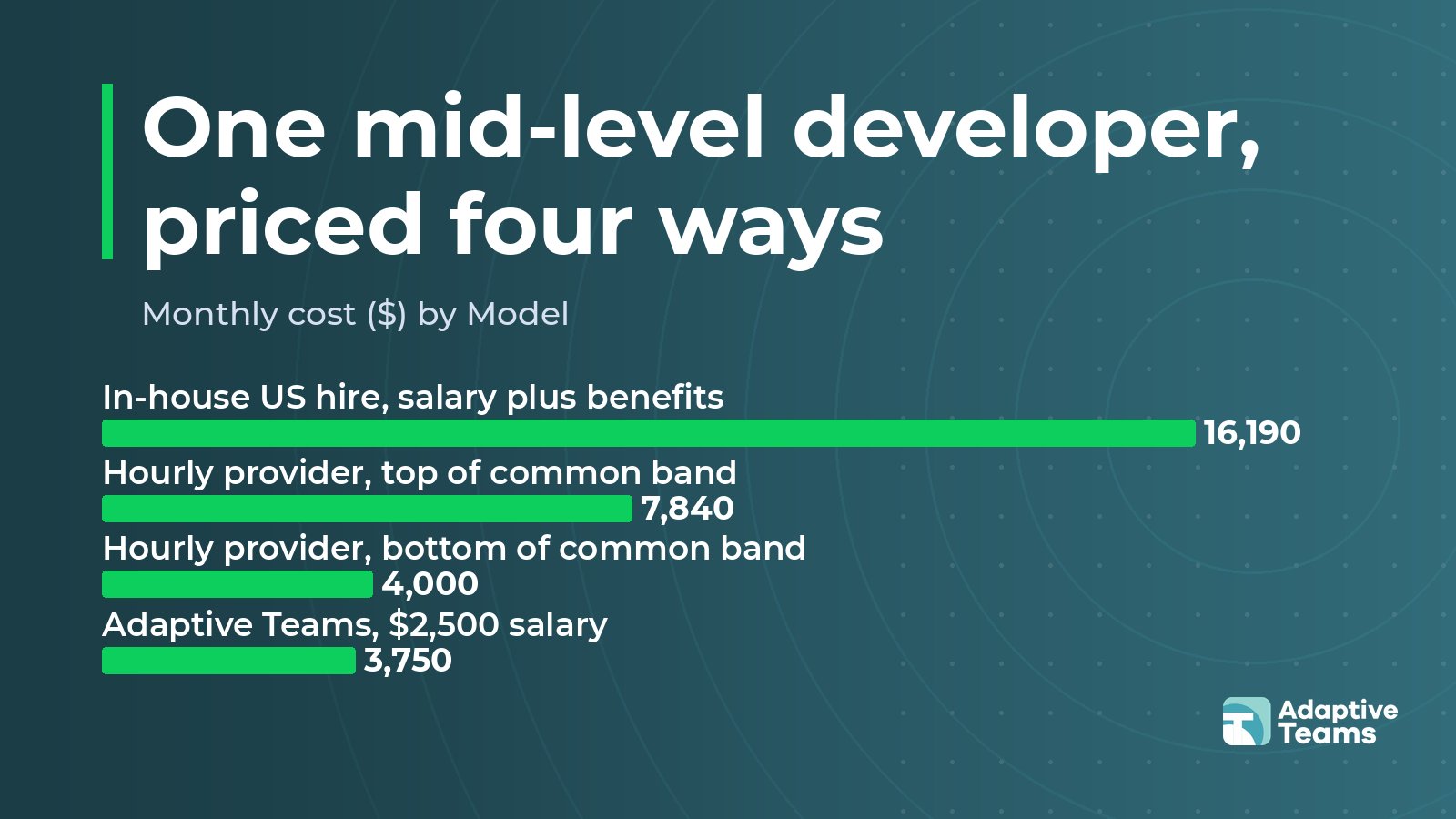
The local number is much higher. The median annual wage for US software developers was $135,980 in May 2025, according to the Bureau of Labor Statistics. That is about $11,332 a month before benefits. Finding that person costs money too: SHRM benchmarking data put the average cost per hire at nearly $4,700.
If you only want the search and plan to employ the engineer yourself, recruitment on its own costs $4,000 flat per hire.
How does staff augmentation engineering work at Adaptive Teams?
It runs from one scoping call to an engineer merging code, usually in 2 to 3 weeks. Senior or niche roles, such as a platform engineer on an unusual stack, can take 4 to 6 weeks.
- Scoping. You share the stack, the seniority, the overlap hours and a salary band. We reply within 24 hours with a monthly number.
- Search. Our Teamtailor account holds 56,287 candidates and 64,982 applications, so the search starts with people we already know. Fresh sourcing runs alongside it.
- Screening. Candidates pass a technical assessment and live problem solving first, then an English and culture screen. We also check the connection, the workspace and past remote work.
- Shortlist. You see 3 to 5 people with their results and run your own technical interview if you want one. You make the final call.
- Start. We hold the contract and run payroll and HR. You add the engineer to your repository, tracker, chat and CI before day one.
The same recruitment team that grew KO Storage from 4 to 70+ people runs every engineering search.
What should be set up before the engineer's first day?
Access, a first ticket and a named reviewer should be ready before the start date. An engineer who waits three days for repository access loses the momentum the search built.
Access with the right scope
Give the engineer the same access a new local developer at their level would get. That usually means the repository, the issue tracker, team chat, CI and a staging environment. Production credentials can wait until they have shipped a few changes through review. Keep secrets in your password manager and share them through it.
A contract that settles who owns the code
Before anyone writes a line, read how the contract assigns the work product to your company. Ask your partner to show you that clause during scoping, so it is settled before the shortlist arrives.
A first ticket and a buddy
Pick one small, real ticket for week one. A bug fix with a clear reproduction teaches your review standards faster than any onboarding document. Pair the engineer with one person who answers questions for the first two weeks.
How do you know it is working after the first month?
You know it is working when the engineer merges real code in week one and needs less help with each review round. A month in, they should pick tickets without a briefing and raise problems before standup. If reviews still come back with the same comments in week four, raise it then.
Every engineer has a manager on our side for HR, payroll and performance check-ins. We check in with you and the engineer during the first 90 days. If the fit is wrong in the first 2 months, we replace the engineer at no extra cost, and the agreement stays month to month with 30 days notice on either side.
When a different model fits better
Augmentation is the wrong choice when nobody on your side can direct the work. If you have a spec but no technical lead, a dedicated team or full project build with its own delivery lead suits you better. A two week fix is also too small to justify a search.
Frequently asked questions
How is staff augmentation engineering different from hiring freelancers?
An augmented engineer works only for you, full time, inside your repository, tracker and standups, on a monthly arrangement. A freelancer usually splits time across clients and bills per hour or per project. The difference shows after a few months, when the dedicated engineer knows your codebase and review standards well.
How much does an augmented engineer cost per month?
With Adaptive Teams you pay the agreed monthly salary plus a staffing fee of 30% to 60% of it, with recruitment included. A QA engineer at an $1,800 salary costs $2,700 a month. A senior back end developer at $4,500 costs $6,075. You pay nothing until the engineer starts.
How fast can an augmented engineer start?
Most Adaptive Teams engineering roles go from the scoping call to a start date in 2 to 3 weeks. Senior or niche roles, such as a platform engineer on an unusual stack, can take 4 to 6 weeks. You see a shortlist of 3 to 5 screened candidates and run your own interviews before deciding.
What happens if the engineer is not a good fit?
If the fit is wrong in the first 2 months, Adaptive Teams replaces the engineer at no extra cost. A manager on our side checks in with you and the engineer during the first 90 days to spot problems early. The agreement runs month to month with 30 days notice on either side.
If you want help with this
Write down the seat you want to fill first, the hours it must overlap with your team and who will review the engineer's code. If you can name that reviewer today, you are ready to start a search.
Our recruitment team scopes the role with you and puts 3 to 5 screened engineers in front of you, usually within 2 to 3 weeks.

Written by the people who recruit, pay and manage remote teams every day, with Nate Ginsburg and Menno Gottmer. About Adaptive Teams