TL;DR
Software offshore staffing adds full-time engineers abroad who work in your repo, your tracker and your standups while a staffing partner handles the contract, payroll and HR. At Adaptive Teams you agree the salary with the engineer and pay a staffing fee of 30% to 60% of it. Most roles fill in 2 to 3 weeks, and the agreement runs month to month with 30 days notice.
You probably already know what you want built. The problem is the gap between the roadmap and the people available to ship it. A local senior search takes months, and every new seat is a large fixed bet on salary, benefits and recruiter fees.
Staffing offshore closes that gap without handing your product to an outside agency. This page covers what the model is, what each engineer costs per month, how the search runs and what the first month inside your codebase looks like.
What is software offshore staffing?
It is a way to add engineers who live in another country but work as part of your own team. You lead the day to day: they take tickets from your backlog, push to your repo and join your code reviews. The staffing partner employs or contracts them, pays them and manages HR in the background.
The model is easy to confuse with two others that sound similar. The difference is who directs the work.
| Model | Who leads the work | Best for | Your involvement |
|---|---|---|---|
| Staff augmentation | You | A roadmap with too few hands | Daily standups, code review, priorities |
| Dedicated software team | A delivery lead keeps the pod aligned with you | Ongoing product work and new initiatives | Product direction and priorities |
| Full project outsourcing | We do, and you judge the result | Defined builds, MVPs, fixed initiatives | Milestones, feedback and sign-off |
Most of our clients start with one or two augmented engineers. Once the work is clear, some move to a dedicated pod. Our page on software outsourcing and staff augmentation explains all three models and the stacks we hire for.
Which engineering roles work well offshore?
Roles with a clear backlog and written requirements work best, because the engineer can pick up a ticket without waiting for a hallway conversation. That covers most of a product team.
The engineering searches we run cover front end and back end developers, QA engineers for manual and automated testing, mobile developers for iOS and Android, DevOps and cloud engineers, data and machine learning engineers, and UX and UI designers. Each one joins your existing process instead of running a parallel one.
Roles that stay harder are the ones where the job is mostly judgment about your local market. A head of engineering who sets product direction usually belongs close to your leadership. An offshore senior engineer reporting to that person works well.
How time zones change the choice
Overlap matters more than distance. We match engineers whose working hours overlap your day, so a question asked at 10:00 gets an answer before lunch. If your team is on US Eastern time, Latin American engineers often share most of the day, while teams elsewhere work with a fixed overlap window. Our comparison of nearshore and offshore team models goes deeper into that trade.
How much does software offshore staffing cost per developer?
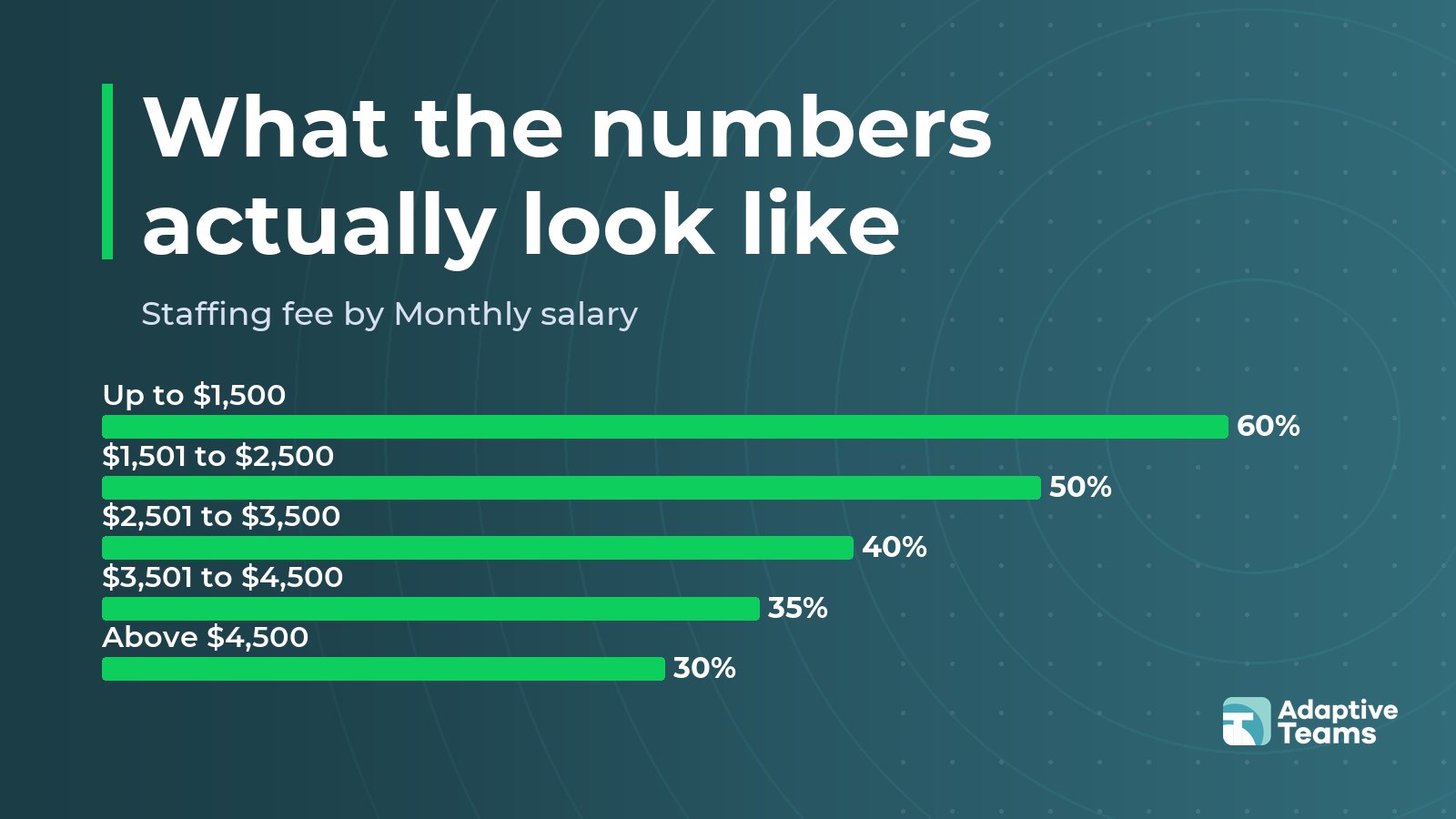
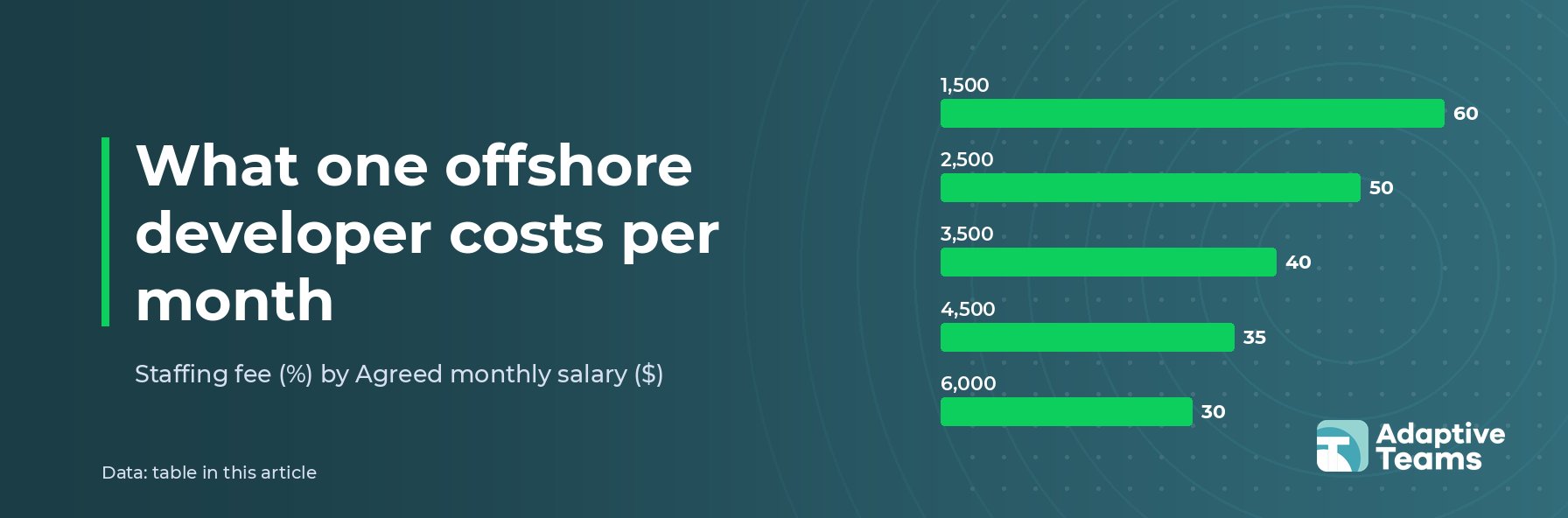
You pay the engineer's agreed monthly salary plus a staffing fee that is a percentage of that salary. The percentage falls as the salary rises, and recruitment is included in the fee.
What one offshore developer costs per month
| Agreed monthly salary ($) | Staffing fee (%) | Fee per month ($) | Your monthly total ($) |
|---|---|---|---|
| 1,500 | 60 | 900 | 2,400 |
| 2,500 | 50 | 1,250 | 3,750 |
| 3,500 | 40 | 1,400 | 4,900 |
| 4,500 | 35 | 1,575 | 6,075 |
| 6,000 | 30 | 1,800 | 7,800 |
The bands are 60% up to $1,500, 50% to $2,500, 40% to $3,500, 35% to $4,500 and 30% above that. There is no placement fee, and you pay nothing until the engineer starts.
Where does the salary itself come from? From the market for your exact role and stack. Our offshore salary benchmarks, built from 148 placement records in July 2026, show mid-level automation and AI engineers in Latin America earning $1,500 to $2,250 a month. Senior developers, tech leads and DevOps engineers earn more. Ask any provider for a real salary for your role, never a blended hourly rate.
The local number you compare it with
The median annual wage for US software developers was $135,980 in May 2025, according to the Bureau of Labor Statistics Occupational Outlook Handbook. That is about $11,332 a month before any benefits.
Benefits add a large share on top. The BLS Employer Costs for Employee Compensation release for June 2026 puts wages at 70% of private employer compensation costs. Gross up the median developer wage and one local seat runs close to $16,190 a month. Finding that person also costs money: SHRM benchmarking data put the average cost per hire at nearly $4,700.
A small pod, priced out
Say a SaaS team has a back end backlog and no QA at all. A realistic first step could look like this, using salaries agreed with each engineer:
| Role | Monthly salary ($) | Staffing fee (%) | Total per month ($) |
|---|---|---|---|
| Senior back end developer | 4,500 | 35 | 6,075 |
| Mid-level front end developer | 2,500 | 50 | 3,750 |
| QA engineer | 1,800 | 50 | 2,700 |
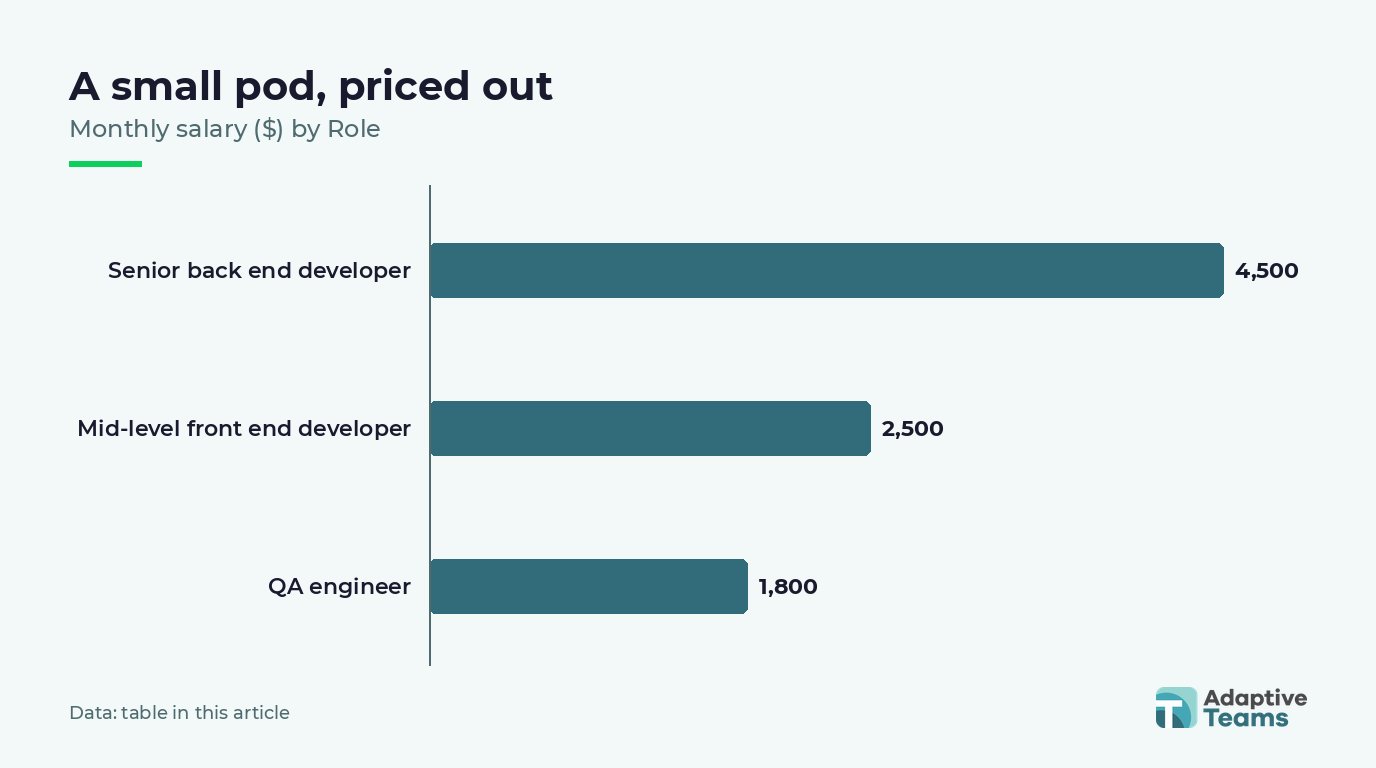
That pod costs $12,525 a month with recruiting, payroll, HR and performance management included. These salaries illustrate the math and are not a quote. For the line items buyers usually forget, such as management time and turnover, read what an offshore development team really costs.
If you only want the search and plan to employ the engineer yourself, recruitment on its own costs $4,000 flat per hire.
How does the search for an engineer work?
It starts with a scoping call on the stack, the seniority, the hours and a salary band. Nobody is sourced until the band is agreed, because an underpaid senior engineer is the one who leaves after six months.
Our Teamtailor account holds 56,287 candidates and 64,982 applications, so a search begins with people we already know. Fresh sourcing runs alongside it.
Screening is where engineering searches differ from other roles. A strong CV and a good call prove very little about shipping in your codebase. Candidates go through a technical assessment and live problem solving first, then an English and culture screen. We also check the connection, the workspace and past remote work, since those decide whether someone lasts.
You get a shortlist of 3 to 5 people with their results, and you run your own technical interview if you want one. You make the final call.
How long it takes
Most roles fill in 2 to 3 weeks. Senior or niche roles, such as a platform engineer on an unusual stack, can take 4 to 6 weeks.
What happens in the first 30 days inside your codebase?
The first month is about removing friction so the engineer writes real code in week one. An engineer who waits days for repo access or gets a vague first task loses the momentum the search built.
Before the start date you add the engineer to your repo, tracker, chat and CI. We confirm hardware, a stable connection and a quiet workspace. On day one payroll and benefits are already running, so nobody is chasing a first payment while learning your systems.
Give them one small, real ticket in the first week. A bug fix with a clear reproduction teaches your review standards faster than any onboarding document. From there the engineer joins your standups, planning, retros and reviews like any other colleague.
Who watches for problems
Every engineer has a manager on our side for HR, payroll and performance check-ins. We check in with you and the engineer often during the first 90 days. If the fit is wrong in the first 2 months, we replace the engineer at no extra cost.
When is software offshore staffing the wrong choice?
It is the wrong choice when nobody on your side can direct the work. An augmented engineer needs a backlog, a reviewer and someone to answer questions. Without a technical lead, a full project build with milestones suits you better.
A two-week fix is also too small. A freelancer handles that with less setup. Staffing pays off when the role is ongoing and the engineer gains value from learning your product month after month. That is also why we build for long tenures: the same recruitment team that grew KO Storage from 4 to 70+ people runs every engineering search.
Frequently asked questions
Which tech stacks can you staff?
We hire for the stack you already run, so new engineers work in your codebase from their first week. Searches cover front end and back end development, mobile apps for iOS and Android, QA, DevOps and cloud, data and AI, and UX and UI design. Tell us your languages and frameworks on the scoping call.
Can I interview the developers myself?
Yes. You see 3 to 5 screened candidates with their technical assessment results, and you can run your own technical interview, a pairing session or a take-home task. You make the final decision. A short live coding round with your own tech lead is a good last check before you say yes to a senior engineer.
Do I need a company in the engineer's country?
No. Adaptive Teams holds the contract and runs payroll through a global payroll partner, which handles local tax and benefits admin in the engineer's country. You receive one invoice per engineer each month and never set up a local entity, while your engineer gets paid in their own country.
Can I cancel if the roadmap changes?
Yes. Software offshore staffing with Adaptive Teams runs month to month with 30 days notice on either side, with no annual lock-in. In the first 2 months, a free replacement covers an engineer who does not fit. You can also scale up one engineer at a time when the roadmap grows again.
Where to start
Pick the ticket type that keeps slipping in your sprints and write down the stack, the hours you need covered and a salary band you can live with. That is enough to scope a search.
If you want us to run it, our recruitment team scopes the role with you and puts screened engineers in front of you, usually within 2 to 3 weeks.

Written by the people who recruit, pay and manage remote teams every day, with Nate Ginsburg and Menno Gottmer. About Adaptive Teams