TL;DR
Staff augmentation meaning, in one line: an outside partner adds people to your team who work under your direction while the partner handles hiring, contracts and payroll. You keep control of the work and the priorities. At Adaptive Teams the fee is a percentage of the agreed monthly salary, recruitment is included, and most roles fill in 2 to 3 weeks on a month to month agreement.
The phrase gets used loosely. A software agency calls its developers "augmented staff". A recruiter uses it for a temp contract. A payroll platform uses it for a contract you signed yourself. Each of those is a different deal with different risks, so the definition matters before you sign anything.
This page breaks the term down, shows what it looks like in a real contract, and gives you the numbers we use when we augment a team.
The staff augmentation meaning, word by word
Staff augmentation means you add capacity to an existing team by bringing in people through an outside partner, and those people take their daily direction from you. "Staff" is the person. "Augmentation" is the point: you grow a team you already run, without opening a new department.
The Wikipedia entry on staff augmentation draws the same line. External people work alongside your employees and take day-to-day direction from the client. In outsourcing, by contrast, a supplier delivers a defined outcome under its own management. That one question, who directs the work, decides most of what follows.
A real staff augmentation deal has a few fixed parts. The person works on your priorities, in your tools, during hours you agree. A partner sits between you and the person for the employment side: the contract, the pay run, HR questions and a replacement if it goes wrong. You pay the partner, and the partner pays the person. You can also end or swap the placement through the partner without firing anyone yourself.
If one of those parts is missing, you are probably looking at a different model with a similar label.
What does staff augmentation look like in practice?
In practice, it looks like a new colleague who joins your Slack, your standups and your task board on day one, with a staffing partner handling everything around the employment.
Here is a typical case from our own work. KO Storage runs 70+ self-storage locations across the US. In August 2024 they asked us for four call center agents. Those agents worked inside KO Storage's own call center operation. We handled the search, the contracts, payroll and performance check-ins.
Eighteen months later KO Storage had 70+ Adaptive Teams contractors across six departments, from revenue management and accounting to IT support. That growth came one department at a time, which is how augmentation tends to scale when the first hires work out.
A role that suits augmentation
Augmentation works best for roles that need your context every day. A bookkeeper who learns your chart of accounts, a support agent who knows your refund rules, a developer who works inside your codebase. Context builds up in the person, so it stays with your team.
A role that does not
A one-off deliverable with a clear finish line, such as a logo or a data migration, rarely needs an augmented hire. You would spend more time onboarding than the project takes. A project agency or a freelancer is the simpler route there.
How staff augmentation compares to similar models
Staff augmentation shares a lot with outsourcing, temp staffing and employer of record contracts, and the differences come down to who finds the person, who directs the work and who carries the employment.
| Staff augmentation | Project outsourcing | Temp staffing | Employer of record | |
|---|---|---|---|---|
| Who finds the person | The partner | The supplier | The agency | You |
| Who directs daily work | You | The supplier | You | You |
| Typical length | Months to years | Until the project ends | Days to months | As long as you keep the hire |
| Who handles contract and payroll | The partner | The supplier | The agency | The platform |
| What you pay for | A person's time | A finished outcome | Hours worked | Compliance and payroll |
Temp staffing is the closest cousin, and it is big. According to the American Staffing Association's staffing industry statistics, nearly 2.2 million temporary and contract employees worked for US staffing companies in an average week in 2024. Only 11% of staffing employees worked in engineering, IT and scientific roles, against 24% in office and administrative work. The term is most used in IT, yet the model reaches well beyond it.
The difference with outsourcing gets its own page. Our breakdown of staff augmentation vs outsourcing walks through cost and legal responsibility side by side.
Who is the employer in staff augmentation?
The partner is the contracting party, while you direct the work, and that split is what keeps the arrangement clean for both sides.
The US tax authority looks at control when it classifies a worker. The IRS guide to independent contractor or employee status groups the evidence into behavioral, financial and relationship factors. Behavioral control asks whether the company controls what the worker does and how. In augmentation you clearly direct the work, so the financial and contract side has to sit with a proper partner.
At Adaptive Teams we offer both contractor and employee arrangements, depending on the role and the country. Each placement runs through our global payroll partner, with payroll twice a month and one invoice per person. If you are weighing the two arrangements, our guide on contractor vs employee for startups sets out the trade-offs.
How much does staff augmentation cost?
Staff augmentation costs the person's salary plus a partner fee, and the useful number to compare is the total monthly cost of one person working only for you.
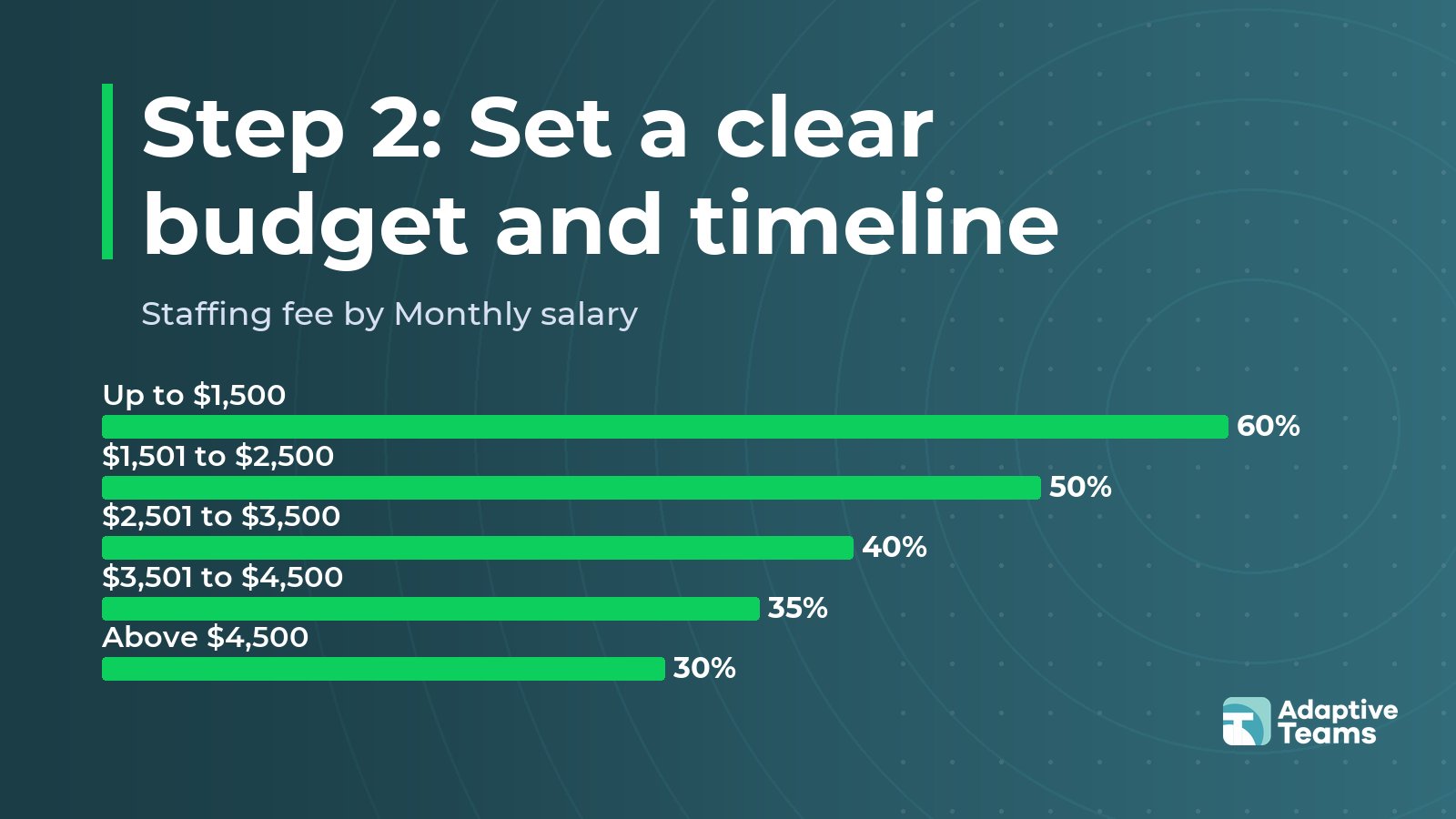
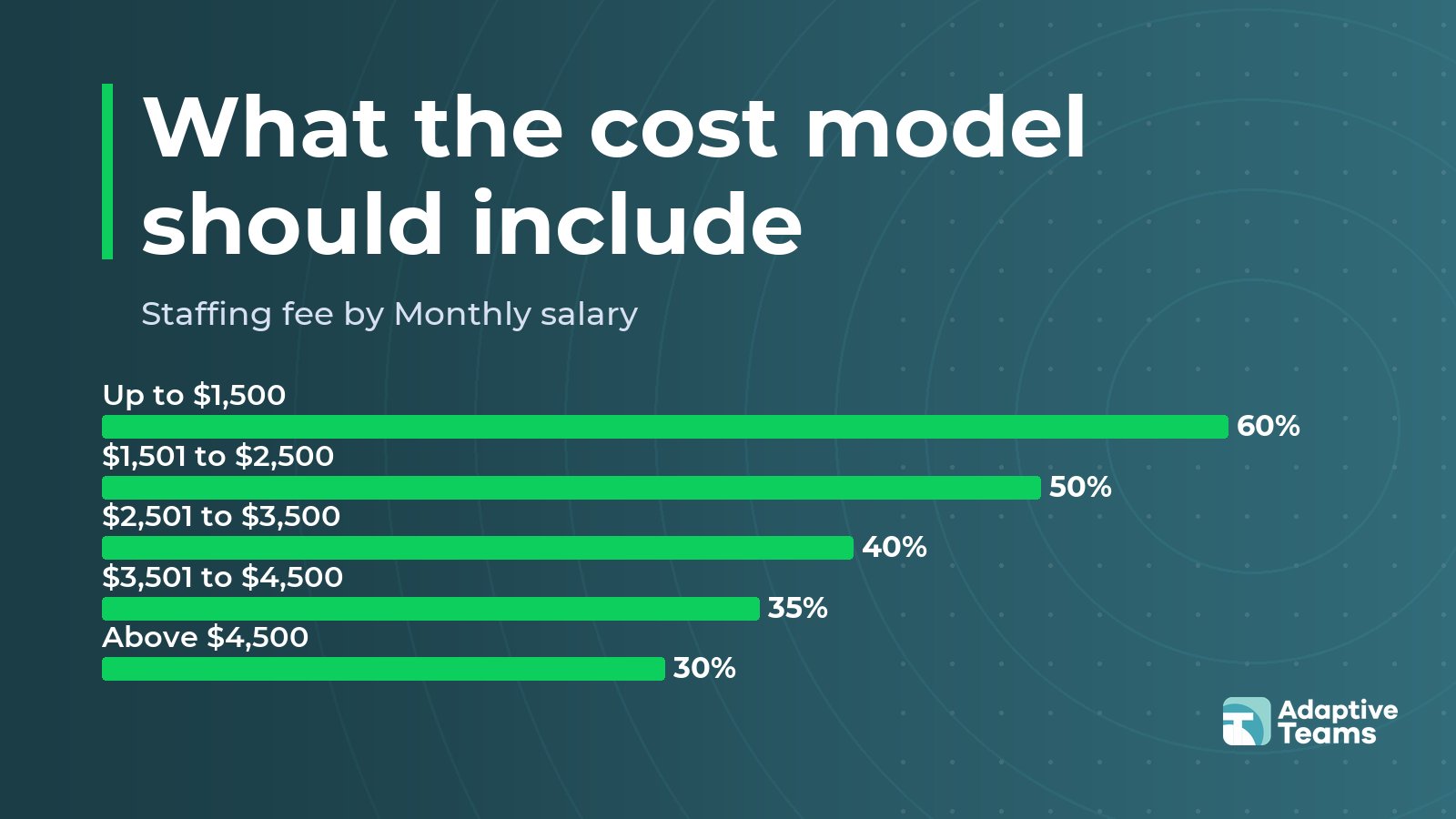
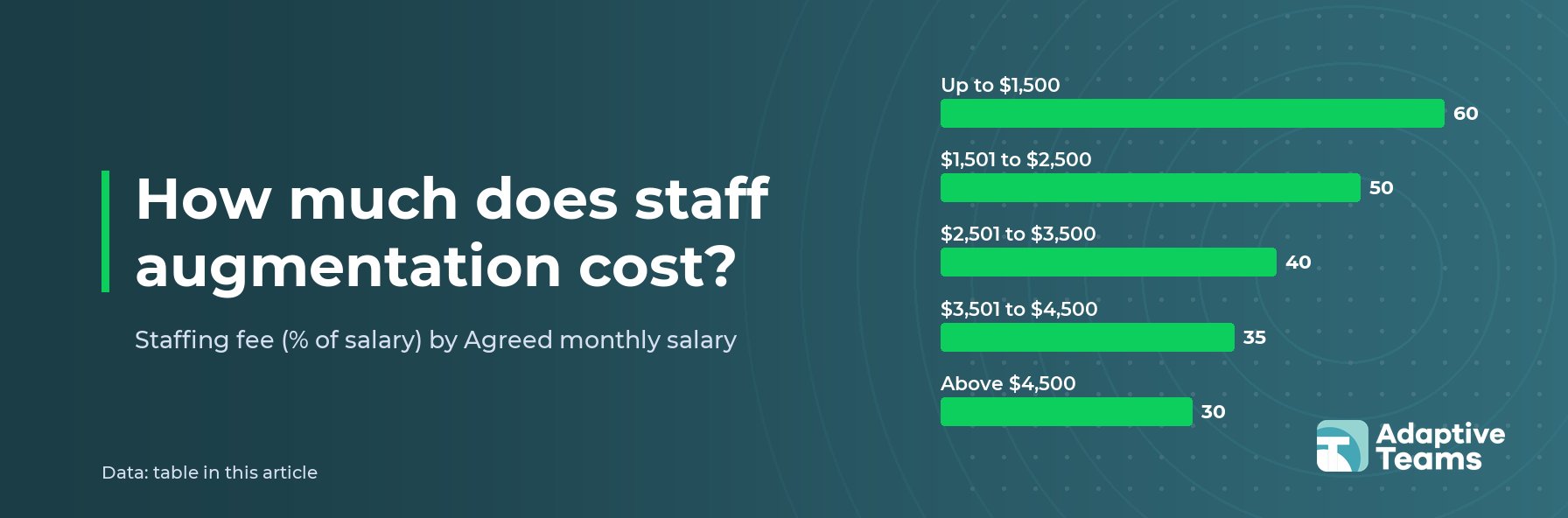
Our staffing fee is a percentage of the monthly salary you agree with your hire. The percentage falls as the salary rises, and recruitment is included:
| Agreed monthly salary | Staffing fee (% of salary) |
|---|---|
| Up to $1,500 | 60 |
| $1,501 to $2,500 | 50 |
| $2,501 to $3,500 | 40 |
| $3,501 to $4,500 | 35 |
| Above $4,500 | 30 |
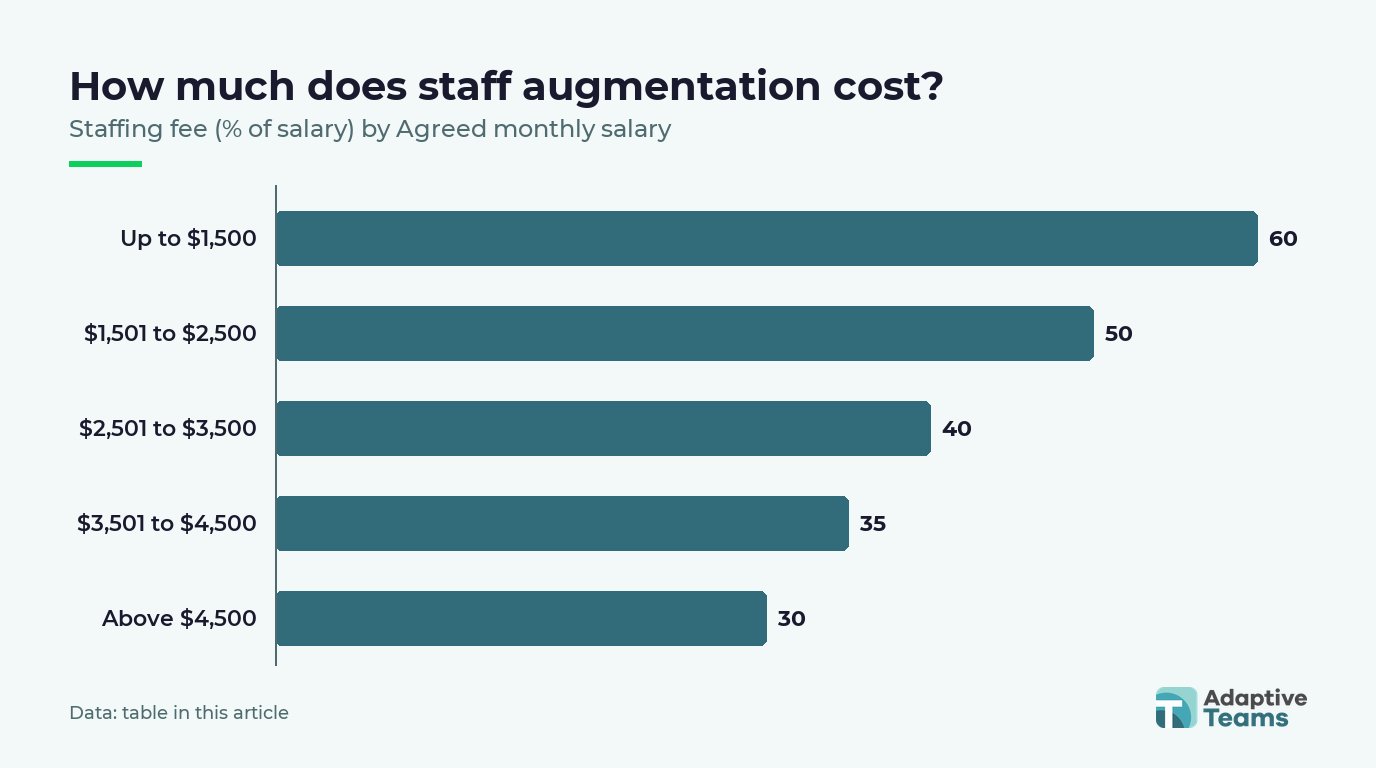
Take a support agent at $1,200 a month. The fee is 60%, or $720, so the monthly total is $1,920. A developer at $4,000 a month sits in the 35% band: the fee is $1,400 and the total is $5,400.
If you only want the search and will run the employment yourself, recruitment on its own is $4,000 flat per hire. Agencies price this in very different ways, and our explainer on how staffing agency fees are built shows what to ask for in a quote.
How fast can you add someone through staff augmentation?
With a partner that keeps a warm pipeline, a role usually fills in 2 to 3 weeks. A local US search often takes 3 to 6 months.
Speed comes from not starting at zero. Our TeamTailor account holds 56,287 candidates, so a new search starts from people we already know. The steps stay the same each time:
- We scope the role with you and confirm the salary band before anyone is sourced.
- Candidates go through structured assessments, skills tests and culture-fit interviews.
- You meet a shortlist of 3 to 5 screened candidates and make the final call.
- Your hire starts, with a dedicated manager for onboarding and performance check-ins.
Every hire also starts with a 2-month probation period. If the fit is wrong in those first 2 months, we replace the person free of charge.
Where staff augmentation goes wrong
Most failures trace back to treating the augmented person as a contractor on the side, when the whole model assumes they are part of your team.
Skipping onboarding is the classic trap. Someone who gets a login and a task list on Monday, and nothing else, will guess at your standards for weeks. Give them two documented tasks and a screen recording of each, then add work as trust grows.
Many teams also assume the partner manages output. In augmentation you own the priorities, so if nobody on your side reviews the work, nobody does. A good partner handles attendance, leave and check-ins, and flags drift early. Your team lead still sets the goals.
Locking in too early is the last one we see often. An annual contract for a role you have never filled before carries real risk. Our agreements run month to month with 30 days written notice on either side, so a role can prove itself before you commit further. Teams that need a full engineering squad can also look at our staff augmentation setup for software teams.
Frequently asked questions
Is staff augmentation the same as outsourcing?
No. In staff augmentation the person joins your team and takes daily direction from you, while a partner handles the contract and payroll. In outsourcing, a supplier delivers a defined result and manages its own people to get there. Augmentation fits roles that need your context, tools and judgment every working day.
Is staff augmentation only for IT roles?
No. The term started in IT, and it still covers developers and engineers, but the same model works for support agents, bookkeepers, executive assistants and operations staff. KO Storage started with four call center agents and later added revenue management, accounting, asset management, security and IT support through the same arrangement.
How long does a staff augmentation arrangement last?
As long as the role keeps earning its place. Some teams use it for a few months to cover a busy season, while others keep the same people for years. At Adaptive Teams agreements run month to month with 30 days notice, and we build for teams that stay together for years.
What happens if an augmented hire does not work out?
You tell your partner and they find a replacement. At Adaptive Teams the replacement is free in the first 2 months, which overlaps the 2-month probation period every hire starts with. After that, the month to month agreement and 30 days notice mean you are never tied to a placement that is not working.
Where to start
Pick the role that has stayed open the longest. Write down the hours it needs, the tools the person will use and a salary band you can live with. That is enough to scope an augmented hire.
If you want us to run it, our recruitment team scopes the role with you and puts 3 to 5 screened candidates in front of you, usually within 2 to 3 weeks.

Written by the people who recruit, pay and manage remote teams every day, with Nate Ginsburg and Menno Gottmer. About Adaptive Teams