TL;DR
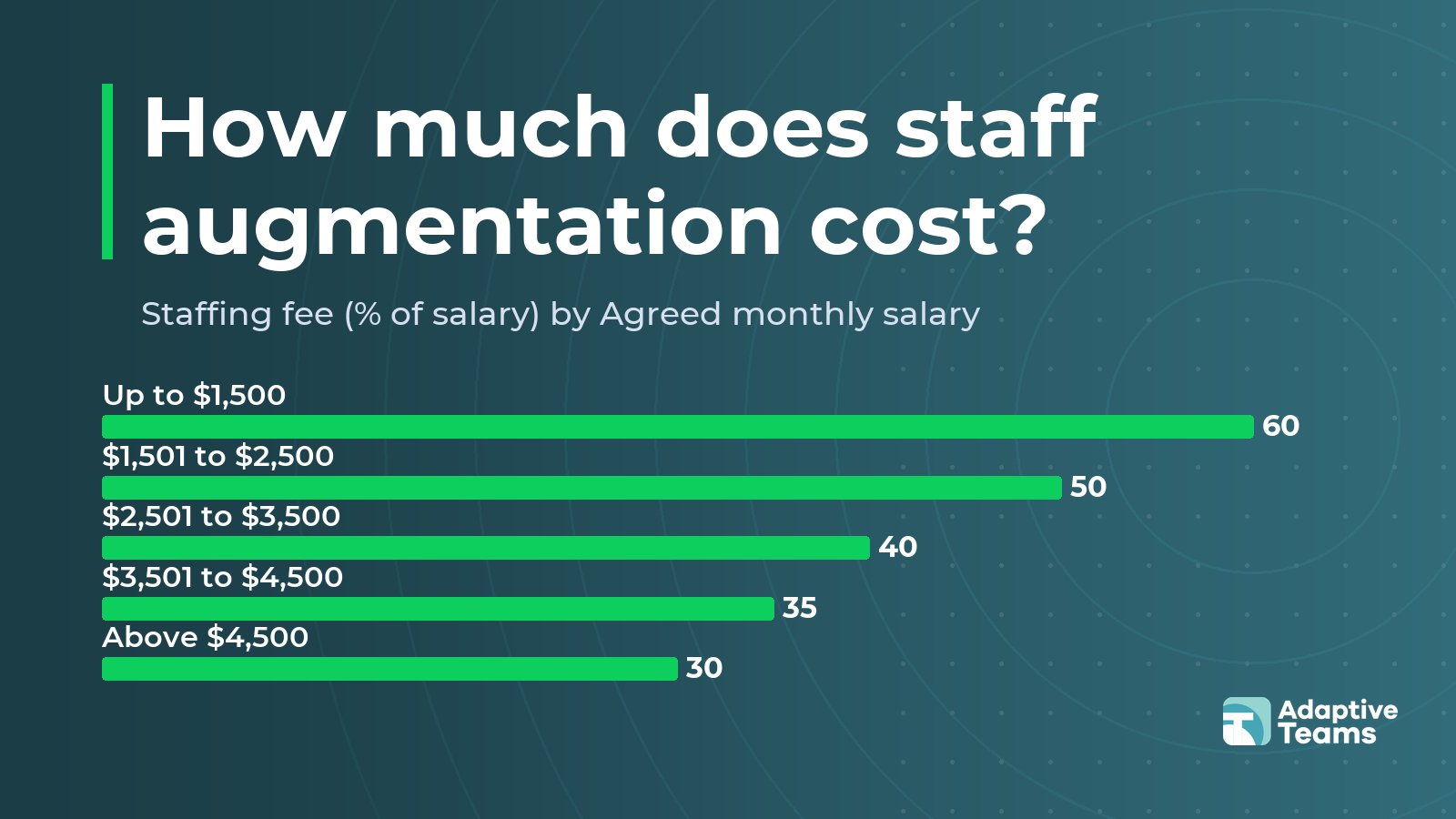
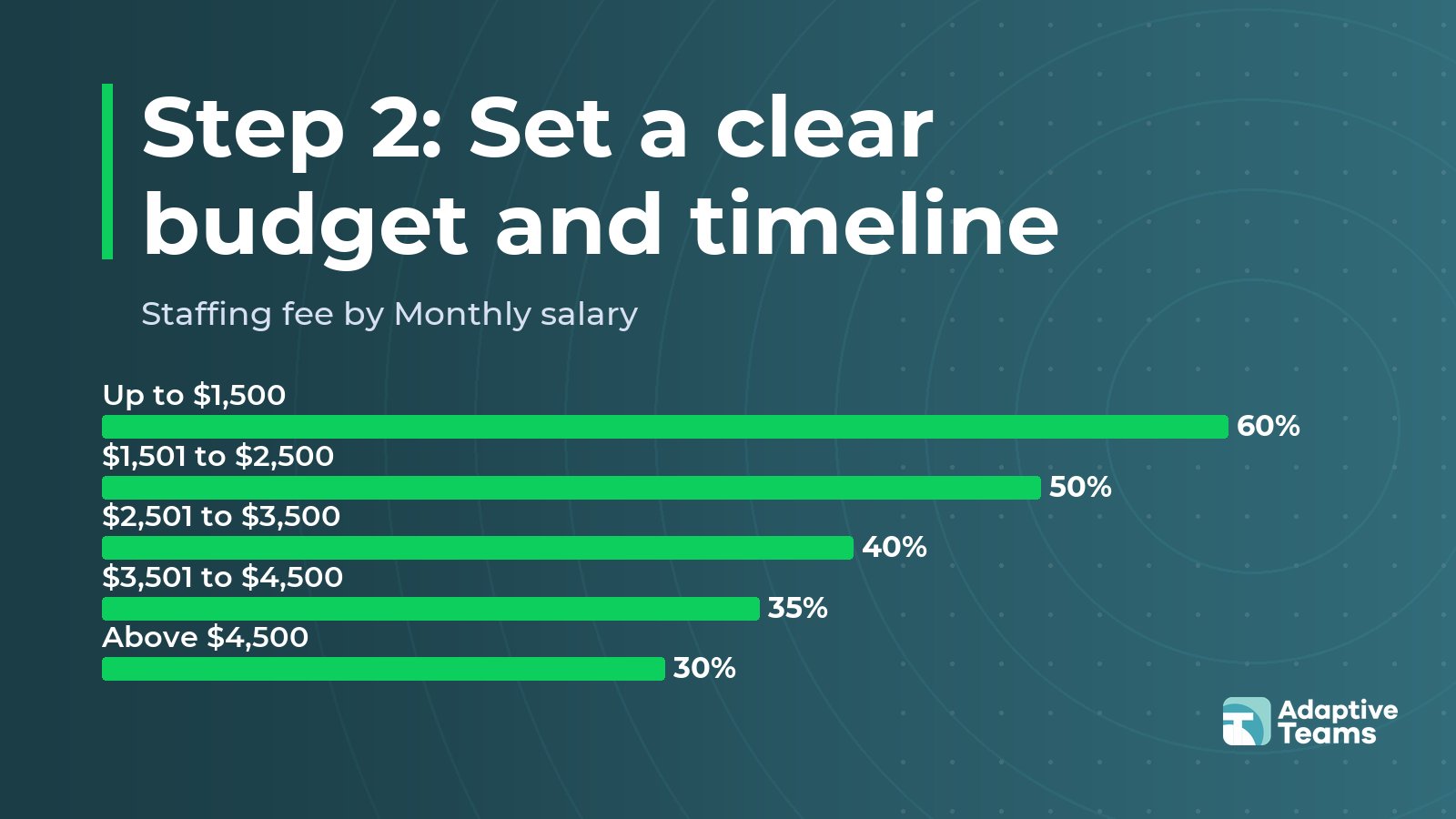
Staff augmentation companies in USA come in four types: local IT staffing firms, freelance networks, offshore development shops and remote staffing partners that hire full time abroad. Most bill by the hour, often $25 to $49. Adaptive Teams bills the person's monthly salary plus a 30% to 60% staffing fee, fills most roles in 2 to 3 weeks and runs month to month.
You searched for a list of companies. The trouble with most lists is that they rank vendors who sell very different things, so a hiring manager ends up comparing an hourly contractor with a full-time remote employee as if they were the same product.
This page sorts the market by how each type of provider works and bills. Then it prices one role four ways, so you can see which model fits the seat you need to fill.
What do staff augmentation companies in the US actually sell?
They sell people who work inside your team while someone else employs or contracts them. You direct the work. The provider handles the search, the contract and the pay. Our explainer on what staff augmentation means covers that split of control in more detail.
What changes between providers is where the person sits, how long they stay and how the bill is built. Those three things decide your real cost far more than any rating.
The four provider types
Local IT staffing firms place contractors who live in the US. They bill an hourly rate that wraps the contractor's pay and the agency's margin together. You get local hours and fast starts, at local prices.
Freelance networks match you with independent contractors, usually by the hour or by the project. They suit short, well defined jobs. The person often works for several clients at once.
Offshore and nearshore development shops are frequently registered in the US with engineers abroad. Many bill by the hour per engineer, and some sell whole project teams with their own delivery lead.
Remote staffing partners hire a full-time person abroad who works only for you. You pay a monthly amount tied to that person's salary. Adaptive Teams works this way, mostly with people in the Philippines, Latin America and Eastern Europe.
How much do staff augmentation companies in USA charge?
Hourly providers cluster between $25 and $49 an hour. Clutch, which reviews IT service firms, says in its IT staff augmentation directory that these companies generally charge $25 to $49 per hour. On the first page we opened, 15 of 29 listed firms sat in that band, and 10 listed a minimum project size of $25,000.
At 160 working hours a month, $25 to $49 an hour comes to $4,000 to $7,840 a month for one person. That is a useful baseline when you compare monthly offers.
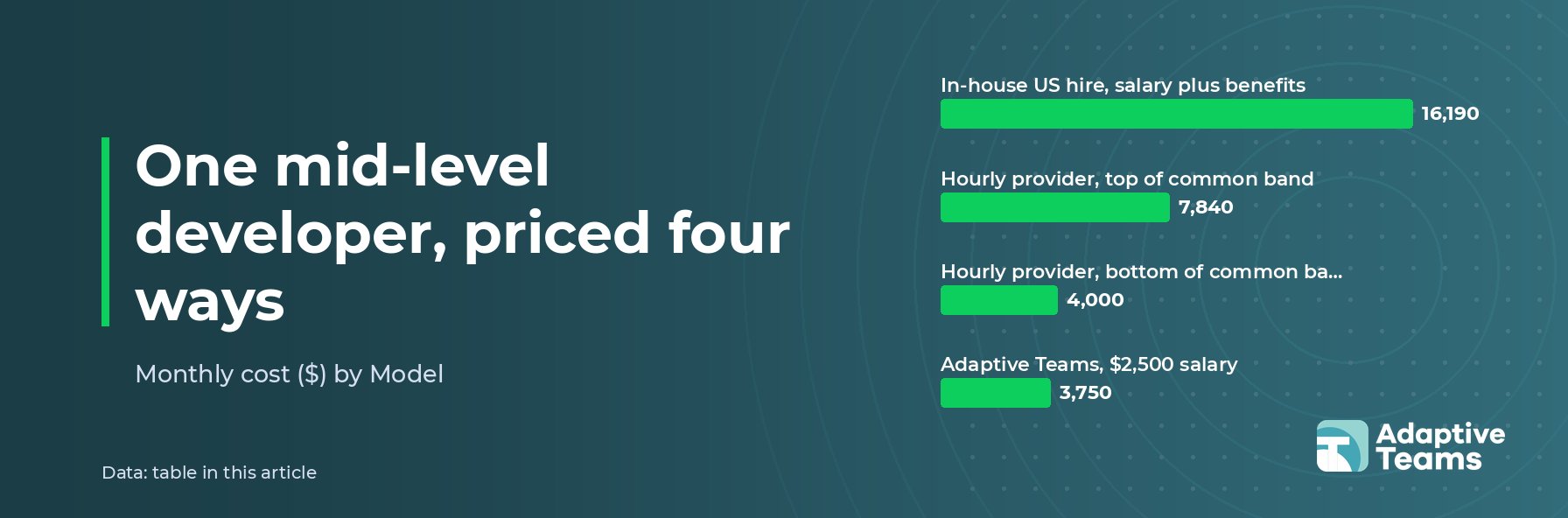
One mid-level developer, priced four ways
The table below prices a single full-time developer for one month. The local figure uses government wage data. The hourly rows use Clutch's common band. The Adaptive Teams row uses a $2,500 salary as an example; the real salary is agreed with the candidate for your role.
| Model | Monthly cost ($) | What sets the price |
|---|---|---|
| In-house US hire, salary plus benefits | 16,190 | Median wage grossed up for benefits |
| Hourly provider, top of common band | 7,840 | $49 an hour for 160 hours |
| Hourly provider, bottom of common band | 4,000 | $25 an hour for 160 hours |
| Adaptive Teams, $2,500 salary | 3,750 | Salary plus 50% staffing fee |
The in-house number comes from two federal sources. The median annual wage for US software developers was $135,980 in May 2025, according to the Bureau of Labor Statistics Occupational Outlook Handbook. That is about $11,332 a month. Wages made up 70% of private employer compensation costs in June 2026, per the BLS Employer Costs for Employee Compensation release, so the full monthly cost lands near $16,190.
Finding that local hire costs extra. SHRM benchmarking data put the average cost per hire at nearly $4,700.
How is the Adaptive Teams fee built?
You pay the person's agreed monthly salary plus a staffing fee that is a percentage of it. The percentage drops as the salary rises, and recruitment is included.
Staffing fee by monthly salary
| Agreed monthly salary ($) | Staffing fee (%) | Fee at that salary ($) | Monthly total ($) |
|---|---|---|---|
| 1,500 | 60 | 900 | 2,400 |
| 2,500 | 50 | 1,250 | 3,750 |
| 3,500 | 40 | 1,400 | 4,900 |
| 4,500 | 35 | 1,575 | 6,075 |
| 6,000 | 30 | 1,800 | 7,800 |
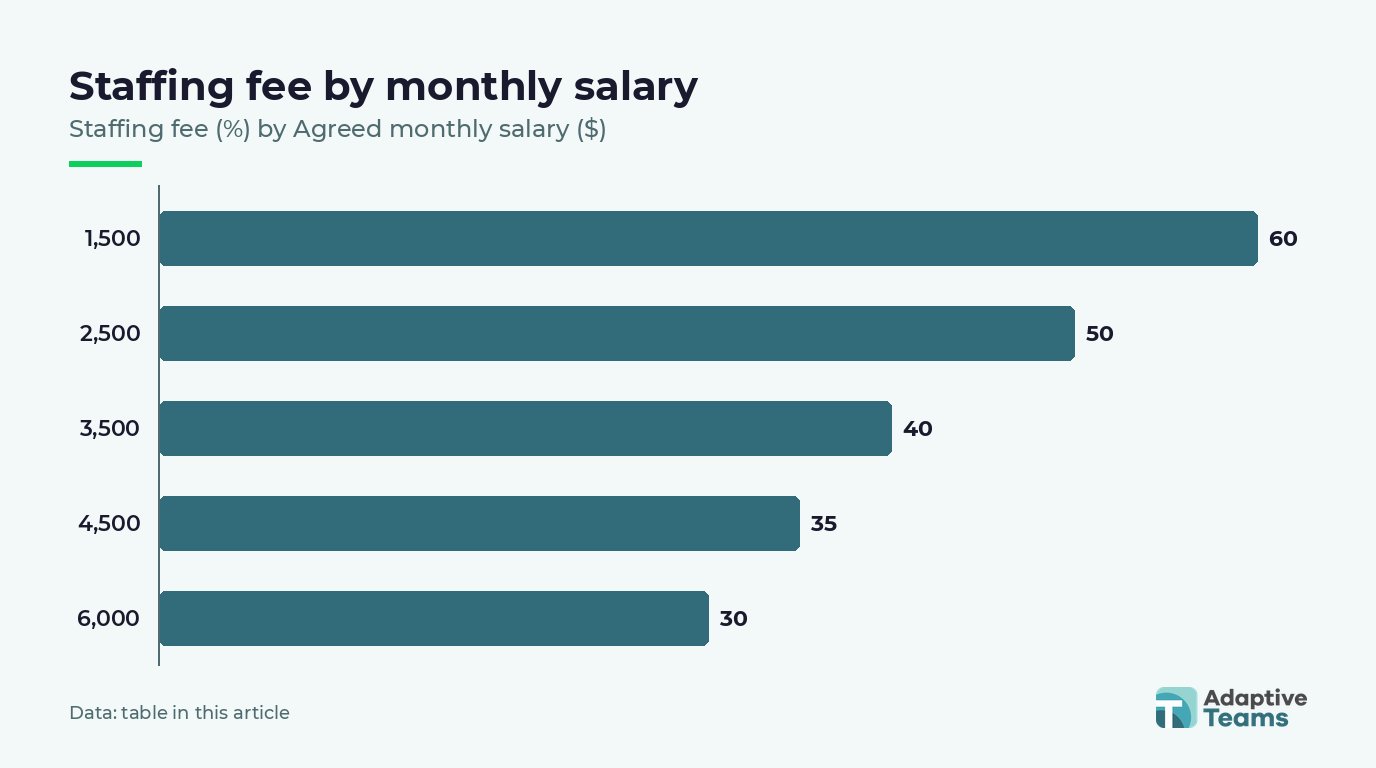
Above $4,500 the fee is 30%, so the last row shows a $6,000 salary as an example. You pay nothing until the person starts. If you only want the search and plan to employ the person yourself, recruitment alone costs $4,000 flat per hire.
Hourly agencies hide their margin inside one rate. A fee shown as a share of a known salary lets you see exactly what the person earns and what the service costs. Our breakdown of how agency rates are built shows why that matters when you renew.
Which type of provider fits your role?
The right type depends on how long the seat lasts and how much local presence it needs. Start from the job, then pick the billing model.
When a local US staffing firm is the better pick
Pick a local firm when the person must be on site, hold a US security clearance or work regulated data that cannot leave the country. Pick one too when you need a contractor next Monday for a six week push. Local firms carry deep benches for exactly that, and the higher rate buys speed and proximity.
When a freelance network makes sense
A freelancer suits a bounded task with a clear finish line, such as a data migration or a landing page. Setup is light. The catch is continuity: the person who knows your system may be booked elsewhere when the next job arrives.
When a full-time remote hire wins
A full-time hire abroad pays off when the role is ongoing and the person gets better by learning your product, customers and tools month after month. Think support, operations, accounting, QA or a developer on a long roadmap.
KO Storage, which runs 70+ self-storage locations across the US, is the clearest example we can give. It started with 4 call center agents in August 2024 and grew to 70+ team members within 18 months, across call center, revenue management, accounting, asset management, security and IT support.
For developers specifically, our page on software offshore staffing walks through the search and the first 30 days inside a codebase.
What should you ask a staff augmentation company before signing?
Ask what the person earns. If a provider will only quote a blended rate, you cannot tell whether a good engineer is underpaid and likely to leave in six months.
A short set of questions separates providers quickly:
- What is the person's salary, and what is your fee on top?
- Is the person full time and dedicated to us, or shared with other clients?
- How long is the notice period, and is there an annual commitment?
- What happens if the hire does not work out in the first weeks?
- Who handles payroll, benefits and HR in the person's country?
- How many candidates will we see, and can we run our own interview?
How Adaptive Teams answers those
The fee is a published share of the salary you agree. Each person works only for you. The agreement runs month to month with 30 days notice on either side. If the fit is wrong in the first 2 months, we replace the person at no extra cost.
You see a shortlist of 3 to 5 screened candidates and make the final call. Searches start from our Teamtailor account, which holds 56,287 candidates and 64,982 applications, so most roles fill in 2 to 3 weeks.
Where do staff augmentation deals go wrong?
Most failures trace back to the wrong model for the seat. An hourly contractor placed in a permanent role slowly turns into an expensive employee with no loyalty to your product.
The second common trap is a minimum engagement that outlives the need. A $25,000 minimum is fine for a defined build. It becomes painful when the roadmap shifts in month two.
The third is missing direction. Augmented staff need someone on your side who sets priorities and answers questions. If nobody can do that, a provider that runs the whole project with its own lead is the safer buy.
If you want to compare named vendors after choosing the model, our list of the best offshore staffing companies compares ten of them side by side.
Frequently asked questions
Are staff augmentation companies in the USA cheaper than hiring?
Usually, yes, though it depends on where the person lives. A local contractor at $49 an hour costs about $7,840 a month, roughly half the $16,190 a median US developer costs with benefits. A full-time hire abroad through Adaptive Teams at a $2,500 salary costs $3,750 a month, recruitment included.
Do I need a foreign entity to use offshore staff augmentation?
No. With Adaptive Teams, we hold the contract and run payroll through a global payroll partner that handles local tax and benefits in the person's country. You get one invoice per person each month. You never register a company abroad, and the person is paid twice a month.
How fast can a staff augmentation company fill a role?
Local firms with a ready bench can sometimes start a contractor within days. For a full-time remote hire, Adaptive Teams fills most roles in 2 to 3 weeks from the scoping call. Senior or unusual roles can take longer, because the shortlist only goes out once 3 to 5 candidates pass screening.
Which roles work best with staff augmentation?
Roles with a steady flow of written work fit best: customer support, operations, bookkeeping and accounting, QA, and software development on a clear backlog. Roles that need a US security clearance, constant on site presence or judgment about your local market usually belong with a local staffing firm or an in-house hire.
Where to start
Write down the role, the hours that must overlap with your team and how long you expect to need the person. If the answer is longer than six months, a full-time remote hire is worth pricing next to any hourly quote.
If you want help with that, our recruitment team scopes the role with you and puts screened candidates in front of you, usually within 2 to 3 weeks.

Written by the people who recruit, pay and manage remote teams every day, with Nate Ginsburg and Menno Gottmer. About Adaptive Teams