TL;DR
Remote staffing companies find, employ and support people who work full time for your business from another country. They differ in who screens, who holds the contract and who manages the person after day one. At Adaptive Teams you agree the salary, pay a staffing fee of 30% to 60% of it, and roles usually fill in 2 to 3 weeks on a month to month agreement.
You probably landed here because a role has been open too long. Maybe it is a support seat that keeps burning out whoever covers it, or a bookkeeper you need but cannot justify at a US salary. The search results mix job boards, outsourcing call centers, payroll software and recruiters, and they all use the same words.
This page sorts them by how they actually work, shows the math on cost, and lists the questions that separate a partner you keep for years from one you replace in a quarter.
What do remote staffing companies actually do?
A remote staffing company places a person who works only for you, from another country, while the company handles some or all of the employment work around that person. How much of that work it carries is the real difference between providers.
Four models show up when you search:
| Dedicated staffing partner | Employer of record platform | Freelance marketplace | Outsourcing firm (BPO) | |
|---|---|---|---|---|
| Who finds the person | The partner | You | You | The firm |
| Who directs the daily work | You | You | You | The firm's supervisor |
| Contract and payroll | The partner | The platform | Mostly you | The firm |
| Ongoing management help | Yes, a dedicated manager | Rarely | No | Yes, inside the firm |
| Usual pricing | Salary plus a staffing fee | Monthly fee per worker | Rate plus platform fees | Per seat or per task |
Adaptive Teams runs the first model. The person joins your team chat, follows your hours and reports to you. We recruit them, sign the contract through our global payroll partner, run payroll twice a month and give each placement a dedicated performance manager.
When an employer of record is enough
An employer of record platform suits a company that already found the person. If you met a great developer in Colombia and only need a compliant contract, the platform is the cheaper tool. You still do the sourcing, screening and the management yourself. Our guide to PEO vs EOR for international hiring goes deeper on that choice.
When outsourcing fits better
A BPO sells an outcome, such as answered tickets or processed invoices, and manages its own people to deliver it. That works when you never want to direct the work. It works less well when the role needs your context, your tools and your judgment every day.
How much do remote staffing companies cost?
The honest comparison is the full monthly cost of one person who works only for you, with recruiting and admin included.
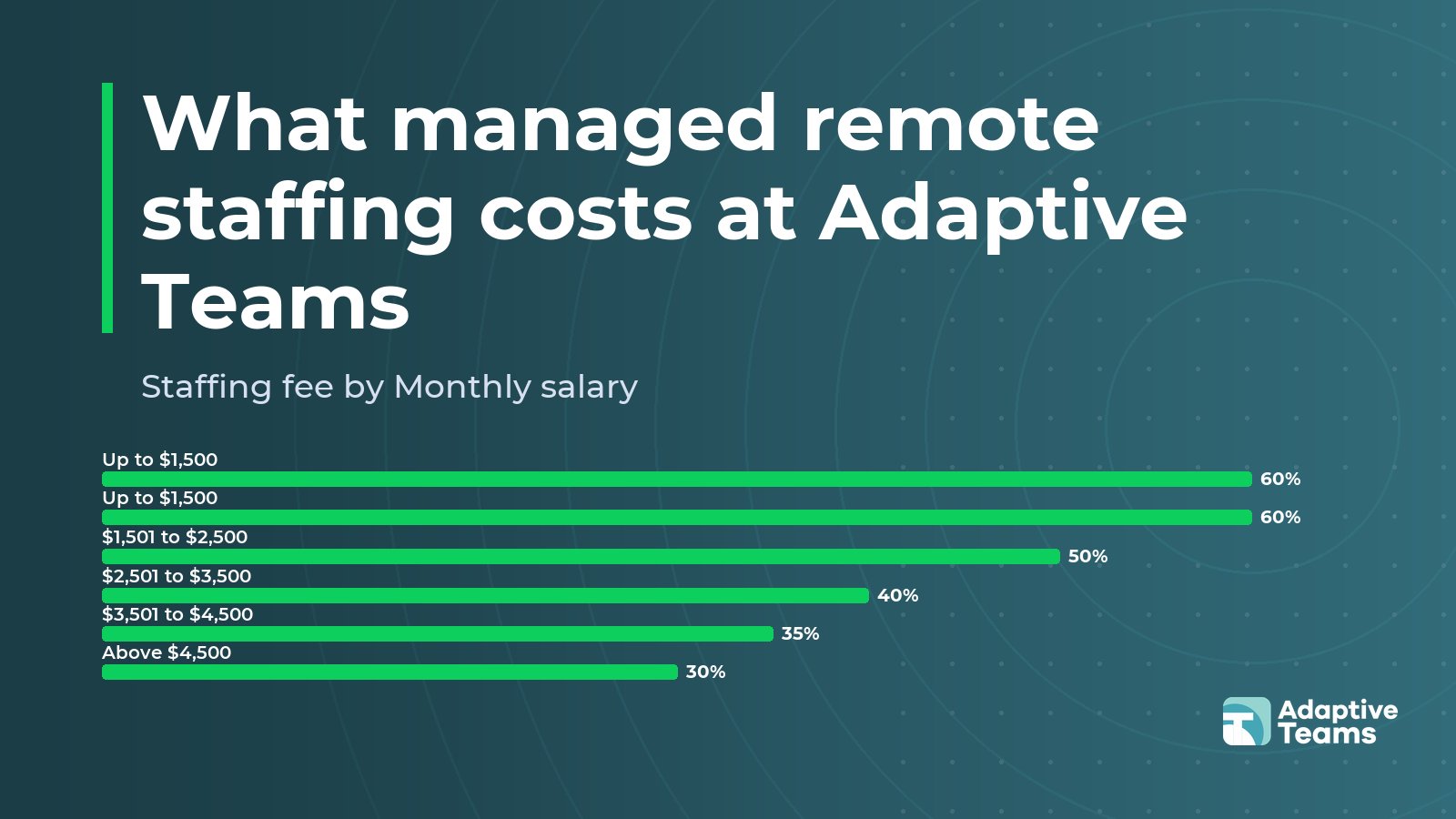
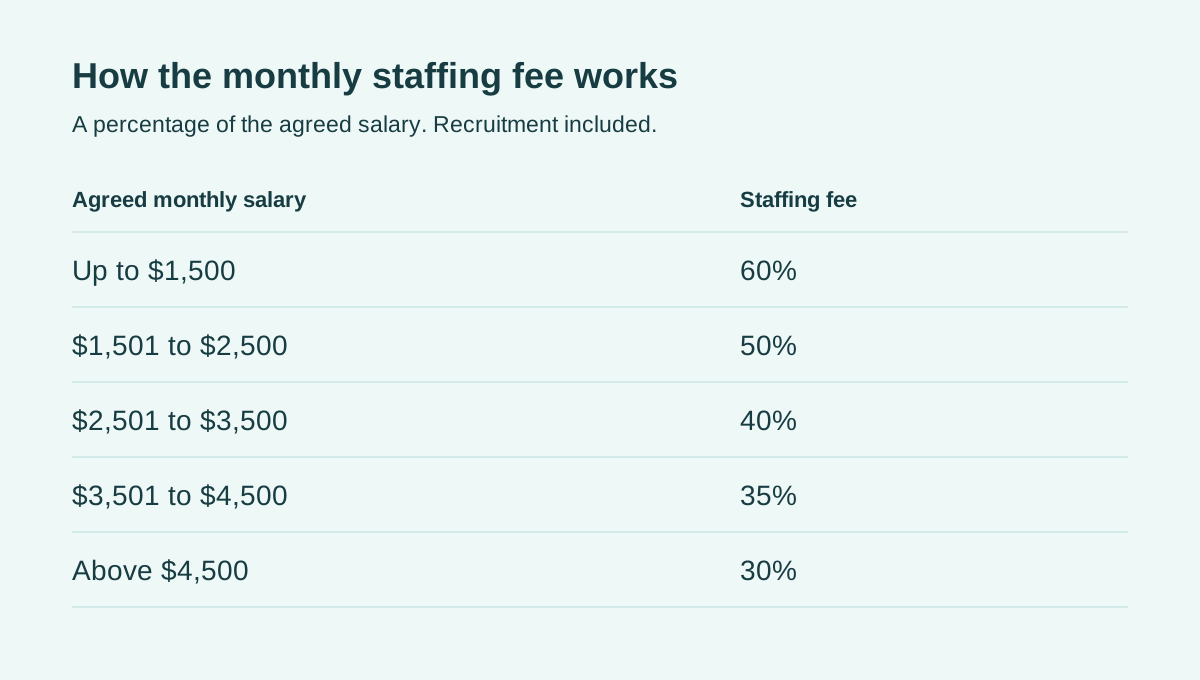
At Adaptive Teams you agree a monthly salary with your hire. Our staffing fee is a percentage of that salary, and the percentage falls as the salary rises:
- Up to $1,500 a month: 60%
- $1,501 to $2,500: 50%
- $2,501 to $3,500: 40%
- $3,501 to $4,500: 35%
- Above $4,500: 30%
Recruitment is included in that fee. If you only want us to run the search and you take over after the hire, recruitment on its own is $4,000 flat per hire.
Two worked examples
Take a customer support agent at an agreed salary of $1,000 a month. The fee is 60%, or $600, so your monthly total is $1,600. A senior bookkeeper at $2,400 a month falls in the 50% band: the fee is $1,200 and the total is $3,600.
Both totals cover the search, the contract, payroll, HR support and the performance manager. There is no upfront placement fee on this model, and you pay nothing until your new team member starts. For a wider look at how other agencies structure their fees, see our explainer on how staffing agency fees are built.
The US hire you are comparing against
Salary is only part of what a local hire costs. The Bureau of Labor Statistics occupational outlook puts the 2025 median pay for customer service representatives at $44,770 a year, about $3,731 a month.
Wages are only 70% of what private employers spend per hour worked, according to the BLS employer cost release for June 2026. Benefits make up the other 30%. Gross up that median wage by the same share and a typical US support hire costs roughly $5,330 a month before you spend anything on recruiting.
Recruiting adds more. SHRM's benchmarking data put the average cost per hire at nearly $4,700. Our numbers on cost-effective remote staffing solutions show where the savings land role by role.
How fast can a remote staffing company fill a role?
Most Adaptive Teams roles fill in 2 to 3 weeks, because the search starts from candidates we already know.
Our TeamTailor account holds 56,287 candidates and 64,982 applications across 956 jobs. A new search still runs in full, but it never starts from an empty pipeline. Here is what happens in those weeks:
- We scope the role with you and confirm the salary band before anyone is sourced.
- We source through TeamTailor, outreach, referrals and remote talent communities, mostly in the Philippines, Latin America and Eastern Europe.
- Candidates take skills tests, English checks, reference checks and a recorded video interview. A pool of 100+ applicants usually becomes 10 to 15 strong candidates.
- You get 3 to 5 of them with scores, the interview recording and our recruiter's notes, and you make the final call.
Payroll and HR start on day one. Every hire also starts with a 2-month probation period, so fit gets proven on real work.
How do you choose between remote staffing companies?
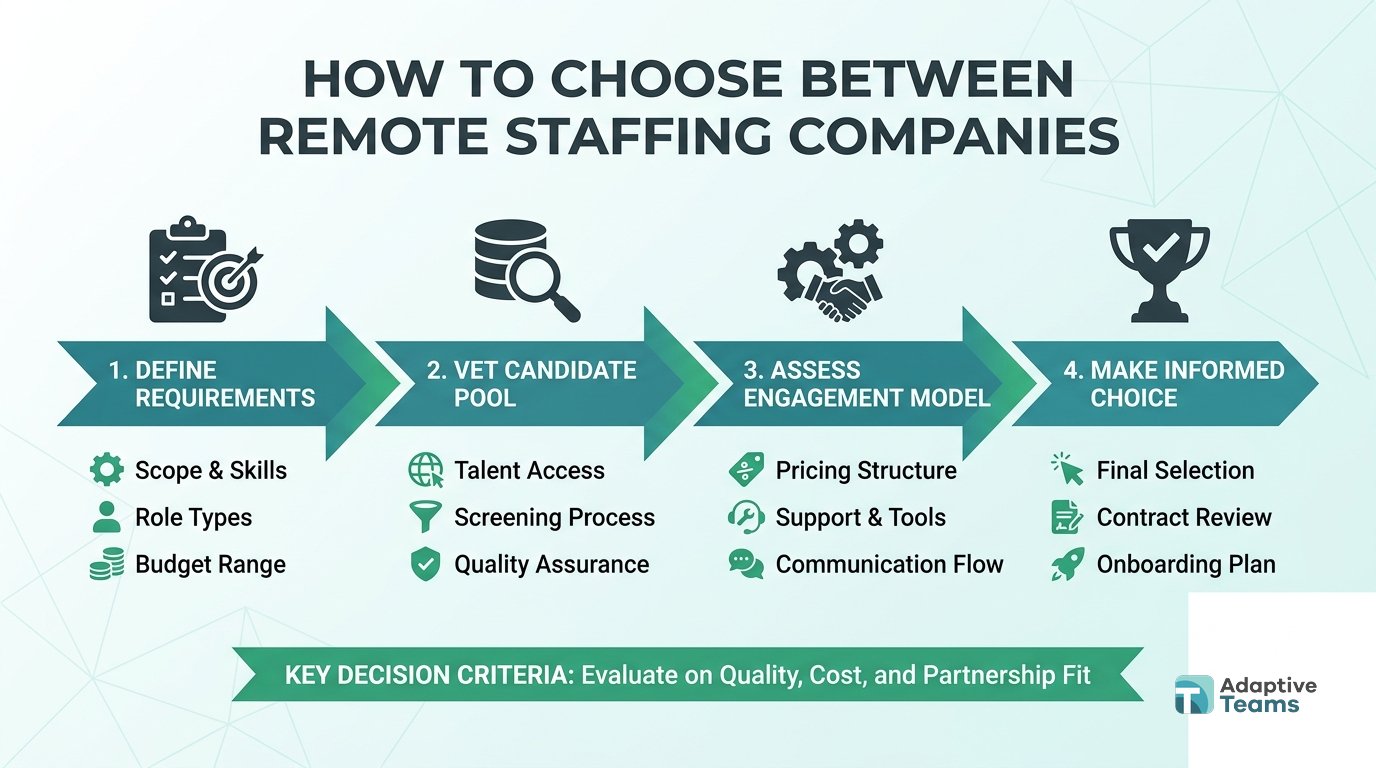
Ask what happens after the hire. Most providers look alike up to the signed contract, and the differences show up in month three.
Who manages the person day to day?
You direct the work. Someone still has to run check-ins, track attendance, handle leave and notice early when a good hire starts drifting. At Adaptive Teams a dedicated manager does that, with semiannual reviews and a skill development plan. Ask any provider to name the person who does this for your hire.
What happens if the hire does not work out?
People sometimes leave, and sometimes the fit is wrong. Our free replacement covers the first 2 months. The agreement runs month to month with 30 days written notice on either side. Be careful with annual lock-ins for a role you have never filled before.
Can you see the salary?
When a provider hides what the person earns, you cannot tell whether a strong hire will stay. We confirm the salary band with you up front, and you agree the salary with your hire directly.
Have they run a team like yours?
Ask for a client who grew with them. KO Storage, which runs 70+ self-storage locations across the US, started with four call center agents in August 2024. Eighteen months later it had 70+ Adaptive Teams contractors across six departments, from revenue management to IT support. Our comparison of the 10 best offshore staffing companies lists more providers worth a call if you want to compare offshore staffing options side by side.
Where do the mistakes usually happen?
The most common one is buying hours when you need a person. A shared pool keeps losing the context a full-time hire builds up, so the same questions come back every week.
Another is treating the provider as a recruiter only. A placement that nobody manages after week two tends to fade quietly. The first sign is usually slower replies, then missed handoffs.
The last is starting too big. Teams that hand one person fifteen tasks on day one get fifteen small errors. Start with two well documented tasks and a screen recording of each, then add more as trust grows. KO Storage started with four agents for a reason.
Frequently asked questions
Are remote staffing companies the same as outsourcing firms?
No. A remote staffing company places a person who works only for you and takes direction from you, while it handles hiring, contracts and payroll. An outsourcing firm sells a finished outcome and manages its own staff to deliver it. Staffing suits roles that need your context and tools every day.
Do I need a foreign entity to hire through a remote staffing company?
No. At Adaptive Teams every contract runs through our global payroll partner, which covers compliant contracts, tax handling and benefits admin in 150+ countries. You receive one invoice per person each month, and your hire is paid twice a month in their own country without you setting up a local company.
What does the staffing fee include?
The Adaptive Teams fee covers recruitment, the contract, payroll twice a month, HR support, a dedicated performance manager and the free replacement in the first 2 months. It is a percentage of the salary you agree with your hire, from 60% for salaries up to $1,500 a month down to 30% above $4,500.
Can I start with one hire and grow later?
Yes, and most clients do. You can start with a single role on a month to month agreement with 30 days notice. KO Storage began with four call center agents and grew to 70+ team members across six departments in 18 months, adding roles as each team proved itself.
Where to start
Write down the role that has been open longest and the hours it needs covered. Add the tools the person will use and a salary band you can live with. That is enough to scope a search.
If you want us to run it, our recruitment team scopes the role with you and puts 3 to 5 screened candidates in front of you, usually within 2 to 3 weeks.

Written by the people who recruit, pay and manage remote teams every day, with Nate Ginsburg and Menno Gottmer. About Adaptive Teams