TL;DR
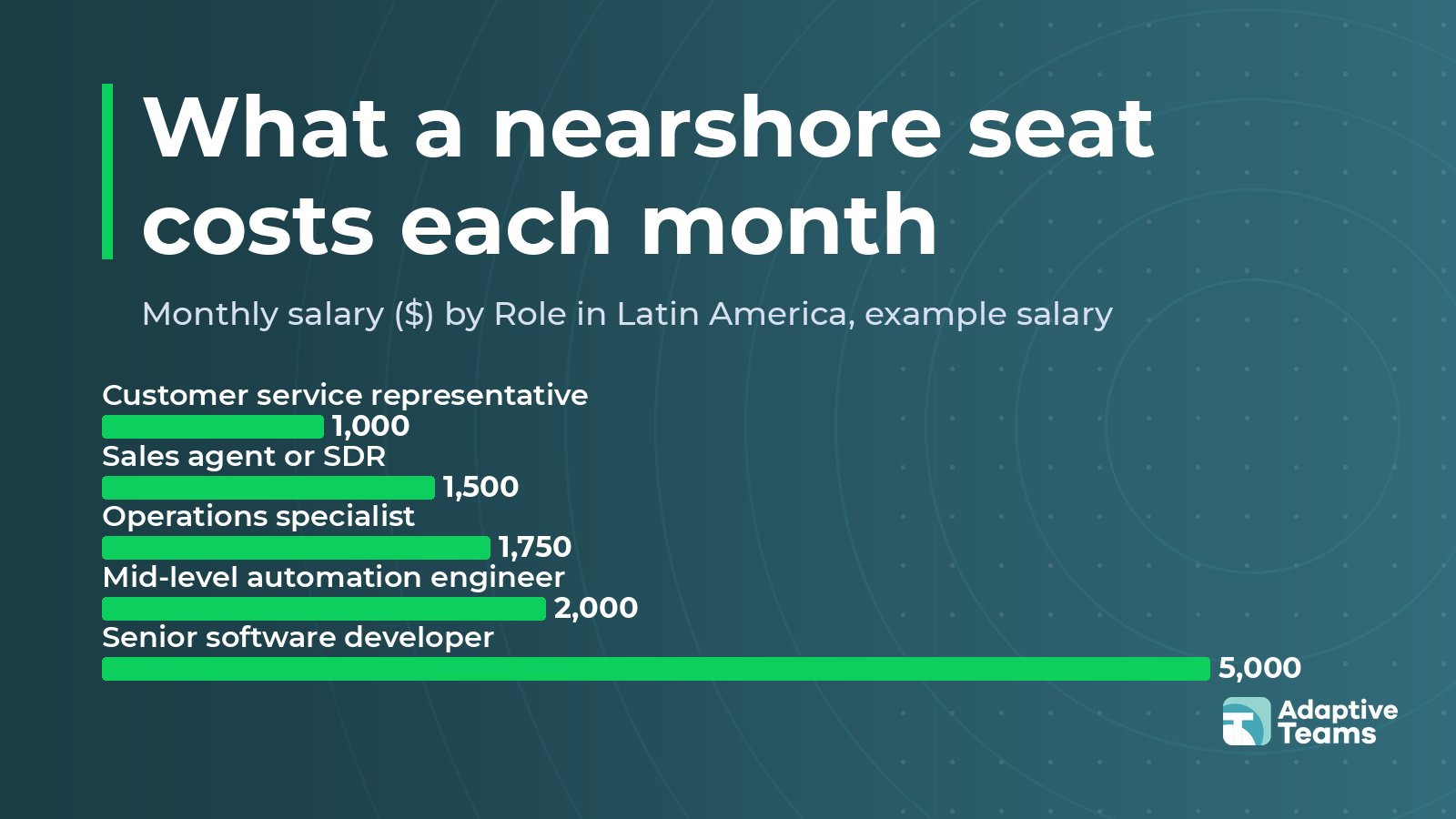
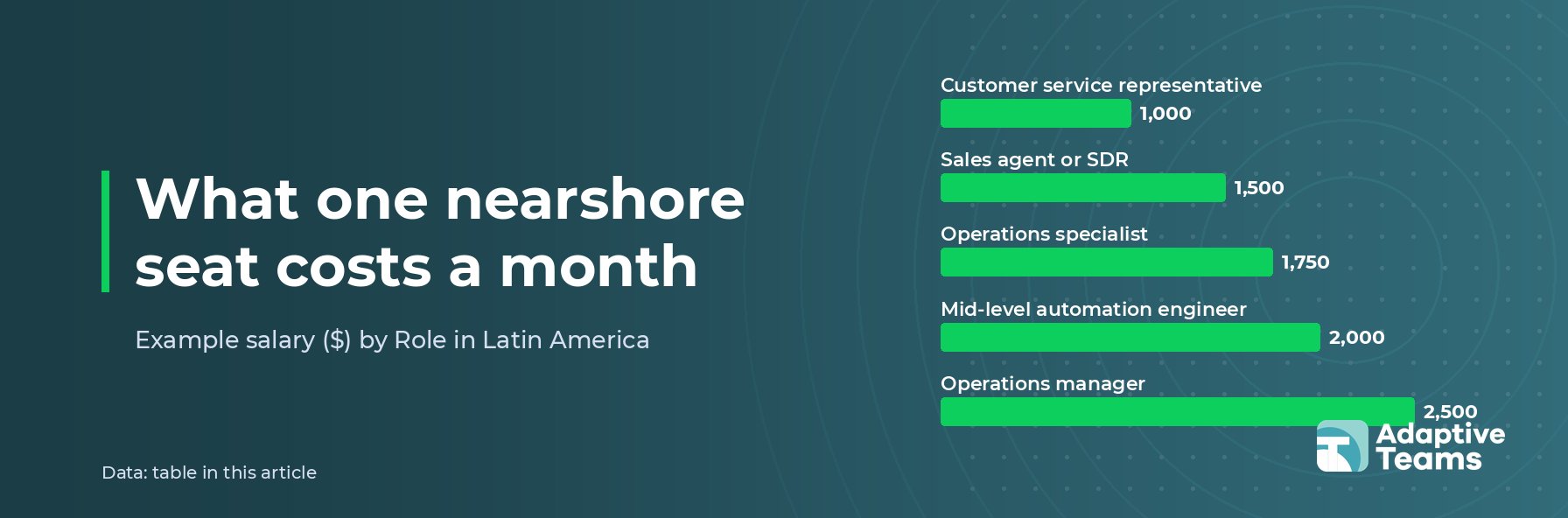
The cost of nearshore teams in Latin America is the salary you agree with each hire plus a staffing fee. With Adaptive Teams a customer service rep at a typical $1,000 salary costs $1,600 a month in total, and a mid-level automation engineer at $2,000 costs $3,000. A five-person team of three support reps, an operations specialist and an engineer comes to about $10,425 a month before volume discounts.
Search for nearshore costs and most results price software projects by the hour. That helps if you are buying a project. It says little about what you will pay to add five people in Colombia or Brazil who work your hours, inside your tools, for years.
This page prices that second case. The salary bands come from our own Latin American payroll records, published on our offshore salary benchmarks page. The fees are the ones we charge every client.
What does one nearshore seat cost per month?
One nearshore seat costs its agreed monthly salary plus a staffing fee that is a percentage of that salary. The fee is 60% for salaries up to $1,500, 50% up to $2,500, 40% up to $3,500, 35% up to $4,500 and 30% above that. Recruitment, the employment contract, payroll, HR and a performance manager are inside the fee.
What one nearshore seat costs a month
| Role in Latin America | Example salary ($) | Staffing fee (%) | Monthly total ($) |
|---|---|---|---|
| Customer service representative | 1,000 | 60 | 1,600 |
| Sales agent or SDR | 1,500 | 60 | 2,400 |
| Operations specialist | 1,750 | 50 | 2,625 |
| Mid-level automation engineer | 2,000 | 50 | 3,000 |
| Operations manager | 2,500 | 50 | 3,750 |
Each example salary sits inside the band our placements actually earn. Customer service reps in Latin America earn $900 to $1,050 a month, with $1,000 typical across 31 placements. Sales agents earn $750 to $1,500, operations specialists $1,250 to $2,000, mid-level automation engineers $1,500 to $2,250 and operations managers $1,750 to $2,500.
You agree the real number with your hire before anyone starts. We confirm the band is realistic for the role and country during scoping, before anyone is sourced.
Why the fee percentage falls as salaries rise
The percentage steps down at each salary bracket, so the fee grows more slowly than pay. A $1,000 rep carries a $600 fee. A senior developer at a $5,000 salary carries a 30% fee of $1,500 and costs $6,500 a month in total.
The cost of nearshore teams, worked through for five people
A five-person nearshore team of three support reps, one operations specialist and one automation engineer costs about $10,425 a month at the example salaries above. Salaries make up $6,750 of that and staffing fees $3,675.
What a five-person nearshore team costs a month
| Seat | Salaries ($) | Staffing fees ($) | Monthly total ($) |
|---|---|---|---|
| Three customer service reps | 3,000 | 1,800 | 4,800 |
| Operations specialist | 1,750 | 875 | 2,625 |
| Mid-level automation engineer | 2,000 | 1,000 | 3,000 |
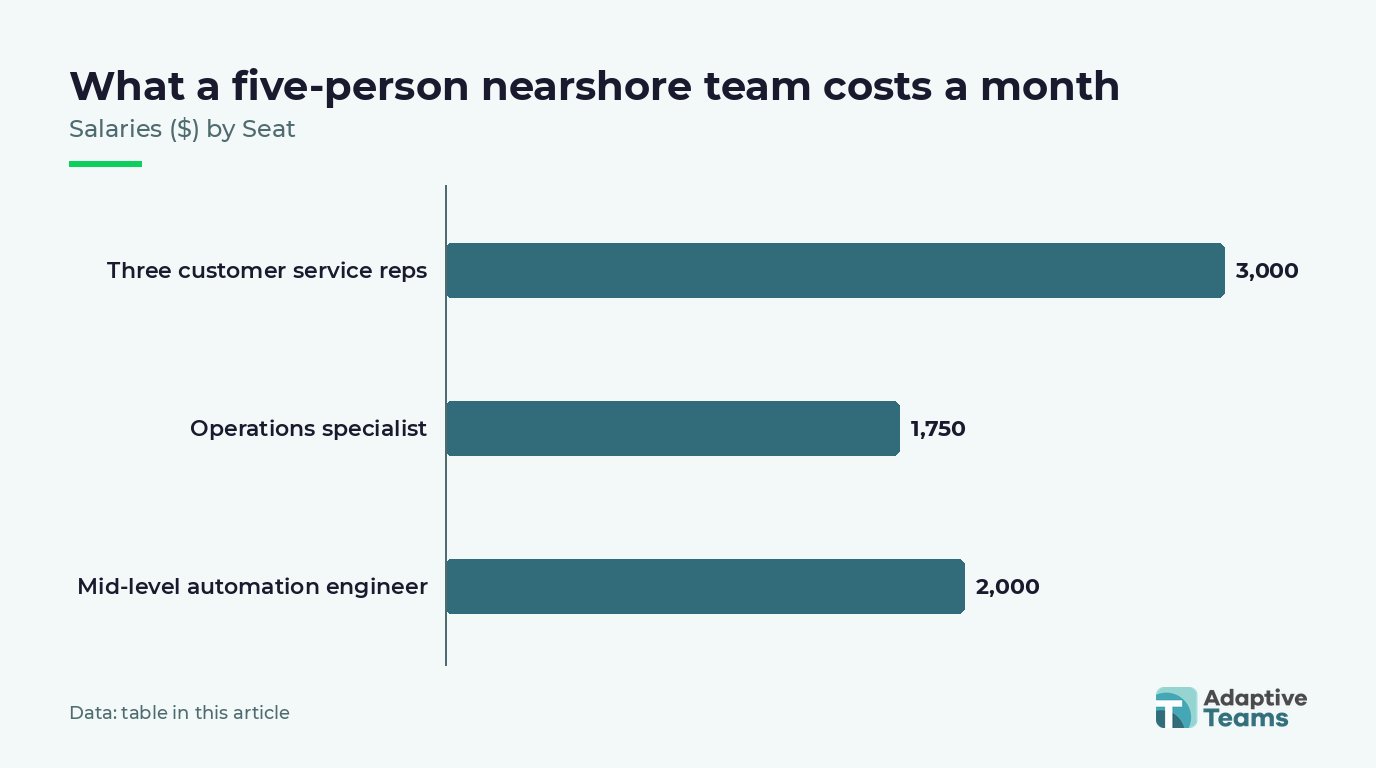
A team of five also qualifies for our volume discount. It is 3% for 2 to 4 people, 6% for 5 to 9 and 9% for 10 or more. The figure above is before that discount, so treat it as the ceiling for this mix.
Teams rarely start at five. KO Storage, which runs self-storage locations across the US, came to us for four call center agents in August 2024. Eighteen months later it had 70+ Adaptive Teams contractors across six departments, from revenue management to IT support.
How does that compare with hiring in the US?
For the same support role, a nearshore rep costs well under half of a US rep's salary alone. The Bureau of Labor Statistics puts the median US customer service representative at $44,770 a year, which is about $3,730 a month before payroll taxes and benefits. Our Latin American rep costs $1,600 a month all in.
Across three support seats the gap grows to roughly $11,190 a month in US median salaries against $4,800 for the nearshore version. Engineering shows the same pattern. The BLS reports a median of $135,980 a year for US software developers, about $11,330 a month. A nearshore developer at a $5,000 salary costs $6,500 with our fee.
Those comparisons use medians, and your local market may pay more or less. They still show where the money goes. Nearshore hiring is cheaper because Latin American salaries are lower for the same work, while the hours stay close to yours.
Why does nearshore cost more than offshore?
Nearshore costs more than offshore because you pay for working hours that overlap with the US day. In our placements Latin America runs 20 to 40 percent above the Philippines for the same role. A Philippine support rep at the typical $800 salary costs $1,280 a month with our fee; the Latin American rep at $1,000 costs $1,600.
That $320 a month buys a person who is online during your meetings. If the role answers customers live, joins daily standups or needs quick answers from your managers, the overlap pays for itself. If the work arrives as written tasks and nobody needs to talk to the person during the day, the cheaper region does the same job. Our comparison of nearshore vs offshore team models runs that test role by role.
What is included in the staffing fee, and what is extra?
The staffing fee covers recruitment, the employment contract, payroll, HR, a performance manager and a free replacement whenever the hire does not work out. There are no upfront placement fees. You get one invoice per person each month.
Some costs pass through at cost and sit outside the fee. Salary adjustments are the main one: when you give a hire a raise, the new salary goes on the invoice and the fee follows the bracket it falls in. Benefits and reimbursements you agree with the hire run through the same payroll.
If you only want the search and will employ the person yourself, recruitment costs $4,000 flat per hire. That compares with the average US cost per hire of nearly $4,700 reported in SHRM benchmarking data, where many employers put the full cost of a new hire at three to four times the salary.
Questions to ask any nearshore provider
Ask what the person actually earns each month. A provider that quotes one blended rate without a salary figure leaves you unable to see how much of your money reaches the person doing the work. Our explainer on how staffing agencies price their work covers the common pricing models.
Ask what happens at month three. Some contracts lock you in for a year or charge a buyout if you hire the person directly. Ours runs month to month with 30 days notice on either side.
Where do nearshore team budgets go wrong?
Nearshore budgets usually break after the quote is signed, on decisions the rate card does not show.
Leaving the seat open too long
A role that sits unfilled for three months costs you the work that did not get done. Our roles are usually filled in 2 to 3 weeks. You interview a shortlist of 3 to 5 people who already passed a skills test, an English check and a recorded video interview.
Budgeting from the bottom of the band
Our salary bands are wide on purpose. The operations specialist band runs from $1,250 to $2,000, and the top of it buys someone who works without close supervision. If you budget at the low end for a role that needs senior judgment, your shortlist will reflect that. Price the role at the middle of the band and move down only for a junior hire.
Forgetting raises
A hire who stays three years will get raises. Because our fee is a percentage of the salary, plan for the fee to rise with them. A rep who moves from $1,500 to $1,600 crosses into the 50% bracket, and the monthly total stays at $2,400. A move from $2,000 to $2,500 lifts the total from $3,000 to $3,750.
Frequently asked questions
How much does a nearshore employee cost per month?
A nearshore employee costs their agreed salary plus a staffing fee. With Adaptive Teams the fee is 30% to 60% of the salary, falling as pay rises. A Latin American customer service rep at $1,000 costs $1,600 a month in total, and an operations manager at $2,500 costs $3,750 a month.
Are there setup or placement fees on top of the monthly cost?
No. Adaptive Teams charges no upfront placement fees. Recruitment, the contract, payroll, HR and a performance manager sit inside the monthly staffing fee. If you want only the search and will employ the person yourself, recruitment costs a flat $4,000 per hire instead of a monthly fee.
Do I get a discount for hiring a whole nearshore team?
Yes. Adaptive Teams applies a volume discount from the second person. It is 3% for 2 to 4 people, 6% for 5 to 9 people and 9% for teams of 10 or more. Ask for the discounted figure when you scope the team, since it changes the total for every seat you add.
What happens to the cost if a nearshore hire leaves early?
If a hire does not work out, Adaptive Teams replaces them at no extra cost, for as long as they work with you. You do not pay a second recruitment fee. After that, the agreement runs month to month with 30 days notice on either side, so you are never paying for a seat you no longer need.
Which roles are cheapest to hire nearshore?
Customer service and sales roles have the lowest salaries in our Latin American placements, at $750 to $1,500 a month. Operations, marketing and automation roles sit higher, mostly between $1,250 and $2,500. The fee percentage is highest on the cheapest roles, so the gap in total cost is smaller than the gap in salary.
Where to start
Write down the roles you want to fill, the hours each one must overlap with your team and the salary you have in mind. Our recruitment team turns that list into a per-seat monthly price and a shortlist of screened candidates, usually within 2 to 3 weeks. Book a free staffing consultation to get your team priced.

Written by the people who recruit, pay and manage remote teams every day, with Nate Ginsburg and Menno Gottmer. About Adaptive Teams