TL;DR
Nearshore outsourcing means moving work to a team in a nearby country, which for US companies usually means Latin America. You get 6 to 8 shared working hours a day and lower salaries than US hires. You can hand a whole process to a vendor or add dedicated people you direct yourself. With Adaptive Teams you pay the agreed salary plus a 30% to 60% staffing fee, and most roles start in 2 to 3 weeks.
Most people who search for nearshore outsourcing already know the basic idea. What they want to know is how it works day to day, what it costs and which kind of provider to call. Those three answers depend on one choice most guides skip: whether you want to buy an outcome or add people to your own team.
This page covers both routes. It is written from the side that recruits, contracts and pays nearshore hires in Colombia, Argentina and Brazil every week.
What is nearshore outsourcing?
Nearshore outsourcing is sending work to people in a country close to yours, in the same or a neighbouring time zone. For a company in New York, Chicago or Austin that means Mexico, Colombia, Brazil, Argentina or another Latin American country. Offshore outsourcing sends the same work further away, to the Philippines, India or Eastern Europe, with a bigger time gap.
The word "outsourcing" hides two very different arrangements:
- Process outsourcing. A vendor takes a function, such as a support queue or a software project, and runs it with its own managers. You pay for the output and see a report.
- Nearshore staffing. A partner recruits a dedicated person who works only for you, inside your tools and meetings. The partner holds the contract and pays them. You set the priorities every day.
Both get called nearshore outsourcing in search results and sales decks. The difference decides who you talk to each morning, what you pay for and how much of your know-how stays in your company. Our explainer on staff augmentation vs outsourcing goes deeper into that split.
What does nearshore outsourcing cost per month?
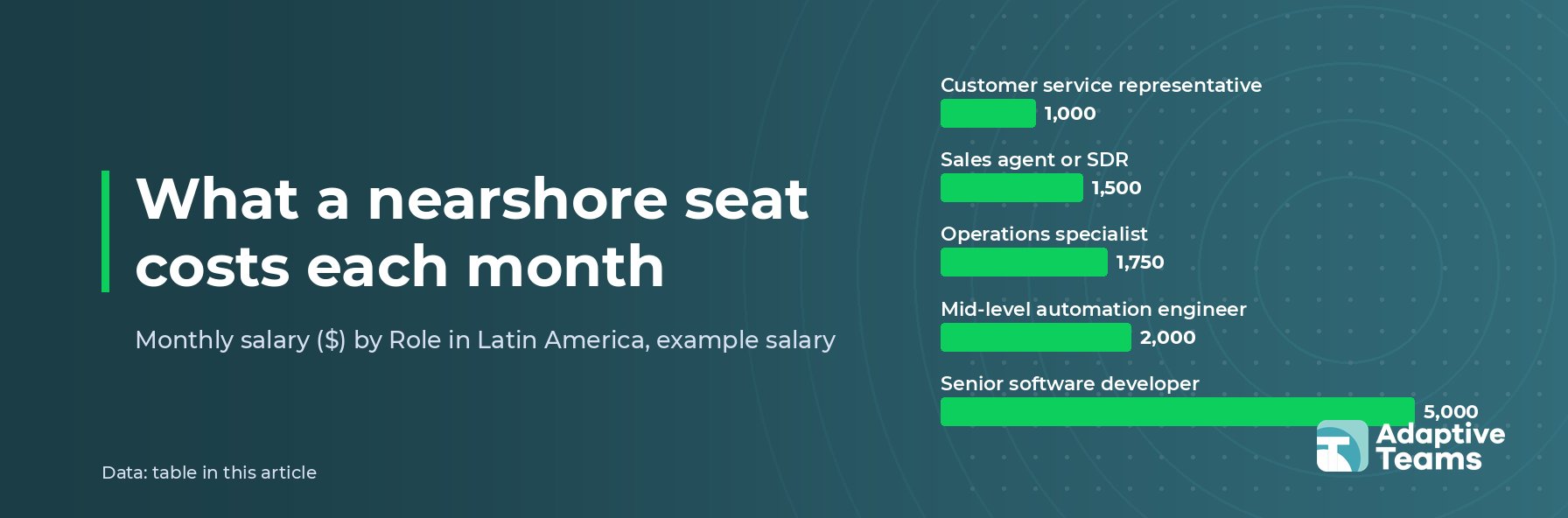
A dedicated nearshore hire costs their agreed salary plus the partner's fee. At Adaptive Teams that fee is a percentage of the monthly salary: 60% up to $1,500, 50% to $2,500, 40% to $3,500, 35% to $4,500 and 30% above that. Recruitment, the contract, payroll, HR and a performance manager sit inside it.
What a nearshore seat costs each month
| Role in Latin America, example salary | Monthly salary ($) | Staffing fee (%) | Monthly total ($) |
|---|---|---|---|
| Customer service representative | 1,000 | 60 | 1,600 |
| Sales agent or SDR | 1,500 | 60 | 2,400 |
| Operations specialist | 1,750 | 50 | 2,625 |
| Mid-level automation engineer | 2,000 | 50 | 3,000 |
| Senior software developer | 5,000 | 30 | 6,500 |
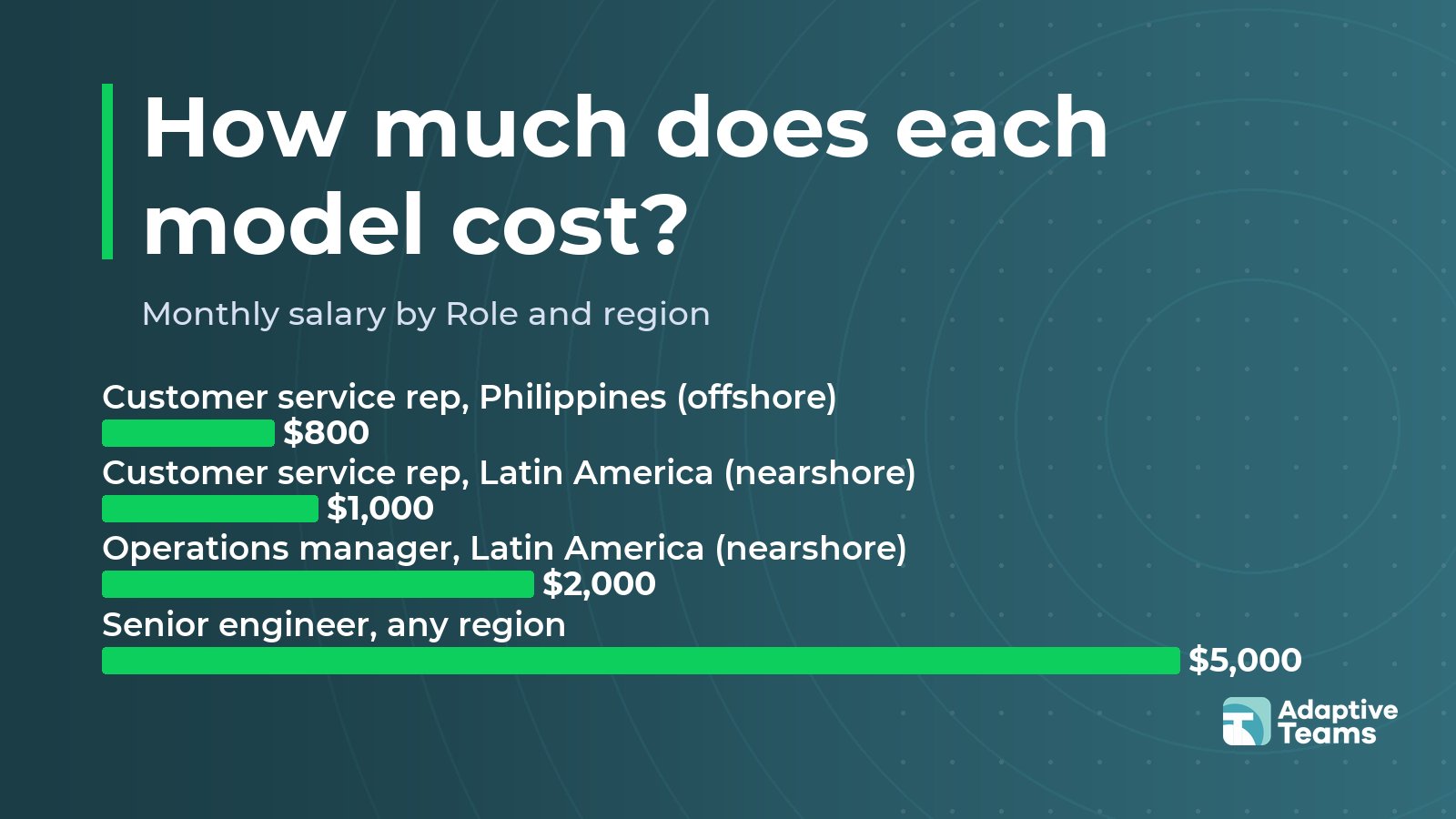
The first four salaries sit inside the pay bands from our own Latin American payroll records; the senior developer is an example. You agree the real figure with your hire before anyone is sourced. A Latin American customer service rep in our placements typically earns about $1,000 a month, against roughly $800 in the Philippines. That $200 gap is the price of sharing your workday. For pay ranges across more roles, see our offshore salary benchmarks by role and region.
If you only want the search and will employ the person yourself, recruitment on its own costs $4,000 flat per hire.
What a vendor quote hides
Process vendors usually price per hour, per seat or per project. Those quotes look simple, but the hourly rate covers the vendor's managers, office and margin as well as the person doing the work. Ask any vendor what the agent or developer actually earns. If they will not say, you cannot tell how much of your money reaches the person you depend on.
The cost of getting the hire wrong matters more than either price. According to SHRM benchmarking data, the average cost per hire was nearly $4,700, and many employers put the full cost of a hire at three to four times the salary. A cheap nearshore seat that turns over every six months repeats that cost.
How many hours does a nearshore team share with you?
A nearshore hire in Latin America shares 6 to 8 hours of a New York workday. An offshore hire in Manila shares none unless someone works a night shift. The table below compares a 9:00 to 17:00 day in New York with the same local hours in each city, using the time zone rules in the IANA Time Zone Database.
Shared hours with a 9 to 5 New York workday
| City | Shared hours in January | Shared hours in July |
|---|---|---|
| Bogotá | 8 | 7 |
| Mexico City | 7 | 6 |
| São Paulo | 6 | 7 |
| Buenos Aires | 6 | 7 |
| Manila | 0 | 0 |
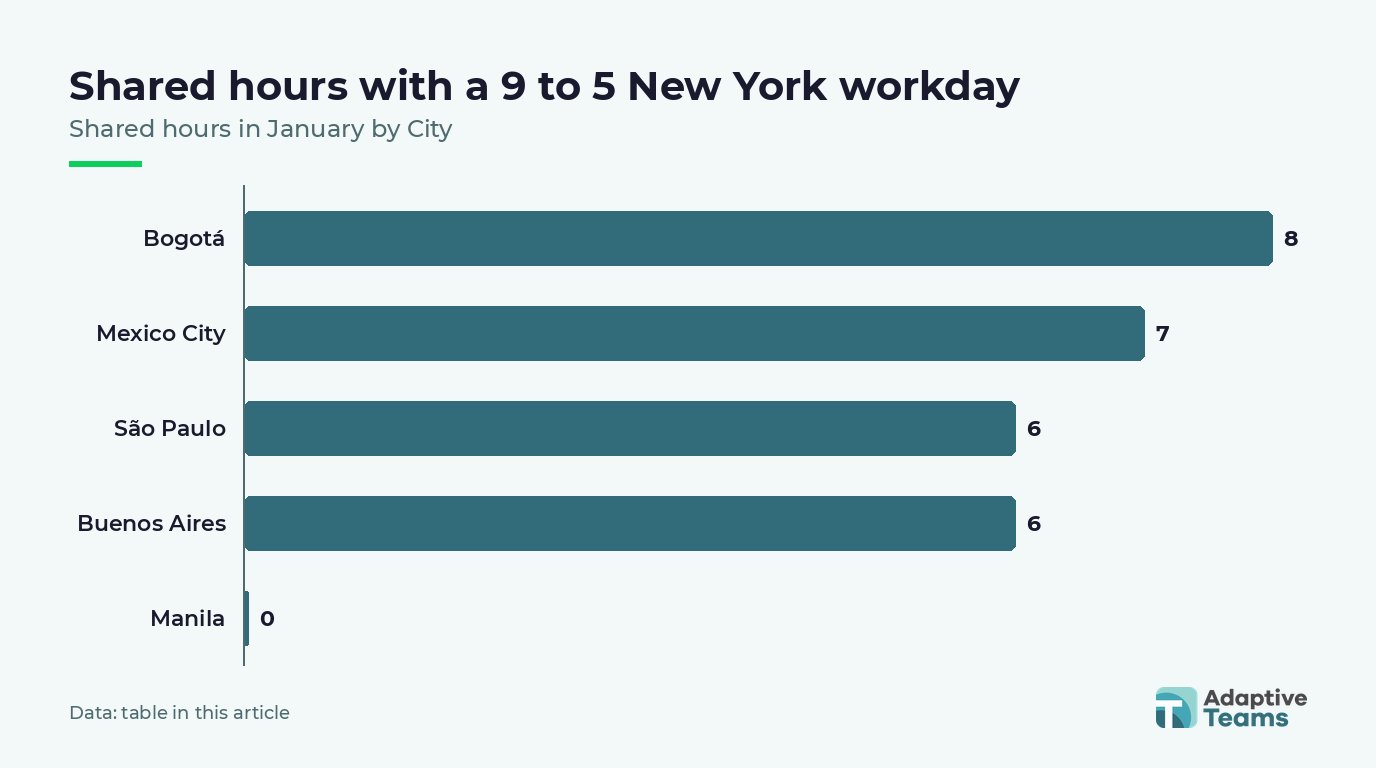
Bogotá, Mexico City, São Paulo and Buenos Aires do not change their clocks, so the overlap only moves when the US switches to and from daylight saving time. In practice that means one hour of drift twice a year, which your hire adjusts to without a new schedule.
Those shared hours are the reason nearshore outsourcing exists. A sales rep can join your pipeline call at 10:00. A developer can ask a question before lunch and ship the fix the same afternoon. A support lead can escalate a customer problem to your product team while the customer is still online.
Should you outsource a process or add dedicated people?
Hand a process to a vendor when you want the result and do not want to manage the work. Add dedicated nearshore people when the work changes weekly, touches your customers directly or depends on knowledge of your company.
When a process vendor fits
A vendor works well for a stable, well defined job with clear volume: a level-one support queue with written scripts, a fixed-scope app build, or data entry against a set template. You measure the vendor on service levels and do not need to know who answers each ticket. The trade-off is that the people learn the vendor's way of working, and your know-how leaves with the contract.
When dedicated nearshore hires fit
Dedicated hires suit roles that sit inside your team. Think of an executive assistant who runs your calendar, a bookkeeper who knows your chart of accounts or a developer who joins your sprints. These people get better every month they work for you, and that value stays with you because they report to you.
Most of the companies we build teams for start with one seat. KO Storage came to us for four call center agents and grew to 70+ team members across six departments within eighteen months, from the call center to accounting and IT.
The wider market is mixing both routes too. Deloitte's Global Outsourcing Survey, based on more than 500 executives, describes companies combining outsourcing, global in-house centers and other sourcing models. It also found that 83% of the executives surveyed already use AI as part of their outsourced services.
How does nearshore staffing work with Adaptive Teams?
It runs from one scoping call to a person working inside your tools, usually in 2 to 3 weeks. Senior or niche roles can take 4 to 6 weeks.
- Scoping. You share the role, the skills, the hours and a salary band. We confirm the band is realistic for the country before sourcing anyone.
- Search. Our Teamtailor account holds 56,287 candidates and 64,982 applications, so the search starts with people we already know. Fresh sourcing in Colombia, Argentina and Brazil runs alongside it.
- Screening. Every candidate takes a skills test, an English check and a recorded video interview before you see them.
- Shortlist. You interview 3 to 5 screened people and make the final call.
- Start. We sign the contract, run payroll and HR, and assign a performance manager from day one. You add the person to your chat, email and tools.
The roles we fill most in Latin America are virtual and executive assistants, customer service reps, bookkeepers, software developers, marketing specialists and sales reps. Our page on hiring Latin American talent lists the roles by country.
If the fit is wrong at any point, we replace the hire at no cost. The agreement runs month to month with 30 days notice on either side.
Where does nearshore outsourcing go wrong?
It goes wrong when the buyer treats a nearshore hire like a ticket queue. The overlap is the asset you are paying for, so a role that never uses it is in the wrong region.
Paying for overlap you never use
If your new hire works alone from written tasks and nobody talks to them during the day, an offshore hire would do the same job for less. Before you choose a region, write down how many live conversations the role needs per day. Our comparison of nearshore vs offshore team models walks through that test role by role.
Moving too slowly on a good candidate
Strong bilingual developers and accountants in Bogotá or Buenos Aires get several offers from US companies at once. A three-round interview process spread over three weeks loses them. Keep it to one or two conversations and decide within a few days of the shortlist.
Buying a vendor when you wanted a teammate
Some buyers sign a process contract, then try to manage the vendor's people directly. That frustrates everyone. The vendor's lead still owns the work, and you pay for a management layer you are trying to bypass. Decide which model you want before you take sales calls.
Skipping the first week
A nearshore hire with no first task, no access and no named contact spends week one waiting. Prepare logins, three real tasks and one person who answers questions for the first two weeks.
Frequently asked questions
Which countries count as nearshore for US companies?
Mexico, Colombia, Brazil, Argentina, Costa Rica and other Latin American countries are the usual nearshore options for US companies. They sit within a few hours of US time zones. Bogotá shares 8 hours of a New York workday in winter. Adaptive Teams recruits nearshore hires in Colombia, Argentina and Brazil.
Is nearshore outsourcing cheaper than hiring in the US?
Yes, for most roles the salary sits well below US pay for the same job. With Adaptive Teams you add a staffing fee of 30% to 60% of that salary, which covers recruitment, contract, payroll and HR. A Latin American customer service rep at a $1,000 salary costs $1,600 a month in total.
How long does it take to hire a nearshore employee?
With Adaptive Teams most nearshore roles go from the first call to a start date in 2 to 3 weeks. Senior or specialist roles can take 4 to 6 weeks. You interview a shortlist of 3 to 5 people who already passed a skills test, an English check and a recorded video interview.
Do I need a company in Latin America to outsource there?
No. With nearshore staffing the partner holds the employment contract and handles local payroll, tax and paperwork. You direct the daily work and the partner handles the employment side. With a process vendor the vendor employs the team, so you sign one services contract and never deal with local law directly.
What happens if a nearshore hire does not work out?
With Adaptive Teams, if a hire is not the right fit at any point, we replace them at no extra cost. A performance manager checks in with you and the hire from the start to catch problems early. The agreement runs month to month with 30 days notice on either side.
Where to start
Write down the role, the hours it must overlap with your team and the salary band you have in mind. If the role needs live conversation every day, it belongs nearshore.
Our recruitment team turns that note into a shortlist of 3 to 5 screened candidates in Colombia, Argentina or Brazil, usually within 2 to 3 weeks.

Written by the people who recruit, pay and manage remote teams every day, with Nate Ginsburg and Menno Gottmer. About Adaptive Teams