



Most founders decide to hire an overseas executive assistant about a year after they should have. The tipping point is rarely dramatic: a missed investor follow-up, a double-booked Tuesday, an inbox that quietly became a second job. By the time you admit you need help, you are already the bottleneck in your own company.
Table of Contents
The instinct is sound. The execution is where people get hurt. An executive assistant is the highest-trust hire most operators ever make offshore, because this person will sit inside your inbox, your calendar, and often your bank-adjacent tools. Hiring for that role the same way you would hire a freelance designer is how you end up back at square one in ninety days, minus a few thousand dollars and a chunk of your confidence in remote hiring.
This guide covers what the role actually looks like when it works, what you should expect to pay, where to find candidates worth interviewing, how to vet for judgment rather than credentials, and the specific failure modes that kill most first attempts.
What an overseas EA actually does when it works
Strip away the job-board boilerplate and a great executive assistant does one thing: they protect your attention. Everything else is a tactic in service of that.
In practice, the first ninety days of a strong overseas EA engagement usually cover four layers, added in order:
- Calendar ownership. Not “sends invites when asked” but full ownership: they hold the rules for what gets on your calendar, defend focus blocks, and reschedule conflicts without pinging you.
- Inbox triage. They read everything, answer what they can in your voice, flag the five messages a day that genuinely need you, and archive the noise. A good EA takes an inbox from 200 daily decisions to 10.
- Follow-up and coordination. Chasing signatures, confirming meetings, prepping agendas, keeping the CRM honest after your sales calls. The unglamorous work that leaks revenue when nobody owns it.
- Personal admin. Travel, appointments, renewals, gifts. Harvard Business Review made the case for executive assistants over a decade ago with simple arithmetic: a modest salary that buys back even 15 percent of a leader’s time pays for itself many times over. The math has only improved since the talent pool went global.
Notice what is not on that list: bookkeeping, marketing, project management, customer support. An EA who is also your marketer and your bookkeeper is three mediocre part-time hires wearing one job title. If you need those functions, hire for them separately. The fastest way to burn an EA is to make the role a landfill for every task you dislike.
What it costs, with real numbers
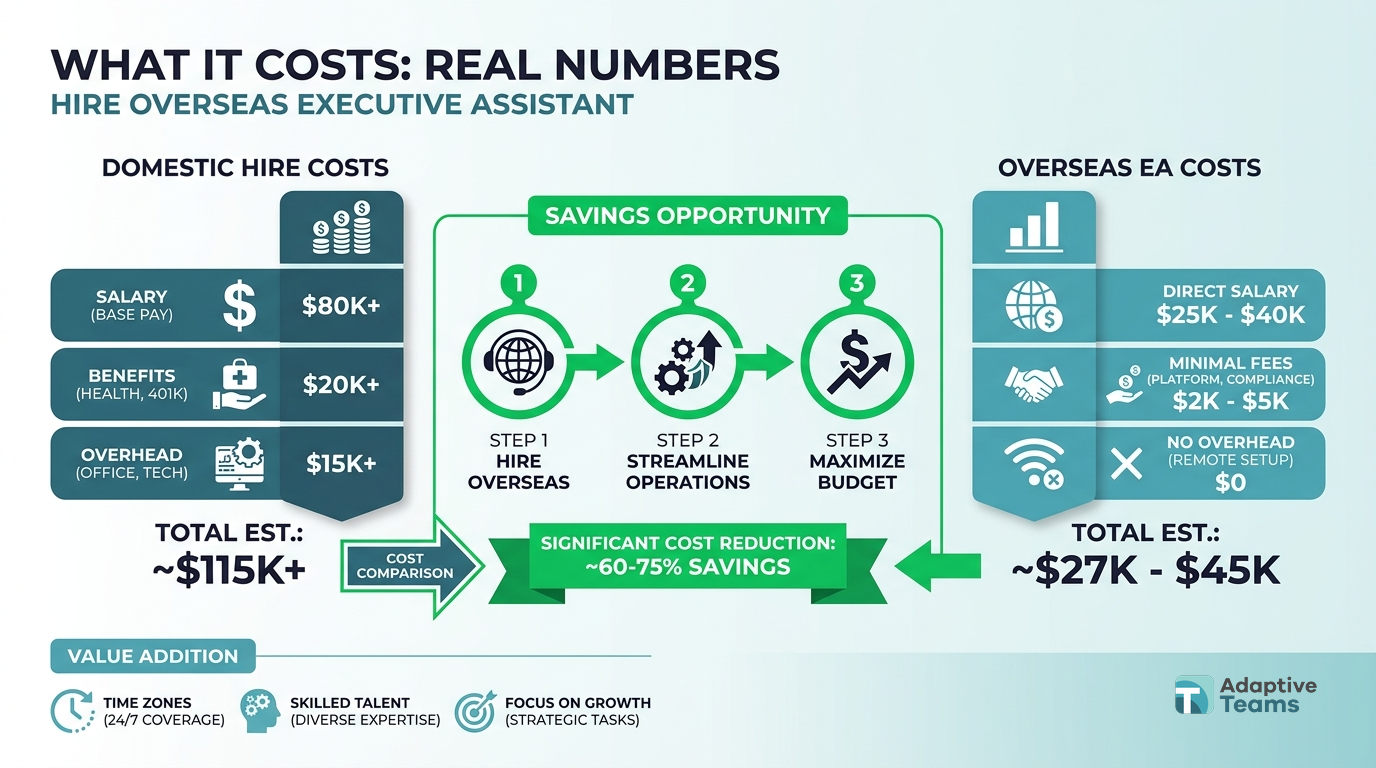
The cost spread on this role is wide enough that averages mislead. In the United States, the Bureau of Labor Statistics puts the median wage for executive secretaries and executive administrative assistants around $70,000 per year before benefits, and experienced EAs in major metros command well above that.
Overseas, the picture changes without the quality dropping the way people assume. Expect these monthly full-time ranges for genuinely executive-level assistants, not entry-level virtual assistants:
- Philippines: $900 to $1,800. The deepest English-fluent EA talent pool in the world, with a long service culture around Western executive support.
- Latin America: $1,200 to $2,500. Time-zone overlap with the US is the draw; you pay a premium for real-time coverage of your working day.
- Eastern Europe and South Africa: $1,500 to $2,800. Strong for EAs who also handle operations-heavy work.
Those figures are for direct engagement. Working through a staffing partner adds a margin but typically includes sourcing, replacement guarantees, and payroll handling. Freelance marketplaces look cheaper per hour and usually cost more per outcome, because you are sampling from a pool optimized for short gigs, not multi-year trust.
Two pricing traps to avoid. First, the $400-a-month “executive assistant” is a data-entry VA with a new title; you will spend more time managing them than they save you. Second, hourly billing for an EA role is a misalignment machine. The job is ownership of outcomes, and ownership does not slice into billable increments. Pay a monthly salary for full-time or half-time attention. For a deeper breakdown of what roles command in each region, see our offshore salary benchmarks by role and region.
Contractor or employee: pick the model on purpose
When you hire across borders you have two clean structures, and the right answer depends on your situation rather than on ideology.
Engaging your EA as an independent contractor is fast and light: a services agreement, an invoice, a wire. It fits a first hire, a half-time arrangement, or a test period where both sides are still deciding. The trade-off is that misclassification rules exist in most countries, and a contractor who works your hours, in your tools, under your direction for years starts to look like an employee to a regulator.
Employment, run either through your own entity or an employer-of-record arrangement, costs more in fees and admin but buys durability: statutory benefits, local compliance, and the psychological safety that makes a great EA stay five years instead of eighteen months. EOR platforms and global payroll providers have made this dramatically simpler than it was even five years ago.
A sensible default: start as a contractor during the trial period, then convert to employment once you both know it works. We walk through the full decision in our comparison of a virtual assistant versus a remote employee, and the same logic applies squarely to executive assistants.
Get an EA Shortlist Without the Sourcing Grind
Tell us what your week looks like and we will hand you vetted executive assistant candidates matched to your time zone and working style.
Where to actually find candidates
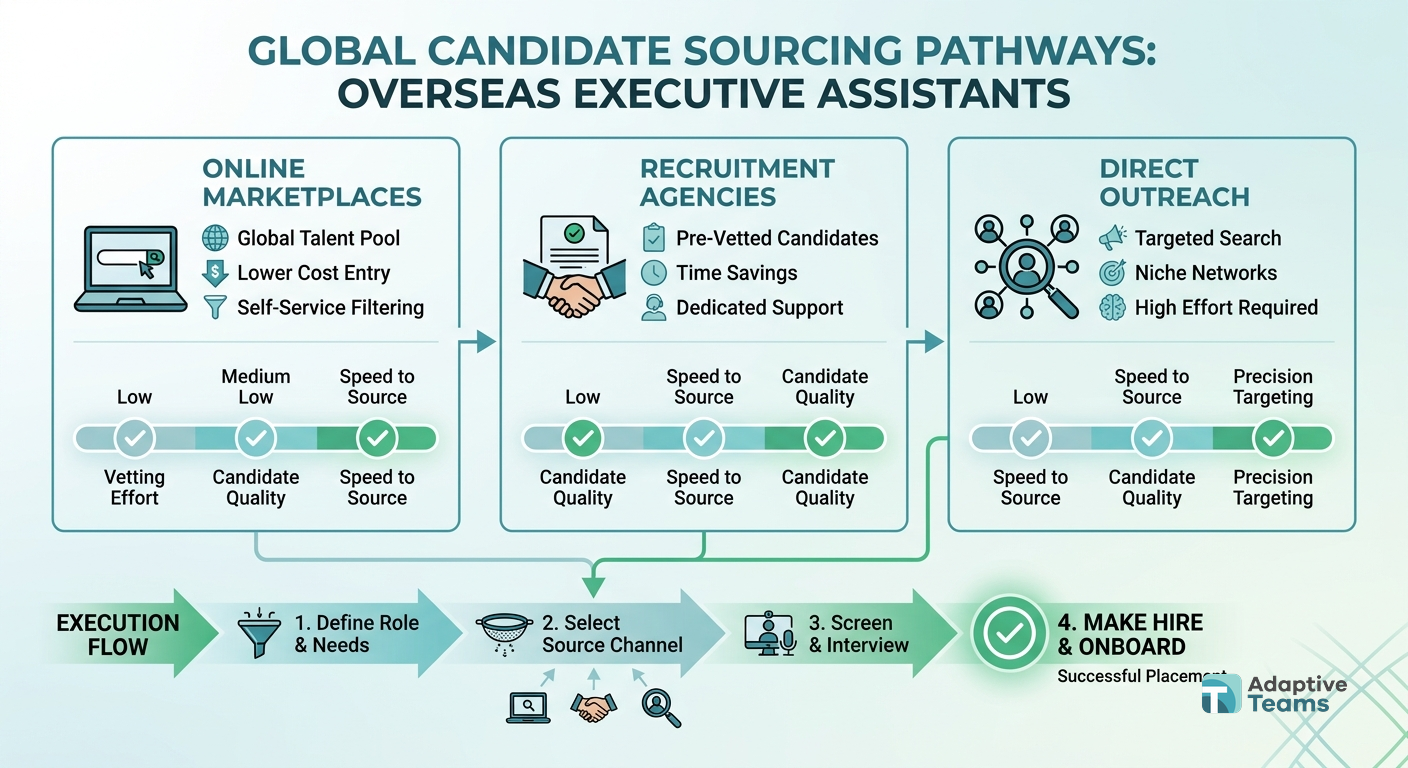
There are three sourcing channels, and they select for different things.
Freelance marketplaces give you volume and speed. You will post a role and receive 200 applications in 48 hours, of which perhaps four are worth a call. The filtering burden sits entirely on you, and the best long-term EAs are usually not there, because the best ones are employed and not browsing gig boards.
Direct sourcing through referrals and communities produces the highest-quality candidates at the lowest cash cost, but it is slow and it depends on a network you may not have. If a founder you trust will introduce you to their EA’s former colleague, take that meeting before any other.
Specialized staffing partners compress the search. A good partner has already interviewed hundreds of EAs, knows which candidates have survived demanding executives, and replaces a mis-hire at no extra cost. You pay for that filter, and for a first offshore hire the insurance is usually worth it. This is the model we run at Adaptive Teams: we recruit for long-term fit and stay involved after placement, because an EA who leaves at month seven costs you far more than any fee. Our recruitment team can run the search end to end if you would rather review a shortlist of five than an inbox of two hundred.
Whichever channel you use, insist on meeting at least three finalists. A single candidate, however impressive, gives you no calibration for what the market can offer at your budget.
Vetting for judgment, not credentials
Resumes are nearly useless for this role. Every applicant will list calendar management, communication skills, and attention to detail. What you are actually hiring is judgment: the ability to make small decisions the way you would, hundreds of times a week, without asking.
Three tests reveal it better than any interview question.
The inbox simulation. Give finalists five real, anonymized emails from your inbox and one instruction: “Handle these as if you were me.” Watch what they draft, what they escalate, and what they ignore. A strong candidate answers three, flags one with a specific question, and correctly deletes one. A weak candidate asks you what to do with all five, which is precisely the behavior you are hiring to eliminate.
The scheduling puzzle. Present a genuinely conflicted week: an investor call, a family commitment, a delayed flight, and a board deadline that cannot all coexist. There is no right answer. You are watching whether they ask about your priorities before proposing a solution, and whether the solution protects the things you said mattered.
The mistake question. Ask for a specific story about a time they made an error that affected their executive, and what they did in the first hour after discovering it. EAs operate with real access, and the ones who hide mistakes are the only truly dangerous ones. You want someone who surfaces bad news fast and owns it.
Run the process with the same rigor you would apply to any senior hire. Our guide on interviewing remote candidates for real team fit covers the structural side: sequencing, scorecards, and paid trial tasks. For reference frameworks on structuring interviews themselves, SHRM maintains a solid interviewing toolkit worth borrowing from.
Why most first attempts fail by month three
The failure rate on first EA hires is high, and it is rarely the assistant’s fault. Four patterns account for most of it.
Delegation by mood. You hand over the calendar on a good week, snatch it back after the first mis-booked call, and never return it. The EA learns that ownership is fake and downgrades themselves to a task-taker. Trust is built by expanding scope on a schedule, not by feel: calendar in week one, inbox triage by week three, full inbox by week six.
No written playbook. Your preferences live in your head, so every decision requires a question, so you conclude the EA “needs too much hand-holding.” The fix costs you two hours: a living document covering your VIP list, meeting rules, tone notes for written replies, and standing weekly tasks. Every question the EA asks gets its answer added to the document, and the questions taper fast.
Tool access as an afterthought. Week one arrives and the EA cannot see your calendar, use a password manager, or send from a delegated address. Momentum dies in IT limbo. Provision access before day one, with proper delegated permissions rather than shared passwords. A structured first month matters as much for an EA as for any hire; our piece on remote onboarding best practices lays out the cadence.
Radio silence as a management style. One fifteen-minute daily check-in for the first month, dropping to twice weekly after, is the entire management overhead a good EA needs. Executives who skip it discover misalignments at month two that a Tuesday call would have caught at day nine.
Frequently asked questions
How much does it cost to hire an overseas executive assistant?
A full-time, genuinely executive-level assistant typically runs $900 to $2,800 per month depending on region and seniority, with the Philippines at the lower end and Latin America or Eastern Europe higher. Staffing partners add a margin that usually covers sourcing, replacement guarantees, and payroll administration.
Is it safe to give an overseas EA access to my inbox and accounts?
Yes, if you provision access properly. Use delegated inbox access rather than sharing your password, a password manager for shared credentials, and permission tiers on financial tools. The vetting process matters more than geography; an assistant screened for integrity and track record is a lower risk than a rushed local hire with full access.
Should my overseas EA work in my time zone?
You need two to four hours of daily overlap, not a full mirrored schedule. Calendar and inbox work compounds fine asynchronously. If you want real-time coverage across your whole working day, hire from Latin America if you are US-based, or expect to pay a night-shift premium elsewhere.
How long before an overseas EA is actually saving me time?
With structured onboarding, expect the calendar handled in two weeks, inbox triage by week four, and net time savings of ten or more hours a week by the end of month two. If you are not seeing clear relief by day sixty, the problem is usually scope or process rather than the person, and it is worth diagnosing before restarting the search.
If you want help with this
You can absolutely run this search yourself: source three finalists, run the inbox simulation, start on a contractor basis, and expand scope weekly against a written playbook. The process above is the whole method.
If you would rather skip the two hundred applications and interview five pre-vetted candidates who have already supported demanding executives, that is exactly what we do. Adaptive Teams recruits overseas executive assistants for long-term fit, handles the compliance and payroll setup in either model, and stays accountable after placement. Start with our recruitment services and tell us what your week currently looks like. The right EA will make sure it never looks that way again.
Ready to Build Your Dream Team?
Book a free staffing consultation with our remote team specialists. No obligations, just actionable insights for scaling your operations.