TL;DR
Remote team augmentation means adding full-time remote people to the team you already manage, while a partner handles the search, contracts and payroll. You set the work and the priorities. With Adaptive Teams you pay the person's agreed salary plus a 30% to 60% staffing fee, most roles fill in 2 to 3 weeks, and the agreement runs month to month.
Most teams look into this when the backlog has outgrown the people. A local hire would take months and cost more than the budget allows, so the real question is practical. How do you add someone who works from another country, joins your rituals and is still with you next year?
This page answers that from the side of the manager doing the adding. It prices a seat, walks through the first month and names the setups where the model breaks.
What is remote team augmentation?
It is adding remote professionals to your existing team as dedicated members who take direction from your own managers. A partner recruits them, employs or contracts them in their own country and pays them. You decide what they work on each day.
That split of control is what separates it from outsourcing. An outsourcing vendor takes on a result and delivers it with its own managers. With augmentation the management stays with you, so the remote hire sits in your standups, your Slack and your code reviews. Our comparison of staff augmentation vs outsourcing goes deeper on who runs the work in each model, and the explainer on what staff augmentation means covers the general contract structure.
How it differs from hiring a freelancer
A freelancer usually splits time across several clients and bills per hour or per project. An augmented team member works only for you, full time, on a monthly arrangement.
That difference matters for any role where the person gets better by learning your product, your customers and your tools. By month six, a dedicated support agent has seen your edge cases many times over. A freelancer who rotates in and out starts from zero each time.
What does remote team augmentation cost per seat?
You pay a monthly amount per person, built from that person's salary. At Adaptive Teams the bill is the agreed monthly salary plus a staffing fee that is a percentage of it, with recruitment included.
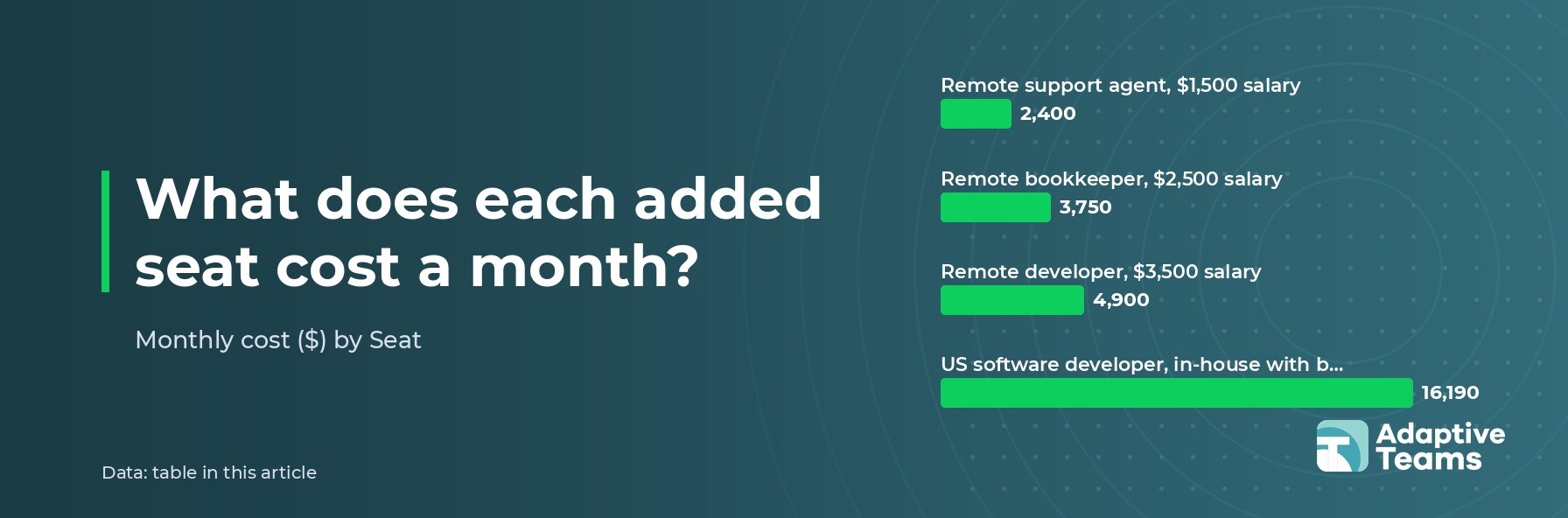
The table prices three seats a growing company often adds, using example salaries, next to one local developer. Real salaries are agreed with each candidate for your role.
What does each added seat cost a month?
| Seat | Monthly cost ($) |
|---|---|
| Remote support agent, $1,500 salary | 2,400 |
| Remote bookkeeper, $2,500 salary | 3,750 |
| Remote developer, $3,500 salary | 4,900 |
| US software developer, in-house with benefits | 16,190 |
The local figure comes from two federal sources. The median annual wage for US software developers was $135,980 in May 2025, according to the Bureau of Labor Statistics Occupational Outlook Handbook. That is about $11,332 a month. Wages and salaries made up 70.0% of private employer compensation costs in June 2026, per the BLS Employer Costs for Employee Compensation release, which grosses the salary up to roughly $16,190.
All three remote seats together come to $11,050 a month. That is about two thirds of one local developer, before you pay to find that developer. SHRM's benchmarking data put the average cost per hire at nearly $4,700.
How the staffing fee scales with salary
The percentage drops as the salary rises. You pay nothing until the person starts.
| Agreed monthly salary ($) | Staffing fee (%) | Monthly total ($) |
|---|---|---|
| 1,500 | 60 | 2,400 |
| 2,500 | 50 | 3,750 |
| 3,500 | 40 | 4,900 |
| 4,500 | 35 | 6,075 |
| 6,000 | 30 | 7,800 |
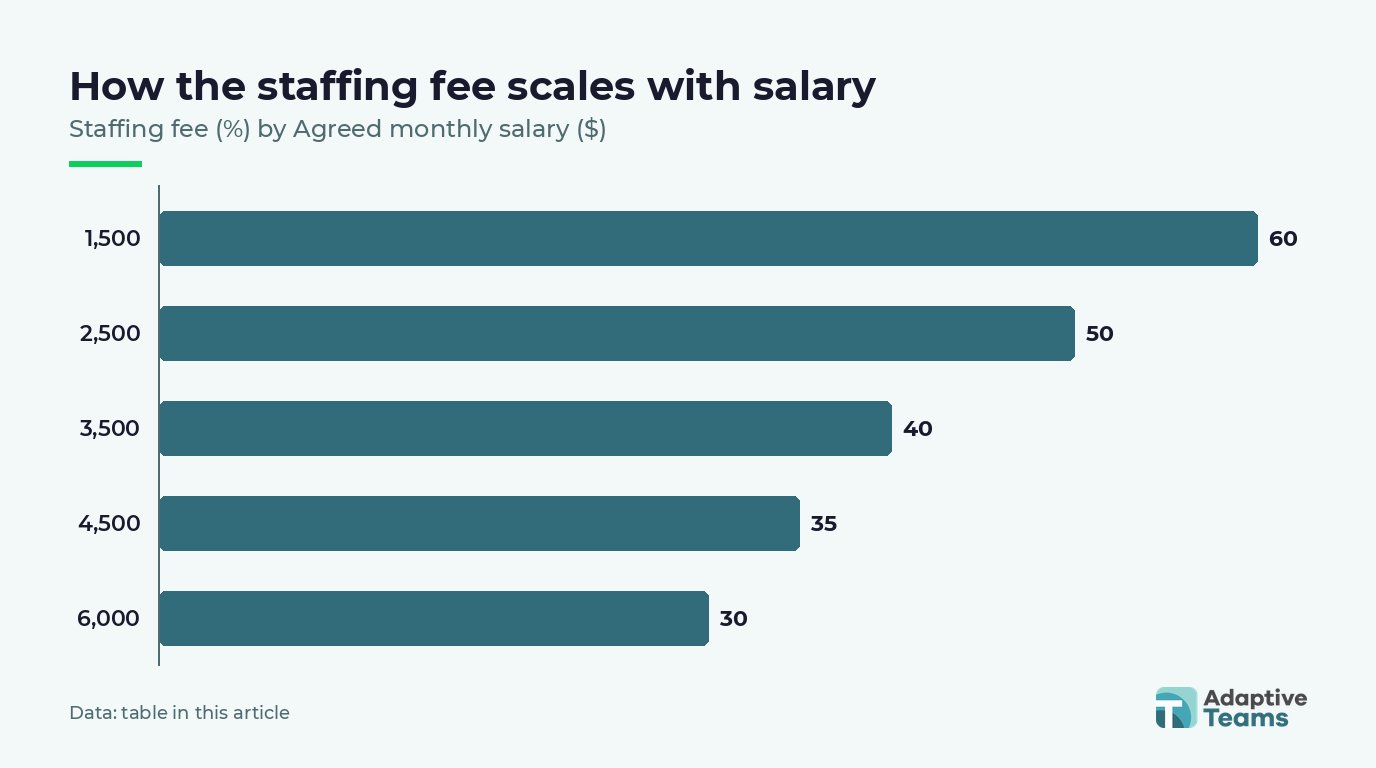
Above $4,500 the fee is 30%, so the last row uses a $6,000 salary as an example. If you only need the search and want to employ the person yourself, recruitment alone costs $4,000 flat per hire.
Seeing the salary on its own line has a practical upside. You know what your team member earns, so you can judge whether the pay will hold a good person for years. A single blended hourly rate hides that number from you.
Which roles suit remote team augmentation?
Roles with a steady stream of written, checkable work fit best. Customer support, operations, accounting, QA and software development on a clear backlog all qualify, because the output shows up in tickets, ledgers and pull requests.
Some roles fit badly. Anything that needs a person on site, a US security clearance or a close feel for your local market belongs with a local hire or a local contractor.
A team that grew seat by seat
KO Storage runs 70+ self-storage locations across the US. It started with 4 call center agents through Adaptive Teams in August 2024 and grew to 70+ team members within 18 months. The added people now cover call center, revenue management, accounting, asset management, security and IT support.
The pattern is common. A company proves the model on one function with a handful of seats. Once its managers trust the workflow, it adds the roles next to it.
How does the first month of remote team augmentation work?
The first month runs from a scoping call to a person shipping real work, and most of that time goes into the search. Here is how it runs with Adaptive Teams.
- Scoping. You describe the role, the hours that must overlap with your team, the tools and a salary band. We come back within 24 hours with a real monthly number.
- Search and shortlist. Searches start from our Teamtailor account, which holds 56,287 candidates and 64,982 applications. You see 3 to 5 screened candidates and run your own interviews.
- Offer and contract. You pick the person. We hold the contract and run payroll through a global payroll partner that handles local tax and benefits, and the person is paid twice a month.
- Start date. Most roles go from the scoping call to a start in 2 to 3 weeks.
- The first 30 days. Your manager owns onboarding: accounts on day one, a buddy, a small real task in week one and a review at day 30.
Step one decides how fast the rest goes. Selleo, a software firm that sells team augmentation, lists clearly defined requirements as the first condition for an augmented team to work. A role that changes after the shortlist goes out sends the search back to the start.
For the onboarding itself, our guide to remote onboarding best practices has a day-by-day plan for the first weeks.
Where does remote team augmentation go wrong?
It goes wrong most often when nobody on your side has time to direct the new person. An augmented hire takes priorities from your manager. Without that manager, a capable person ends up guessing what matters.
Too little overlap in working hours
A team member who never shares working hours with their manager waits a full day for every answer. Agree on a fixed overlap window before the search starts, because it narrows which candidates fit. Our piece on remote team time zone management covers schedules that avoid late night calls.
Keeping the remote hire at arm's length
Some companies add a remote person, leave them out of planning and then wonder why they leave. Put them in the same channels, rituals and reviews as everyone else.
Good people have options. BLS projects jobs for software developers, QA analysts and testers to grow 10% from 2025 to 2035, much faster than the average for all occupations. Retention comes down to how the person is treated once they join.
Using augmentation for a short project
A six week project with a hard end date suits a freelancer or a project vendor. Spending a search and a month of onboarding on a seat that disappears in two months wastes your time and theirs.
What happens if a hire does not work out?
With Adaptive Teams you get a free replacement in the first 2 months. Read the notice period and the replacement terms before you sign with any partner, because those two clauses decide how much a wrong hire costs you.
Adaptive Teams runs month to month with 30 days notice on either side. If the fit is wrong in that window, we replace the person at no extra cost. Each person works only for you, so you never compete with another client for their attention.
Frequently asked questions
Is remote team augmentation the same as staff augmentation?
Yes. It is staff augmentation where the added people work remotely, usually from another country. You keep day to day direction, while the partner handles recruiting, contracts and payroll. The remote version adds a few things to plan for: overlap hours, written communication and onboarding at a distance.
How much does remote team augmentation cost?
With Adaptive Teams you pay the agreed monthly salary plus a staffing fee of 30% to 60%, with recruitment included. A remote support agent at a $1,500 salary costs $2,400 a month, and a developer at $3,500 costs $4,900. You pay nothing until the person starts.
How long does it take to add someone to a remote team?
Most Adaptive Teams roles go from the scoping call to a start date in 2 to 3 weeks. Senior or unusual roles can take longer, because the shortlist only goes out once 3 to 5 candidates pass screening. Plan the first 30 days of onboarding on your side as part of the timeline.
Do I need a company abroad to augment my team remotely?
No. Adaptive Teams holds the contract and runs payroll through a global payroll partner that handles local tax and benefits in the person's country. You receive one invoice per person each month, and the person is paid twice a month. You never register an entity abroad or run foreign payroll yourself.
Can augmented team members stay with the team long term?
Yes, and that is where the model pays off. Each person works only for you, full time, inside your tools, meetings and reviews. KO Storage started with 4 call center agents in August 2024 and grew to 70+ team members within 18 months, adding new functions as its trust in the setup grew.
If you want help with this
Write down the seats you want to add, the hours each must overlap with your team and how long you expect to need them. If the answer is longer than six months, a full-time remote hire is worth pricing first.
Our recruitment team scopes each role with you and puts 3 to 5 screened candidates in front of you, usually within 2 to 3 weeks.

Written by the people who recruit, pay and manage remote teams every day, with Nate Ginsburg and Menno Gottmer. About Adaptive Teams