


Somewhere between your third failed senior engineer search and the agency quote that made your CFO wince, someone on your leadership team probably floated the phrase offshore development center. It sounds like jargon, and most definitions online do not help: they describe it as “a dedicated team in another country” and stop there. That description fits a dozen arrangements that behave nothing alike, from a true extension of your engineering org to a body shop that bills you for strangers.
Table of Contents
The difference matters more than the label. Get it right and you own a stable team that compounds knowledge about your product for years. Get it wrong and you rent capacity that resets to zero every time the vendor rotates staff.
This article draws the line clearly: what an offshore development center actually is, what it costs, the three ways to set one up, and the failure modes that sink most first attempts.
The test that separates an ODC from outsourcing
An offshore development center is a dedicated engineering team based in another country that works exclusively on your product, under your direction, inside your systems. The people are physically elsewhere. Everything else about how they work should look like your in-house team.
Project outsourcing is a different animal. You hand a vendor a spec, their project manager runs delivery, and you receive output. The vendor decides who works on your account and for how long.
Here is a quick test you can run on any arrangement someone pitches you. Ask five questions:
- Who runs the daily standup, your lead or theirs?
- Whose Slack and repo do the engineers live in?
- Who decides what gets built next sprint?
- If an engineer leaves, do you interview the replacement?
- Do the same people work on your product a year from now?
If the answers point back at your company, you are looking at a genuine offshore development center. If they point at a vendor’s project manager, you are buying outsourced delivery, whatever the contract calls it. Neither model is wrong, but they solve different problems. Outsourcing fits bounded projects with a clear end state. An ODC fits a product that will need engineering attention for years, which is to say, almost every product that survives.
Why companies build one, honestly
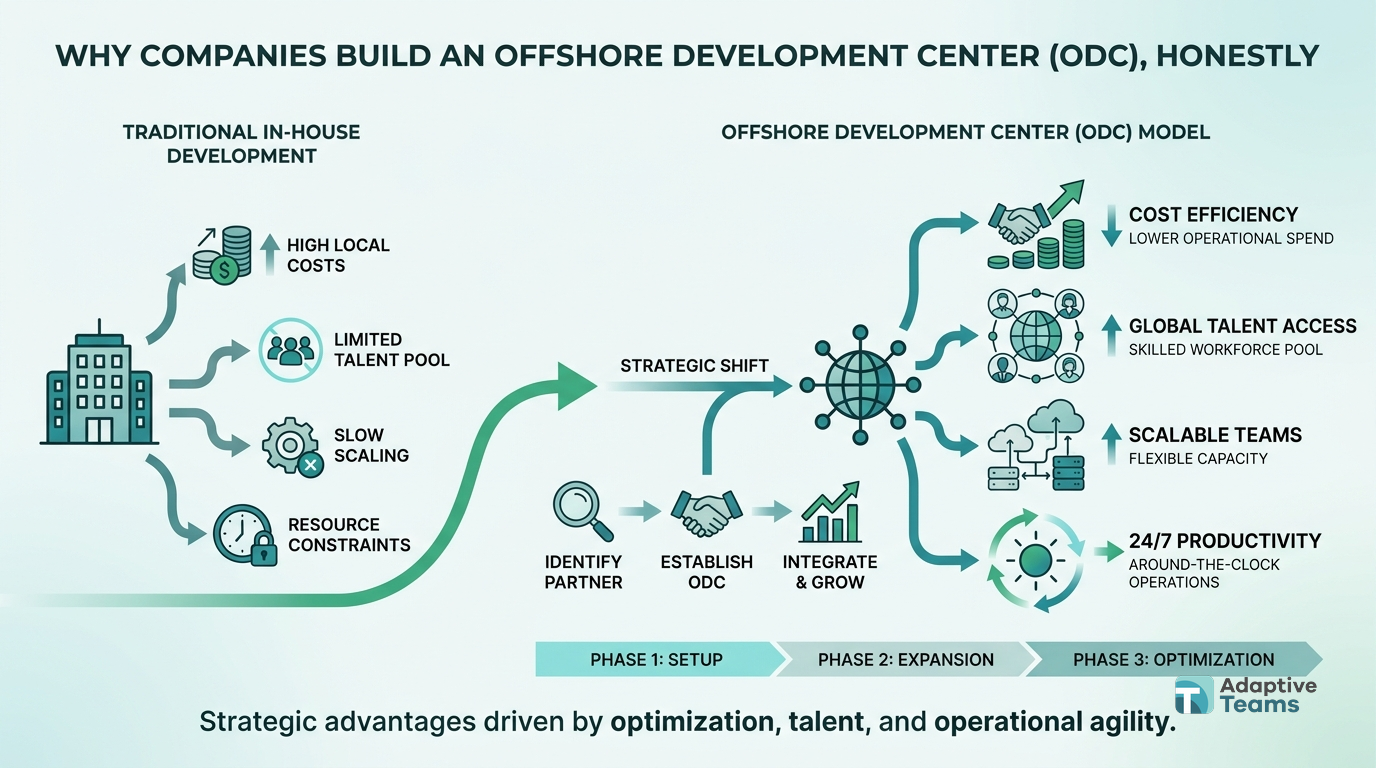
Cost gets the headlines, and the savings are real. But talk to operators who run offshore teams well and cost is rarely the reason they started. Capacity is.
The U.S. Bureau of Labor Statistics projects faster than average growth for software developer roles through the decade, which keeps domestic hiring competitive and slow. Korn Ferry’s workforce research puts the global skilled talent shortfall at 85 million workers by 2030. When a senior engineer search in your home market takes five months and closes at the top of your band, the constraint is not your budget. It is the pool you are fishing in.
The math still deserves a clear look, because it changes what you can afford to build:
- A senior engineer in a major U.S. metro runs $150,000 to $180,000 in base salary, and roughly $190,000 to $230,000 fully loaded once you add benefits, payroll taxes, and equipment.
- A comparable senior engineer in Latin America or Southeast Asia typically lands between $48,000 and $90,000 all-in, depending on region and specialty. Our offshore salary benchmarks by role and region break down real pay ranges in detail.
- Recruiting costs stack on top either way. SHRM pegs the average cost per hire near $4,700, and for engineering roles the true figure often lands several times higher once you count agency fees and interview hours.
Run those numbers across a five-person team and the delta funds two additional hires. That is the practical effect: an offshore development center does not just cut the cost of the team you have, it makes the team you actually need affordable. For a fuller breakdown of what the invoice includes, see what an offshore development team really costs.
One caution on the math. Savings quoted per engineer evaporate if churn is high, because every departure resets product context. A team that costs 40 percent less but turns over every ten months is more expensive than the one you were trying to escape. Retention is the metric that decides whether the spreadsheet works.
Three ways to set one up
There are three workable structures for an offshore development center. The right one depends on your size, timeline, and appetite for administrative work.
Open your own entity
The classic route: incorporate in the target country, register as an employer, lease space or go remote-first, and run local payroll and compliance yourself. You get maximum control and the lowest per-head cost at scale.
The catch is everything before “at scale.” Entity setup commonly takes six to twelve months, needs local legal and accounting counsel, and creates permanent obligations that outlive any single hire. This route makes sense when you are confident you will employ twenty or more people in one country for years. Below that, the overhead eats the savings.
Build-operate-transfer
A partner sets up the center, recruits the team, and runs operations for a defined period, then transfers the whole operation to you, entity and all. You get speed now and ownership later.
BOT works well for mid-sized companies with a clear long-term headcount plan. Read the transfer terms carefully. The price of the handover and the conditions that trigger it are where these agreements go sideways.
Partner-managed team
A staffing partner recruits engineers to your spec, employs or contracts them locally, and handles payroll, benefits, and compliance. The engineers work only for you, in your tools, on your roadmap, from day one. You skip the entity question entirely.
On the employment model itself, there is no single right answer. Contractors offer flexibility and simpler setup; local employees bring stability and richer benefits, often through EOR platforms or a partner’s local entity. The right choice depends on the country, the permanence of the role, and what strong candidates in that market expect. A good partner will walk you through both rather than push one.
This is the fastest route to a working team, often four to eight weeks from kickoff to first commits, and it is where most companies under a few hundred employees should start. The partner’s incentives matter enormously, though. You want one built for long-term retention, not placement volume. We covered how to tell the difference in how to choose an offshore development partner.
Build an Offshore Team That Feels In-House
Get a free consultation that maps the right roles, regions, and realistic all-in costs for your first offshore engineering hires.
Where offshore development centers go wrong
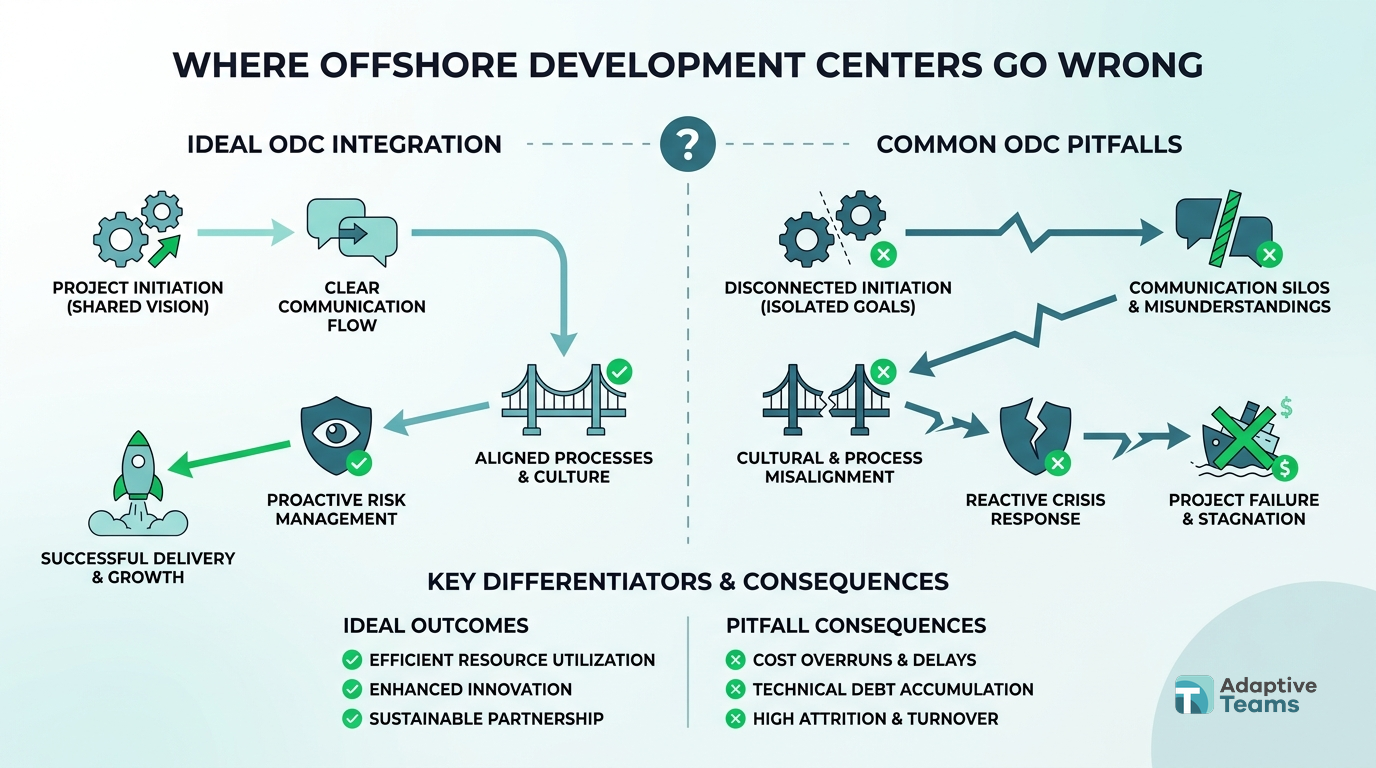
Most ODC failures trace back to a handful of preventable decisions. Naming them up front is cheaper than living them.
Treating it as a cost project instead of a team
When the offshore center reports to finance instead of engineering, every decision optimizes for the invoice. Salaries get set at the bottom of the local band, the best people leave within a year, and product knowledge walks out with them. Companies that succeed treat offshore engineers exactly like in-house engineers who happen to live elsewhere: same standup, same code review standards, same career conversations.
Hiring for stack keywords instead of fit
A resume that lists your entire stack tells you little about whether the person can work asynchronously, push back on a bad spec, or ask questions early instead of guessing. Screening for those behaviors takes deliberate interview design, and skipping it is the single most common hiring mistake we see.
Ignoring the clock
A team ten hours offset from yours can work, but not by accident. One mid-sized SaaS company we know watched a six-person offshore team ship almost nothing for a quarter because every pull request waited twenty hours for a U.S. review. The fix was boring: four hours of guaranteed overlap, review authority inside the offshore team, and decisions documented in writing instead of relayed in meetings.
Drip-feeding context
New offshore engineers who receive a laptop, a repo link, and silence will produce exactly what that investment deserves. Structured onboarding, with a first-week plan, a named buddy, and early low-stakes shipping, is what turns hires into contributors. The playbook in our guide to remote onboarding that actually integrates new hires applies directly here.
Letting a two-tier culture form
The moment your organization starts saying “the offshore guys,” you have two teams, and the second one is disposable. Small habits prevent this: cameras on for everyone or no one, meeting times that rotate the pain, offshore engineers presenting their own work in demos, and equal access to leadership.
What the first 90 days should look like
You can stand up a working offshore development center in a quarter if you sequence it properly.
Days 1 to 30: decide, then define. Pick your region based on time zone overlap first and rates second; a cheaper engineer you can never talk to is not cheaper. Choose your structure from the three above. Write real role definitions for your first two or three hires, including the behaviors you will screen for, not just the stack.
Days 31 to 60: hire and onboard. Run interviews that test judgment and communication, not just algorithms. Get accounts, hardware, and access sorted before day one. Assign a buddy and a first-week plan that ends with something small shipped to production.
Days 61 to 90: integrate and measure. Fold the new engineers into your normal sprint cadence. Track cycle time, review turnaround, and retention signals rather than hours logged. By the end of the quarter you should know whether the model works for you, and you will know because the team is shipping, not because a dashboard says utilization is high.
Start smaller than you think you need. Two or three excellent engineers who stay for years beat eight rushed hires, and they become the seed team that helps you interview the next wave.
How is an offshore development center different from outsourcing?
An offshore development center is your dedicated team working under your direction on your product long-term, while outsourcing hands a project to a vendor who manages delivery themselves. The practical test is who runs the standup and who decides what gets built next sprint. If those answers point at a vendor, it is outsourcing.
How many engineers do you need to justify an ODC?
With a partner-managed model, two or three engineers is a perfectly sensible start, because the partner absorbs the fixed overhead. Opening your own legal entity usually only makes financial sense once you are confident about twenty or more long-term hires in a single country.
Which countries are best for an offshore development center?
There is no universal best, only best for your constraints. Latin America offers strong U.S. time zone overlap. The Philippines combines deep English proficiency with strong rates. Eastern Europe suits complex engineering with European overlap. Rank regions by overlap with your core hours first, then compare rates within the finalists.
Do offshore developers work as contractors or employees?
Both models are legitimate and widely used. Contractors set up faster and offer flexibility; local employment through an entity or EOR platform offers stability and benefits that help retention in some markets. The right answer depends on the country, the role’s permanence, and what strong local candidates expect.
How much does an offshore development center cost?
All-in costs for a senior engineer typically run $48,000 to $90,000 per year in major offshore regions, against $190,000 or more fully loaded in a U.S. metro. Add partner fees or entity overhead depending on your structure, and budget real money for onboarding and retention, because churn is what quietly destroys the savings.
Where to start
Before you talk to any partner or lawyer, write one page: the roles you need in the next six months, the hours of overlap your team genuinely requires, and the product knowledge a new engineer must absorb to be useful. That page will make every later conversation sharper, and it will expose whether you need a bounded project delivered or a durable team built.
If the answer is a durable team, that is the work we do all day. Adaptive Teams builds offshore teams that feel in-house, with recruitment that screens for judgment and team fit, not just stack keywords and the follow-up structure that keeps good people for years. Start with the one-page exercise, then bring it to a conversation with us and we will tell you honestly which of the three models fits.
Ready to Build Your Dream Team?
Book a free staffing consultation with our remote team specialists. No obligations, just actionable insights for scaling your operations.