



TL;DR: Staff augmentation vs outsourcing comes down to who directs the work. With staff augmentation, vetted people join your team and you lead them day to day. With outsourcing, a partner owns delivery against a scope and you judge the result. Pick augmentation when you have the roadmap and need hands. Pick outsourcing when the job is defined and you have nobody free to manage it.
Table of Contents
- How do staff augmentation and outsourcing differ?
- What does staff augmentation actually look like?
- What does project outsourcing actually look like?
- Which model costs less?
- Who is legally responsible for the worker?
- When is outsourcing the better pick?
- A quick way to decide this week
- If you want help with this
- Frequently Asked Questions
Most buyers arrive at this question after something has already gone wrong. A product release slipped because two engineers left. A support queue doubled and nobody inside has time to hire. Someone on the leadership team says “let’s just outsource it,” someone else says “we need our own people,” and the discussion stalls.
We run both models at Adaptive Teams, often for the same client in the same quarter. So this page skips the textbook definitions and focuses on the choice you actually face: how much of the work you want to steer yourself.
How do staff augmentation and outsourcing differ?
Staff augmentation adds people to your team; outsourcing hands a result to another team. That one difference drives everything else, from who writes the tickets to who carries the risk when a deadline slips.
With augmentation, a developer, accountant or support agent works in your tools, joins your standups and takes direction from your managers. The staffing partner recruits them, handles contracts and payroll, and replaces them if the fit is wrong. You own the output.
With outsourcing, you agree on a goal, a scope and milestones. The provider picks the people, manages them and delivers the finished work. You own the decision about whether it is good enough.
Staff augmentation vs outsourcing side by side
What does staff augmentation actually look like?
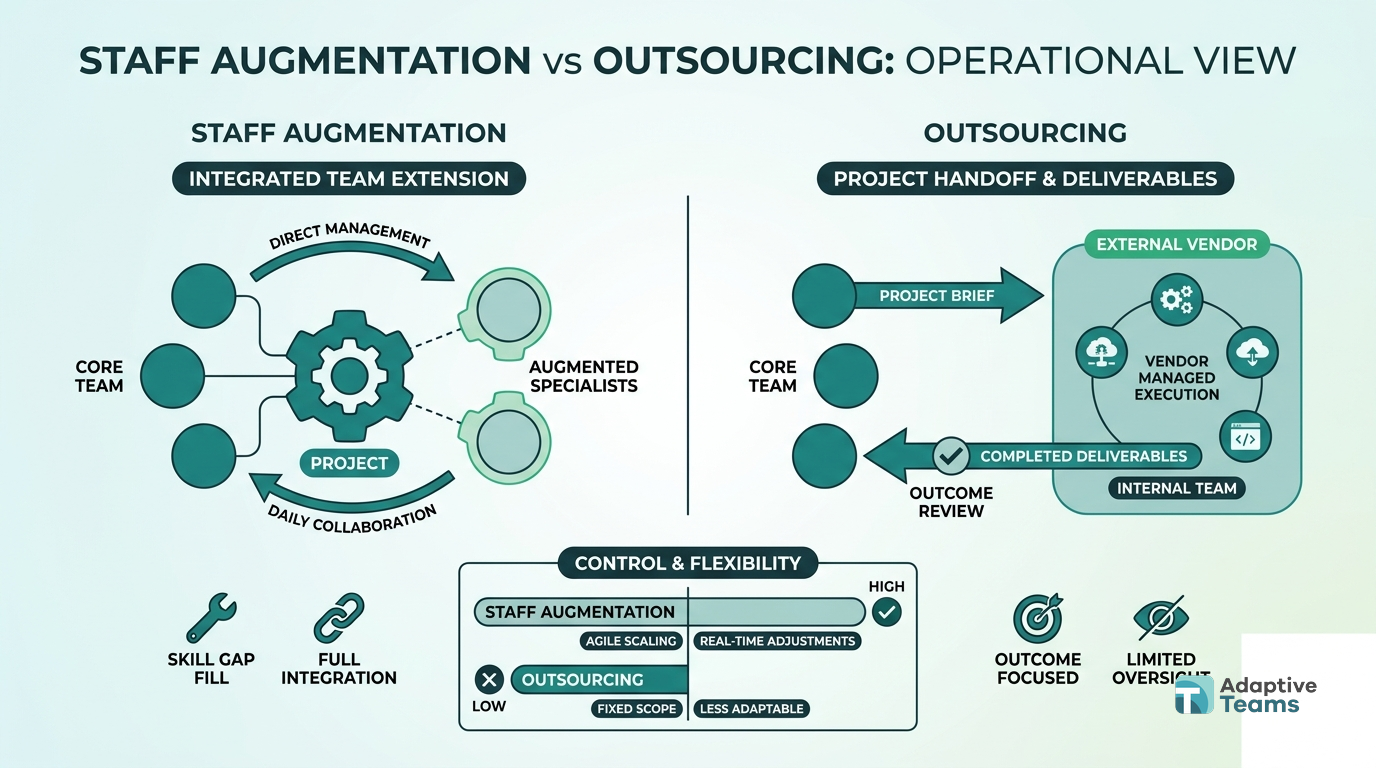
Staff augmentation looks like a new colleague who happens to be employed through a partner. On day one they get a laptop login, a Slack handle and a manager on your side. After a month, your team mostly forgets they came through an agency.
The work behind that is less visible. At Adaptive Teams, a typical staff augmentation engagement runs like this: we scope the role with you, source and test candidates, and put a short list in front of your hiring manager. Once you pick someone, we issue the contract, run payroll in their country and handle leave, reviews and follow-up. Most engagements start at $2,500 a month all-in, month to month, with no placement fee.
The best example we have is KO Storage. They came to us needing 4 call center agents. Eighteen months later they had more than 70 remote team members across 6 departments, all directed by their own managers. That growth only worked because each hire plugged into KO Storage’s processes instead of a vendor’s.
Where augmentation breaks down
Augmentation fails when nobody on your side has time to lead. If you add three developers to a team without a tech lead, you have bought three people waiting for tickets. The model assumes you bring the direction.
It also struggles with a vague role. “We need help with marketing” produces a weak hire. “We need someone to run paid social for two product lines, reporting to our growth lead” produces a strong one.
What does project outsourcing actually look like?
Project outsourcing looks like a contract with a finish line. You describe what you need, the provider scopes it, and you see progress at milestones instead of in daily standups.
For a clearly defined build, that is a relief. You get a team that already works together, a delivery lead who chases the details, and one invoice. Our software team augmentation and outsourcing page lists the three ways we structure it: adding engineers to your team, a dedicated pod that works only on your product, or full project delivery from spec to ship.
Where outsourcing breaks down
Outsourcing hurts when the scope keeps moving. Every change becomes a negotiation, and the provider has little reason to absorb extra work. It also leaves you with a knowledge gap. When the contract ends, the people who understand the system leave with it unless you paid for documentation and a proper handover.
Deloitte’s 2024 Global Outsourcing Survey, based on more than 500 executives, found that insourcing is rising again as companies look for more control and want to build strategic capabilities internally. That matches what we hear on discovery calls. Companies outsource a first build, then want their own people for everything that follows.
Which model costs less?
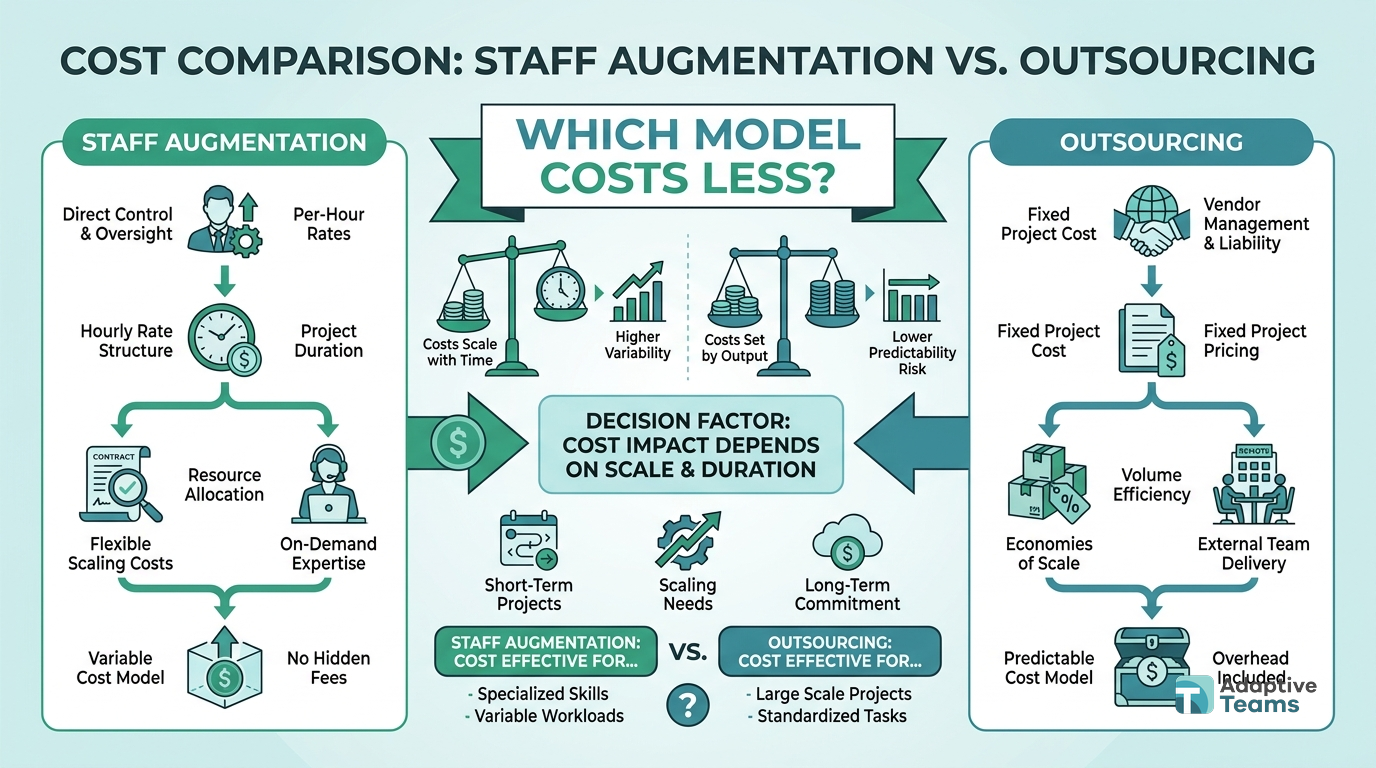
Neither model is cheaper by default; the cheaper one is the one that matches how settled your work is. A fixed-price project looks cheaper on paper when the scope is tight. Once scope shifts, change requests add up and the gap closes quickly.
Staff augmentation costs are easier to predict. You pay a monthly rate per person and decide what they work on. The honest question is whether you would keep that person busy. A developer at a monthly rate who waits for specs half the week costs more than a fixed-price project would have.
Look at the margin too. Some agencies add a markup on top of salary that is never shown to you. Our guide to how staffing agency markup works breaks down what sits inside a typical rate so you can compare quotes line by line.
Not Sure Which Model Fits Your Roadmap?
Tell us what you are building and we will recommend augmentation, a dedicated team or full outsourcing within 24 hours.
Who is legally responsible for the worker?
In both models, the partner normally employs or contracts the worker, which removes most payroll and compliance work from your plate. The difference shows up in how much control you exercise, and control is exactly what employment rules look at.
The IRS guidance on independent contractors versus employees groups the evidence into three categories: behavioral control, financial control and the type of relationship. Staff augmentation gives you heavy behavioral control, because you direct the work. That is fine when a staffing partner is the legal employer or contracting party and handles the obligations. It is risky when a company runs a long-term, full-time contractor directly without that structure. The U.S. Department of Labor defines misclassification as treating a worker who is an employee under the FLSA as an independent contractor, which can cost that worker minimum wage, overtime and other protections.
Outsourcing keeps you further from that line, because the provider directs its own people. The tradeoff is less say over who does the work.
When is outsourcing the better pick?
Outsourcing is the better pick when the work has a clear end and you lack the managers to run it. We tell clients this regularly, even though augmentation is most of our business.
The clearest case is a defined build with a fixed budget, such as an MVP, a data migration or an integration with a clear spec. Work outside your team’s expertise belongs here too: if nobody inside can judge a senior engineer’s code, you cannot lead that engineer either. A one-time spike, like a seasonal campaign that will not repeat next quarter, rarely justifies adding people to your team.
Augmentation wins when the work never really ends. Customer support, bookkeeping, ongoing product development and recruiting are all continuous. For those, you want people who build context over months and stay inside your systems.
A quick way to decide this week
Write down the work you need done in two columns. In the first, list tasks that need your judgment every day. In the second, list tasks where you would be happy to see only the finished result.
If the first column is longer, you want staff augmentation. When the second is longer and the scope fits on one page, outsourcing will serve you better. Many companies with two long columns run a hybrid: augmented staff for the core team, and an outsourced partner for a defined side project.
Then check one thing before you sign anything: who on your side will own this? Augmentation needs a manager with a few hours a week per hire. Outsourcing needs someone who can review milestones and say no to scope creep.
If you want help with this
We run staff augmentation, dedicated teams and project outsourcing, so we have no reason to push you toward one. Most clients start with a short call where we map their work into the two columns above and tell them which model fits. You can see how we recruit on our remote recruitment services page, or book a free consultation and get a staffing plan within 24 hours.
Frequently Asked Questions
Is staff augmentation cheaper than outsourcing?
It depends on how stable your work is. For ongoing work you can direct, staff augmentation is usually more predictable because you pay a monthly rate per person. For a tightly scoped project with a firm end date, a fixed-price outsourcing contract can cost less. Changing scope tends to make outsourcing more expensive over time.
Can I switch from outsourcing to staff augmentation later?
Yes, and many companies do exactly that after a first build. The key is planning the handover early. Ask the outsourcing provider for documentation and code walkthroughs, then bring augmented staff in before the contract ends so they overlap with the original team and absorb the context that would otherwise walk out the door.
How fast can augmented staff start?
At Adaptive Teams, most roles are filled in 2 to 3 weeks from the first call. That covers scoping the role, sourcing and testing candidates, your interviews and the contract. Speed depends on how clear the role is. A precise job description with a named manager is filled faster than a broad or shifting brief.
Who manages augmented staff day to day?
Your own managers do. Augmented staff work in your tools and follow your processes, just like the rest of your team. The staffing partner handles everything around the job itself: contracts, payroll, leave, performance check-ins and replacing someone if the fit is wrong. You direct the work and they handle the employment side.
Ready to Build Your Dream Team?
Book a free staffing consultation with our remote team specialists. No obligations, just actionable insights for scaling your operations.
Want more of this in your Google results? Add Adaptive Teams as a preferred source.