


The best remote staffing solution is not the provider with the biggest candidate database. It is the operating system that gets the right person hired, paid, managed, retained, and improved without turning your leadership team into a part-time HR department.
Table of Contents
That distinction matters. Many companies start looking for remote staffing because a role has been open too long. A founder needs an operations coordinator. A COO needs customer support coverage across time zones. A marketing lead needs execution capacity but cannot justify another local full-time salary. The visible problem is hiring speed. The real problem is usually capacity, accountability, and management overhead arriving at the same time.
If your only goal is to fill a seat, almost any recruiting channel can look useful. If your goal is to build a remote team member who stays, performs, and fits into your operating cadence, the bar is higher.
What a remote staffing solution should actually solve
A serious remote staffing partner should reduce 5 types of drag at once: sourcing, evaluation, onboarding, payroll, and performance management.
Most hiring delays do not come from a lack of applicants. They come from too many weak applicants, unclear screening standards, slow interview loops, and poor follow-up after the offer. The U.S. Bureau of Labor Statistics JOLTS program tracks hiring, job openings, quits, and separations because labor movement itself is an operating variable. When hiring slows or turnover rises, managers feel it in missed SLAs, late reporting, stretched customer response times, and more founder involvement in day-to-day execution.
Remote staffing adds another layer. You are often hiring across countries, pay expectations, employment models, working norms, and compliance rules. A simple recruiter can help with the first interview. That does not mean they can help you decide whether the person should be a contractor or employee, set up payroll, manage attendance expectations, or replace the hire if the fit is wrong.
That is why the best remote staffing solution should function less like a vendor and more like hiring infrastructure.
The evaluation criteria that matter
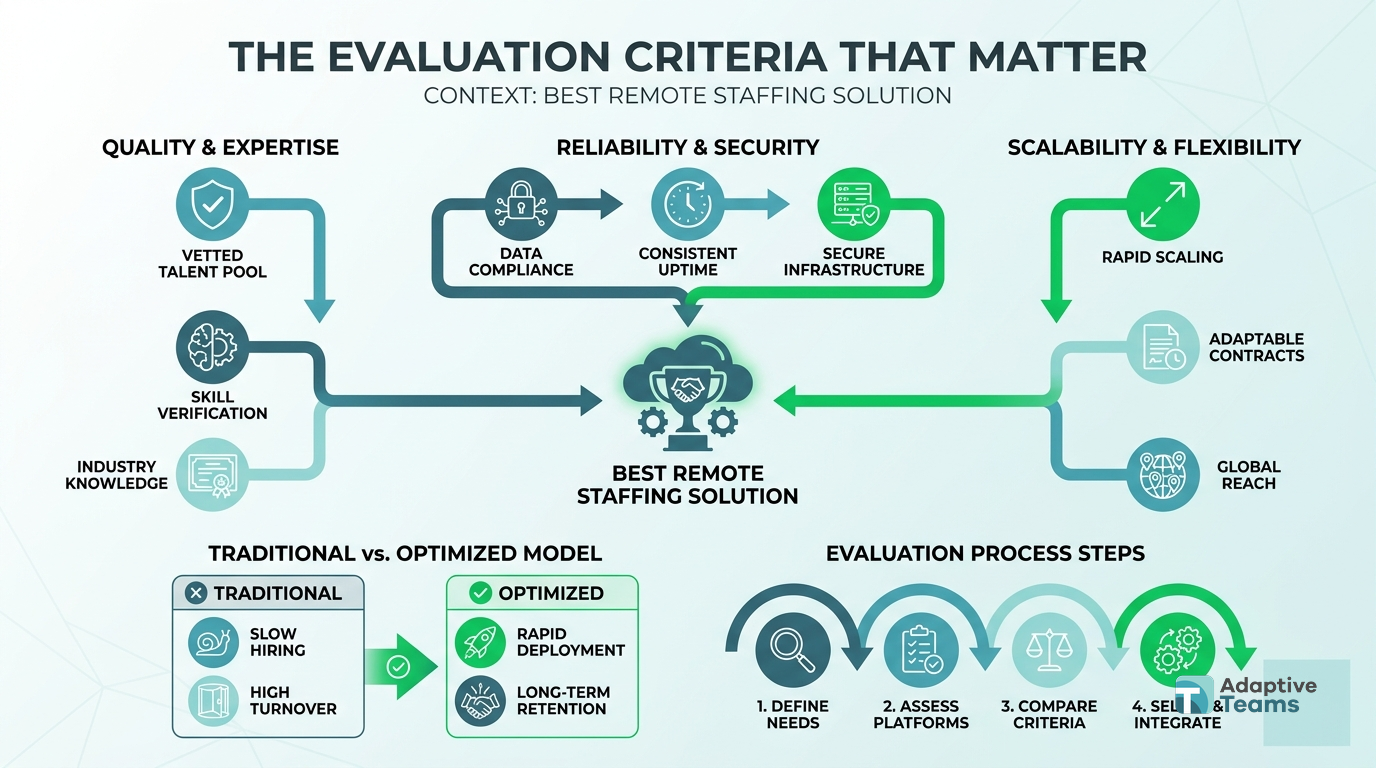
The right choice depends on the roles you need, how much management capacity you have, and whether the hire will become part of your core operating rhythm.
Speed only counts if quality stays high
Fast hiring is valuable when it compresses the time between approved headcount and useful output. It is not valuable when it produces a rushed hire who needs to be replaced after 45 days.
Ask a staffing partner how they define time-to-fill. Some count from candidate search to shortlist. Others count from kickoff to signed offer. What you care about is time-to-productive-capacity. That includes role clarity, screening, hiring, onboarding, tools access, manager alignment, and first meaningful output.
For an agency scaling account management support, the difference is practical. A remote coordinator who starts quickly but cannot follow SOPs will create more review work for senior staff. A slightly slower hire who understands ticket ownership, client notes, deadlines, and escalation rules creates leverage.
The model must fit the role
There is no single correct model for every remote hire. Some roles fit contractor arrangements. Others should be structured as employees. Adaptive Teams supports both models because the right answer depends on work scope, control, duration, local rules, and how embedded the person will be.
Compliance should be treated as a design constraint, not an afterthought. The IRS guidance on independent contractor versus employee status focuses on behavioral control, financial control, and the relationship between the parties. The U.S. Department of Labor also provides worker classification guidance under wage and hour rules. Even if you are hiring outside the United States, the principle travels: the more control and permanence you need, the more carefully the engagement model should be designed.
This is where a remote staffing solution should protect your time. You should not have to become an expert in each country before making a hire. You do need a partner that can flag the tradeoffs and structure the engagement responsibly.
Recruiting is only one slice of the system
A traditional recruiter can find candidates. A freelance marketplace can expose you to a broad labor pool. A global payroll provider can process payments. None of those pieces alone solve the full operating problem.
If your team is serious about remote hiring, look for a provider that connects recruiting with HR operations. That includes candidate screening, reference checks, compensation guidance, payroll setup, compliance support, attendance expectations, performance follow-up, and replacement coverage when needed.
This is especially important for companies building offshore teams over time. The economics look attractive on paper, but the margin advantage disappears if managers spend 10 hours per week chasing updates, rewriting work, or restarting searches.
Where companies choose the wrong solution
The biggest mistake is picking the channel before defining the operating problem.
If the problem is “we need a specialist for a short project,” a marketplace can be enough. If the problem is “our internal team cannot keep up with customer operations, finance admin, reporting, and fulfillment coordination,” then a one-off contractor search is likely too shallow.
Mistake 1: treating remote hiring as cheaper local hiring
Cost arbitrage is real, but it is not the whole business case. A remote hire should reduce the fully loaded cost of capacity while preserving output quality. If a U.S.-based operations hire costs $75,000 plus benefits and management overhead, a remote team member may create meaningful savings. But the savings only matter if the role is scoped well and the person stays long enough to compound process knowledge.
The better question is not “How cheap can we hire?” It is “What level of output do we need, and what infrastructure makes that output reliable?”
Mistake 2: ignoring management capacity
Remote employees do not fail only because of poor talent. They often fail because no one translated expectations into a usable operating rhythm.
That rhythm includes written SOPs, clear ownership, measurable outputs, async communication norms, and a manager who knows what good looks like. If your internal team cannot provide that, your staffing partner should help close the gap. Adaptive Teams builds long-term remote team members with follow-up and performance oversight because unmanaged hiring is just a delayed bottleneck.
The same principle applies after the hire. If you want practical systems for keeping distributed employees accountable, this guide on how to manage remote employees effectively is a useful companion.
Mistake 3: comparing providers by candidate volume
A huge database sounds impressive. It tells you little about fit.
You need to know how candidates are screened, what skills are tested, how communication is evaluated, how compensation is benchmarked, and what happens if the person is not working out. A shortlist of 3 tightly matched candidates beats 40 resumes that force your managers into another filtering job.
Build Remote Capacity Without HR Drag
Get recruiting, payroll, compliance, and performance support in one managed staffing system.
A practical decision framework
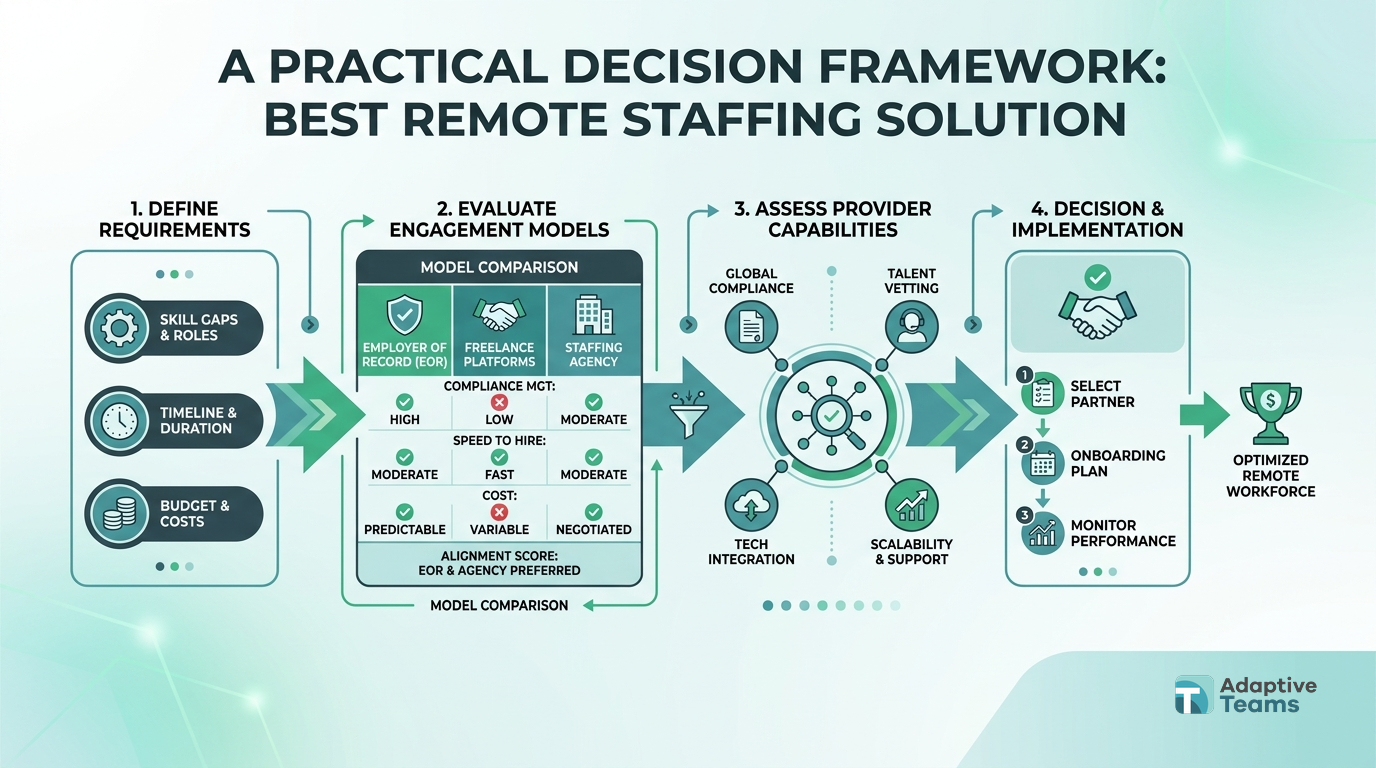
Use this framework before you speak with any provider. It will make the sales conversation sharper and prevent you from buying the wrong service.
1. Define the work by recurring outcomes
Do not start with a job title. Start with the work that must happen every week.
For example, “operations assistant” is vague. “Own daily supplier follow-ups, update shipment status, reconcile late orders, and flag exceptions before 11 AM EST” is much easier to hire for. A good remote staffing partner can translate that into screening criteria, compensation expectations, and onboarding requirements.
This is also where you decide whether the role is truly ongoing. If the work is recurring, operational, and close to your core business, treat it as a team-building decision. If it is temporary or specialized, a lighter model may be enough.
2. Decide how embedded the person needs to be
Some remote workers execute tickets independently. Others attend team meetings, handle customer conversations, manage sensitive workflows, or represent your company internally. The more embedded the role, the more you need cultural fit, retention support, HR oversight, and structured management.
If you are creating a larger offshore function, read this breakdown of building offshore teams. The point is not just finding people in another country. It is creating a working model where the remote team feels like part of the company.
3. Map the real cost
A remote hire has a wage cost, but the true cost includes recruiting time, interview time, onboarding time, management time, software access, payroll administration, compliance risk, replacement risk, and quality control.
This is where many comparisons become misleading. A marketplace hire can look cheaper until you add the hours your team spends screening, testing, contracting, paying invoices, and recovering from inconsistent output. A managed staffing solution costs more than a raw marketplace search, but it may be cheaper than building recruiting, HR, payroll, and performance systems internally.
For a broader cost comparison, see this guide to offshore development team cost. The same logic applies outside development: price matters, but cost of control matters more.
4. Check the replacement process before you need it
Remote hiring works best when the provider has a clear replacement guarantee or remediation process. That does not mean churn is acceptable. It means the provider is accountable for fit beyond the signed offer.
Ask what happens if the hire underperforms after 30, 60, or 90 days. Who diagnoses the issue? Who speaks with the worker? Who supports the manager? Who sources a replacement? If the answer is vague, you may be buying recruiting rather than staffing infrastructure.
5. Look for performance management, not just placement
The strongest providers care about retention and output after the start date. They help set expectations, follow up with both sides, and create a feedback loop before small issues become resignation risk.
Research from McKinsey on new talent pools and changing worker expectations reinforces a practical point: companies cannot keep hiring the same way and expect different retention outcomes. Remote staffing should help you access talent pools, but it should also help you keep the people who perform.
When Adaptive Teams is the right fit
Adaptive Teams is built for companies that need remote team members who become part of the operating system, not a temporary layer of freelance labor.
That usually includes agencies that need client service capacity, e-commerce brands with operational complexity, SaaS companies building support or admin coverage, and leadership teams that are tired of running recruiting loops themselves.
The model works best when you have recurring work, real hiring intent, and a need for structure around recruiting, HR, payroll, compliance, and performance management. It is less useful if you need a one-time task, a tiny project, or the lowest possible hourly rate with no management support.
The value is not just access to remote talent. The value is removing the operational drag around that talent. Adaptive Teams sources candidates, supports the right engagement structure, handles payroll and compliance, provides performance oversight, and stands behind the hire with replacement support.
That combination changes the hiring equation. Instead of asking your founder, COO, or department lead to become the recruiter, HR manager, payroll coordinator, and performance coach, you get a managed system designed around long-term capacity.
Questions to ask before choosing a provider
Use these questions in your next evaluation call:
- What roles do you consistently fill for companies like ours?
- How do you screen for communication, ownership, and role-specific execution?
- What is your expected time from kickoff to productive output?
- Do you support both contractor and employee models?
- How do you handle payroll, compliance, and local employment considerations?
- What performance follow-up happens after the person starts?
- What replacement guarantee or remediation process is included?
- How do you help managers create expectations for remote team members?
The answers will reveal whether you are speaking with a recruiter, a marketplace, a payroll tool, or a true remote staffing partner.
FAQ
What is the best remote staffing solution for a growing company?
The best option is usually a managed staffing partner that combines recruiting, payroll, HR support, compliance guidance, performance follow-up, and replacement support. Growing companies need more than candidate access because the real cost of hiring includes management time, retention, and operational continuity.
Is remote staffing better than hiring locally?
Remote staffing can be better when the role is well-defined, the talent pool is stronger outside your local market, and the provider can support onboarding and management. Local hiring may still be better for roles that require physical presence, heavy in-person collaboration, or market-specific relationships.
Should remote team members be contractors or employees?
It depends on the role, country, control level, duration, and business relationship. Some roles fit a contractor model, while others should be structured as employment. A strong staffing partner should help you evaluate the tradeoffs instead of forcing one model onto every hire.
How long does remote staffing usually take?
Timelines vary by role complexity, compensation, required experience, and interview speed. For operators, the more important metric is time-to-productive-capacity, not time-to-resume. A fast shortlist means little if onboarding, payroll, and performance expectations are not handled.
What roles work well for remote staffing?
Operations coordination, customer support, admin support, finance operations, marketing execution, recruitment support, sales operations, data cleanup, and process management often work well remotely. The common factor is recurring work with clear outputs and a manager who can define success.
Where to start
Choosing the best remote staffing solution is a capacity decision, not a vendor comparison exercise. Start by defining the recurring work, the level of embeddedness, the management support required, and the cost of leaving the role unfilled.
If the answer points toward a long-term remote team member, not a one-off freelancer, Adaptive Teams can help you build the role, source the right person, structure the engagement, and manage the HR infrastructure around it. You can book a free staffing consultation to map the roles where remote capacity would reduce the most operational drag.
Ready to Build Your Dream Team?
Book a free staffing consultation with our remote team specialists. No obligations, just actionable insights for scaling your operations.