



If you are searching for the best staffing companies, you are probably trying to solve a speed problem, a quality problem, or both. In many growing companies, hiring delays do more than slow recruiting. They delay revenue, overload your top performers, and pull founders or operators into work they should not be doing.
Table of Contents
- Introduction
- What Are the Best Staffing Companies?
- How Staffing Companies Work
- Key Benefits of Working With Staffing Companies
- Step-by-Step Guide to Choosing the Right Partner
- Best Tools and Resources for Evaluating Staffing Partners
- Common Mistakes to Avoid
- Advanced Tips and Strategies
- Frequently Asked Questions
- Conclusion
However, not every staffing partner solves the same problem. Some focus on short-term placement volume. Others help you build stable, long-term teams with recruiting, HR, payroll, and performance management built in. In this guide, you will learn how the best staffing companies work, what separates strong partners from risky ones, and how to choose a model that actually supports growth.
Introduction
If you are comparing the best staffing companies, you are likely feeling the cost of slow hiring already. Open roles do not just sit on an org chart. They slow delivery, stretch managers, and create expensive bottlenecks across your business.
At the same time, the market is crowded with agencies, recruiters, and staffing partners that look similar on the surface. However, their operating models are very different. Some only source candidates. Others help you build stable, long-term teams with recruiting, HR, payroll, and performance support.
In this guide, you will learn how the best staffing companies work, what red flags to watch for, and how to choose a partner that improves hiring speed without creating more management drag.
What Are the Best Staffing Companies?
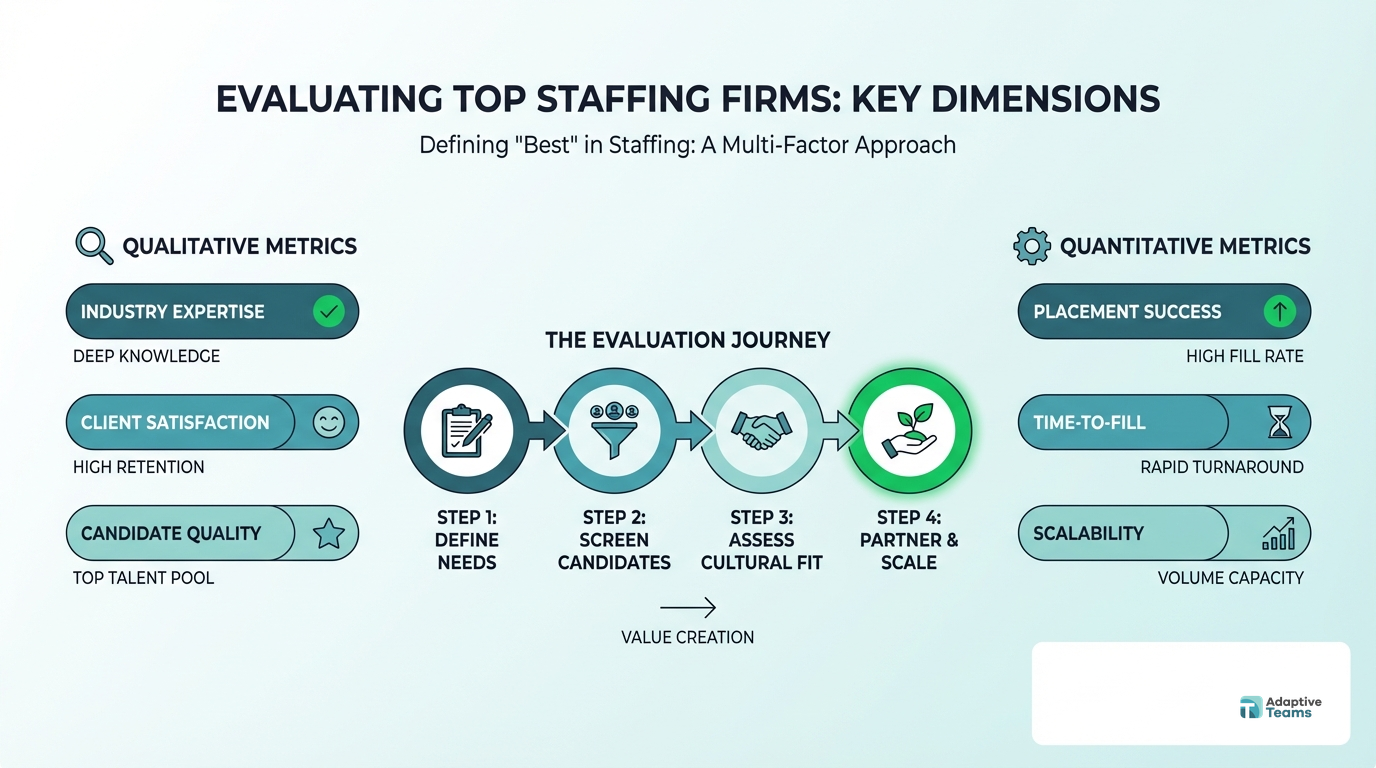
The best staffing companies are hiring partners that help you fill roles faster, reduce hiring risk, and improve long-term team performance. In practice, that can include recruiting firms, remote staffing agencies, managed staffing partners, and providers that combine sourcing with HR operations, payroll support, and performance oversight.
Importantly, the right definition depends on your operating model. If you need a short burst of project support, one type of provider may fit. However, if you need a remote team member who feels embedded in your company, you need a partner built for long-term team building.
That distinction matters more in 2026. According to labor market reporting from the U.S. Bureau of Labor Statistics and hiring research from LinkedIn, employers still face long time-to-fill cycles for many skilled roles, while remote hiring has expanded candidate access across borders. As a result, the best staffing companies now compete on speed, structure, and retention, not just candidate volume.
How Staffing Companies Work
The best staffing companies usually follow a repeatable process. The best staffing companies also make that process visible, measurable, and easier for your team to manage. Although service depth varies, the mechanics are similar.
1. Role scoping
First, the provider helps define the job, success metrics, budget, and reporting line. This step matters because vague briefs create weak candidate pipelines.
2. Candidate sourcing
Next, recruiters search across talent pools, databases, referrals, and outbound channels. Strong firms also screen for communication skills, time zone fit, and culture alignment.
3. Screening and shortlisting
Then, the staffing partner interviews candidates, checks experience, and presents a shortlist. Therefore, your internal team spends time only on qualified finalists.
4. Hiring and onboarding support
After selection, the provider often manages contracts, payroll setup, documentation, and onboarding coordination. In more advanced models, they also support compliance and local employment logistics.
5. Ongoing management or follow-up
Finally, the best staffing companies do not disappear after placement. Instead, they stay involved through performance reviews, replacement support, retention check-ins, or HR administration.
This is where the biggest difference appears. A transactional recruiter helps you hire once. A managed staffing partner helps you keep the hire productive. If your business is scaling, that second model often creates more operational leverage. For a deeper look at how this works in practice, see How to Manage Remote Employees Effectively.
Key Benefits of Working With Staffing Companies
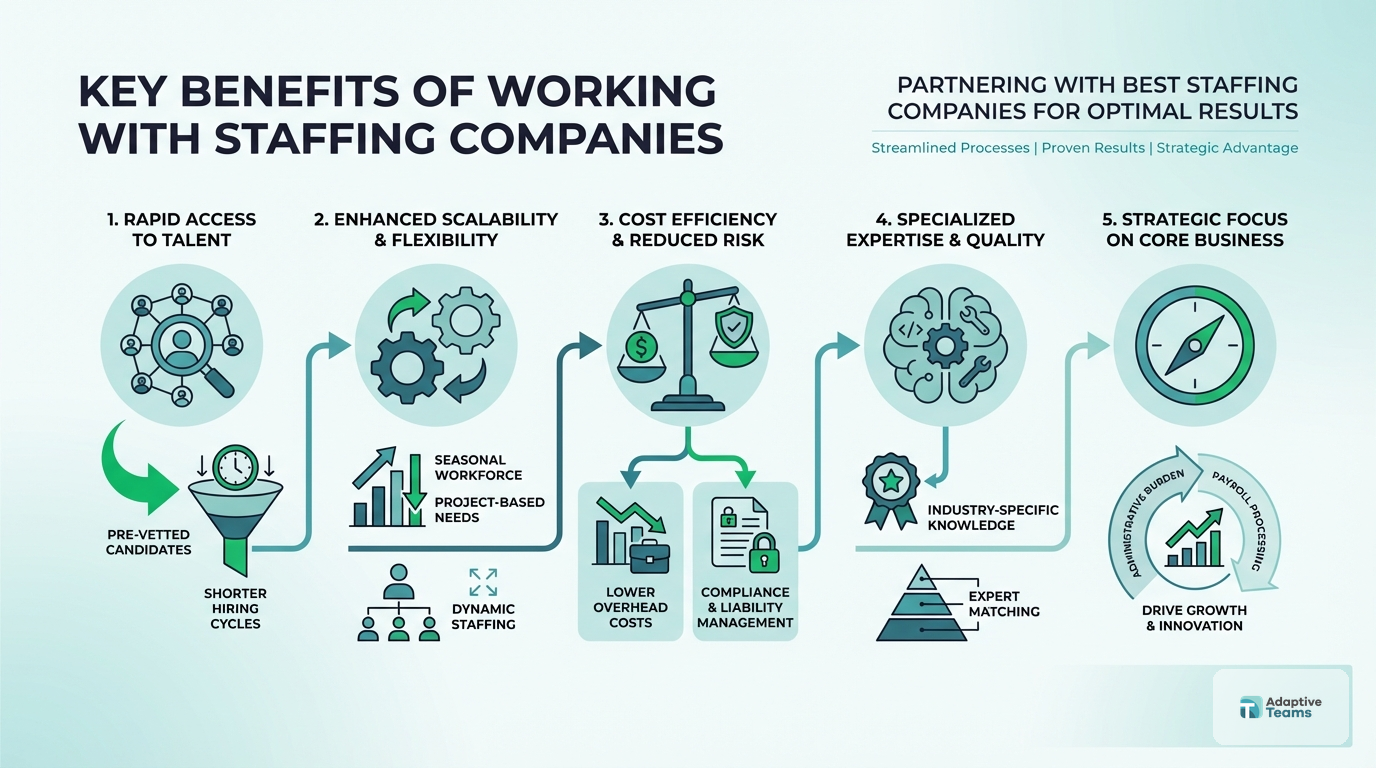
When you choose the right partner, the upside goes beyond filling open roles.
Faster hiring cycles
- The best staffing companies reduce sourcing time by bringing pre-built pipelines and market knowledge. That matters when open roles stall delivery or sales capacity.
Lower management drag
- Additionally, strong partners remove admin work from founders and operators. Instead of managing job boards, screening calendars, and paperwork, you stay focused on growth.
Better access to talent
- Remote and offshore hiring models expand your available talent pool. As a result, you can fill specialized roles that are hard to hire locally.
More predictable costs
- Staffing partners often package recruiting, HR, payroll, and support into a clearer monthly cost. Therefore, you can compare total cost against local hiring with less guesswork.
Reduced compliance exposure
- If your provider supports payroll, contracts, and employment structure, you reduce misclassification and cross-border admin risk. This is especially important when hiring across markets.
Higher retention potential
- The best staffing companies focus on fit, onboarding, and follow-up. In fact, retention usually improves when hires receive structured support instead of being dropped into chaos.
Replacement protection
- Many strong providers offer replacement guarantees. Consequently, you lower the downside if a hire does not work out early.
For operators trying to scale, these benefits compound. A role filled 30 days faster can protect pipeline, delivery deadlines, and leadership focus at the same time.
Step-by-Step Guide to Choosing the Right Partner
You do not need a long vendor list. You need a disciplined selection process.
Step 1: Define the real hiring problem
First, identify what is actually broken. Are you struggling with sourcing, interview quality, onboarding, payroll administration, or retention? If you do not name the bottleneck, you will choose the wrong provider category.
Step 2: Decide whether you need placement or infrastructure
Some firms only introduce candidates. Others help you build an operating system around the hire. Therefore, decide whether you need a one-time recruiter or a partner that covers recruiting, HR, payroll, and performance management.
Step 3: Compare time-to-fill benchmarks
Next, ask for average time-to-shortlist and time-to-start by role type. Strong providers should give realistic ranges, not vague promises. For example, a credible partner might tell you they can present qualified candidates in 7 to 14 days for common operational roles.
Step 4: Review screening depth
Do not just ask whether candidates are screened. Ask how. Specifically, check whether the provider evaluates communication, reliability, manager fit, technical skill, and long-term motivation. Surface-level screening creates hidden costs later.
Step 5: Assess support after the hire
This step is often skipped. However, post-hire support is where many hiring outcomes are won or lost. Ask whether the partner offers onboarding guidance, HR management, performance tracking, and replacement support.
Step 6: Model the total cost
Compare the provider fee against the fully loaded cost of local hiring, internal recruiting time, software, payroll admin, and turnover risk. In many cases, the cheapest fee does not produce the lowest operating cost.
Step 7: Check for role and market specialization
Some of the best staffing companies are strong only in certain functions or geographies. Therefore, ask for examples of recent placements in roles similar to yours.
Step 8: Validate references and retention outcomes
Finally, speak with current clients if possible. Ask how long placements stay, how issues are handled, and whether the partner improves over time. Retention and responsiveness usually tell you more than brand visibility.
Build a Team Without Hiring Drag
Get a staffing model that combines recruiting, HR, payroll, and follow-up support.
If you are scaling beyond one role, this process should become part of your operating rhythm. You can also compare your options against HR outsourcing for small business and building offshore teams to see where managed staffing creates more leverage.
Best Tools and Resources for Evaluating Staffing Partners
You do not need dozens of tools, but a few resources can improve your evaluation process.
Labor market data sources
Use sources like the U.S. Bureau of Labor Statistics, LinkedIn Talent Blog, and SHRM research to benchmark hiring conditions, salary pressure, and labor availability.
Candidate assessment platforms
Additionally, assessment tools can help you validate skills before final interviews. For example, role-based tests are useful for customer support, operations, finance, and technical support roles.
Internal hiring scorecards
Create a simple scorecard for communication, experience, reliability, time zone fit, and role-specific skills. Therefore, you can compare provider shortlists more objectively.
Process documentation
Use a shared onboarding checklist, 30-60-90 day plan, and manager expectations doc. This reduces the gap between a good hire and a productive hire.
Strategic staffing content
Resources like Scaling a Team Without Hiring Full Time and Contractor vs Employee for Startups can help you decide which employment model fits your stage.
Common Mistakes to Avoid
Even experienced operators make predictable mistakes when comparing the best staffing companies.
Choosing based on brand recognition alone
Large or visible firms are not automatically the best fit. In contrast, a smaller specialist partner may move faster and provide stronger role alignment.
Optimizing for lowest upfront fee
Cheap placements often carry hidden costs in weak screening, slow replacements, and poor follow-up. Therefore, always compare total operating cost, not just vendor price.
Ignoring post-hire support
Many teams focus on sourcing and stop there. However, if onboarding and performance management are weak, early churn will erase any recruiting win.
Using the same provider for every role
Different hiring needs require different models. For example, short-term project help and long-term offshore team building are not the same buying decision.
Failing to define success metrics
If you do not define what success looks like in the first 90 days, it is hard to evaluate whether the partner delivered. As a result, teams repeat poor hiring decisions.
Advanced Tips and Strategies
Once you understand the basics, you can get better outcomes from the best staffing companies by tightening your operating model.
Build a hiring system, not a one-off process
First, document role briefs, interview rubrics, onboarding, and weekly performance reviews. That way, every new hire enters a stable system instead of reinventing the process each time.
Segment providers by use case
Use one framework for urgent coverage, another for strategic team expansion, and another for specialized leadership roles. Consequently, you avoid judging every provider by the wrong criteria.
Track ramp time, not just hire date
A filled role is not the finish line. Measure how long it takes for the person to produce independently. This reveals whether your staffing partner is supplying truly aligned candidates.
Pressure-test communication workflows early
In remote and offshore models, communication quality matters as much as functional skill. Therefore, use trial tasks, structured interviews, and scenario questions before you commit.
Prioritize partners that improve retention
The best staffing companies help you keep good people, not just find them. In other words, look for partners with replacement guarantees, manager support, and regular follow-up. That is especially useful if you are building long-term remote capacity through offshore staffing solutions.
Frequently Asked Questions
What are the best staffing companies for growing businesses?
The best staffing companies for growing businesses are the ones that match your hiring model, speed requirements, and management capacity. If you need long-term remote team members, choose a partner that supports recruiting, onboarding, HR, payroll, and retention instead of only candidate sourcing.
How do I compare the best staffing companies fairly?
Compare them on time-to-fill, screening depth, role specialization, post-hire support, replacement terms, and total cost. In addition, ask for examples of recent placements similar to yours so you can judge fit more accurately.
Are staffing companies worth it for small and mid-sized businesses?
Yes, they can be worth it when hiring delays are slowing growth or overloading leadership. A strong staffing partner can reduce founder time in recruiting, speed up hiring, and lower the cost of bad hires.
What is the difference between a staffing company and a recruiter?
A recruiter often focuses on sourcing and placement. A staffing company may provide broader support, including screening, onboarding, payroll coordination, HR administration, and performance follow-up, depending on the model.
Can staffing companies help with remote and offshore hiring?
Yes, many can. However, the best results usually come from partners built for remote team integration, compliance support, and long-term management rather than short-term placements alone.
What should I ask before signing with a staffing company?
Ask about average time-to-fill, candidate screening methods, replacement guarantees, onboarding support, billing structure, and what happens after a hire starts. Those questions reveal whether the provider can support your actual growth needs.
Conclusion
The best staffing companies do more than fill vacancies. They help you hire with more speed, more structure, and less operational friction. If a partner cannot explain how they support screening, onboarding, retention, and long-term team health, they are probably solving only part of the problem.
Therefore, evaluate every option through the lens of operating leverage. The best staffing companies should reduce founder involvement, improve hiring outcomes, and help your team scale in a way that actually lasts.
Next Steps
If you are evaluating the best staffing companies, do not stop at candidate quality or fee structure. Look at the full operating impact: hiring speed, management time saved, retention support, and risk reduction. The right partner should make your team easier to scale, not just easier to source.
If you want a model built for long-term remote team growth, HR support, payroll administration, and performance follow-up, start with a staffing consultation. Book a free staffing consultation at https://adaptiveteams.co/services/ and map out the hiring structure that fits your next stage of growth.
Ready to Build Your Dream Team?
Book a free staffing consultation with our remote team specialists. No obligations, just actionable insights for scaling your operations.