



Introduction
By 2026, over 70% of mid-market companies employ at least one offshore team member, according to a Deloitte Global Outsourcing Survey. Yet many business leaders still struggle to find the right offshore staffing solutions for their specific needs. If you are looking to reduce operational costs, access specialized talent, or scale your team without geographic limitations, this guide walks you through every step of the process.
Table of Contents
- Introduction
- What Are Offshore Staffing Solutions?
- How Offshore Staffing Works
- Key Benefits of Offshore Staffing Solutions
- Step-by-Step Guide to Building Your Offshore Team
- Best Tools and Resources for Offshore Team Management
- Common Mistakes to Avoid
- Advanced Tips and Strategies
- Frequently Asked Questions
- Conclusion: Get Started With Your Offshore Team Today
You will learn exactly what offshore staffing solutions are, how they work in practice, the key benefits and pitfalls to watch for, and a step-by-step framework for building a high-performing offshore team. Whether you are evaluating offshore staffing solutions for the first time or looking to optimize an existing setup, this resource has you covered.
What Are Offshore Staffing Solutions?
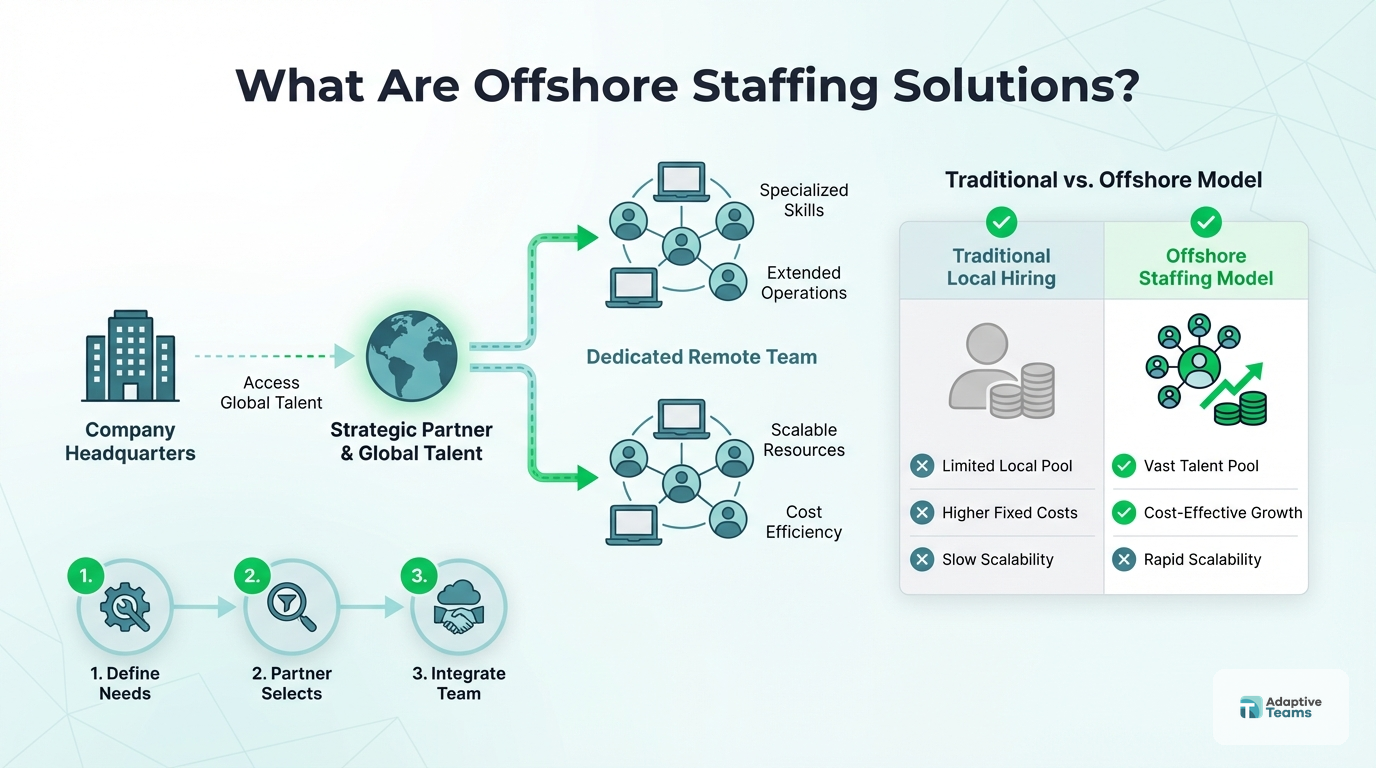
Offshore staffing solutions refer to the practice of hiring full-time or part-time professionals in a different country to work as dedicated members of your team. Unlike traditional outsourcing, where you hand off entire projects, offshore staffing gives you direct management over each team member. As a result, you maintain control over quality, timelines, and company culture.
The offshore staffing solutions model has grown rapidly because the global talent pool is deeper than ever. Countries like the Philippines, Colombia, India, and Brazil produce thousands of highly skilled graduates every year. Furthermore, advances in collaboration technology mean that your offshore team can operate as seamlessly as someone sitting in the next office.
For businesses facing talent shortages or rising labor costs, offshore staffing solutions offer a practical path forward. In fact, SHRM reports that 83% of employers struggled to find qualified candidates in 2025. Offshore hiring directly addresses this challenge by expanding your candidate pool beyond local borders.
How Offshore Staffing Works
The mechanics behind offshore staffing solutions are straightforward once you understand the core model. Here is how a typical offshore staffing solutions engagement works:
1. Define Your Role Requirements
First, you identify the position you need filled. This includes the skills, experience level, working hours, and reporting structure. Additionally, you specify whether you need full-time dedication or part-time support.
2. Partner With an Offshore Staffing Provider
Next, you engage a staffing partner that specializes in your target region. A good provider handles recruitment, pre-screening, compliance, and payroll administration. Therefore, you avoid the complexity of setting up a foreign legal entity.
3. Review and Interview Candidates
Your provider presents pre-vetted candidates that match your requirements. You then conduct interviews exactly as you would for a local hire. This ensures cultural and technical alignment before any commitment.
4. Onboard Your New Team Member
Once you select a candidate, the onboarding process mirrors your internal procedures. However, you will want to pay extra attention to communication norms, tool access, and time zone overlap expectations.
5. Manage and Scale
After onboarding, the team member works directly under your supervision. Consequently, you can iterate on processes, add new roles, and scale your offshore team based on performance and business needs.
Key Benefits of Offshore Staffing Solutions
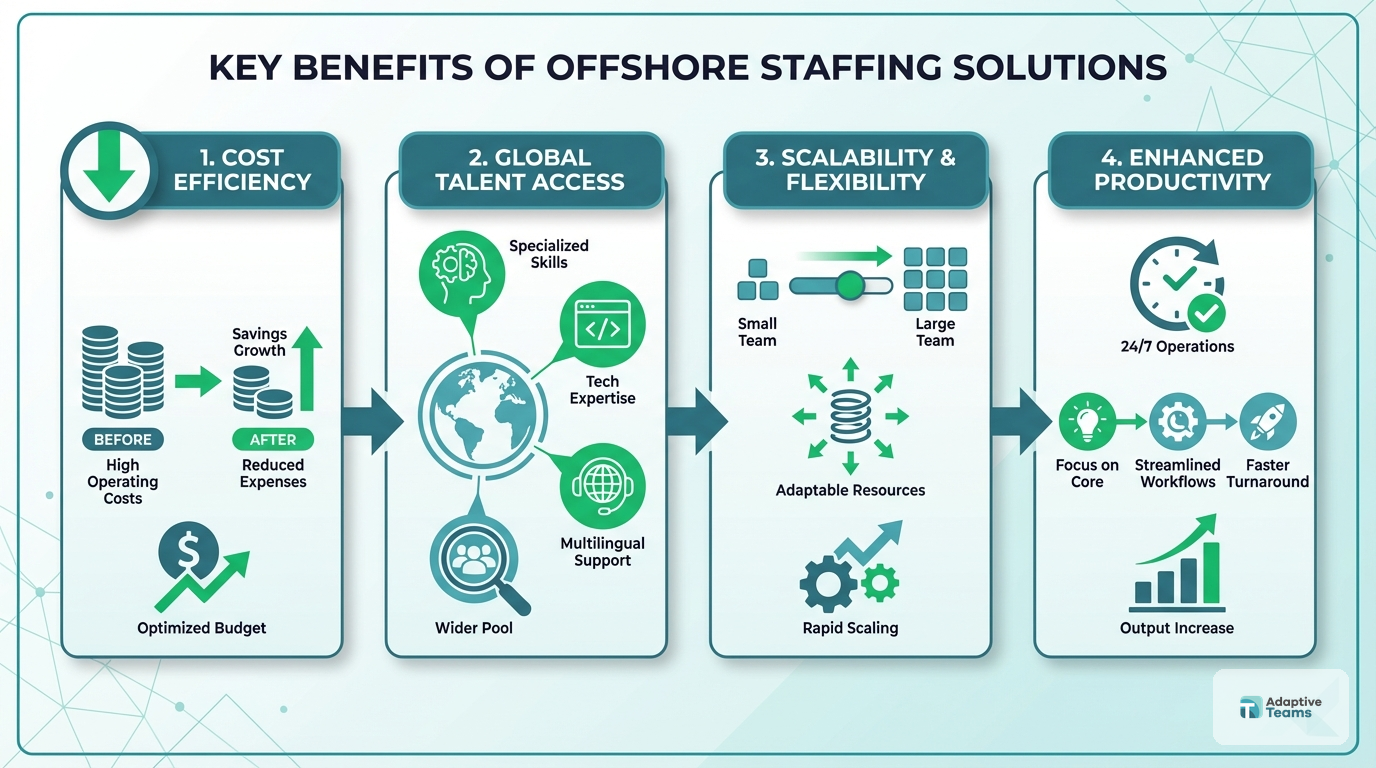
The advantages of implementing offshore staffing solutions go far beyond cost savings. Here are the most impactful benefits:
- Significant cost reduction. You can save 40-70% on labor costs depending on the role and region. For example, a senior developer in Latin America typically earns $30,000-$50,000 annually compared to $120,000+ in the US.
- Access to global talent. You are no longer limited to candidates within commuting distance. As a result, you can find specialists with exact skill matches that may be scarce locally.
- Faster time to hire. Offshore staffing providers maintain candidate pipelines. Therefore, you can fill positions in 2-4 weeks instead of the 3-6 months typical for competitive domestic roles.
- Operational scalability. You can scale your team up or down based on project demands without the overhead of physical office expansion.
- Extended business hours. Time zone differences become an advantage when you structure your team for round-the-clock coverage. Consequently, customer support, development, and operations can run nearly 24/7.
- Reduced administrative burden. Your staffing partner handles payroll, benefits, compliance, and HR administration. This frees your internal team to focus on core business activities.
Step-by-Step Guide to Building Your Offshore Team
Implementing offshore staffing solutions successfully requires deliberate planning. Follow these steps to maximize your chances of success.
Step 1: Audit Your Current Team Structure
Start by identifying which roles can be performed remotely without impacting quality. Specifically, look for positions that rely on digital tools, have clear deliverables, and do not require in-person client interaction. Administrative roles, software development, customer support, and data analysis are strong candidates.
Step 2: Choose Your Target Region
Different regions offer different strengths. Latin America provides strong cultural alignment and time zone overlap with North American companies. Southeast Asia offers deep technical talent at competitive rates. Additionally, Eastern Europe is known for engineering excellence. Match your region to your priority, whether that is cost, overlap, or specialization.
Step 3: Select a Staffing Partner
Evaluate potential partners based on their track record, industry expertise, and support infrastructure. Ask for client references and examine their retention rates. A quality partner should offer dedicated recruitment and HR support rather than simply matching resumes to job descriptions.
Step 4: Create Detailed Role Profiles
Write comprehensive job descriptions that include hard skills, soft skills, communication requirements, and cultural expectations. Moreover, specify the tools your team uses and the level of English proficiency required. Vague descriptions lead to poor matches.
Step 5: Establish Communication Protocols
Before your first hire starts, document your communication expectations. Decide on daily standup times, preferred messaging platforms, meeting frequency, and escalation paths. For instance, many successful teams designate a 4-hour overlap window for synchronous work.
Step 6: Invest in Onboarding
Treat offshore onboarding with the same rigor as in-house onboarding. Assign a buddy or mentor, provide video walkthroughs of your processes, and schedule daily check-ins for the first two weeks. Consequently, your new team member ramps up faster and feels connected to the team.
Step 7: Set Clear KPIs and Review Cycles
Define measurable performance indicators from day one. Furthermore, establish weekly or bi-weekly review cycles to provide feedback and address issues early. Clarity in expectations is the single biggest predictor of offshore team success.
Build Your High-Performing Offshore Team
Get matched with pre-vetted global talent in under 3 weeks.
Best Tools and Resources for Offshore Team Management
Making your offshore staffing solutions work effectively requires the right technology stack. Here are the essential tools:
Slack or Microsoft Teams
Real-time messaging is the backbone of offshore collaboration. These platforms support channels, threads, and integrations that keep communication organized. Specifically, use dedicated channels for each project or function.
International Payroll and Compliance Tools
International payroll and compliance platforms simplify contracts and labor law management. Instead of navigating foreign regulations yourself, these tools handle the legal complexity across 150+ countries. Your staffing partner should be able to recommend or provide an integrated solution.
Loom
Asynchronous video messaging bridges the gap created by time zones. Use Loom to record process walkthroughs, code reviews, or weekly updates that your team can watch on their own schedule.
Notion or Confluence
A centralized knowledge base ensures that your offshore team has access to the same documentation as your local team. Additionally, it reduces dependency on synchronous communication for routine questions.
Time Doctor or Hubstaff
Time tracking tools provide visibility into work patterns and help identify productivity bottlenecks. However, use them as coaching tools rather than surveillance. Trust-based management produces better results than micromanagement.
Common Mistakes to Avoid
Even experienced companies make critical errors when implementing offshore staffing solutions. Understanding these common offshore staffing solutions pitfalls helps you protect your investment.
Hiring on Price Alone
The cheapest option is rarely the best option. While cost savings are a primary driver, prioritizing the lowest rate often leads to high turnover and quality issues. Instead, focus on value. A slightly more expensive hire who stays for three years delivers far more ROI than a bargain hire who leaves after three months.
Skipping Cultural Alignment
Technical skills are necessary but insufficient. A candidate who cannot communicate effectively or align with your work culture will underperform regardless of their resume. Therefore, always include a cultural fit assessment in your interview process.
Micromanaging Across Time Zones
Attempting to monitor every minute of your offshore team’s workday destroys trust and morale. Instead, manage by outcomes. Define clear deliverables and deadlines, then give your team the autonomy to execute. McKinsey research consistently shows that autonomy is one of the strongest predictors of team performance.
Neglecting Legal Compliance
Each country has specific labor laws covering contracts, termination, benefits, and data protection. Ignoring these creates legal liability. As a result, always work with a staffing partner experienced in international compliance to ensure you are protected.
Advanced Tips and Strategies
Once your offshore staffing solutions are operational, these advanced techniques will help you get even more value from your offshore staffing solutions investment.
Create Career Pathways
Offshore team members are more likely to stay long-term when they see growth opportunities. Design clear promotion tracks and skill development programs. For example, a junior developer should know exactly what skills and milestones lead to a senior role.
Build a Hybrid Leadership Model
Promote high-performing offshore team members into leadership positions. This creates local management capacity and reduces your dependency on headquarters for day-to-day decisions. Furthermore, it demonstrates that your company values talent regardless of location.
Implement Structured Knowledge Transfer
Document every process, decision, and workflow in a shared knowledge base. This practice protects your organization from single points of failure. Specifically, require that any process owned by one person must be documented well enough for someone else to execute it within 48 hours.
Use Overlap Hours Strategically
Do not waste your synchronous overlap time on status updates. Instead, reserve these precious hours for collaborative problem-solving, brainstorming, and relationship building. Move routine updates to asynchronous channels. This approach maximizes the value of every shared working hour.
Frequently Asked Questions
How much do offshore staffing solutions typically cost?
The cost varies significantly by role and region. Generally, you can expect to pay 40-70% less than equivalent domestic salaries. A full-time customer service representative in the Philippines might cost $800-$1,200 per month, while a senior software developer in Latin America ranges from $2,500-$4,500 per month. Your staffing partner typically charges a management fee on top of the employee’s compensation.
What is the difference between offshore staffing and outsourcing?
Offshore staffing gives you dedicated team members who work exclusively for your company under your direct management. Outsourcing hands off entire projects or functions to a third-party vendor who manages the work independently. With offshore staffing solutions, you retain control over processes, priorities, and team culture.
How long does it take to hire an offshore team member?
Most offshore staffing providers can present qualified candidates within 1-2 weeks. The full process from initial briefing to a team member starting work typically takes 2-4 weeks. This is considerably faster than domestic hiring timelines, which average 44 days according to SHRM data.
How do you manage quality with an offshore team?
Quality management starts with hiring the right people and setting clear expectations. Implement structured onboarding, define measurable KPIs, and conduct regular performance reviews. Additionally, use project management tools to track deliverables and maintain visibility into work progress. Companies that invest in proper management frameworks report offshore quality levels matching or exceeding their domestic teams.
What are the best countries for offshore staffing?
The best country depends on your needs. The Philippines excels in customer service and administrative roles. India and Vietnam lead in IT and software development. Colombia, Brazil, and Argentina offer strong talent with excellent North American time zone overlap. South Africa provides multilingual support capabilities. Your staffing partner can help match specific roles to optimal regions.
How do you handle time zone differences with offshore staff?
Successful teams establish a minimum 3-4 hour overlap window for synchronous collaboration. Outside this window, they use asynchronous communication tools like Loom, Slack, and shared documentation. Many companies find that time zone differences actually increase productivity because work progresses across multiple shifts throughout the day.
Is offshore staffing legal and compliant?
Offshore staffing is fully legal when structured correctly. Your staffing provider should handle local employment contracts, tax withholding, benefits administration, and compliance with labor laws. However, you must ensure that your provider operates as the employer of record in the local jurisdiction. Working with an established offshore staffing partner ensures full compliance across all relevant regulations.
Conclusion: Get Started With Your Offshore Team Today
Offshore staffing solutions have moved from a competitive advantage to a business necessity. Companies that build effective global teams access better talent, reduce costs by 40-70%, and gain the operational flexibility to scale rapidly.
The key to success is approaching offshore staffing solutions as a strategic initiative rather than a cost-cutting exercise. Choose the right partner, invest in onboarding and management systems, and treat your offshore team members as valued extensions of your organization.
If you are ready to explore how offshore staffing solutions can transform your business operations, Adaptive Teams specializes in connecting companies with pre-vetted global talent. With dedicated recruitment, HR support, and compliance management, you can build your offshore team with confidence. Book a free staffing consultation to discuss your specific needs and get a customized staffing plan.
Ready to Build Your Dream Team?
Book a free staffing consultation with our remote team specialists. No obligations, just actionable insights for scaling your operations.